
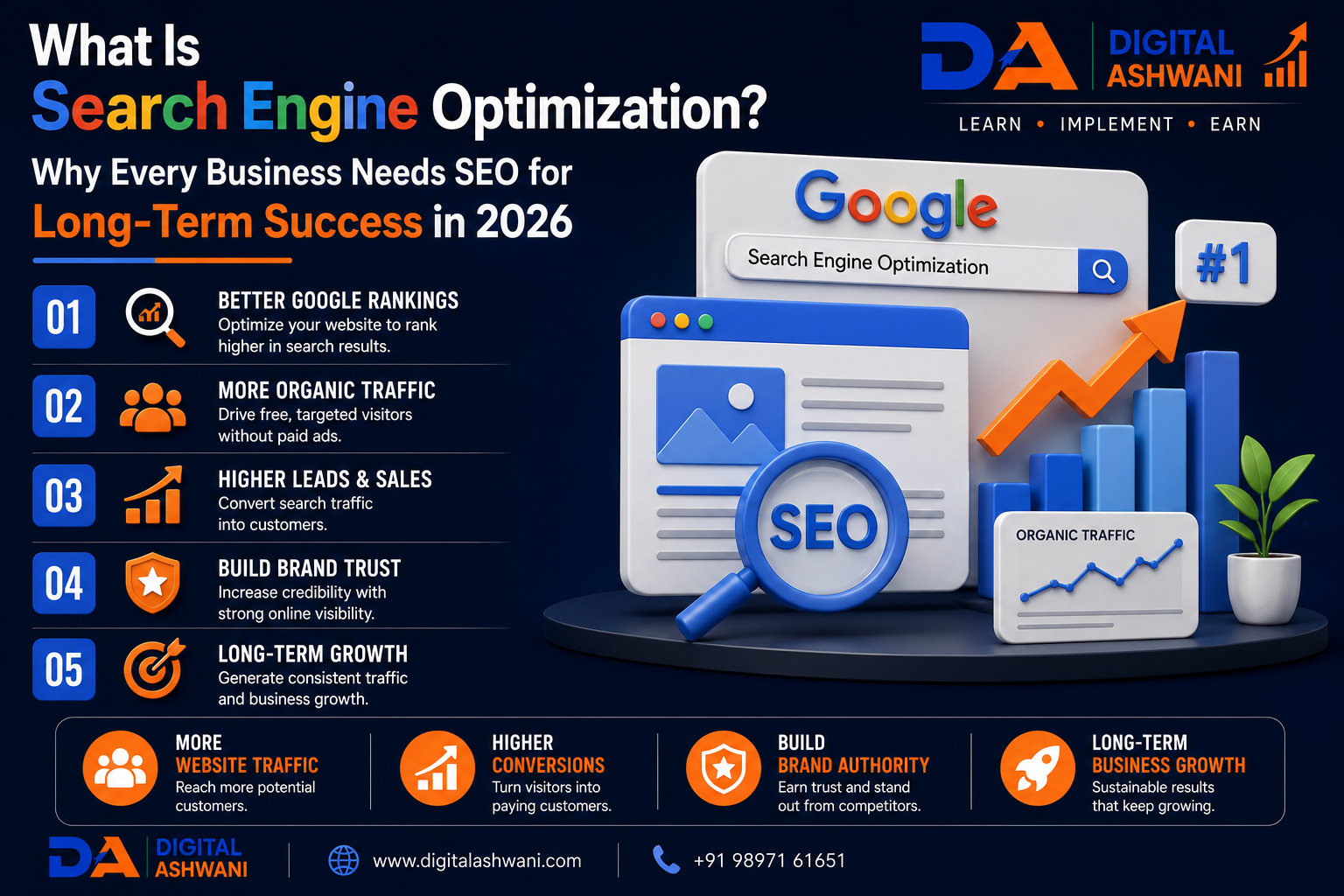
What Is Search Engine Optimization?
In today’s digital world, having a website alone is no longer enough. Millions of websites compete for attention, and if your business doesn’t appear on the first page of Google, your potential customers are likely finding your competitors instead.
This is where Search Engine Optimization (SEO) becomes essential.
Whether you run a local business, eCommerce store, startup, healthcare clinic, law firm, educational institute, SaaS company, or multinational brand, SEO helps your website become more visible in search engines, attract qualified visitors, and generate consistent leads without relying entirely on paid advertising.
As Google continues integrating Artificial Intelligence through AI Overviews, AI Mode, and conversational search experiences, SEO has evolved beyond keywords. Today, successful SEO focuses on user intent, content quality, technical excellence, trust, and overall user experience.
In this comprehensive guide by Digital Ashwani, you’ll learn what Search Engine Optimization is, how it works, why it matters, and the proven strategies businesses should follow to succeed in 2026.
What Is Search Engine Optimization (SEO)?
Search Engine Optimization (SEO) is the process of improving a website so that it ranks higher in search engine results for relevant keywords and topics.
The primary objective of SEO is to attract organic (non-paid) traffic from search engines like Google by making your website more useful, trustworthy, technically optimized, and relevant to users’ search intent.
Unlike paid advertising, SEO generates long-term traffic and continues delivering value even after content is published.
For example:
If someone searches:
- Best Digital Marketing Agency
- SEO Services Near Me
- Local SEO Company
- Google Ads Expert
Google analyzes thousands of websites before deciding which pages deserve to appear at the top of search results.
SEO helps improve your chances of becoming one of those top-ranking websites.
How Search Engines Work
Search engines follow three primary steps:
1. Crawling
Search engines use automated bots (also called crawlers or spiders) to discover new and updated webpages across the internet.
2. Indexing
After crawling a page, Google stores its content in a massive database called the search index.
Only indexed pages are eligible to appear in search results.
3. Ranking
When someone performs a search, Google’s algorithms evaluate hundreds of ranking factors to determine which pages provide the most relevant, trustworthy, and helpful answers.
The highest-quality pages appear at the top of search results.
Why SEO Matters for Every Business
Modern customers rely on Google before making purchasing decisions.
They research:
- Products
- Services
- Prices
- Reviews
- Comparisons
- Business reputation
- Case studies
- Customer experiences
If your website ranks well, your business gains visibility at the exact moment potential customers are searching.
SEO helps businesses:
- Increase brand awareness
- Generate qualified leads
- Improve credibility
- Reduce advertising costs
- Build long-term authority
- Increase conversions
Whether you’re a local business or a global enterprise, SEO remains one of the highest ROI digital marketing channels.
15 Powerful Reasons Every Business Needs SEO
1. SEO Increases Organic Website Traffic
Organic traffic comes from users who actively search for information, products, or services.
Unlike paid traffic, organic visitors continue arriving without paying for every click.
2. SEO Builds Trust
Users naturally trust websites that rank on Google’s first page.
Strong rankings often signal:
- Authority
- Expertise
- Reliability
- Quality
Trust leads to higher conversions.
3. SEO Generates High-Quality Leads
People searching Google already have intent.
Examples include:
- Buy Running Shoes
- SEO Agency in Delhi
- Dentist Near Me
These users are much more likely to convert.
4. SEO Supports Long-Term Growth
Paid ads stop generating traffic when campaigns end.
SEO continues attracting visitors for months and often years after content is published.
5. SEO Improves User Experience
Google rewards websites that offer:
- Fast loading speed
- Mobile friendliness
- Easy navigation
- Helpful content
- Secure browsing
Improving user experience also improves rankings.
6. SEO Reduces Customer Acquisition Costs
Although SEO requires time and investment, the long-term cost per lead is often much lower than continuous paid advertising.
Businesses that consistently rank well rely less on expensive PPC campaigns.
7. Local SEO Attracts Nearby Customers
Businesses serving specific locations benefit from Local SEO.
Examples:
- Restaurant Near Me
- Lawyer in Delhi
- Beauty Salon in Noida
- Real Estate Agent Gurgaon
Local SEO helps businesses appear in Google Maps and local search results.
8. SEO Strengthens Brand Authority
Publishing valuable content consistently establishes your business as an industry expert.
Customers are more likely to choose brands they recognize and trust.
9. SEO Delivers a Higher Return on Investment (ROI)
One of the biggest advantages of SEO is its long-term return on investment.
Unlike paid advertising, where traffic stops when your budget ends, SEO continues generating visitors and leads long after your content is published.
Why SEO Offers Better ROI
SEO helps businesses:
- Generate consistent organic traffic
- Reduce dependency on paid ads
- Build lasting online visibility
- Increase customer lifetime value
- Create evergreen content assets
For many businesses, SEO becomes one of the most cost-effective digital marketing channels.
10. SEO Supports Every Stage of the Customer Journey
Customers don’t always buy immediately.
Some people research for weeks or even months before making a decision.
Create Content for Every Stage
Awareness Stage
- Beginner guides
- Educational blogs
- Industry trends
- Problem-solving articles
Consideration Stage
- Product comparisons
- Case studies
- Buying guides
- Reviews
Decision Stage
- Service pages
- Pricing pages
- Testimonials
- Consultation pages
Covering every stage helps attract and convert more qualified visitors.
11. SEO Helps Businesses Compete with Larger Brands
Even small businesses can outrank larger competitors by targeting niche keywords and creating highly valuable content.
Focus on Long-Tail Keywords
Examples:
- Affordable SEO Services in Delhi
- Best Dentist for Kids in Noida
- Organic Skincare Products India
- Digital Marketing Agency for Startups
Long-tail keywords usually have lower competition and higher conversion rates.
12. SEO Works with AI-Powered Search
Google’s AI Overviews, AI Mode, and conversational search experiences are changing how people find information.
Optimize for AI Search
Focus on:
- Answering user questions directly
- Using structured headings
- Creating FAQ sections
- Demonstrating EEAT
- Publishing original insights
- Updating content regularly
Businesses that optimize for AI-powered search will be better positioned for future visibility.
13. SEO Builds Brand Recognition
When your website appears repeatedly for relevant searches, users become familiar with your brand.
Even if they don’t convert immediately, repeated exposure increases trust and improves future conversion opportunities.
Strengthen Brand Presence
Publish:
- Helpful blogs
- Industry research
- Case studies
- Videos
- Customer success stories
Strong branding supports both SEO and business growth.
14. SEO Provides Measurable Results
Modern SEO is highly data-driven.
Track Important Metrics
Monitor:
- Organic traffic
- Keyword rankings
- Conversion rate
- Click-through rate (CTR)
- Bounce rate
- Leads generated
- Revenue from organic search
- Core Web Vitals
Regular analysis helps refine your SEO strategy.
15. SEO Future-Proofs Your Business
Search behavior continues to evolve with AI, voice search, visual search, and new technologies.
Businesses that invest in SEO today are better prepared for tomorrow’s digital landscape.
Future SEO Priorities
Focus on:
- Helpful Content
- AI Search Optimization (AEO)
- Technical SEO
- EEAT
- Entity SEO
- Structured Data
- First-Party Data
- Brand Authority
SEO is no longer just about rankings—it’s about becoming the most trusted source in your industry.
Types of SEO
A successful SEO strategy combines multiple areas of optimization.
On-Page SEO
Optimizing:
- Titles
- Meta descriptions
- Headings
- Content
- Images
- Internal links
Off-Page SEO
Building authority through:
- Backlinks
- Brand mentions
- Digital PR
- Guest posting
Technical SEO
Improving:
- Website speed
- Mobile friendliness
- XML sitemaps
- Robots.txt
- Schema markup
- Core Web Vitals
- Crawlability
Local SEO
Optimizing for local searches through:
- Google Business Profile
- Local citations
- Customer reviews
- Location pages
Common SEO Mistakes to Avoid
Keyword Stuffing
Overusing keywords makes content difficult to read and can negatively affect rankings.
Ignoring Search Intent
Ranking isn’t just about keywords—it requires answering the user’s actual question.
Publishing Thin Content
Short, low-value articles rarely perform well. Create comprehensive, helpful resources that solve real problems.
Neglecting Technical SEO
Slow websites, broken links, poor mobile usability, and indexing issues reduce both rankings and user experience.
Not Updating Content
Search engines prefer fresh and accurate information. Review and update important pages regularly.
SEO Checklist for Businesses
| SEO Task | Status |
|---|---|
| Keyword Research | ✅ |
| Content Optimization | ✅ |
| Technical SEO | ✅ |
| Mobile Optimization | ✅ |
| Core Web Vitals | ✅ |
| Internal Linking | ✅ |
| Schema Markup | ✅ |
| Local SEO | ✅ |
| EEAT Optimization | ✅ |
| AI Search Optimization | ✅ |
Internal Linking Suggestions (Digital Ashwani)
Strengthen your SEO content cluster by linking this article with:
- SEO Checklist for 2026: 25 Things You Must Do Before Publishing Any Blog
- AI SEO vs Traditional SEO
- How to Rank in ChatGPT, Gemini & AI Search Results (AEO Guide)
- Google AI Overviews Complete Guide
- Google AI Mode: Everything You Need to Know
- Top Digital Marketing Trends in 2026
- Keyword Research Guide
- Technical SEO Complete Guide
- Local SEO Guide
- Google Search Console Tutorial
These internal links improve topical authority, help users discover related resources, and strengthen your overall SEO strategy.
External Resources
For official SEO guidance, explore:
- Google Search Central
- Google Search Central Blog
- Google Search Console Help
- Google PageSpeed Insights
- Google Analytics Help Center
These official resources provide the latest best practices for website optimization and search visibility.
Frequently Asked Questions
What is Search Engine Optimization (SEO)?
Search Engine Optimization (SEO) is the process of improving a website’s visibility in search engines to attract more organic traffic through high-quality content, technical optimization, and user-focused experiences.
Why is SEO important for businesses?
SEO helps businesses increase online visibility, attract qualified customers, build trust, reduce advertising costs, and generate long-term organic traffic.
How long does SEO take to show results?
Most websites begin seeing measurable improvements within 3–6 months, although highly competitive industries may require more time.
Is SEO still relevant in the age of AI?
Yes. AI-powered search makes high-quality, trustworthy, and well-structured content even more valuable. SEO continues to evolve rather than becoming obsolete.
Can small businesses benefit from SEO?
Absolutely. Local SEO and long-tail keyword strategies allow small businesses to compete effectively with larger brands and attract nearby customers.
Final Thoughts
Understanding What Is Search Engine Optimization is the first step toward building a successful online presence. SEO is no longer just about ranking for keywords—it is about creating valuable experiences that help users find accurate information, solve problems, and make informed decisions.
As Google continues integrating AI through AI Overviews, AI Mode, and conversational search, businesses that prioritize helpful content, technical excellence, EEAT, and user intent will continue to succeed. Whether you’re a startup, local business, eCommerce brand, or enterprise, investing in SEO today will help build sustainable traffic, stronger brand authority, and long-term business growth.
At Digital Ashwani, we regularly publish practical guides on SEO, AI Search, Google Updates, PPC, and Digital Marketing to help businesses stay ahead in the rapidly evolving search landscape.
