

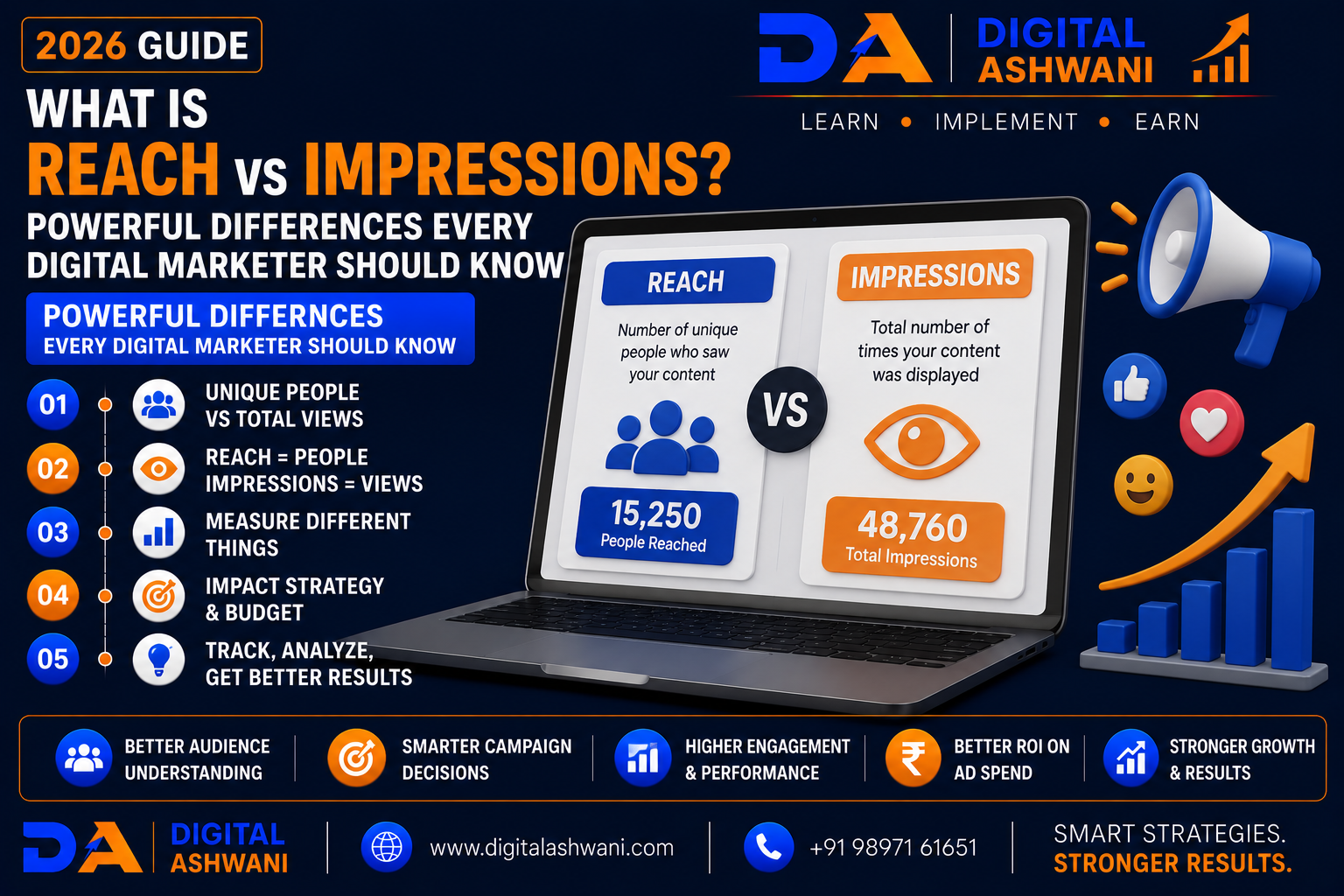
What Is Reach vs Impressions?
When measuring the success of social media campaigns, Google Ads, Facebook Ads, LinkedIn campaigns, or other digital marketing activities, two metrics appear repeatedly:
- Reach
- Impressions
Although these terms are often used interchangeably, they measure different aspects of your marketing performance.
Understanding the difference between Reach vs Impressions helps businesses evaluate brand awareness, audience engagement, advertising efficiency, and campaign effectiveness more accurately.
In this comprehensive guide by Digital Ashwani, you’ll learn 15 key differences, how each metric works, when to focus on reach or impressions, and how to improve both in 2026.
What Is Reach?
Reach refers to the number of unique people who see your content, advertisement, or social media post.
If one person sees your advertisement multiple times, they are counted only once in your reach.
Example:
- 1,000 different people viewed your Facebook post.
Reach = 1,000
Reach measures audience size.
What Are Impressions?
Impressions refer to the total number of times your content is displayed.
If the same person sees your advertisement several times, each view counts as another impression.
Example:
- One person sees your advertisement five times.
Reach = 1
Impressions = 5
Impressions measure total exposure.
Reach vs Impressions
| Metric | Reach | Impressions |
|---|---|---|
| Measures | Unique People | Total Views |
| Counts Repeat Views | No | Yes |
| Measures | Audience Size | Content Exposure |
| Useful For | Brand Awareness | Ad Frequency |
| Higher Value | Usually Lower | Usually Higher |
Why These Metrics Matter
Monitoring reach and impressions helps marketers:
- Evaluate Brand Awareness
- Measure Campaign Visibility
- Optimize Advertising Budget
- Improve Audience Targeting
- Analyze Content Performance
- Increase Marketing ROI
Both metrics should be analyzed together rather than independently.
15 Key Differences Between Reach and Impressions
1. Reach Counts Unique Users
Each individual is counted only once.
2. Impressions Count Every View
Repeated exposure increases impressions.
3. Reach Measures Audience Size
Reach indicates how many different people saw your content.
4. Impressions Measure Visibility
Impressions indicate how often your content appeared.
5. Reach Is Ideal for Brand Awareness
Growing reach expands your audience.
6. Impressions Help Measure Ad Frequency
Higher impressions often indicate repeated exposure.
7. Reach Usually Stays Lower
Unique users are generally fewer than total views.
8. Impressions Are Usually Higher
One person can generate multiple impressions.
9. Reach Focuses on New Audiences
If your objective is to introduce your brand to more people, increasing reach should be a priority.
Higher reach helps:
- Build Brand Awareness
- Attract New Customers
- Expand Market Presence
- Increase Organic Visibility
10. Impressions Measure Content Exposure
Repeated exposure can reinforce your brand message.
Higher impressions help:
- Improve Brand Recall
- Support Retargeting Campaigns
- Increase Ad Visibility
- Strengthen Marketing Consistency
However, impressions alone do not guarantee engagement or conversions.
11. Analyze Reach and Impressions Together
Neither metric tells the complete story.
Compare both alongside:
- Click-Through Rate (CTR)
- Engagement Rate
- Conversion Rate
- Website Traffic
- Leads Generated
A complete performance analysis leads to better marketing decisions.
12. Improve Reach with Better Content
Increase your reach by:
- Publishing High-Quality Content
- Using Relevant Hashtags
- Posting Consistently
- Sharing Valuable Information
- Encouraging Shares
- Collaborating with Influencers
Helpful content naturally reaches more unique users.
13. Improve Impressions Through Consistent Visibility
Increase impressions by:
- Running Paid Ads
- Posting Frequently
- Republishing Evergreen Content
- Using Multiple Social Platforms
- Improving SEO
- Expanding Keyword Coverage
More visibility creates additional opportunities for users to see your content.
14. Understand Frequency
Frequency measures how often each person sees your content.
Formula:
Frequency = Impressions ÷ Reach
Example:
- Reach = 2,000
- Impressions = 6,000
Average Frequency = 3
This means each person saw your content approximately three times.
Monitoring frequency helps avoid showing the same advertisement too often.
15. Use the Right Metric for Your Goal
Choose your primary metric based on campaign objectives.
Focus on Reach when:
- Launching a New Brand
- Building Awareness
- Reaching New Audiences
Focus on Impressions when:
- Running Remarketing Campaigns
- Reinforcing Brand Recognition
- Measuring Ad Exposure
The best campaigns balance both metrics.
Reach vs Impressions Checklist
Before evaluating campaign performance, verify the following:
- Reach Reviewed
- Impressions Measured
- Frequency Calculated
- CTR Monitored
- Engagement Rate Analyzed
- Conversion Rate Tracked
- Audience Targeting Optimized
- Creative Performance Compared
- Campaign Goal Defined
- Monthly Performance Reviewed
Following this checklist improves marketing analysis and optimization.
Common Reach vs Impressions Mistakes
Confusing Reach with Impressions
Reach measures unique users.
Impressions measure total content displays.
Always distinguish between the two.
Ignoring Frequency
Very high frequency may lead to ad fatigue.
Monitor how often the same audience sees your advertisements.
Focusing Only on Impressions
High impressions without clicks or conversions do not necessarily indicate campaign success.
Measure business outcomes alongside visibility.
Ignoring Audience Quality
Reaching the wrong audience reduces campaign effectiveness.
Target users most likely to engage or convert.
Not Tracking Conversions
Reach and impressions are awareness metrics.
Always evaluate them alongside leads, sales, and ROI.
Internal Linking Suggestions (Digital Ashwani)
Strengthen your analytics and social media content cluster by linking this article with:
- Complete Facebook Marketing Guide for Small Businesses and Local Brands
- Complete Instagram Marketing Guide for Business Growth
- Complete LinkedIn Marketing Guide for B2B Business Lead Generation
- Complete YouTube Marketing Guide for Business Growth and Brand Awareness
- What Is Cost Per Click (CPC)?
- Website Conversion Rate Optimization Guide
- Ultimate Analytics and Tracking Guide for Long-Term Business Growth
- What Is Looker Studio and How Does It Improve Marketing Reporting?
- Digital Marketing Career in 2026
- Top Digital Marketing Trends in 2026
These internal links strengthen topical authority while helping readers understand analytics, advertising metrics, reporting, and social media marketing.
External Resources
For trusted marketing guidance, refer to:
- Google Analytics Help Center
- Meta Business Help Center
- LinkedIn Marketing Solutions
- Google Ads Help Center
- YouTube Creator Academy
These official resources provide current guidance on advertising metrics, analytics, audience measurement, and campaign optimization.
Frequently Asked Questions
What is the difference between reach and impressions?
Reach measures the number of unique people who see your content, while impressions measure the total number of times your content is displayed, including repeat views by the same person.
Why are impressions usually higher than reach?
Because one person can view the same post or advertisement multiple times. Each additional view counts as another impression but does not increase reach.
Which metric is better for brand awareness?
Reach is generally the primary metric for measuring how many unique people were exposed to your brand, while impressions indicate how often they saw it.
Can high impressions be a bad sign?
Not necessarily. However, if impressions continue increasing without improvements in clicks, engagement, or conversions, it may indicate ad fatigue or ineffective creative.
Should marketers track both reach and impressions?
Yes. Analyzing both metrics together provides a more complete understanding of campaign visibility, audience size, frequency, and overall performance.
Final Thoughts
Understanding What Is Reach vs Impressions is essential for accurately measuring the success of digital marketing campaigns. While reach shows how many unique people have seen your content, impressions reveal how frequently your message has been displayed. Both metrics play an important role in evaluating brand awareness and campaign visibility.
Instead of focusing on a single metric, successful marketers analyze reach, impressions, frequency, engagement, click-through rate, and conversions together. This broader perspective leads to smarter optimization decisions and stronger marketing performance.
As digital marketing continues to evolve, businesses that understand how these metrics work—and how to balance them with meaningful business outcomes—will be better equipped to build brand awareness, engage their audience, and generate sustainable growth.
At Digital Ashwani, we regularly publish practical guides on SEO, Google Ads, Social Media Marketing, Analytics, AI Marketing, and Digital Marketing to help businesses make data-driven decisions and achieve long-term online success.
