

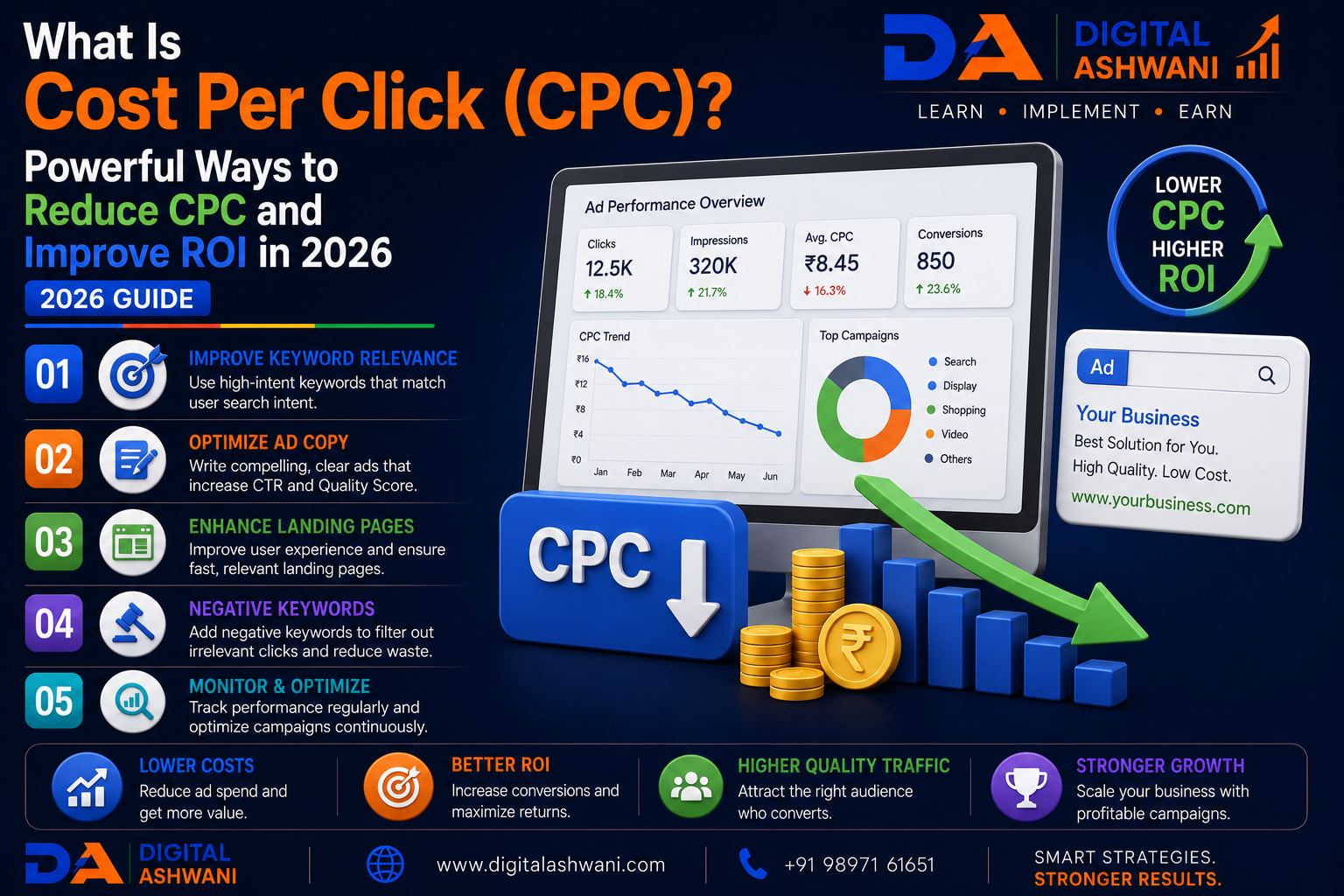
What Is Cost Per Click (CPC)?
When running online advertising campaigns, one of the first metrics you’ll encounter is Cost Per Click (CPC). Whether you’re advertising on Google Ads, Microsoft Ads, Facebook, LinkedIn, or other PPC platforms, CPC plays a major role in determining how efficiently your advertising budget is spent.
Many businesses focus only on generating clicks, but successful advertisers understand that every click has a cost—and controlling that cost is essential for maximizing profitability and return on investment (ROI).
A lower CPC doesn’t always mean a better campaign. The real objective is to achieve high-quality clicks that convert into leads or sales while maintaining a profitable advertising cost.
In this comprehensive guide by Digital Ashwani, you’ll learn what Cost Per Click (CPC) is, how it’s calculated, what factors influence it, and the best strategies to optimize CPC in 2026.
What Is Cost Per Click (CPC)?
Cost Per Click (CPC) is the amount an advertiser pays each time someone clicks on their advertisement.
Instead of paying simply for displaying an advertisement, advertisers are charged only when a user clicks the ad.
CPC is one of the most important pricing models used in:
- Google Ads
- Microsoft Ads
- Facebook Ads
- LinkedIn Ads
- X Ads
- Other PPC advertising platforms
It helps businesses measure advertising efficiency and control campaign spending.
CPC Formula
The formula for calculating Cost Per Click is simple:
Cost Per Click (CPC) = Total Advertising Cost ÷ Total Number of Clicks
Example
Suppose:
- Total Ad Spend = ₹20,000
- Total Clicks = 1,000
CPC = ₹20 per click
This means every visitor who clicked your advertisement cost approximately ₹20.
How Does CPC Work?
When a user performs a search or views an advertisement, advertising platforms conduct an auction.
Your actual CPC depends on factors such as:
- Keyword competition
- Maximum bid
- Quality Score
- Ad relevance
- Landing page quality
- Competitor bids
Because of this auction system, advertisers often pay less than their maximum bid.
Why CPC Matters
Monitoring CPC helps businesses:
- Control advertising costs
- Increase ROI
- Improve campaign efficiency
- Optimize keyword selection
- Allocate budgets effectively
Understanding CPC is essential for running profitable advertising campaigns.
15 Powerful Ways to Reduce Cost Per Click
1. Improve Quality Score
Google rewards advertisers who create highly relevant advertisements and landing pages.
A better Quality Score often leads to:
- Lower CPC
- Better Ad Rank
- Higher Click-Through Rate (CTR)
Focus on creating relevant ads that match user intent.
2. Choose High-Intent Keywords
Instead of targeting broad terms, focus on keywords indicating purchase intent.
Examples include:
- Buy Running Shoes Online
- SEO Agency Delhi
- Best CRM Software for Small Business
High-intent keywords generally generate better conversions.
3. Use Negative Keywords
Negative keywords prevent advertisements from appearing for irrelevant searches.
Examples:
- Free
- Jobs
- Internship
- Tutorial
Regularly reviewing Search Terms Reports helps identify new negative keywords.
4. Improve Landing Page Experience
A well-designed landing page improves:
- User experience
- Conversion rates
- Quality Score
Ensure pages:
- Load quickly
- Are mobile-friendly
- Match ad messaging
- Include clear CTAs
5. Optimize Ad Copy
Compelling advertisements improve CTR and Quality Score.
Include:
- Strong headlines
- Clear benefits
- Relevant keywords
- Effective Call-to-Actions
Better ads often reduce CPC.
6. Target the Right Audience
Avoid showing advertisements to irrelevant users.
Use targeting options such as:
- Geographic location
- Device
- Language
- Audience interests
- Demographics
Better targeting improves advertising efficiency.
7. Test Multiple Ad Variations
A/B testing helps identify higher-performing advertisements.
Experiment with:
- Headlines
- Descriptions
- Display URLs
- Calls-to-Action
Continuous testing leads to improved campaign performance.
8. Monitor Search Term Reports
Review the actual searches triggering your ads.
Remove:
- Irrelevant queries
- Low-converting keywords
- High-cost, low-performance terms
Regular optimization prevents wasted ad spend.
9. Use Long-Tail Keywords
Long-tail keywords usually face less competition and often generate more qualified traffic.
Instead of targeting:
- Digital Marketing
Target keywords such as:
- Digital Marketing Agency for Small Businesses
- Best SEO Company in Delhi
- Affordable Google Ads Management Services
Long-tail keywords generally produce lower CPCs and higher conversion rates.
10. Schedule Ads During High-Converting Hours
Your advertisements don’t always need to run 24/7.
Analyze campaign data to identify:
- Peak conversion hours
- High-performing days
- Device performance
- Geographic performance
Running ads during profitable periods helps improve ROI while reducing unnecessary spending.
11. Improve Click-Through Rate (CTR)
A higher CTR signals that your advertisements are relevant to users.
Google often rewards relevant ads with:
- Better Ad Rank
- Higher Quality Score
- Lower CPC
Ways to Increase CTR
- Write compelling headlines
- Include the focus keyword
- Highlight unique selling points
- Add strong Call-to-Actions
- Use ad extensions
12. Use Smart Bidding Carefully
Google Ads offers AI-powered bidding strategies that automatically optimize bids.
Popular options include:
- Maximize Clicks
- Maximize Conversions
- Target CPA
- Target ROAS
- Maximize Conversion Value
Choose a bidding strategy that aligns with your campaign objectives rather than selecting one by default.
13. Monitor Competitor Activity
Your competitors influence CPC through bidding and keyword competition.
Regularly review:
- Competitor ad copy
- Landing pages
- Offers
- Keywords
- Promotions
Competitive research helps identify opportunities to improve campaign performance without simply increasing bids.
14. Track Conversion Rate Alongside CPC
A low CPC isn’t always profitable if visitors don’t convert.
Evaluate CPC together with:
- Conversion Rate
- Cost Per Acquisition (CPA)
- Return on Ad Spend (ROAS)
- Revenue
- Lead Quality
The objective is profitable advertising—not simply cheaper clicks.
15. Continuously Optimize Campaigns
Successful PPC campaigns require ongoing improvements.
Review campaigns regularly by:
- Updating keywords
- Refreshing ad copy
- Adding negative keywords
- Improving landing pages
- Testing bidding strategies
- Monitoring conversion tracking
Continuous optimization helps reduce CPC while increasing overall campaign performance.
Average CPC by Industry
Actual CPC varies depending on competition, keyword intent, and industry.
Typical examples include:
| Industry | Average CPC Trend |
|---|---|
| Legal Services | Very High |
| Insurance | Very High |
| Finance | High |
| Healthcare | High |
| Real Estate | Medium to High |
| SaaS | Medium to High |
| Education | Medium |
| eCommerce | Medium |
| Restaurants | Low to Medium |
| Local Services | Medium |
These are general trends. Actual CPC depends on market competition and campaign quality.
CPC vs CPA vs CPM
Understanding these advertising metrics helps evaluate campaign performance more effectively.
| Metric | Meaning | Best Used For |
|---|---|---|
| CPC | Cost Per Click | Website Traffic |
| CPA | Cost Per Acquisition | Lead Generation & Sales |
| CPM | Cost Per 1,000 Impressions | Brand Awareness |
Businesses should track all three metrics rather than relying on CPC alone.
Common Cost Per Click (CPC) Mistakes Focusing Only on Low CPC
A cheaper click isn’t valuable if it doesn’t generate qualified leads or sales.
Ignoring Quality Score
Poor ad relevance and weak landing pages often increase CPC unnecessarily.
Using Broad Keywords Without Optimization
Broad targeting can attract irrelevant clicks and waste advertising budget.
Not Adding Negative Keywords
Failing to exclude irrelevant searches increases CPC and reduces campaign efficiency.
Never Reviewing Campaign Performance
Regular optimization is essential for maintaining a competitive CPC and improving ROI.
Cost Per Click Optimization Checklist
| CPC Optimization Task | Status |
|---|---|
| High-Intent Keywords Selected | ✅ |
| Negative Keywords Added | ✅ |
| Quality Score Improved | ✅ |
| Landing Pages Optimized | ✅ |
| Smart Bidding Configured | ✅ |
| Ad Extensions Enabled | ✅ |
| Search Terms Reviewed | ✅ |
| Conversion Tracking Active | ✅ |
| CTR Monitored | ✅ |
| Campaign Optimized Monthly | ✅ |
Internal Linking Suggestions (Digital Ashwani)
Strengthen your PPC and Digital Marketing content cluster by linking this article with:
- What Is Google Ads and How Does It Work?
- What Is Cost Per Acquisition (CPA)?
- What Is Return on Ad Spend (ROAS)?
- What Is Cost Per Mille (CPM)?
- Google Analytics 4 Complete Guide
- Google Ads AI Features 2026
- Keyword Research Guide
- Landing Page Optimization Guide
- Performance Marketing vs Digital Marketing
- ROI Calculator & PPC Calculator Tools
These internal links improve topical authority, strengthen semantic relevance, and enhance user navigation.
External Resources
For official guidance, explore:
- Google Ads Help Center
- Google Skillshop
- Google Analytics Help Center
- Microsoft Advertising Help
- Google Search Central
These resources provide the latest recommendations for PPC campaign management and advertising optimization.
Frequently Asked Questions
What is a good Cost Per Click (CPC)?
A good CPC depends on your industry, competition, conversion rate, and business goals. A higher CPC may still be profitable if it generates high-quality leads and strong ROI.
How can I reduce CPC in Google Ads?
Improve your Quality Score, use relevant keywords, optimize landing pages, add negative keywords, test different ad variations, and regularly optimize your campaigns.
Is a lower CPC always better?
No. The most important objective is profitable conversions. A slightly higher CPC can deliver better results if it attracts customers who are more likely to convert.
What factors affect CPC?
Keyword competition, Quality Score, ad relevance, landing page experience, bidding strategy, and competitor activity all influence CPC.
How often should I optimize CPC campaigns?
Review campaigns at least weekly and perform detailed optimization every month to maintain strong performance and improve ROI.
Final Thoughts
Cost Per Click (CPC) is one of the most important metrics in digital advertising because it directly influences how efficiently your marketing budget is used. However, successful advertisers understand that the goal isn’t simply to reduce CPC—it’s to generate qualified traffic that leads to conversions, revenue, and long-term business growth.
By improving Quality Score, selecting high-intent keywords, optimizing landing pages, using Smart Bidding, monitoring competitor activity, and continuously refining campaigns, businesses can achieve a healthy balance between advertising costs and profitability.
At Digital Ashwani, we regularly publish practical guides on Google Ads, PPC, SEO, AI Marketing, Analytics, and Digital Marketing to help businesses maximize advertising performance and achieve sustainable growth.
