

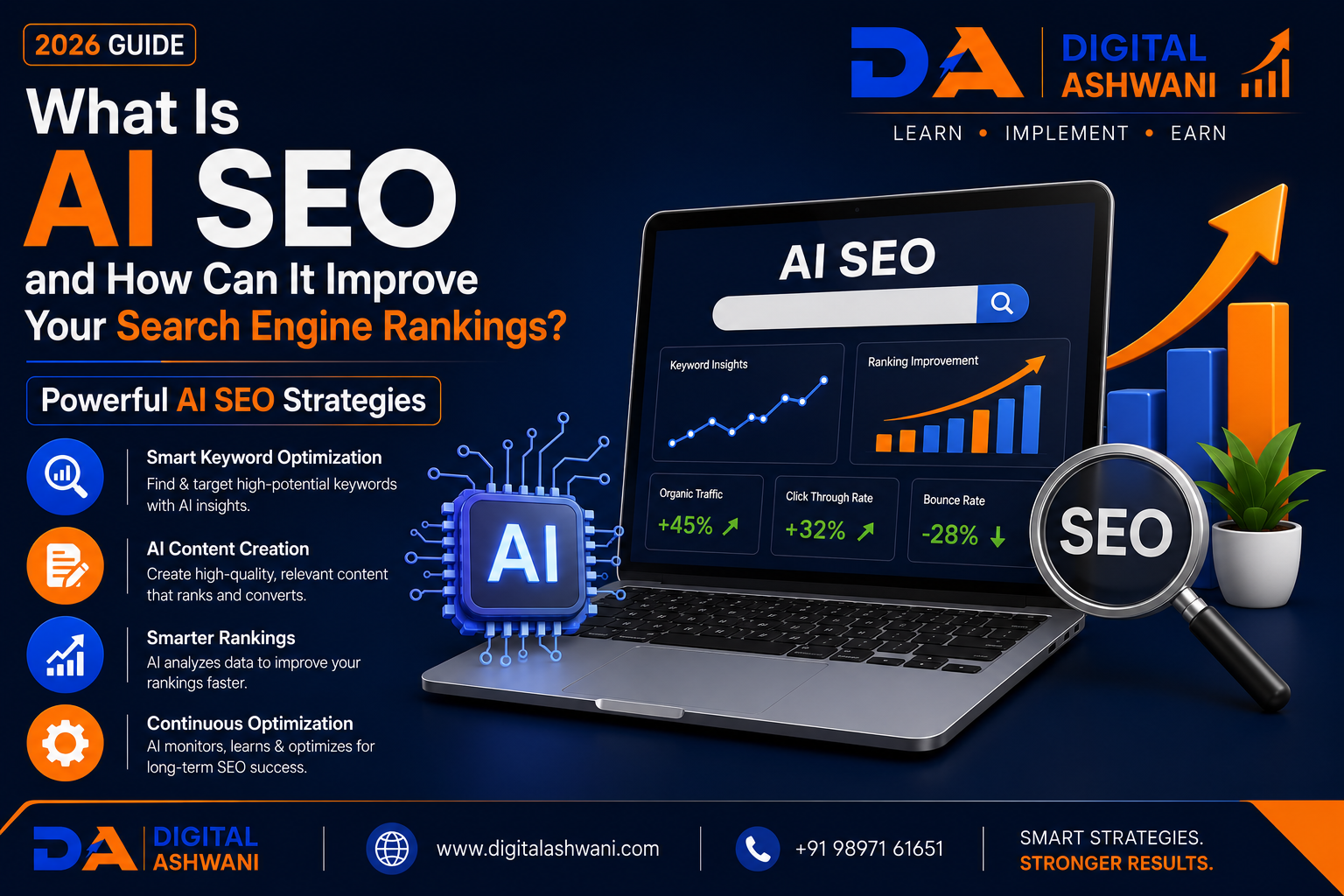
What Is AI SEO and How Can It Improve Your Search Engine Rankings?
Artificial Intelligence is transforming the way search engines understand, rank, and present information. Search Engine Optimization (SEO) is no longer limited to keyword placement, backlinks, and technical improvements. Today, Google uses advanced AI systems to understand user intent, evaluate content quality, and deliver the most relevant answers. At the same time, AI-powered platforms like ChatGPT, Google Gemini, Perplexity, and Google’s AI Overviews are changing how people search for information online.
As a result, businesses need to optimize not only for traditional Google Search but also for AI-powered search experiences. This new approach is known as AI SEO.
AI SEO combines proven SEO techniques with Artificial Intelligence to improve keyword research, content planning, technical optimization, search intent analysis, competitor research, and performance tracking. Instead of replacing SEO professionals, AI acts as a powerful assistant that helps marketers work faster, make better decisions, and create more valuable content for users.
Whether you manage a business website, blog, eCommerce store, or digital marketing agency, understanding AI SEO is becoming essential for long-term organic growth. Businesses that adapt early are more likely to achieve higher rankings, improve visibility in AI-powered search results, and attract qualified organic traffic.
In this complete guide by Digital Ashwani, you’ll learn what AI SEO is, why it matters, how it works, and 15 powerful AI SEO strategies that can improve your search engine rankings in 2026.
What Is AI SEO?
AI SEO (Artificial Intelligence Search Engine Optimization) is the process of using Artificial Intelligence to improve every stage of SEO, including keyword research, content creation, technical optimization, competitor analysis, user intent analysis, and performance monitoring.
Instead of relying only on manual research, AI helps marketers make faster and smarter optimization decisions.
AI SEO can assist with:
- Keyword Research
- Content Planning
- Search Intent Analysis
- Topic Clustering
- Technical SEO Audits
- Internal Linking
- Meta Tag Optimization
- Content Refreshes
- Competitor Analysis
- SEO Reporting
AI increases efficiency, but successful SEO still depends on human expertise, creativity, and strategic planning.
Why AI SEO Is Important
Search engines have become much smarter than they were a few years ago.
Google now evaluates:
- User Intent
- Helpful Content
- EEAT Signals
- Page Experience
- Semantic Relevance
- Website Authority
- Content Freshness
- User Engagement
In addition, AI-powered search experiences often summarize information directly for users. Businesses that structure their content clearly and provide trustworthy information have a better chance of being featured in AI-generated responses.
This makes AI SEO an important part of every modern digital marketing strategy.
Benefits of AI SEO
Businesses that implement AI SEO can achieve:
- Higher Organic Rankings
- Better Search Visibility
- Faster Content Research
- Improved Keyword Targeting
- Better Content Quality
- Increased Organic Traffic
- Improved Productivity
- Stronger Topical Authority
- Better AI Search Visibility
- Smarter Data-Driven Decisions
When used correctly, AI helps marketers spend less time on repetitive tasks and more time creating valuable content.
15 Powerful AI SEO Strategies
1. Use AI for Smarter Keyword Research
Keyword research remains the foundation of SEO.
AI-powered tools can identify:
- High-Intent Keywords
- Long-Tail Keywords
- Question-Based Searches
- Semantic Keywords
- Trending Topics
- Content Opportunities
Rather than targeting only search volume, prioritize keywords that solve real user problems and match search intent.
2. Focus on Search Intent Instead of Keyword Density
Modern search engines prioritize user satisfaction.
AI helps classify search intent into:
- Informational
- Commercial
- Transactional
- Navigational
Content that fully satisfies user intent is more likely to rank well than content that simply repeats keywords.
3. Build Topic Clusters Instead of Individual Articles
Search engines reward websites that demonstrate topical authority.
For example, if your main topic is AI SEO, create supporting articles such as:
- AI SEO Tools
- Google AI Overviews
- Entity SEO
- ChatGPT for SEO
- AI Search Optimization
- Semantic SEO
Interlinking these articles strengthens your site’s authority and improves crawlability.
4. Create AI-Assisted, Human-Reviewed Content
AI can accelerate content creation by helping with:
- Blog Outlines
- Content Research
- FAQs
- Meta Descriptions
- Content Expansion
- Content Refreshes
However, every article should be reviewed by a human to ensure accuracy, originality, and real value.
Google rewards helpful content—not content created solely for search engines.
5. Optimize for Google AI Overviews
Google increasingly provides AI-generated summaries for many informational searches.
Improve your chances of appearing by:
- Using Clear Headings
- Answering Questions Directly
- Adding FAQ Sections
- Using Bullet Lists
- Providing Accurate Information
- Demonstrating Expertise
Structured content is easier for AI systems to understand and reference.
6. Improve On-Page SEO with AI
AI tools can identify opportunities to optimize:
- SEO Titles
- Meta Descriptions
- Heading Structure
- Internal Links
- Keyword Placement
- Readability
- Image ALT Text
Strong on-page SEO improves both user experience and search engine understanding.
7. Strengthen Technical SEO
Technical SEO remains essential even in the AI era.
AI-powered audit tools can quickly detect:
- Broken Links
- Duplicate Content
- Crawl Errors
- Missing Metadata
- Slow Pages
- Mobile Usability Issues
- Core Web Vitals Problems
Fixing these issues helps search engines crawl and index your website more efficiently.
8. Analyze Competitors Using AI
AI-powered SEO tools make competitor research faster and more actionable.
Analyze:
- Ranking Keywords
- Content Gaps
- Backlink Profiles
- SERP Features
- Content Structure
- Top-Performing Pages
Learning from successful competitors helps identify opportunities to strengthen your own SEO strategy.
9. Optimize for Entity SEO
Modern search engines increasingly understand entities (people, brands, products, organizations, and places) instead of relying only on keywords.
Strengthen your entity signals by:
- Creating detailed About pages
- Using Organization Schema
- Building author profiles
- Maintaining consistent brand information
- Earning mentions from authoritative websites
- Using structured data
Entity SEO helps search engines understand your brand and improve trust.
10. Refresh Existing Content Regularly
SEO is an ongoing process—not a one-time task.
Update your existing content by:
- Adding recent statistics
- Including new AI features
- Improving examples
- Expanding FAQs
- Updating screenshots
- Fixing outdated information
- Improving internal links
Fresh content is more likely to remain competitive in search results.
11. Build High-Quality Topical Authority
Instead of publishing unrelated articles, focus on becoming an authority within your niche.
For example, if your website focuses on SEO, publish interconnected articles about:
- Technical SEO
- Local SEO
- AI SEO
- Ecommerce SEO
- Entity SEO
- On-Page SEO
- Off-Page SEO
- Google Updates
A strong topical cluster improves both rankings and user experience.
12. Use AI SEO Tools Responsibly
AI tools can improve productivity, but they should support—not replace—human expertise.
Popular AI SEO tools include:
- ChatGPT
- Google Gemini
- Claude
- Perplexity AI
- Surfer SEO
- Semrush
- Ahrefs
- Screaming Frog
- Google Search Console
Use these tools for research, optimization, and analysis while ensuring all published content is reviewed for quality and accuracy.
13. Build High-Quality Backlinks
Backlinks continue to be an important ranking signal.
Earn links through:
- Original Research
- Industry Case Studies
- Guest Articles
- Digital PR
- Expert Interviews
- Resource Pages
- Shareable Content
Avoid purchasing spammy backlinks, as they can harm long-term SEO performance.
14. Track SEO Performance Using Data
AI SEO should always be supported by measurable data.
Monitor important metrics such as:
- Organic Traffic
- Keyword Rankings
- Click-Through Rate (CTR)
- Impressions
- Conversions
- Bounce Rate
- User Engagement
- AI Search Visibility
Review your SEO performance regularly to identify opportunities for improvement.
15. Combine AI with Human Expertise
The most successful SEO strategy combines AI efficiency with human experience.
Human expertise remains essential for:
- Strategic Planning
- Creativity
- Industry Knowledge
- Fact Verification
- Brand Voice
- Customer Understanding
AI accelerates workflows, but genuine expertise and helpful content remain the foundation of long-term SEO success.
Best AI SEO Tools
Popular AI SEO tools include:
- ChatGPT
- Google Gemini
- Claude AI
- Perplexity AI
- Surfer SEO
- Semrush
- Ahrefs
- Frase
- Clearscope
- Google Search Console
Each tool serves different purposes, from keyword research and content optimization to technical SEO and performance analysis.
Common AI SEO Mistakes
Publishing AI Content Without Editing
Always review AI-generated content to ensure accuracy, originality, and usefulness.
Ignoring EEAT
Experience, Expertise, Authoritativeness, and Trustworthiness remain critical ranking factors.
Demonstrate real-world knowledge through case studies, examples, and expert insights.
Overusing Keywords
Modern search engines understand context.
Write naturally instead of forcing keywords into every paragraph.
Neglecting Technical SEO
Even the best content may struggle to rank if your website has technical issues.
Regularly audit your website for crawlability, speed, mobile usability, and Core Web Vitals.
Depending Completely on AI
AI is an assistant—not a replacement for strategic thinking.
Combine AI-generated insights with human judgment to create trustworthy, user-focused content.
Internal Linking Suggestions (Digital Ashwani)
Strengthen your AI SEO content cluster by linking this article with:
- AI SEO vs Traditional SEO: Which Strategy Works Better?
- Entity SEO Strategies for AI-Powered Search Engines
- ChatGPT for SEO: How to Create High-Quality Content That Ranks
- What Is Artificial Intelligence (AI) in Digital Marketing?
- How To Measure AI Search Visibility
- What Is Search Engine Optimization and Why Does Every Business Need SEO?
- Complete Beginner’s Guide to Understanding How Google Search Ranking Really Works
- How Search Engines Crawl, Index and Rank Websites for Better Visibility
- Ecommerce SEO Strategies to Increase Organic Product Sales
- Ultimate Analytics and Tracking Guide for Long-Term Business Growth
These internal links strengthen topical authority, improve semantic relevance, and help search engines understand your AI SEO expertise.
External Resources
For official SEO and AI guidance, explore:
- Google Search Central
- Google Search Central Blog
- Google AI
- Google Search Console Help
- Schema.org
These trusted resources provide the latest recommendations for AI-powered search, technical SEO, structured data, and search optimization.
Frequently Asked Questions
What is AI SEO?
AI SEO is the practice of using Artificial Intelligence to improve search engine optimization through keyword research, content optimization, technical SEO, competitor analysis, and performance monitoring.
Can AI improve search engine rankings?
Yes. AI helps marketers create better content, identify keyword opportunities, optimize technical SEO, and understand search intent. However, long-term rankings still depend on helpful, original, and trustworthy content.
Is AI replacing traditional SEO?
No. AI is enhancing SEO rather than replacing it. Traditional SEO principles such as technical optimization, content quality, backlinks, and user experience remain essential.
Which AI tools are best for SEO?
Popular AI SEO tools include ChatGPT, Google Gemini, Claude, Surfer SEO, Semrush, Ahrefs, Frase, Clearscope, and Google Search Console.
How can beginners start with AI SEO?
Start by learning SEO fundamentals, then use AI tools for keyword research, content planning, technical audits, and optimization. Always review AI-generated recommendations before implementing them.
Final Thoughts
AI SEO represents the next evolution of Search Engine Optimization. As Google and other search platforms continue integrating Artificial Intelligence into their ranking systems, businesses must move beyond traditional keyword-focused strategies and prioritize user intent, topical authority, technical excellence, and high-quality content.
Artificial Intelligence can dramatically improve productivity by simplifying keyword research, competitor analysis, content planning, and SEO reporting. However, the websites that consistently perform well are those that combine AI-powered efficiency with human expertise, originality, and trustworthiness.
The future of SEO belongs to businesses that create genuinely helpful content, optimize for both traditional and AI-powered search experiences, and continuously adapt to changing search behavior. By implementing the strategies in this guide, you can improve search engine rankings, increase organic traffic, and build sustainable online authority.
At Digital Ashwani, we regularly publish practical guides on AI SEO, Technical SEO, Google Search, Google Ads, AI Marketing, Content Marketing, and Digital Marketing to help businesses stay ahead in the evolving world of search.
