
SEO for SaaS Companies
The SaaS industry is more competitive than ever. Whether you offer CRM software, project management tools, marketing automation, accounting software, HR platforms, AI applications, or cybersecurity solutions, your potential customers usually begin their buying journey with a Google search.
Popular searches include:
- Best CRM Software
- Project Management Tool
- AI Writing Software
- Email Marketing Platform
- HR Management Software
- Accounting Software for Small Business
If your SaaS product isn’t visible in search results, potential customers are likely signing up for competing platforms.
This is where SEO for SaaS Companies becomes one of the most effective long-term growth strategies.
Unlike paid advertising that stops generating leads when your budget ends, SEO and content marketing continuously attract high-intent users who are actively researching software solutions.
A well-planned SaaS SEO strategy helps improve Google rankings, educate potential customers, build authority, increase free-trial signups, and reduce customer acquisition costs (CAC).
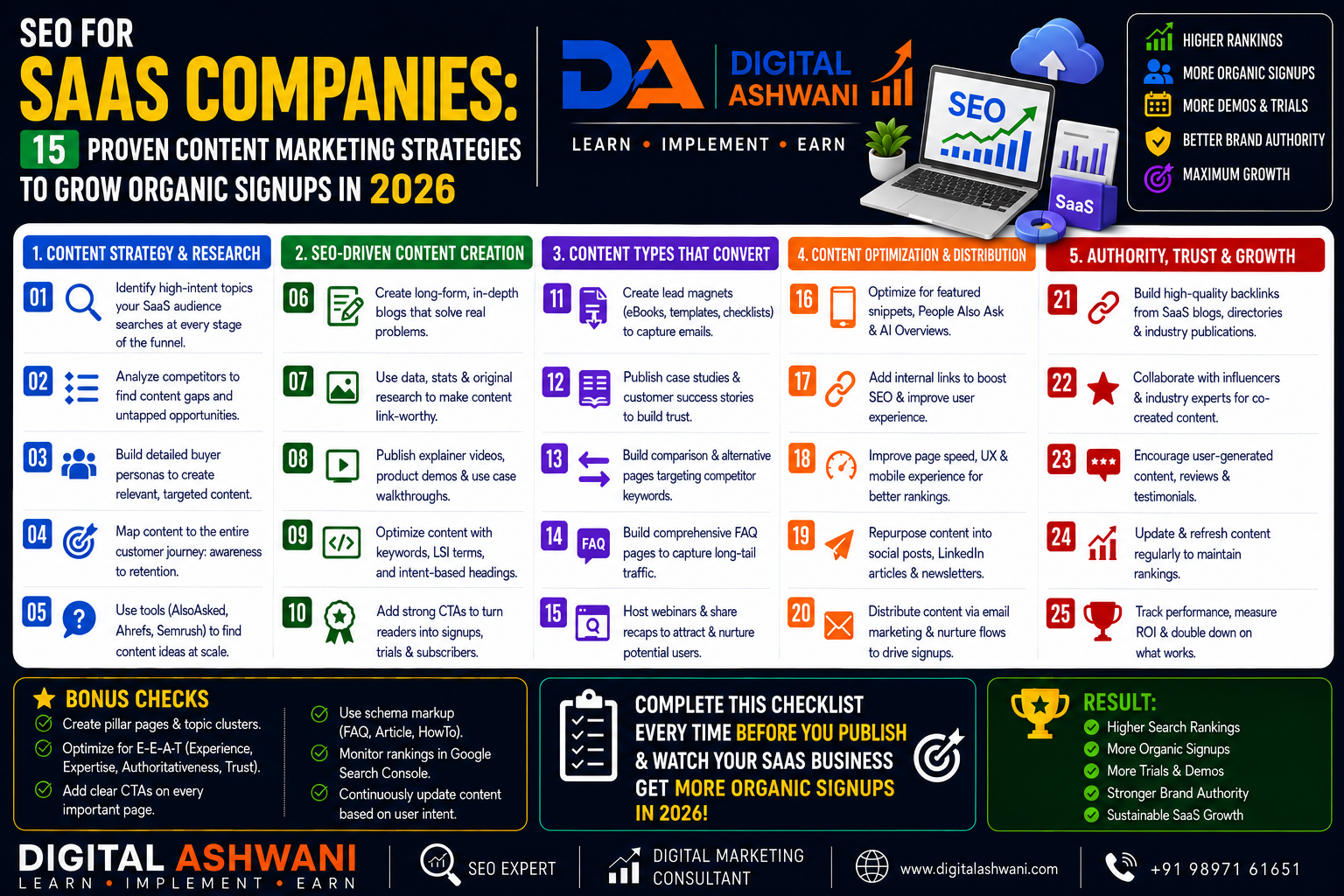
In this comprehensive guide by Digital Ashwani, you’ll learn 15 proven content marketing and SEO strategies to grow organic traffic, generate qualified leads, and increase SaaS signups in 2026.
Why SEO Matters for SaaS Companies
Today’s software buyers rarely purchase a product immediately.
Instead, they research:
- Features
- Pricing
- Comparisons
- Alternatives
- Integrations
- Customer reviews
- Tutorials
- Case studies
SEO helps your software appear throughout every stage of this buying journey.
Popular searches include:
- Best CRM for Startups
- HubSpot Alternatives
- Project Management Software Comparison
- AI SEO Tool
- Best Accounting Software
- Marketing Automation Platform
Ranking for these searches allows your SaaS business to capture users with strong purchase intent.
Benefits of SEO for SaaS Companies
A successful SaaS SEO strategy helps:
- Increase free-trial signups
- Generate qualified B2B leads
- Improve Google rankings
- Reduce customer acquisition costs
- Build topical authority
- Increase recurring organic traffic
- Strengthen brand credibility
- Support sustainable business growth
SEO becomes a scalable acquisition channel that continues delivering value over time.
15 Proven Content Marketing Strategies
1. Perform SaaS Keyword Research
Keyword research forms the foundation of every successful SaaS SEO campaign.
Target Commercial Intent Keywords
Examples include:
- CRM Software
- Marketing Automation Software
- Best HR Software
- AI Writing Tool
- Project Management Software
These keywords target users actively searching for software solutions.
Target Bottom-of-Funnel Keywords
Examples:
- HubSpot Alternatives
- Notion vs ClickUp
- Best CRM for Real Estate
- Affordable Email Marketing Software
- AI SEO Tool for Agencies
Comparison and alternative keywords often generate highly qualified leads.
2. Build Dedicated Product & Feature Pages
Each product feature should have its own SEO-optimized landing page.
Examples of Feature Pages
Create dedicated pages for:
- CRM Features
- Marketing Automation
- Team Collaboration
- Workflow Automation
- AI Integrations
- Reporting Dashboard
- Mobile App
- API Documentation
Dedicated pages increase keyword relevance and improve organic visibility.
Provide Detailed Product Information
Every page should include:
- Feature overview
- Benefits
- Use cases
- Screenshots
- Videos
- Frequently Asked Questions
- Free Trial CTA
Comprehensive product pages improve user engagement and conversion rates.
3. Build a Topic Cluster Strategy
Topical authority is essential for SaaS SEO success.
Create Content Hubs
Develop content around major themes such as:
- CRM Software
- Project Management
- AI Productivity
- Sales Automation
- Customer Support
- Team Collaboration
Topic clusters help search engines understand your expertise.
Connect Pages with Internal Links
Link related blogs, feature pages, comparison articles, case studies, and tutorials to strengthen site architecture and improve crawlability.
4. Publish Educational Content
Most SaaS customers need education before making a purchasing decision.
Create Helpful Blog Articles
Examples include:
- How to Choose CRM Software
- Best Project Management Tools
- Sales Automation Guide
- Email Marketing Best Practices
- AI Productivity Tips
- SaaS Buying Checklist
Educational content attracts users in the awareness stage.
Answer Common Questions
Cover topics such as:
- Which CRM is best for small businesses?
- What is SaaS?
- How much does CRM software cost?
- Which project management software is easiest to use?
Helpful content builds trust and authority.
5. Create Comparison & Alternative Pages
Comparison pages are among the highest-converting SaaS content assets.
Write Product Comparison Articles
Examples include:
- HubSpot vs Salesforce
- ClickUp vs Asana
- Notion vs Trello
- Canva vs Adobe Express
These pages target users close to making a purchase decision.
Publish Alternative Guides
Examples:
- Best HubSpot Alternatives
- Top Salesforce Alternatives
- ClickUp Alternatives
- Best AI Writing Tools
Alternative pages attract users actively evaluating competitors.
6. Improve Website Speed
A fast website improves both SEO performance and user experience.
Optimize Performance
Improve speed by:
- Compressing images
- Optimizing JavaScript
- Minifying CSS
- Using browser caching
- Implementing a CDN
- Choosing high-performance hosting
Fast-loading pages improve engagement and reduce bounce rates.
Monitor Core Web Vitals
Track:
- Largest Contentful Paint (LCP)
- Interaction to Next Paint (INP)
- Cumulative Layout Shift (CLS)
Strong Core Web Vitals support better rankings and user satisfaction.
7. Publish Case Studies & Customer Success Stories
Trust is a major factor in B2B software purchasing decisions.
Create Detailed Case Studies
Include:
- Customer challenges
- Solution implementation
- Results achieved
- ROI improvements
- Screenshots
- Customer quotes
Real-world success stories help potential customers understand your product’s value.
Highlight Customer Testimonials
Display:
- Video testimonials
- User reviews
- Ratings
- Client logos
- Awards
- Industry recognitions
These trust signals improve credibility and increase conversion rates.
8. Optimize Visual Content
Visual assets help explain software features more effectively.
Use High-Quality Visuals
Include:
- Product screenshots
- Dashboard previews
- Workflow diagrams
- Video tutorials
- GIF demonstrations
- Feature walkthroughs
Visual content improves engagement and product understanding.
Follow Image SEO Best Practices
Optimize all media by:
- Compressing files
- Using descriptive filenames
- Adding keyword-rich ALT text
- Implementing lazy loading
Optimized visuals improve page speed and search visibility.
Quick SaaS SEO Checklist
| SEO Area | Importance |
|---|---|
| Keyword Research | ⭐⭐⭐⭐⭐ |
| Product Page SEO | ⭐⭐⭐⭐⭐ |
| Topic Clusters | ⭐⭐⭐⭐⭐ |
| Educational Content | ⭐⭐⭐⭐⭐ |
| Comparison Pages | ⭐⭐⭐⭐⭐ |
| Website Speed | ⭐⭐⭐⭐☆ |
| Case Studies | ⭐⭐⭐⭐⭐ |
| Image SEO | ⭐⭐⭐⭐☆ |
9. Implement SaaS Schema Markup
Structured data helps search engines understand your SaaS business and improves the likelihood of earning rich search results.
Use Relevant Schema Types
Implement structured data for:
- Software Application
- Organization
- Product
- Service
- FAQ
- Breadcrumb
- Review (where applicable)
Schema markup can enhance your visibility by displaying additional information such as ratings, FAQs, pricing, and software details directly in search results.
Validate Structured Data
Test your schema using Google’s Rich Results Test or Schema Markup Validator to ensure there are no implementation issues.
10. Optimize Product & Landing Pages for Conversions
Organic traffic is valuable only if visitors become free-trial users or paying customers.
Build High-Converting Product Pages
Every product page should include:
- Clear value proposition
- Feature highlights
- Product screenshots
- Demo videos
- Customer testimonials
- Pricing information
- FAQs
- Free Trial CTA
Well-structured landing pages improve both SEO and conversions.
Create Strong Calls-to-Action
Examples include:
- Start Your Free Trial
- Book a Live Demo
- Try It Free
- Schedule a Product Demo
- Get Started Today
Clear CTAs guide visitors toward the next step.
11. Build a Product-Led Content Marketing Strategy
Content marketing is one of the biggest growth drivers for SaaS companies.
Create Content for Every Funnel Stage
Develop content for:
Top of Funnel (Awareness)
- Educational blogs
- Industry trends
- Beginner guides
- How-to articles
Middle of Funnel (Consideration)
- Product comparisons
- Buying guides
- Feature explainers
- Webinars
Bottom of Funnel (Decision)
- Case studies
- ROI calculators
- Customer success stories
- Demo pages
A full-funnel content strategy helps move prospects from discovery to signup.
Refresh Existing Content
Regularly update:
- Statistics
- Screenshots
- Product features
- Pricing details
- Integrations
- Industry trends
Fresh content maintains rankings and improves user trust.
12. Build High-Quality Backlinks
Authoritative backlinks strengthen domain authority and improve rankings.
Earn Links from Relevant Websites
Focus on backlinks from:
- SaaS blogs
- Technology publications
- Startup communities
- Business websites
- Industry associations
- Software review platforms
- Digital marketing blogs
Relevant backlinks help improve organic visibility.
Publish Link-Worthy Resources
Create valuable assets such as:
- Industry reports
- Original research
- Benchmark studies
- Free tools
- Templates
- Whitepapers
- Comprehensive guides
High-value resources naturally attract backlinks over time.
13. Monitor SEO Performance
SEO is an ongoing optimization process.
Track Important Metrics
Monitor:
- Organic traffic
- Free-trial signups
- Demo requests
- Keyword rankings
- Conversion rate
- Bounce rate
- Customer acquisition cost (CAC)
- Organic revenue
Tracking performance helps identify opportunities for continuous improvement.
Use Professional SEO Tools
Recommended tools include:
- Google Search Console
- Google Analytics
- Google PageSpeed Insights
- Google Tag Manager
- Microsoft Clarity
These tools provide insights into user behavior, technical performance, and search visibility.
14. Demonstrate EEAT
Trust plays a major role in SaaS purchasing decisions.
Showcase Your Expertise
Highlight:
- Founding team
- Product expertise
- Industry certifications
- Awards
- Customer success stories
- Media mentions
- Security certifications
- Integration partners
Strong trust signals improve both credibility and conversions.
Increase Business Transparency
Clearly display:
- Company information
- Contact details
- Privacy Policy
- Terms of Service
- Security page
- GDPR compliance
- Cookie Policy
Transparency reassures users and strengthens trust.
15. Continuously Improve Your SEO Strategy
SEO evolves with search algorithms, user behavior, and technology.
Regularly Update Product Content
Review and improve:
- Feature pages
- Pricing pages
- Help documentation
- Knowledge base articles
- API documentation
- Integration pages
Updated content remains competitive in search results.
Publish Consistent Educational Content
Continue creating resources such as:
- Product tutorials
- Industry insights
- AI trends
- Workflow automation guides
- Customer onboarding articles
- Best practices
Consistent publishing builds topical authority and supports long-term organic growth.
SaaS SEO Checklist
| SEO Task | Status |
|---|---|
| Keyword Research | ✅ |
| Product Page SEO | ✅ |
| Topic Clusters | ✅ |
| Content Marketing | ✅ |
| Schema Markup | ✅ |
| Technical SEO | ✅ |
| Website Speed | ✅ |
| Internal Linking | ✅ |
| Backlink Strategy | ✅ |
| Conversion Optimization | ✅ |
Common SaaS SEO Mistakes
Targeting Only High-Volume Keywords
Many SaaS companies ignore long-tail, comparison, and alternative keywords that often generate higher-converting traffic.
Weak Internal Linking
Failing to connect blogs, product pages, feature pages, documentation, and case studies reduces topical authority and makes navigation harder for both users and search engines.
Ignoring Product-Led Content
Publishing only promotional content limits organic growth. Educational resources, tutorials, and comparison articles attract users earlier in the buying journey.
Poor Technical SEO
Slow page speed, crawl errors, broken links, duplicate content, and indexing issues can significantly impact rankings and user experience.
No Conversion Optimization
Driving traffic without optimizing landing pages, CTAs, free-trial forms, or demo requests reduces the return on your SEO investment.
Internal Linking Suggestions (Digital Ashwani)
Strengthen your SaaS SEO content cluster by linking this article with:
- SEO Checklist for 2026: 25 Things You Must Do Before Publishing Any Blog
- AI SEO vs Traditional SEO
- How to Rank in ChatGPT Search Results
- Zero-Click SEO Strategy
- Google AI Mode Rollout: Complete SEO Impact Analysis
- Why Organic Traffic Is Dropping Even When Rankings Stay the Same
- Top Digital Marketing Trends in 2026
- Content Marketing Strategy Guide
- Technical SEO Complete Guide
- Google Search Console Guide
- Keyword Research Guide
These internal links improve topical authority, strengthen your website architecture, and help users discover more valuable Digital Ashwani content.
External Resources
For trusted SEO and SaaS guidance, refer to:
- Google Search Central
- Google Search Console Help
- Google PageSpeed Insights
- Schema.org SoftwareApplication Documentation
- Google Analytics Help Center
These resources provide best practices for technical SEO, structured data, and website performance.
Frequently Asked Questions
How long does SEO for SaaS Companies take to show results?
Most SaaS companies begin seeing measurable SEO improvements within 3–6 months, although highly competitive industries may require additional time. Consistent content creation, technical optimization, and backlink acquisition are key factors.
Why is content marketing important for SaaS SEO?
Content marketing helps educate potential customers throughout the buying journey. Publishing guides, tutorials, comparisons, and case studies builds trust, demonstrates expertise, and attracts qualified organic traffic.
Can SEO increase SaaS signups?
Yes. A well-executed SEO strategy attracts users actively searching for software solutions. Combined with optimized product pages and effective CTAs, SEO can significantly increase free-trial signups and demo requests.
Should every SaaS feature have its own page?
Yes. Dedicated pages for each feature, integration, use case, and industry solution improve keyword targeting, user experience, and organic search visibility.
Why are comparison and alternative pages valuable?
Users searching for comparisons or alternatives are often close to making a purchasing decision. These pages target high-intent keywords and frequently deliver some of the highest conversion rates in SaaS SEO.
Final Thoughts
Implementing SEO for SaaS Companies is one of the most effective long-term strategies for increasing qualified traffic, generating organic signups, and reducing customer acquisition costs. By combining keyword research, technical SEO, product-led content marketing, optimized landing pages, structured data, educational resources, strategic backlink building, and continuous performance monitoring, SaaS businesses can create a sustainable growth engine that compounds over time.
Instead of focusing solely on rankings, build content that solves real customer problems, demonstrates product value, and supports users throughout the entire buying journey. A customer-first SEO strategy not only improves search visibility but also strengthens brand authority, increases product adoption, and drives long-term recurring revenue.
