

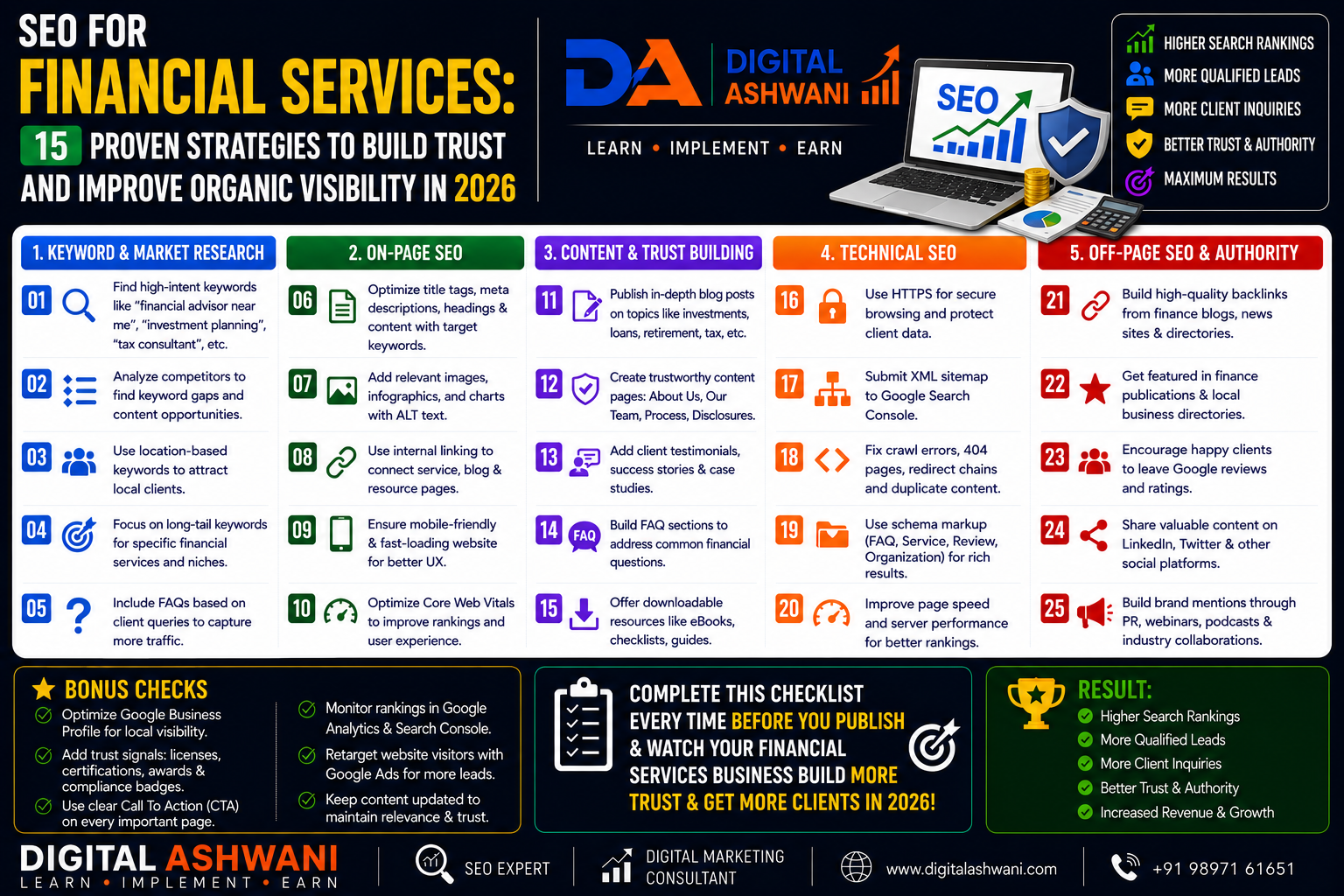
SEO for Financial Services
The financial services industry is one of the most competitive and highly regulated industries online. Whether you provide financial planning, investment advisory, tax consulting, accounting, insurance, wealth management, banking solutions, or loan consultancy, your prospective clients almost always begin their journey with Google Search.
People search for queries like:
- Financial Advisor Near Me
- Best Tax Consultant
- Investment Advisor in Delhi
- Retirement Planning Services
- Business Loan Consultant
- Wealth Management Company
If your business doesn’t appear on the first page of Google, potential clients are likely choosing competitors who have invested in strong SEO and content marketing.
This is where SEO for Financial Services becomes one of the most valuable long-term marketing investments.
Unlike paid advertisements that stop generating leads when the budget runs out, SEO continuously attracts people actively searching for financial advice and professional services. A well-executed SEO strategy improves search visibility, builds trust, increases consultation requests, and generates qualified leads consistently.
In this comprehensive guide by Digital Ashwani, you’ll discover 15 proven SEO strategies to improve Google rankings, establish authority, and generate more qualified financial clients in 2026.
Why SEO Matters for Financial Services
Financial decisions involve trust.
Before choosing a financial advisor, accountant, tax consultant, or wealth manager, most customers spend time researching multiple providers online.
They compare:
- Professional experience
- Certifications
- Customer reviews
- Services offered
- Industry expertise
- Case studies
- Educational content
- Company reputation
Google also treats financial websites as Your Money or Your Life (YMYL) websites. Because financial advice can directly impact people’s money and future, Google expects a much higher level of quality, accuracy, expertise, and trustworthiness.
Businesses that publish authoritative, accurate, and helpful content generally perform better in organic search.
Benefits of SEO for Financial Services
An effective Financial SEO strategy helps you:
- Generate qualified financial leads
- Increase consultation bookings
- Improve Google rankings
- Build long-term trust
- Strengthen online authority
- Increase local visibility
- Reduce customer acquisition costs
- Generate consistent organic traffic
- Improve brand recognition
- Support long-term business growth
Unlike paid advertising, SEO continues generating traffic and leads long after your content is published.
15 Proven Strategies to Build Trust and Improve Organic Visibility
1. Perform Financial Keyword Research
Keyword research forms the foundation of every successful Financial SEO campaign.
Target Commercial Intent Keywords
Examples include:
- Financial Advisor
- Investment Consultant
- Wealth Management Services
- Tax Consultant
- Chartered Accountant
- Retirement Planning Advisor
- Insurance Consultant
- Loan Consultant
These keywords target users actively searching for financial services.
Target Long-Tail Keywords
Examples include:
- Best Financial Advisor in Delhi
- Retirement Planning Consultant Near Me
- Income Tax Consultant in Noida
- SIP Investment Advisor
- Wealth Management Company in India
- Business Loan Consultant Delhi
Long-tail keywords usually convert better because users already know what service they need.
2. Create Dedicated Service Pages
Instead of listing all services on one page, create dedicated landing pages for each financial service.
Examples of Service Pages
Develop individual pages for:
- Financial Planning
- Wealth Management
- Investment Advisory
- Tax Planning
- Insurance Advisory
- Retirement Planning
- Business Loans
- Accounting Services
- GST Consultancy
Dedicated pages improve keyword relevance and help search engines better understand your expertise.
Include Complete Service Information
Every service page should contain:
- Service overview
- Benefits
- Consultation process
- Eligibility (if applicable)
- Frequently Asked Questions
- Client testimonials
- Consultation CTA
Comprehensive pages increase user trust and improve conversion rates.
3. Strengthen Local SEO
Many financial businesses primarily serve customers in specific cities.
Target Local Search Keywords
Examples:
- Financial Advisor in Delhi
- Tax Consultant in Gurgaon
- Wealth Manager in Noida
- Chartered Accountant Near Me
Location-specific keywords improve local rankings.
Create Dedicated Location Pages
If your business serves multiple cities, build separate landing pages for each location with:
- Unique content
- Office information
- Customer testimonials
- Service details
- Local case studies
Location pages improve visibility for regional searches.
4. Optimize Your Google Business Profile
Google Business Profile is one of the strongest Local SEO assets for financial businesses.
Complete Every Profile Section
Include:
- Business name
- Address
- Phone number
- Website
- Office hours
- Service categories
- Professional office photos
- Team photos
- Customer reviews
A complete profile improves both visibility and credibility.
Post Regular Business Updates
Share:
- Tax filing reminders
- Investment insights
- Financial planning tips
- Budget planning advice
- Company achievements
- Educational webinars
Fresh updates keep your profile active and improve engagement.
5. Publish Helpful Educational Content
Financial customers need education before making important decisions.
Create High-Quality Blog Content
Examples include:
- Tax Saving Guide
- Retirement Planning Checklist
- Mutual Funds vs SIP
- Home Loan Guide
- Investment Planning for Beginners
- Personal Finance Tips
Educational content attracts potential clients in the research stage.
Answer Frequently Asked Questions
Examples:
- How much should I invest every month?
- Which investment is safest?
- How can I reduce income tax?
- What is retirement planning?
- How do financial advisors charge?
Helpful content builds authority while improving SEO performance.
6. Improve Website Speed
Fast websites improve user experience and Google rankings.
Optimize Website Performance
Improve loading speed by:
- Compressing images
- Optimizing CSS & JavaScript
- Using browser caching
- Implementing lazy loading
- Choosing fast hosting
- Using a CDN
Better performance increases engagement and reduces bounce rates.
Monitor Core Web Vitals
Track:
- Largest Contentful Paint (LCP)
- Interaction to Next Paint (INP)
- Cumulative Layout Shift (CLS)
Optimizing these metrics supports better rankings.
7. Showcase Author Expertise
Financial websites must clearly demonstrate expertise.
Highlight Professional Credentials
Include:
- Certifications
- Licenses
- Years of experience
- Awards
- Industry memberships
- Publications
- Speaking engagements
Expert author profiles strengthen EEAT signals.
Create Detailed About Pages
Include:
- Company history
- Mission
- Leadership team
- Professional qualifications
- Contact information
- Office details
Transparent business information increases customer confidence.
8. Build Trust with Reviews & Case Studies
Trust is the foundation of financial services.
Publish Client Success Stories
Share examples of:
- Investment planning
- Tax savings
- Retirement planning
- Business financial consulting
- Wealth management outcomes
Case studies demonstrate practical expertise.
Display Customer Reviews
Highlight:
- Google Reviews
- Video testimonials
- Client ratings
- Awards
- Industry recognition
- Success stories
Positive reviews significantly improve credibility and conversion rates.
Quick Financial SEO Checklist
| SEO Area | Importance |
|---|---|
| Keyword Research | ⭐⭐⭐⭐⭐ |
| Service Page SEO | ⭐⭐⭐⭐⭐ |
| Local SEO | ⭐⭐⭐⭐⭐ |
| Google Business Profile | ⭐⭐⭐⭐⭐ |
| Educational Content | ⭐⭐⭐⭐⭐ |
| Website Speed | ⭐⭐⭐⭐☆ |
| EEAT Signals | ⭐⭐⭐⭐⭐ |
| Reviews & Testimonials | ⭐⭐⭐⭐⭐ |
9. Implement Financial Services Schema Markup
Structured data helps Google better understand your financial business and increases the chances of appearing in rich search results.
Use Relevant Schema Types
Implement structured data for:
- Organization
- Local Business
- Financial Service
- Service
- FAQ
- Breadcrumb
- Review (where appropriate)
Using the correct schema improves search visibility and helps Google display enhanced search results.
Validate Structured Data
Test your schema using:
- Google Rich Results Test
- Schema Markup Validator
Fix any validation errors to ensure search engines can correctly interpret your structured data.
10. Optimize Service Pages for Conversions
Ranking is only half the battle. Your website should convert visitors into consultations and qualified leads.
Build High-Converting Service Pages
Each financial service page should include:
- Clear value proposition
- Service benefits
- Consultation process
- Certifications
- Customer testimonials
- Frequently Asked Questions
- Trust badges
- Strong Call-to-Action
Well-designed landing pages improve both user experience and conversion rates.
Use Clear Calls-to-Action
Examples include:
- Book a Free Consultation
- Schedule a Financial Review
- Talk to an Advisor
- Request Tax Assistance
- Contact Our Experts
Simple and visible CTAs encourage users to take action.
11. Build an EEAT-Focused Content Strategy
Financial websites fall under Google’s Your Money or Your Life (YMYL) category, making EEAT (Experience, Expertise, Authoritativeness, and Trustworthiness) essential.
Create Content for Every Stage of the Customer Journey
Awareness Stage
- Financial education
- Investment basics
- Budgeting guides
- Tax-saving tips
Consideration Stage
- Service comparisons
- Financial planning checklists
- Investment strategy guides
- Insurance comparisons
Decision Stage
- Client case studies
- Consultation pages
- Success stories
- Testimonials
A structured content strategy improves topical authority and attracts high-intent visitors.
Keep Existing Content Updated
Regularly update:
- Tax laws
- Investment regulations
- Government schemes
- Financial statistics
- Market insights
- Service offerings
Fresh content maintains rankings and builds credibility.
12. Earn High-Quality Backlinks
Authoritative backlinks remain one of the strongest ranking signals.
Build Links from Trusted Sources
Focus on backlinks from:
- Financial publications
- Business websites
- Government resources (where appropriate)
- Professional associations
- Finance blogs
- Local business directories
- News websites
Quality backlinks strengthen your authority in Google’s eyes.
Create Link-Worthy Resources
Examples include:
- Tax calculators
- Financial planning templates
- Retirement planning checklists
- Investment guides
- Budget worksheets
- Financial ebooks
Useful resources naturally attract backlinks and shares.
13. Monitor SEO Performance
SEO requires continuous improvement based on data.
Track Important Metrics
Monitor:
- Organic traffic
- Consultation requests
- Contact form submissions
- Phone calls
- Keyword rankings
- Conversion rate
- Bounce rate
- User engagement
These insights help you optimize your SEO strategy over time.
Use Professional SEO Tools
Recommended tools:
- Google Search Console
- Google Analytics
- Google PageSpeed Insights
- Google Tag Manager
- Microsoft Clarity
These tools help identify technical issues and growth opportunities.
14. Build Trust Across Your Website
Trust is one of the biggest ranking and conversion factors in financial services.
Show Your Credentials
Display:
- Professional certifications
- Regulatory registrations
- Awards
- Years of experience
- Client testimonials
- Media mentions
- Professional memberships
These trust signals reassure both users and search engines.
Increase Transparency
Clearly display:
- Company address
- Phone number
- Email address
- Office hours
- Privacy Policy
- Terms & Conditions
- Disclaimer
- Contact page
Transparent businesses earn higher customer confidence.
15. Continue Improving Your SEO Strategy
SEO is an ongoing process rather than a one-time task.
Update Existing Pages
Regularly improve:
- Service pages
- Blog posts
- FAQ sections
- Author profiles
- Testimonials
- Case studies
- Location pages
Fresh, accurate content helps maintain strong rankings.
Publish New Financial Content Consistently
Cover topics such as:
- Budget planning
- Retirement strategies
- Investment trends
- Tax updates
- Business finance
- Personal finance
- Market analysis
Consistent publishing strengthens topical authority and attracts repeat visitors.
Financial Services SEO Checklist
| SEO Task | Status |
|---|---|
| Keyword Research | ✅ |
| Service Page SEO | ✅ |
| Local SEO | ✅ |
| Google Business Profile | ✅ |
| Schema Markup | ✅ |
| Technical SEO | ✅ |
| Website Speed | ✅ |
| EEAT Optimization | ✅ |
| Backlink Strategy | ✅ |
| Conversion Optimization | ✅ |
Common Financial SEO Mistakes
Publishing Thin Financial Content
Short or generic financial articles rarely rank well. Comprehensive, expert-written content builds greater trust and performs better in search results.
Ignoring EEAT
Financial websites must clearly demonstrate expertise, author credentials, transparency, and trustworthiness. Weak EEAT signals can limit search visibility.
Weak Local SEO
Many financial businesses overlook Google Business Profile optimization and location-specific pages, reducing their visibility in local searches.
Not Updating Financial Information
Tax laws, regulations, investment products, and financial policies change frequently. Outdated information reduces credibility and may negatively impact rankings.
Poor Conversion Optimization
Generating traffic without optimized consultation forms, clear CTAs, or trust elements limits the return on your SEO investment.
Internal Linking Suggestions (Digital Ashwani)
Strengthen your financial services SEO content cluster by linking this article with:
- SEO Checklist for 2026: 25 Things You Must Do Before Publishing Any Blog
- AI SEO vs Traditional SEO
- How to Rank in ChatGPT & AI Search Results
- Zero-Click SEO Strategy
- Google AI Mode Rollout: Complete SEO Impact Analysis
- Why Organic Traffic Is Dropping Even When Rankings Stay the Same
- Top Digital Marketing Trends in 2026
- Local SEO Guide for Businesses
- Technical SEO Complete Guide
- Google Search Console Guide
- Keyword Research Guide
These internal links improve topical authority, help users discover more valuable content, and strengthen your overall SEO strategy.
External Resources
For trusted financial SEO guidance, refer to:
- Google Search Central
- Google Search Console Help
- Google PageSpeed Insights
- Google Business Profile Help
- Google Analytics Help Center
These official resources provide best practices for technical SEO, website performance, and search optimization.
Frequently Asked Questions
How long does SEO for Financial Services take to show results?
Most financial businesses begin seeing measurable SEO improvements within 3–6 months, although highly competitive markets may require additional time. Consistent optimization and high-quality content are essential.
Why is EEAT important for Financial Services SEO?
Google treats financial websites as YMYL (Your Money or Your Life) websites. Demonstrating expertise, experience, authority, and trustworthiness helps improve both rankings and customer confidence.
Can SEO generate qualified financial leads?
Yes. A well-planned SEO strategy attracts users actively searching for financial services. Combined with optimized landing pages and strong CTAs, SEO can generate consistent, high-quality consultation requests.
Should every financial service have its own page?
Yes. Separate pages for financial planning, wealth management, tax consulting, retirement planning, insurance, and investment advisory improve keyword targeting and user experience.
Why is educational content important for financial businesses?
Financial decisions require trust and research. Educational content helps answer customer questions, demonstrate expertise, build authority, and attract qualified organic traffic.
Final Thoughts
Implementing SEO for Financial Services is one of the most effective ways to build trust, improve online visibility, and generate qualified financial leads. By combining keyword research, Local SEO, dedicated service pages, EEAT optimization, structured data, educational content, authoritative backlinks, and conversion-focused landing pages, financial businesses can create a sustainable source of long-term organic growth.
Instead of relying solely on referrals or paid advertising, invest in a comprehensive SEO strategy that educates potential clients, demonstrates professional expertise, and builds lasting credibility. Businesses that consistently publish valuable financial content and maintain strong trust signals will be better positioned to succeed in Google’s evolving search ecosystem.
