

Publishing a blog without proper SEO is like opening a shop in the middle of a desert—no matter how good your content is, very few people will find it.
In 2026, search engine optimization is no longer just about adding keywords. Google and AI-powered search platforms evaluate content quality, user experience, website authority, technical SEO, and helpfulness before deciding where your article should appear.
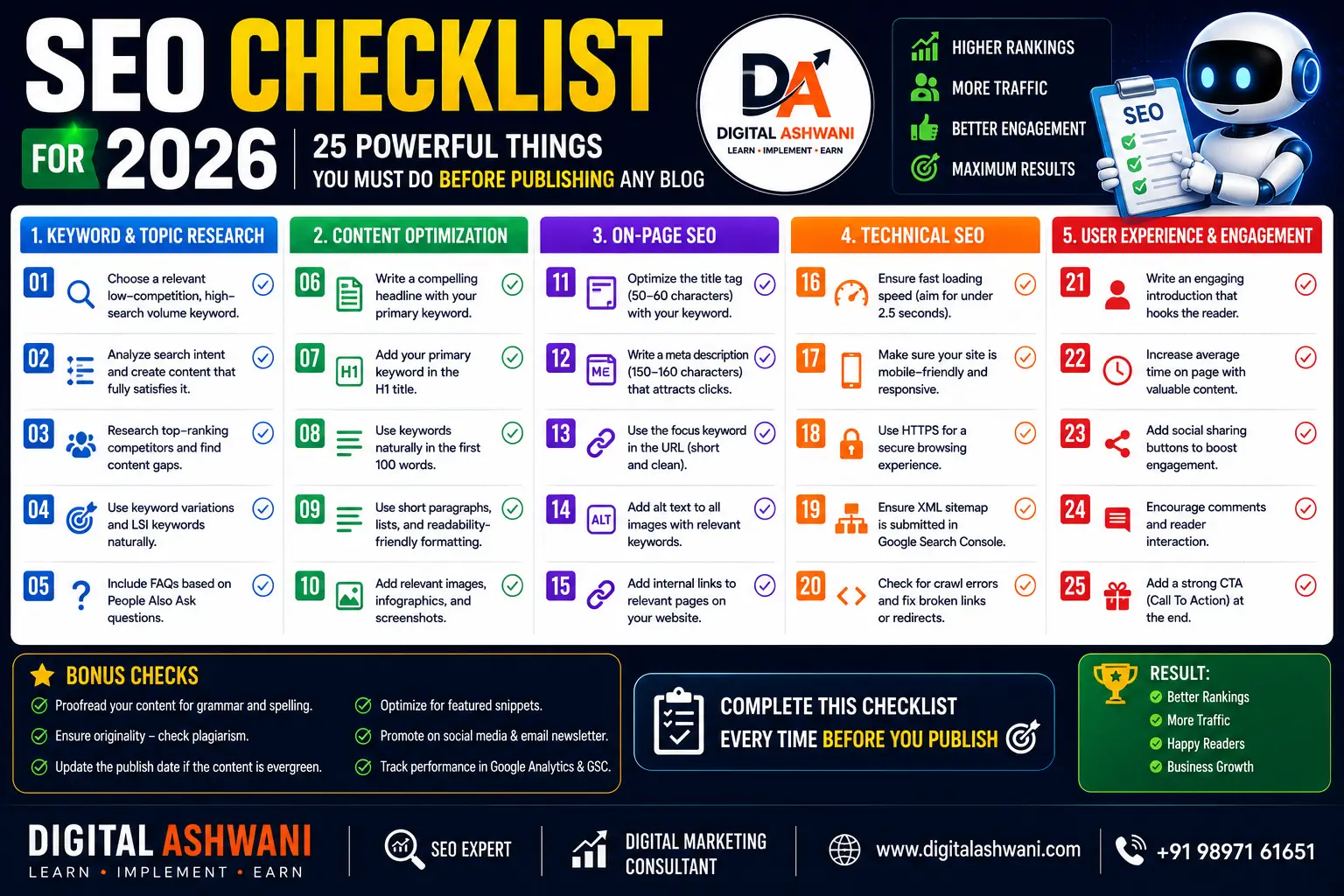
That’s why every blogger, digital marketer, business owner, freelancer, and SEO professional should follow a structured SEO Checklist 2026 before hitting the Publish button.
At Digital Ashwani, we use this checklist before publishing every SEO article. Whether you’re writing a news post, evergreen guide, or affiliate article, these 25 steps can help improve your chances of ranking in Google Search, Google AI Overviews, ChatGPT, Gemini, and other AI-powered search experiences.
Why You Need an SEO Checklist
A consistent SEO process helps you:
- Improve Google rankings
- Reduce SEO mistakes
- Increase organic traffic
- Improve user experience
- Optimize for AI search
- Strengthen EEAT signals
- Publish higher-quality content
Using a checklist ensures that every article meets a consistent quality standard.
The Ultimate SEO Checklist for 2026
1. Choose One Primary Focus Keyword
Every article should target one clear keyword.
Example:
SEO Checklist 2026
2. Understand Search Intent
Before writing, identify whether users want:
- Information
- Products
- Comparisons
- Tutorials
- Reviews
- Services
Matching search intent is one of the biggest ranking factors.
3. Research Secondary Keywords
Include related phrases naturally throughout the article.
Examples:
- Blog SEO Checklist
- On-Page SEO Checklist
- SEO Before Publishing
4. Write a Click-Worthy SEO Title
A good title should include:
- Primary keyword
- Number
- Power word
- Positive sentiment
Example:
SEO Checklist for 2026: 25 Powerful Things You Must Do Before Publishing Any Blog
5. Write an Optimized Meta Description
Include:
- Focus keyword
- User benefit
- Call-to-action
Keep it around 150–160 characters.
6. Create a Short SEO-Friendly URL
Good example:
seo-checklist-2026
Avoid long URLs with unnecessary words.
7. Add the Focus Keyword in the Introduction
Mention the keyword naturally within the first 100 words.
8. Use Proper Heading Structure
Organize content using:
- H1
- H2
- H3
- H4 (when necessary)
This improves readability and helps search engines understand your content.
9. Add a Table of Contents
Long articles become easier to navigate.
A table of contents also improves user experience.
10. Write Helpful, Comprehensive Content
Don’t publish thin articles.
Cover the topic thoroughly and answer common questions.
11. Maintain Natural Keyword Density
Avoid keyword stuffing.
Use your focus keyword naturally throughout the article, along with related terms and synonyms.
12. Optimize Images
Before publishing:
- Compress images
- Use descriptive file names
- Add keyword-rich ALT text
- Choose appropriate dimensions
Images improve engagement and accessibility.
13. Add Internal Links
Link to related articles on your website.
For Digital Ashwani, relevant internal links include:
- AI SEO vs Traditional SEO
- AEO Guide 2026
- Google Ads AI Features 2026
- Digital Marketing Trends 2026
- Google Spam Update 2026
- Keyword Research Guide
- Technical SEO Checklist
Internal links improve topical authority and help users discover more content.
14. Add External Links
Link to authoritative resources where appropriate, such as:
- Google Search Central
- Google Search Console Help
- Google Analytics Help
- Google Ads Help Center
External references improve credibility.
15. Improve Readability
Use:
- Short paragraphs
- Bullet points
- Numbered lists
- Simple language
- Descriptive headings
Readable content keeps visitors engaged.
16. Optimize for EEAT
Demonstrate:
- Experience
- Expertise
- Authoritativeness
- Trustworthiness
Include examples, original insights, and accurate information.
17. Optimize for Featured Snippets
Answer important questions directly before expanding into detailed explanations.
Use definitions, steps, and tables where appropriate.
18. Add FAQ Section
Frequently Asked Questions help address user concerns and support both SEO and Answer Engine Optimization (AEO).
19. Optimize for AI Search
Modern content should also be easy for AI systems to understand.
Focus on:
- Clear structure
- Conversational language
- Semantic relevance
- Topical authority
- Question-and-answer format
20. Check Mobile Friendliness
Ensure your content looks good on smartphones and tablets.
Most users now browse on mobile devices.
21. Improve Page Speed
Fast websites provide a better user experience and can positively influence search performance.
Compress images, minimize unnecessary scripts, and optimize loading times.
22. Review Grammar and Spelling
Proofread every article before publishing.
Clear writing improves credibility and professionalism.
23. Add a Strong Conclusion
Summarize the key takeaways and encourage readers to take the next step, such as exploring related articles or subscribing to your newsletter.
24. Preview the Article
Check how your blog appears on desktop and mobile.
Verify:
- Headings
- Images
- Links
- Formatting
- Tables
25. Perform a Final SEO Audit
Before publishing, confirm:
- Focus keyword is set
- SEO title is optimized
- Meta description is complete
- URL is clean
- Images have ALT text
- Internal links are added
- External links are working
- Content is readable
- No broken links
- Schema (if applicable) is implemented
Only then should you publish your article.
Technical SEO Checklist
Before publishing, ensure:
- HTTPS enabled
- XML sitemap updated
- Robots.txt configured correctly
- Canonical URL set
- No crawl errors
- Core Web Vitals monitored
- Mobile-friendly layout
- Proper indexing settings
Technical SEO supports long-term search visibility.
AI Search Optimization Checklist
As AI-powered search continues to grow, optimize your articles for:
- Google AI Overviews
- ChatGPT
- Gemini
- Perplexity AI
- Microsoft Copilot
Best practices include:
- Answer questions clearly
- Use structured headings
- Build topical authority
- Keep content updated
- Publish original insights
Before You Hit Publish
Ask yourself:
✅ Does this article solve the user’s problem?
✅ Is the information accurate and up to date?
✅ Is the content easy to read?
✅ Have I linked to related articles?
✅ Have I added trusted external references?
✅ Is the article optimized for both search engines and AI search?
If the answer is “yes” to all of the above, your blog is ready to go live.
Frequently Asked Questions
What is an SEO Checklist?
An SEO checklist is a step-by-step list of tasks that helps ensure a webpage is fully optimized before publication.
Why is an SEO checklist important?
It reduces mistakes, improves consistency, enhances user experience, and increases the likelihood of ranking well in search results.
How often should I update my checklist?
Review your checklist regularly to reflect changes in search algorithms, AI search experiences, and industry best practices.
Does this checklist work for AI search too?
Yes. Many of the practices—such as clear structure, topical authority, and helpful answers—support both traditional SEO and AI-powered search.
Can beginners use this checklist?
Absolutely. The checklist is designed for bloggers, marketers, businesses, freelancers, and anyone publishing content online.
Final Thoughts
A well-optimized article doesn’t happen by accident—it follows a repeatable process. By using this SEO Checklist 2026 before publishing every blog, you can reduce common SEO mistakes, improve content quality, and create articles that are better prepared for both traditional search engines and AI-powered search platforms.
Remember, SEO is not about tricking algorithms. It’s about helping users find accurate, useful, and trustworthy information. Combine strong technical SEO, helpful content, thoughtful internal linking, and a focus on user intent, and you’ll build a website that performs well over the long term.
At Digital Ashwani, this checklist forms the foundation of every article we publish. Use it consistently, refine it as search evolves, and you’ll give your content the best possible chance of succeeding in 2026 and beyond.
