

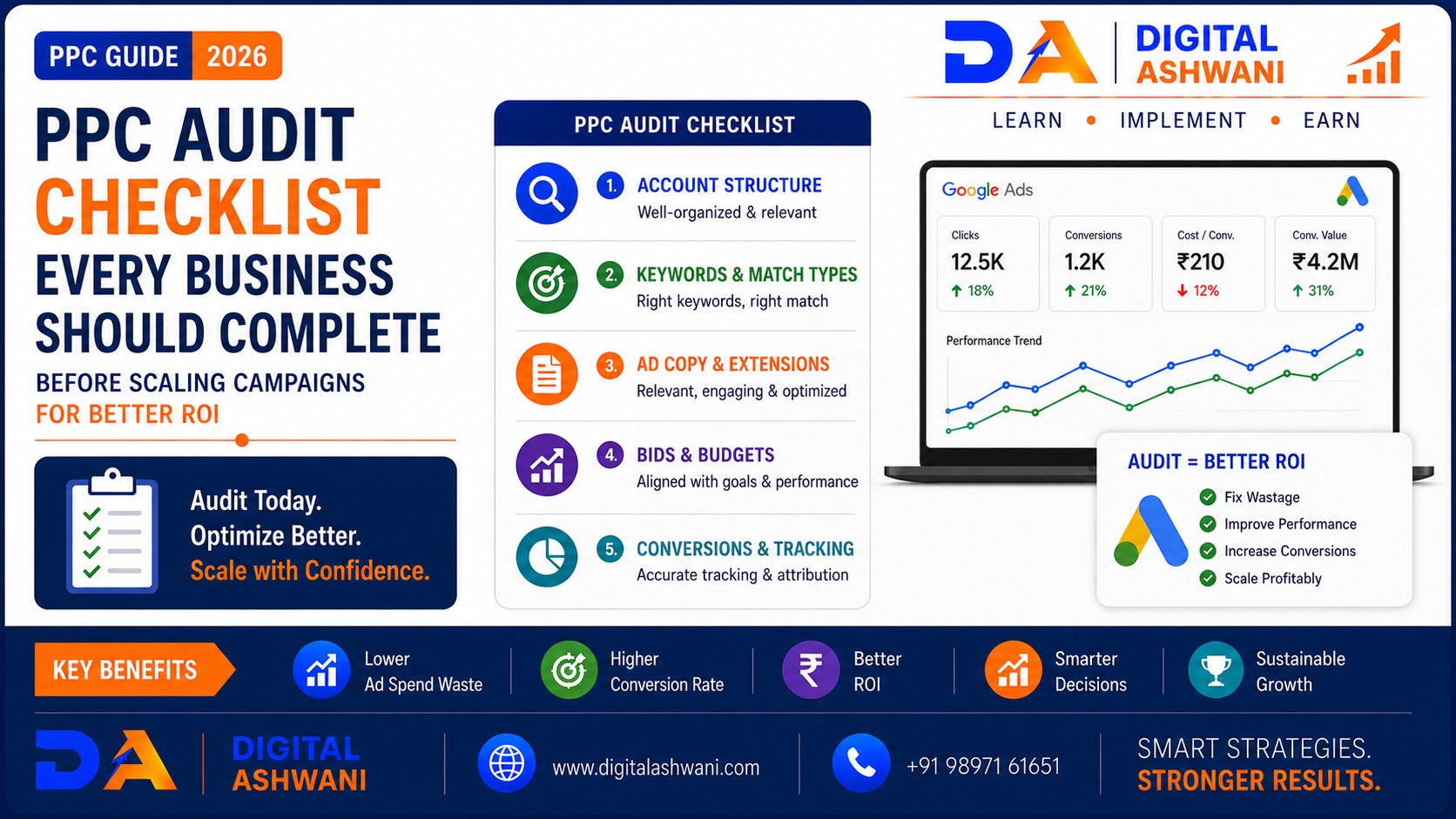
PPC Audit Checklist Every Business Should Complete Before Scaling Campaigns
Scaling a PPC campaign can increase leads, sales, and revenue—but scaling a poorly optimized campaign can also multiply wasted advertising spend.
Many businesses increase their Google Ads or paid advertising budget as soon as they see more clicks or conversions. However, before increasing spend, advertisers should verify whether campaigns are generating profitable and qualified results.
A campaign may appear successful while still having hidden problems such as:
- Incorrect Conversion Tracking
- Irrelevant Search Queries
- Poor-Quality Leads
- Weak Landing Pages
- High-Cost Keywords
- Inefficient Budget Allocation
- Poor Ad Relevance
- Tracking Gaps
- Unprofitable Conversions
This is why conducting a thorough PPC audit before scaling campaigns is essential.
A PPC audit examines the entire advertising funnel—from campaign structure and targeting to conversions, landing pages, lead quality, and business revenue.
In this comprehensive guide by Digital Ashwani, you’ll learn how to audit your PPC campaigns before increasing your advertising budget and how to identify optimization opportunities that can improve efficiency and ROI.
What Is a PPC Audit?
A PPC audit is a systematic review of a paid advertising account to identify:
- Performance Problems
- Wasted Spend
- Tracking Errors
- Targeting Issues
- Conversion Opportunities
- Budget Inefficiencies
- Campaign Structure Problems
The objective is not simply to find what’s wrong.
A good PPC audit should answer:
What’s working?
What’s wasting money?
What should be improved?
What is safe to scale?
Why Audit PPC Campaigns Before Scaling?
Increasing your advertising budget doesn’t automatically increase profitable growth.
If a campaign currently spends ₹50,000 and produces poor-quality leads, increasing the budget to ₹1,00,000 could simply double the waste.
Before scaling, verify:
- Conversion Accuracy
- Lead Quality
- Cost Per Conversion
- Revenue
- Profitability
- Search Intent
- Landing Page Performance
- Campaign Efficiency
Scaling should happen after the campaign foundation is strong enough to support additional investment.
PPC Account Structure Audit
Review Campaign Organization
Check whether campaigns are logically organized around:
- Products
- Services
- Locations
- Customer Segments
- Business Objectives
Avoid unnecessary campaign complexity.
A well-organized account makes performance analysis and budget management easier.
Check Ad Group Relevance
Keywords within an ad group should have a meaningful relationship with the advertisements and landing page.
Poorly grouped keywords can reduce relevance and make optimization more difficult.
Conversion Tracking Audit
Verify Every Important Conversion
One of the most important parts of a PPC audit is checking whether conversions are being recorded correctly.
Review:
- Form Submissions
- Phone Calls
- Purchases
- Appointment Bookings
- Quote Requests
- Lead Forms
- WhatsApp Clicks
- Other Valuable Actions
Make sure important actions aren’t missing from tracking.
Check for Duplicate Conversions
A single customer action should not accidentally be counted multiple times.
Duplicate conversions can make campaign performance appear better than it actually is.
Conversion Quality Audit
Don’t Treat Every Lead as Equal
A campaign may report hundreds of conversions while producing very few genuine customers.
Review:
- Qualified Leads
- Sales-Ready Leads
- Appointments
- Completed Purchases
- Closed Deals
- Customer Revenue
Where possible, connect PPC data with CRM or sales data.
This helps identify campaigns that generate valuable customers, not simply cheap conversions.
Keyword Audit
Review Keyword Performance
Evaluate keywords based on:
- Clicks
- Impressions
- CTR
- CPC
- Conversions
- Conversion Rate
- Cost Per Conversion
- Conversion Value
Identify keywords that consistently spend money without generating meaningful outcomes.
Review Search Intent
Ask:
Does this keyword represent someone who could realistically become my customer?
High traffic isn’t necessarily high-value traffic.
Search Terms Audit
Find Irrelevant Searches
Review actual search queries triggering your advertisements.
Look for searches related to:
- Jobs
- Courses
- Free Services
- Tutorials
- Research
- Unrelated Products
- Informational Intent
Add appropriate negative keywords where necessary.
Search-term analysis is one of the simplest ways to identify wasted PPC spend.
Negative Keyword Audit
Build a Strong Negative Keyword Strategy
Check whether negative keywords are preventing irrelevant traffic.
Create lists where appropriate for recurring irrelevant searches.
For example, a business selling professional services may need to exclude searches related to:
- Jobs
- Careers
- Internships
- Free
- Training
Negative keywords should be based on actual search behavior and business requirements rather than added blindly.
Ad Copy Audit
Review Your Advertising Messages
Evaluate whether advertisements clearly communicate:
- Product or Service
- Main Benefit
- Unique Selling Proposition
- Location
- Offer
- Call-to-Action
Ads should match the user’s search intent.
Check Asset Quality
Review available ad assets such as:
- Sitelinks
- Callouts
- Structured Snippets
- Call Assets
- Location Assets
Use relevant assets where appropriate.
Landing Page Audit
Check Post-Click Experience
A successful PPC campaign doesn’t end with the click.
Review whether the landing page:
- Loads Quickly
- Works on Mobile
- Matches the Advertisement
- Clearly Explains the Offer
- Has a Strong CTA
- Builds Trust
- Makes Conversion Easy
A poor landing page can waste otherwise effective advertising traffic.
Landing Page Conversion Audit
Reduce Conversion Friction
Check:
- Form Length
- CTA Visibility
- Page Layout
- Contact Options
- Mobile Usability
- Trust Signals
- Navigation
Remove unnecessary distractions from conversion-focused landing pages.
Bidding Strategy Audit
Check Whether Your Bidding Strategy Matches Your Goal
Review whether you’re optimizing for:
- Clicks
- Leads
- Sales
- Conversion Value
- Target CPA
- Target ROAS
Your bidding strategy should reflect your actual business objective.
A campaign focused on qualified leads shouldn’t be evaluated solely on click volume.
Budget Allocation Audit
Find Where Your Budget Is Going
Review spending across:
- Campaigns
- Locations
- Devices
- Products
- Services
- Keywords
- Audiences
Identify areas receiving significant spend without producing proportional business value.
At the same time, don’t automatically cut campaigns simply because they have a higher CPC. Evaluate the complete conversion and revenue picture.
Geographic Targeting Audit
Check Where Your Ads Are Showing
For local and regional businesses, location targeting is particularly important.
Review:
- Target Locations
- Excluded Locations
- Location Performance
- Presence vs Interest Settings Where Available
- Local Conversion Data
Make sure your budget isn’t being spent in areas your business doesn’t serve.
Device Performance Audit
Compare Mobile, Desktop, and Other Devices
Review:
- Clicks
- CPC
- Conversion Rate
- Cost Per Conversion
- Lead Quality
- Revenue
A campaign may perform differently across devices.
Don’t make changes based on conversion volume alone. Consider conversion quality and value.
Audience and Remarketing Audit
Review Audience Signals
Where applicable, evaluate:
- Remarketing Audiences
- Customer Lists
- In-Market Audiences
- Website Visitors
- Engaged Users
Make sure audience strategies support your campaign objectives and comply with applicable privacy and advertising requirements.
PPC Performance Audit
Analyze the Right Metrics
Important PPC metrics include:
- Impressions
- Clicks
- CTR
- CPC
- Conversions
- Conversion Rate
- CPA
- Conversion Value
- ROAS
- Revenue
- Profitability
The right metrics depend on your business model.
For lead generation, qualified lead cost may be more useful than raw conversion volume.
For eCommerce, profit and conversion value may be more meaningful than clicks.
Check Attribution and Measurement
Understand Where Conversions Come From
Review your analytics and attribution setup to understand how users move from advertisement to conversion.
Check for:
- Tracking Gaps
- Attribution Issues
- Cross-Domain Problems
- Missing UTM Parameters
- Incorrect Conversion Sources
Accurate measurement is essential before scaling.
PPC Profitability Audit
Look Beyond ROAS
A campaign can show a strong ROAS and still be less profitable than expected if margins are low.
Consider:
- Revenue
- Product Margin
- Customer Acquisition Cost
- Average Customer Value
- Repeat Purchases
- Sales Costs
For lead generation, connect advertising spend to actual closed revenue whenever possible.
PPC Scaling Readiness Checklist
Before increasing your budget, verify:
- Conversion Tracking Accurate
- No Major Tracking Errors
- Lead Quality Verified
- Search Terms Reviewed
- Negative Keywords Updated
- Ads Relevant
- Landing Pages Optimized
- Bidding Strategy Appropriate
- Budget Allocation Reviewed
- Geographic Targeting Correct
- Device Performance Reviewed
- Audience Strategy Evaluated
- Revenue Data Connected Where Possible
- Profitability Understood
- Scaling Goal Clearly Defined
When Should You Scale a PPC Campaign?
Scale When Performance Is Consistent
Consider scaling when:
- Conversions Are Consistent
- Tracking Is Reliable
- Lead Quality Is Strong
- Acquisition Costs Are Sustainable
- Landing Pages Convert
- Campaign Data Is Stable
- Additional Demand Exists
Don’t scale simply because one week produced unusually strong results.
Look for repeatable performance.
How to Scale PPC Campaigns Safely
Increase Gradually
Large budget changes can affect campaign behavior.
Consider gradual increases while monitoring:
- Conversion Volume
- CPA
- ROAS
- Lead Quality
- Search Terms
- Impression Share
- Revenue
Scaling should be treated as a controlled experiment rather than a one-time budget increase.
Common PPC Audit Mistakes
Auditing Only Keywords
PPC performance depends on the entire funnel.
Ignoring Conversion Tracking
Incorrect data can make every other optimization decision unreliable.
Focusing Only on CPC
A high CPC can still be profitable if it generates valuable customers.
Scaling Based on Clicks
More traffic doesn’t automatically mean more revenue.
Ignoring Sales Data
For lead-generation businesses, closed deals provide a better picture of PPC effectiveness than raw leads.
Making Too Many Changes at Once
If everything changes simultaneously, it becomes difficult to identify what actually improved performance.
PPC Audit Checklist
| Audit Area | What to Check |
|---|---|
| Account Structure | Campaign and ad group organization |
| Conversion Tracking | Accuracy and duplicate conversions |
| Keywords | Relevance and performance |
| Search Terms | Intent and irrelevant queries |
| Negative Keywords | Wasted traffic prevention |
| Ads | Relevance and messaging |
| Landing Pages | UX and conversion performance |
| Bidding | Goal alignment |
| Budget | Spending efficiency |
| Locations | Geographic relevance |
| Devices | Performance differences |
| Audiences | Targeting and remarketing |
| Attribution | Measurement accuracy |
| Lead Quality | Qualified prospects |
| Profitability | Revenue and business value |
Internal Linking Suggestions (Digital Ashwani)
Strengthen the PPC and Google Ads content cluster by linking this article with:
- Best Google Search Campaign Bidding Strategies Explained
- Complete Google Search Ads Campaign Setup Guide for Better Lead Generation
- How Artificial Intelligence Is Changing Google Ads Campaign Optimization
- What Is Cost Per Click (CPC)? Powerful Ways to Reduce CPC and Improve ROI
- Google Ads Strategy for Doctors to Increase Patient Appointments
- Facebook Lead Ads Strategy That Converts Visitors Into Paying Customers
- Website Conversion Rate Optimization Guide
- How Google Analytics 4 Tracks Website Visitors and User Behavior
These links create a stronger topical cluster around PPC auditing, Google Ads, AI optimization, conversion tracking, analytics, and lead generation.
External Resources
For current advertising and analytics guidance, refer to:
- Google Ads Help
- Google Ads Policies
- Google Analytics Help
- Google Search Central
Always review the latest platform documentation because advertising features, reporting, and policies can change.
Frequently Asked Questions
What is a PPC audit?
A PPC audit is a systematic review of a paid advertising account to identify wasted spend, tracking issues, targeting problems, optimization opportunities, and campaign performance gaps.
Why should I audit PPC campaigns before scaling?
An audit helps ensure you’re scaling profitable and repeatable performance rather than increasing spending on campaigns with hidden inefficiencies.
How often should PPC campaigns be audited?
A detailed audit can be performed periodically, while important areas such as search terms, conversion tracking, budgets, and lead quality should be monitored regularly.
What should I check first in a PPC audit?
Start with conversion tracking and business outcomes. If the underlying data is inaccurate, other campaign metrics can be misleading.
Can a PPC audit reduce advertising costs?
It can identify wasted spend, irrelevant searches, inefficient targeting, poor-performing keywords, and conversion problems that may create opportunities to improve efficiency.
Final Thoughts
A thorough PPC Audit Checklist helps businesses determine whether their advertising campaigns are genuinely ready for growth.
Before increasing budgets, audit the entire customer journey:
Ad → Click → Landing Page → Conversion → Qualified Lead → Sale → Revenue
Don’t scale based on clicks or cheap conversions alone.
Verify your tracking, search intent, lead quality, landing pages, bidding strategy, budget allocation, geographic targeting, and profitability first.
Once the fundamentals are strong and performance is repeatable, gradual scaling becomes much more predictable.
The goal isn’t simply to spend more on PPC.
The goal is to scale profitable customer acquisition.
At Digital Ashwani, we regularly publish practical guides on Google Ads, PPC, SEO, AI Marketing, Conversion Optimization, Analytics, and Digital Marketing to help businesses improve advertising performance and achieve sustainable growth.
