

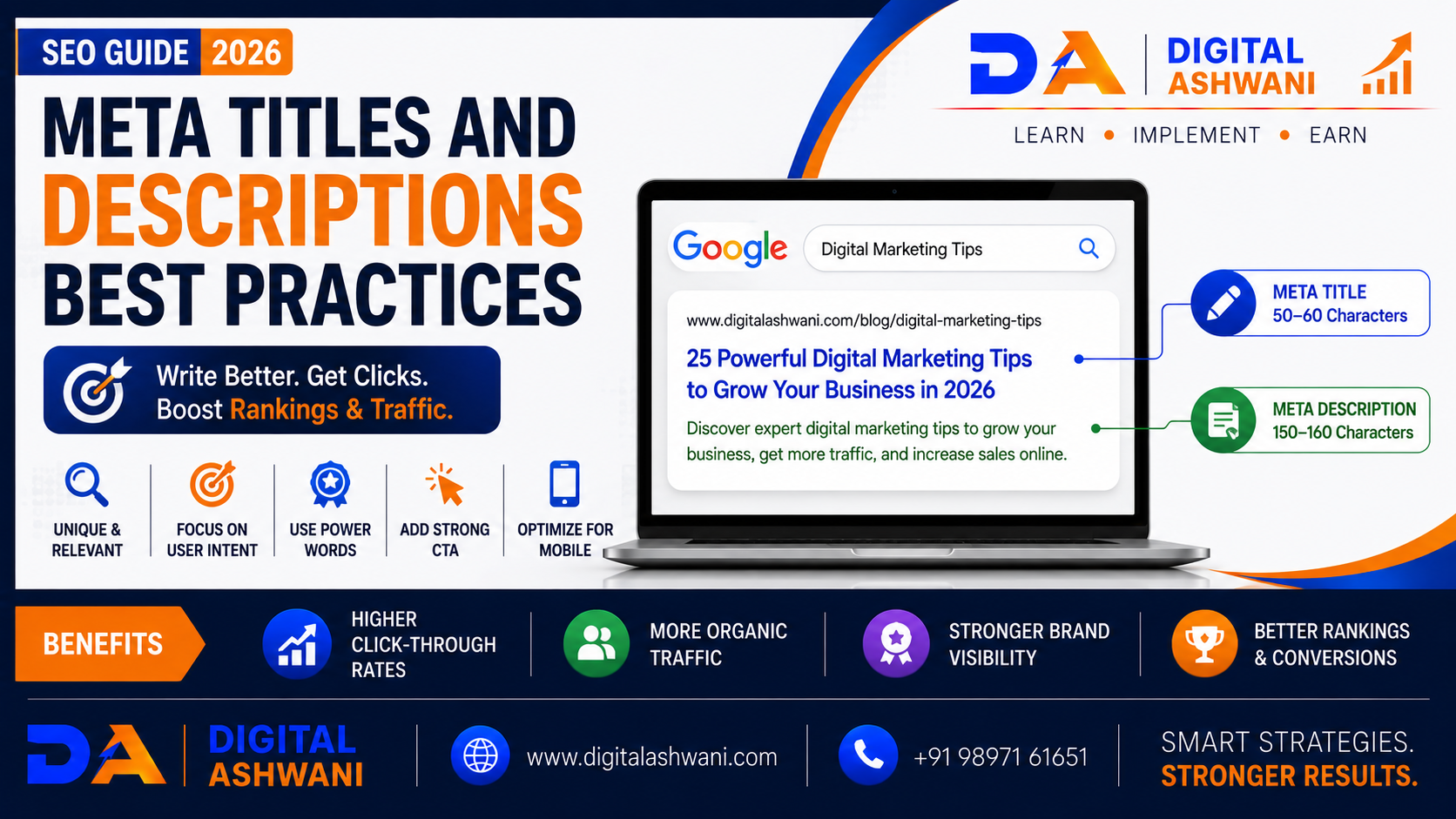
Meta Titles and Descriptions Best Practices for Higher Click-Through Rates
Getting a webpage to rank on Google is only part of SEO success. Even when your page appears on the first page, users still need a reason to click your result.
This is where meta titles and meta descriptions become important.
A compelling SEO title tells searchers what your page offers, while a well-written meta description provides additional context and encourages users to visit your website.
Effective metadata is not simply about adding keywords. Search intent, relevance, clarity, uniqueness, branding, and user appeal all influence how your search result competes for attention.
With Google Search becoming increasingly dynamic through AI-powered features, rich results, featured snippets, and changing SERP layouts, businesses need metadata that is useful for both search engines and people.
In this comprehensive guide by Digital Ashwani, you’ll learn the most important Meta Titles and Descriptions Best Practices for improving organic CTR, attracting qualified visitors, and creating stronger search results.
What Are Meta Titles?
A meta title, technically represented by the HTML <title> element, is the title search engines may display for a webpage in search results.
It can also appear in:
- Browser Tabs
- Bookmarks
- Shared Links
- Search Engine Results
A strong title helps users quickly understand what a webpage is about.
What Are Meta Descriptions?
A meta description is a short summary describing the content of a webpage.
Search engines may display it below the title in search results, although Google can generate a different snippet when another section of the page better matches the user’s query.
A useful description should clearly communicate:
- What the page covers
- Who it is for
- What users can expect
Why Meta Titles and Descriptions Matter
Well-written metadata can help:
- Improve Organic CTR
- Communicate Search Intent
- Attract Qualified Traffic
- Improve SERP Visibility
- Strengthen User Experience
- Support SEO Performance
Your title and description are often the first impression users have of your webpage in search results.
How Meta Titles and Descriptions Influence CTR
Imagine two search results:
Result A:
SEO Services | Company Name
Result B:
SEO Services for Small Businesses: Strategies to Grow Online
The second title provides more context and communicates a clearer benefit.
A relevant and compelling result may attract more clicks from the same search visibility.
However, CTR should not be treated as a direct Google ranking factor. The primary objective is to create accurate, useful search snippets that encourage the right users to visit your page.
Best Practices for Meta Titles
1. Match Search Intent
Understand What Users Are Looking For
Before writing a title, determine whether the searcher wants:
- Information
- A Product
- A Service
- A Comparison
- A Tutorial
- A Local Business
Your title should clearly match that intent.
2. Use the Primary Keyword Naturally
Avoid Keyword Stuffing
Include your primary keyword where it fits naturally.
For example:
Poor:
SEO SEO Services SEO Company SEO Agency SEO
Better:
SEO Services for Small Businesses: Complete Beginner's Guide
Write for people first and search engines second.
3. Keep Titles Clear and Concise
Communicate the Main Topic Quickly
Avoid unnecessary words and repetition.
A user should understand the page topic immediately after reading the title.
Search engines may truncate titles depending on available display width, so concise titles are generally easier to scan.
4. Make Every Title Unique
Avoid Duplicate Titles
Every important webpage should have a distinctive title.
For example:
/seo-services/local-seo-services/technical-seo-services
should not all use exactly the same title.
Unique titles help search engines and users understand the difference between pages.
5. Highlight the Main Benefit
Tell Users Why They Should Click
Instead of:
Digital Marketing Services
consider:
Digital Marketing Services to Generate More Leads Online
The second version communicates a clearer benefit.
6. Use Numbers When They Add Genuine Value
Make Content Specific
Numbers can make titles more attractive when they accurately represent the content.
Examples:
7 Local SEO Mistakes to AvoidSEO Checklist for Small BusinessesComplete Google Ads Guide for Beginners
Do not add numbers simply for SEO.
7. Use Relevant Power Words
Make Titles More Compelling
Useful words include:
- Complete
- Practical
- Proven
- Essential
- Effective
- Beginner-Friendly
Only use them when they accurately describe the content.
Best Practices for Meta Descriptions
1. Clearly Summarize the Page
Explain What Users Will Learn
A good description should answer:
What will I get if I click this result?
Keep the message specific and relevant.
2. Include the Primary Keyword Naturally
Improve Relevance
Include your focus keyword where it fits naturally.
Google may bold matching words in search snippets, which can make relevant terms more noticeable.
3. Focus on User Benefits
Give Users a Reason to Visit
Mention useful outcomes such as:
- Learn SEO Strategies
- Generate More Leads
- Improve Rankings
- Increase Website Traffic
- Improve Conversions
Benefits make descriptions more persuasive.
4. Add a Natural Call-to-Action
Encourage the Next Step
Examples include:
- Learn More
- Discover the Strategies
- Read the Complete Guide
- Explore the Tips
- Get Started
Keep CTAs natural rather than overly promotional.
5. Avoid Duplicate Descriptions
Create Unique Metadata
Important pages should have their own relevant descriptions.
Avoid using the same generic description across your entire website.
6. Match the Page Content
Never Mislead Searchers
Your description should accurately represent the content.
If users click expecting one thing and find something completely different, trust and engagement can suffer.
Meta Title and Description Examples
| Page Type | Example Meta Title | Example Meta Description |
|---|---|---|
| SEO Guide | SEO Guide for Beginners: How to Improve Google Rankings | Learn essential SEO strategies for beginners, including keyword research, on-page SEO, technical SEO, and link building. |
| Local SEO | Local SEO Guide: How to Rank Higher on Google Maps | Discover practical Local SEO strategies to improve Google Maps visibility, attract local customers, and generate more enquiries. |
| Google Ads | Google Ads Guide for Small Businesses | Learn how to create effective Google Ads campaigns, choose keywords, track conversions, and generate qualified leads. |
| Digital Marketing | Digital Marketing Guide for Businesses | Explore SEO, Google Ads, social media, content marketing, email marketing, and other strategies for growing your business online. |
Common Meta Title and Description Mistakes
Keyword Stuffing
Adding the same keyword repeatedly makes metadata unnatural.
Use keywords naturally.
Using the Same Metadata Everywhere
Every important page should have unique metadata relevant to its content.
Writing Clickbait Titles
Avoid misleading claims simply to increase clicks.
Your title should accurately represent the page.
Ignoring Search Intent
A title that doesn’t match what users are searching for may receive fewer qualified clicks.
Writing Extremely Long Titles
Excessively long titles may be truncated in search results.
Keep them concise and focused.
Ignoring Mobile Users
Search snippets can appear differently across devices.
Make sure the most important information appears early in the title.
Internal Linking Suggestions (Digital Ashwani)
Strengthen this SEO content cluster by linking this article with:
- Top On-Page SEO Techniques to Improve Rankings and Organic Website Traffic
- How Search Engines Crawl, Index, and Rank Websites for Better Visibility in 2026
- Building Topical Authority Through Strategic Content Clusters and Internal Linking
- What Is E-E-A-T and Why Is It Important for Modern SEO?
- How AI Is Transforming Modern SEO Strategies for Business Growth
- What Is Organic Reach?
- Why Organic Traffic Is Dropping Even When Rankings Stay the Same
- SEO Checklist for 2026
- Keyword Research Guide
- Website Conversion Rate Optimization Guide
These internal links strengthen topical authority and help readers explore related SEO strategies.
Frequently Asked Questions
What is a meta title in SEO?
A meta title is the HTML <title> element that identifies a webpage and is often displayed as the clickable headline in search results.
What is a meta description?
A meta description is a short summary of a webpage that search engines may display beneath the title in search results.
Does a meta description directly improve Google rankings?
No. Meta descriptions are not a direct Google ranking factor. However, a useful and compelling description can help improve the likelihood that relevant users click your search result.
How long should a meta title be?
There is no fixed character limit that guarantees proper display because Google generally truncates titles based on available display width. Focus on keeping the title concise, descriptive, and placing the most important information early.
How long should a meta description be?
There is no guaranteed character limit because Google may rewrite or truncate snippets based on the search query and device. Focus on writing a concise, useful summary rather than targeting an exact character count.
Final Thoughts
Strong Meta Titles and Descriptions Best Practices are essential for creating search results that attract the right audience. A good title communicates the page topic and search intent, while a useful description provides additional context and encourages qualified users to click.
The goal should not be to manipulate search engines or chase an arbitrary character count. Instead, create unique, accurate, concise, benefit-focused metadata that genuinely represents your webpage.
When combined with strong content, technical SEO, search-intent optimization, and a well-structured website, effective metadata can help your pages stand out in increasingly competitive search results.
At Digital Ashwani, we regularly publish practical guides on SEO, AI Search, Google Ads, Local SEO, Social Media Marketing, Content Marketing, and Digital Marketing to help businesses improve their online visibility and generate sustainable growth.
