

Traditional SEO is no longer the only way people discover information online. Millions of users now ask questions directly to AI assistants instead of typing keywords into search engines.
Platforms like ChatGPT, Google AI Search, Gemini, Perplexity AI, and Microsoft Copilot are changing how content is found and recommended.
Because of this shift, website owners, bloggers, SEO professionals, and businesses are asking an important question:
“How can I rank in ChatGPT Search Results?”
The answer isn’t about tricks or secret algorithms. It requires creating trustworthy, helpful, well-structured content that AI systems can understand and reference.
In this complete guide by Digital Ashwani, you’ll learn exactly how to optimize your website for ChatGPT Search Results, improve your visibility in AI-powered search, and prepare for the future of SEO.
What are ChatGPT Search Results?
ChatGPT Search Results refer to the information and website references that may appear when ChatGPT answers user questions, particularly when it has access to web browsing or current online information.
Unlike traditional Google Search, AI systems aim to provide direct, conversational answers instead of only displaying a list of links.
This makes content quality, clarity, and authority even more important.
How ChatGPT Finds Information
AI systems evaluate many signals, including:
- Helpful content
- Website authority
- Content freshness
- Clear structure
- User intent
- Trusted sources
- Semantic relevance
- Publicly accessible web pages
Rather than focusing only on keywords, AI tries to understand the meaning behind content.
Can Websites Rank in ChatGPT?
Yes.
Although ChatGPT doesn’t publish a traditional ranking algorithm like search engines, websites that consistently publish high-quality, authoritative, and well-organized content are more likely to be referenced in AI-generated responses.
Think of it as earning trust instead of chasing rankings.
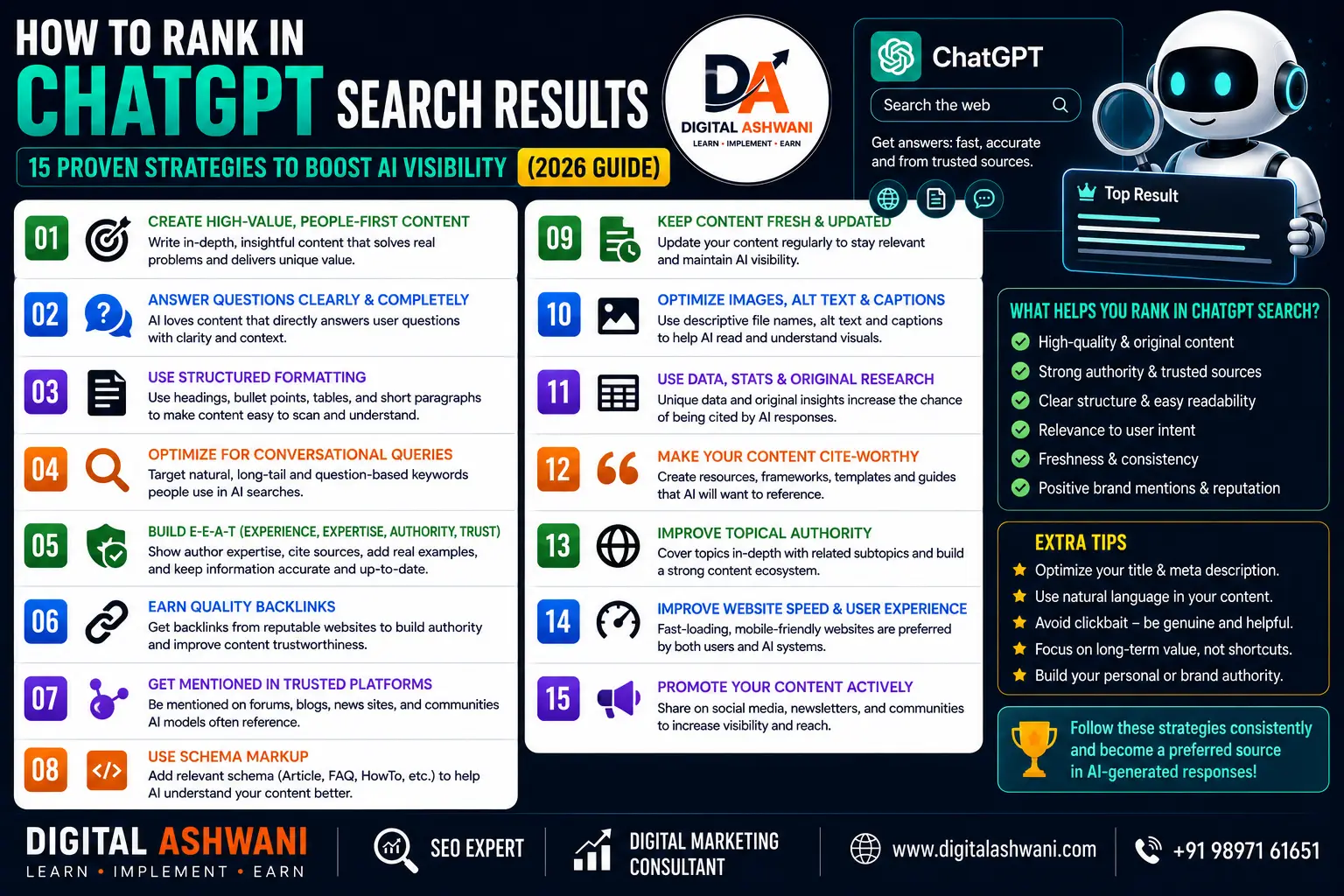
15 Proven Ways to Rank in ChatGPT Search Results
1. Publish Helpful Content
Create articles that solve real problems.
Answer actual user questions instead of writing only for search engines.
2. Build Topical Authority
Instead of writing one article about SEO, create an entire content cluster.
Example:
- SEO Checklist
- Technical SEO
- Keyword Research
- Google Updates
- AI SEO
- ChatGPT SEO
- AEO Guide
Topic clusters help AI understand your expertise.
3. Focus on Search Intent
Every article should satisfy one clear user intent.
Examples include:
- Informational
- Commercial
- Transactional
- Navigational
4. Optimize for AEO
Answer Engine Optimization (AEO) is becoming essential.
Use:
- FAQs
- Clear answers
- Question-based headings
- Structured formatting
- Simple language
5. Demonstrate EEAT
Show:
- Experience
- Expertise
- Authoritativeness
- Trustworthiness
Publish original insights, practical examples, and accurate information.
6. Write Comprehensive Guides
AI systems often prefer detailed resources that fully answer a topic rather than thin articles.
Aim to cover:
- Definitions
- Benefits
- Examples
- Best practices
- FAQs
- Common mistakes
7. Use Clear Heading Structure
Organize articles using:
- H1
- H2
- H3
This improves readability for both users and AI systems.
8. Keep Content Updated
Refresh evergreen articles regularly.
Update:
- Statistics
- Screenshots
- Examples
- Industry trends
- Google updates
Fresh content remains more relevant.
9. Add Internal Links
Connect related articles throughout your website.
This helps users and AI understand relationships between topics.
10. Link to Trusted Sources
Support important claims using official documentation and reputable sources.
Credible references strengthen trust.
11. Improve Readability
Write:
- Short paragraphs
- Bullet points
- Numbered lists
- Simple explanations
Easy-to-read content benefits both humans and AI.
12. Optimize Technical SEO
Ensure your website is:
- Fast
- Mobile-friendly
- Secure (HTTPS)
- Crawlable
- Easy to navigate
Strong technical SEO supports discoverability.
13. Add FAQ Sections
Frequently Asked Questions provide concise answers that AI systems can easily understand and reference.
14. Build Brand Authority
Publish consistently.
Share expertise through:
- Case studies
- Research
- Tutorials
- Original insights
Strong brands are more likely to be recognized across AI platforms.
15. Create Original Content
Avoid copying competitors.
Unique research, opinions, examples, and real experiences increase your credibility and long-term visibility.
Common Mistakes That Prevent ChatGPT Visibility
Avoid:
- Keyword stuffing
- Thin content
- Duplicate articles
- Misleading titles
- Poor formatting
- Outdated information
- Broken links
- Ignoring user intent
High-quality content consistently outperforms shortcuts.
ChatGPT SEO vs Traditional SEO
| Traditional SEO | ChatGPT SEO |
|---|---|
| Focuses on keyword rankings | Focuses on helpful answers |
| Optimizes for search engines | Optimizes for AI understanding |
| Link-based discovery | Context-based discovery |
| SERP visibility | AI-generated visibility |
| Search intent | Conversational intent |
The best strategy combines both approaches.
Future of AI Search
AI-powered search will continue to evolve.
Website owners should prepare by:
- Building topical authority
- Publishing expert content
- Optimizing for AEO
- Improving technical SEO
- Updating content regularly
- Creating helpful resources
Businesses that adapt early will have a competitive advantage.
Internal Linking Suggestions (Digital Ashwani)
Strengthen your AI SEO content cluster by linking this article with:
- AI SEO vs Traditional SEO
- How AI Is Changing Google Search & Digital Marketing
- Google Marketing Live 2026
- Google Ads AI Features 2026
- Top Digital Marketing Trends in 2026
- SEO Checklist 2026
- Best AI Tools for Digital Marketing
- Cloudflare AI Crawler Blocking
External Resources
Recommended official resources:
- OpenAI Documentation
- Google Search Central
- Google AI
- Google Search Central Blog
- Bing Webmaster Guidelines
Always follow official guidance as AI-powered search continues to evolve.
Frequently Asked Questions
Can my website rank in ChatGPT Search Results?
Yes. Websites with helpful, trustworthy, and well-structured content are more likely to be referenced by AI-powered systems.
Is ChatGPT SEO different from traditional SEO?
Yes. Traditional SEO focuses on search engine rankings, while ChatGPT SEO emphasizes creating content that AI systems can easily understand and use in responses.
What is AEO?
Answer Engine Optimization (AEO) is the practice of optimizing content so AI assistants and answer engines can provide it as a direct response to user questions.
Does keyword density still matter?
Keywords remain useful for context, but natural language, topical authority, and content quality are more important than repeating a keyword excessively.
Will AI replace SEO?
No. AI is changing SEO, not replacing it. Future success will come from combining traditional SEO, AEO, and high-quality content.
Final Thoughts
The rise of AI-powered search is transforming how people discover information online. Learning how to rank in ChatGPT Search Results is no longer optional for businesses that want long-term visibility.
Instead of chasing loopholes, focus on creating content that genuinely helps users, demonstrates expertise, and answers questions clearly. Combine traditional SEO with AEO, technical optimization, and topical authority to build a website that performs well across both search engines and AI assistants.
As AI continues to evolve, websites that consistently publish trustworthy, original, and user-focused content will have the greatest opportunity to appear in AI-generated responses.
At Digital Ashwani, we regularly publish practical guides on AI SEO, Google updates, Answer Engine Optimization, and digital marketing to help you stay ahead of the future of search.
