

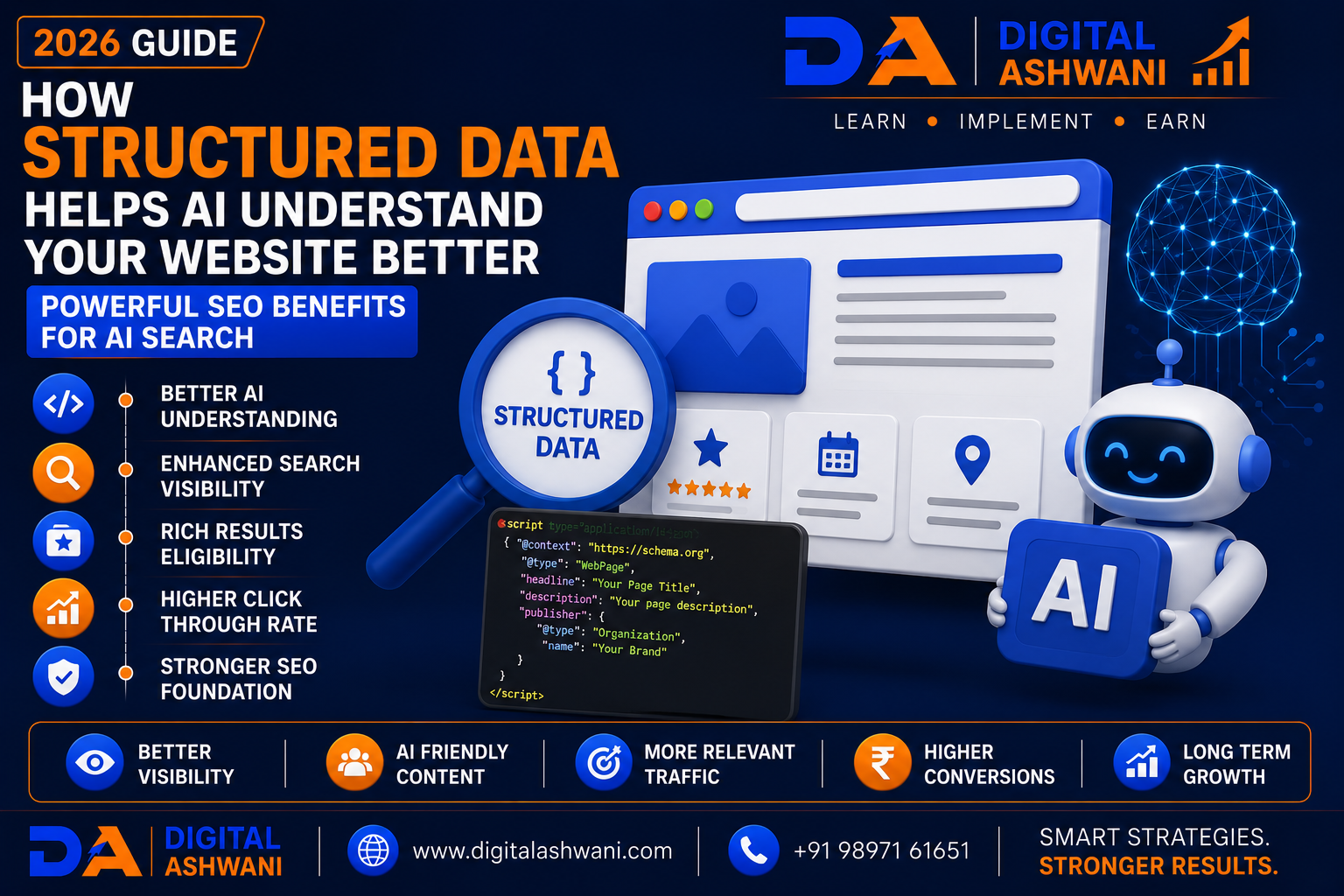
How Structured Data Helps AI Understand Your Website Better
Artificial Intelligence is changing the way search engines discover, interpret, and present website content. Instead of relying only on keywords, modern AI-powered search systems analyze context, relationships between entities, user intent, and structured information to generate accurate search results and AI-generated answers.
One of the most effective ways to help AI understand your website is by implementing Structured Data, also known as Schema Markup.
Structured data provides search engines with clear information about your pages, products, services, articles, FAQs, organizations, events, reviews, and many other types of content. This additional context helps Google and other AI-powered search systems interpret your website more accurately.
Whether you manage a business website, eCommerce store, blog, educational platform, healthcare website, or local business, structured data can improve your visibility in traditional search as well as AI-powered search experiences.
In this comprehensive guide by Digital Ashwani, you’ll learn 15 powerful ways structured data helps AI understand your website better, along with practical implementation strategies and SEO best practices for 2026.
What Is Structured Data?
Structured data is standardized code added to webpages that helps search engines understand the meaning of your content.
Instead of simply reading text, search engines can identify information such as:
- Business Name
- Products
- Services
- Articles
- Reviews
- Authors
- Events
- FAQs
Most websites implement structured data using Schema.org vocabulary in JSON-LD format.
Why AI Uses Structured Data
AI systems process enormous amounts of information every second.
Structured data helps AI:
- Understand Context
- Identify Entities
- Connect Related Information
- Improve Accuracy
- Reduce Ambiguity
- Generate Better Search Results
This additional context improves both traditional SEO and AI-powered search experiences.
Benefits of Structured Data
Proper implementation can help:
- Improve AI Understanding
- Increase Rich Results Eligibility
- Strengthen Technical SEO
- Improve Click-Through Rates
- Enhance Website Visibility
- Build Trust Signals
- Support Knowledge Graph Recognition
- Improve User Experience
15 Powerful Ways Structured Data Helps AI
1. Helps AI Understand Website Content
Schema provides explicit information about your pages.
Instead of guessing page intent, AI can more accurately identify:
- Articles
- Products
- Services
- Organizations
- FAQs
- Events
Clear context improves interpretation.
2. Improves Rich Results Eligibility
Structured data may help eligible pages appear with enhanced search features such as:
- FAQ Results
- Review Snippets
- Product Information
- Recipe Results
- Event Listings
Rich results can improve search visibility.
3. Strengthens Entity Recognition
Schema helps search engines understand important entities including:
- Business Name
- Brand
- Author
- Product
- Organization
- Location
Better entity recognition supports AI-generated search experiences.
4. Supports AI Overviews
AI-powered search systems rely on multiple signals when generating summaries.
Well-structured content combined with appropriate schema can make information easier for AI systems to interpret.
5. Improves Local SEO
Local businesses benefit from structured information including:
- Business Address
- Phone Number
- Opening Hours
- Service Area
- Reviews
- Business Category
This helps search engines understand local business information more accurately.
6. Organizes Website Information
Schema connects related content across your website.
Examples include:
- Articles linked to Authors
- Products linked to Brands
- Services linked to Organizations
These relationships improve content understanding.
7. Supports Better Knowledge Graph Connections
Structured data helps search engines associate your business with relevant topics, products, services, and people.
This contributes to stronger entity relationships across the web.
8. Improves Content Classification
Schema helps AI classify webpages more accurately into categories such as:
- Blog Articles
- Product Pages
- Service Pages
- FAQ Pages
- Local Business Pages
- Organization Pages
Accurate classification supports better indexing and retrieval.
9. Use JSON-LD for Schema Implementation
JSON-LD is Google’s recommended format for implementing structured data.
Benefits include:
- Easy to Maintain
- Cleaner Website Code
- Better Compatibility
- Simplified Updates
- Improved Readability
Whenever possible, implement Schema Markup using JSON-LD instead of older formats.
10. Validate Your Structured Data
After adding schema, always test it to ensure there are no errors.
Regular validation helps you:
- Detect Missing Properties
- Fix Syntax Errors
- Verify Rich Result Eligibility
- Improve Data Quality
- Maintain Accurate Markup
Testing your schema reduces the likelihood of implementation issues affecting search visibility.
11. Keep Structured Data Updated
Outdated schema can confuse both users and search engines.
Update structured data whenever you:
- Publish New Articles
- Add New Products
- Change Business Information
- Update Services
- Modify Contact Details
- Revise FAQs
Accurate structured data helps AI interpret your website correctly.
12. Match Schema to Visible Content
Structured data should accurately reflect what users can see on the page.
For example:
- Product schema should describe the displayed product.
- FAQ schema should match visible questions and answers.
- Organization schema should reflect your actual business information.
Avoid adding markup for information that does not appear on the page.
13. Combine Schema with High-Quality Content
Schema enhances understanding—it does not replace quality content.
Continue creating:
- Helpful Articles
- Original Research
- Case Studies
- Detailed Service Pages
- Comprehensive Product Information
- Clear FAQs
The strongest SEO results come from combining structured data with valuable, user-focused content.
14. Monitor Structured Data Performance
Review your technical SEO regularly.
Monitor:
- Rich Result Eligibility
- Search Performance
- Click-Through Rate (CTR)
- Indexed Pages
- Search Console Enhancements
- Crawl Health
Ongoing monitoring helps identify opportunities for improvement.
15. Prepare for the Future of AI Search
AI-powered search continues to evolve.
Businesses should focus on:
- Accurate Schema Markup
- Strong Technical SEO
- Entity-Based Optimization
- EEAT Signals
- Internal Linking
- Helpful Content
- Consistent Website Maintenance
These practices help websites remain understandable to both search engines and AI systems.
Structured Data SEO Checklist
Before publishing your pages, verify the following:
- Appropriate Schema Selected
- JSON-LD Implemented
- Required Properties Completed
- Schema Matches Visible Content
- Business Information Updated
- FAQ Schema Verified
- Organization Schema Added
- Rich Result Testing Completed
- Search Console Reviewed
- Regular Schema Audits Scheduled
This checklist helps maintain accurate and effective structured data across your website.
Common Structured Data Mistakes
Using the Wrong Schema Type
Choose the schema type that accurately represents your page rather than applying generic markup everywhere.
Adding Schema That Doesn’t Match the Content
Structured data should always reflect the visible information users see on the page.
Ignoring Validation Errors
Even small implementation errors can reduce the effectiveness of structured data.
Review validation results after every major update.
Forgetting to Update Business Information
Changes to addresses, phone numbers, services, pricing, or opening hours should also be reflected in your schema.
Expecting Instant Ranking Improvements
Structured data helps search engines understand your content, but rankings also depend on content quality, relevance, authority, technical SEO, and user experience.
Internal Linking Suggestions (Digital Ashwani)
Strengthen your AI SEO and technical SEO content cluster by linking this article with:
- AI SEO: How Artificial Intelligence Can Improve Your Search Engine Rankings
- How Search Engines Crawl, Index, and Rank Websites for Better Visibility
- What Is Local SEO and Why Is It Important for Small Businesses?
- What Is Artificial Intelligence (AI) in Digital Marketing?
- Why Organic Traffic Is Dropping Even When Rankings Stay the Same
- How to Rank in ChatGPT, Gemini & AI Search Results (AEO Guide)
- Complete Technical SEO Guide for Better Website Performance
- SEO Checklist for 2026: Things You Must Do Before Publishing Any Blog
- Ultimate Analytics and Tracking Guide for Long-Term Business Growth
- What Is Google Search Console and How to Use It Effectively?
These internal links strengthen topical authority while helping readers explore related AI SEO, technical SEO, structured data, analytics, and search optimization topics.
External Resources
For trusted structured data guidance, explore:
- Schema.org Documentation
- Google Search Central
- Google Search Console Help
- Google Rich Results Test
- Google Search Central Documentation
These official resources provide current recommendations for Schema Markup, structured data implementation, validation, and technical SEO.
Frequently Asked Questions
What is structured data in SEO?
Structured data is standardized code (commonly using Schema.org vocabulary in JSON-LD format) that helps search engines better understand the content and meaning of webpages.
Does structured data improve SEO rankings?
Structured data is not a direct ranking factor, but it can improve how search engines understand your content and may increase eligibility for rich results, which can enhance visibility and click-through rates.
Why is JSON-LD recommended for Schema Markup?
JSON-LD is Google’s preferred implementation format because it is easier to maintain, separates structured data from page content, and simplifies updates.
Can structured data help AI-powered search?
Yes. Structured data provides explicit context about entities, products, services, organizations, and content, making it easier for AI-powered search systems to interpret your website accurately.
Should every webpage include structured data?
Where appropriate, yes. Different page types can benefit from different schema types, such as Article, Product, Organization, LocalBusiness, FAQ, or Service schema, depending on the content.
Final Thoughts
Understanding How Structured Data Helps AI Understand Your Website Better is becoming increasingly important as search engines continue evolving toward AI-powered experiences. Structured data gives search systems clearer context about your content, making it easier to interpret pages, identify entities, and present relevant information across traditional search and AI-generated results.
Although Schema Markup alone cannot guarantee higher rankings, it strengthens your technical SEO foundation by improving content understanding, supporting rich results, and helping AI connect your website with relevant topics and entities.
The most effective long-term strategy combines accurate structured data, helpful content, strong EEAT signals, internal linking, technical SEO, and ongoing website maintenance. Businesses that consistently invest in these areas will be better prepared for the future of AI-driven search.
At Digital Ashwani, we regularly publish practical guides on AI SEO, Technical SEO, Google Search, Google Ads, Analytics, Content Marketing, and Digital Marketing to help businesses improve online visibility and grow sustainably.
