

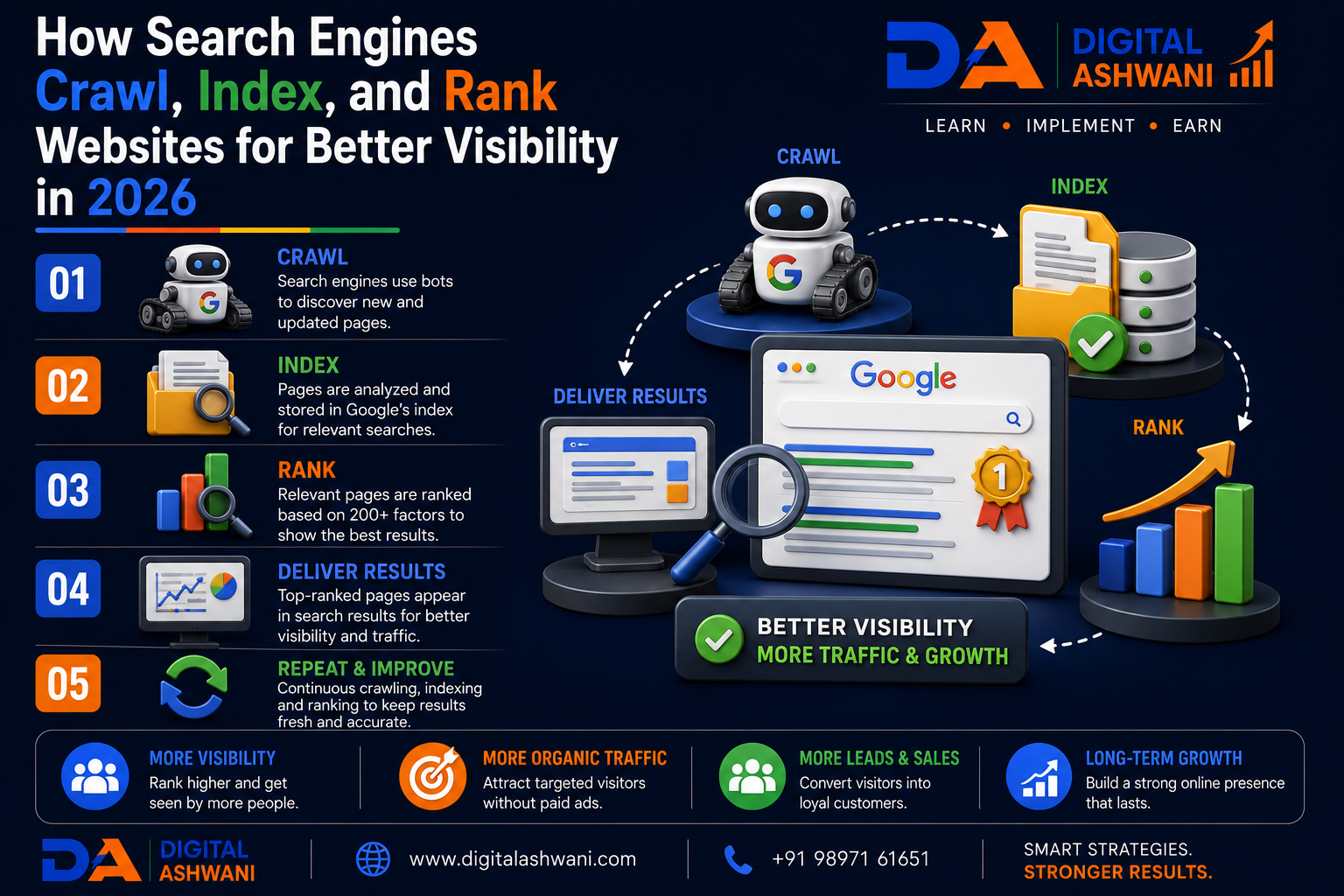
How Search Engines Crawl, Index, and Rank Websites for Better Visibility
Every time someone searches on Google, Bing, or another search engine, millions of webpages compete for a position in the search results. Within a fraction of a second, search engines decide which pages deserve to appear first and which remain hidden.
For many beginners, this process seems mysterious. However, every search engine follows three essential stages before displaying any webpage:
- Crawling
- Indexing
- Ranking
Understanding these stages is one of the most important foundations of Search Engine Optimization (SEO). If search engines cannot crawl your website, they cannot index it. If your pages aren’t indexed, they cannot rank. And if they don’t rank, potential customers won’t find your business.
As Google continues integrating Artificial Intelligence through AI Overviews, AI Mode, and conversational search, the fundamentals of crawling, indexing, and ranking remain critical. Businesses that build technically sound websites with valuable content continue to perform best.
In this comprehensive guide by Digital Ashwani, you’ll learn exactly how search engines crawl, index, and rank websites, why these processes matter, and the practical SEO strategies that improve your online visibility.
What Are Search Engines?
Search engines are software systems designed to help users discover relevant information on the internet.
Popular search engines include:
- Bing
- Yahoo
- DuckDuckGo
- Brave Search
Although each search engine has its own algorithms, they all generally follow the same three-step process:
- Crawl webpages
- Index content
- Rank results
What Is Crawling?
Crawling is the process where search engine bots automatically discover webpages across the internet.
Google uses automated software called Googlebot to visit websites, follow links, and identify new or updated content.
How Google Finds Pages
Googlebot discovers pages through:
- Internal links
- External backlinks
- XML sitemaps
- Previously crawled pages
- Newly published URLs
The easier it is for Googlebot to access your website, the more efficiently your content can be discovered.
Why Crawling Is Important
If search engines cannot crawl your webpages, they will never know the content exists.
Common crawling issues include:
- Broken internal links
- Incorrect robots.txt rules
- Server errors
- Slow website performance
- Orphan pages
- Infinite URL parameters
Improving crawlability is a fundamental part of Technical SEO.
What Is Indexing?
After a webpage is crawled, search engines analyze its content and determine whether it should be stored in the search index.
The search index is Google’s enormous database of webpages that are eligible to appear in search results.
During Indexing, Google Understands
- Page topic
- Keywords
- Images
- Videos
- Structured data
- Internal links
- External links
- Overall content quality
Only indexed pages have the opportunity to rank.
Why Pages May Not Be Indexed
Google may choose not to index pages that have:
- Duplicate content
- Thin content
- Noindex directives
- Poor quality
- Crawl errors
- Canonical issues
- Soft 404 errors
Monitoring indexing through Google Search Console helps identify these issues early.
What Is Ranking?
Ranking is the process of determining the order in which indexed webpages appear for a user’s search query.
Google evaluates hundreds of signals before deciding which page deserves the top position.
Instead of relying only on keywords, Google’s ranking systems consider:
- User intent
- Relevance
- Authority
- Trustworthiness
- Page quality
- Technical performance
- User experience
The most helpful pages appear higher in search results.
Why Crawling, Indexing & Ranking Matter
These three stages work together.
Without crawling:
Your pages cannot be discovered.
Without indexing:
Your pages cannot appear in search results.
Without ranking:
Your pages receive little or no organic visibility.
Understanding this process helps businesses identify where SEO problems occur.
15 SEO Strategies to Improve Crawling, Indexing & Rankings
1. Create an XML Sitemap
XML sitemaps help search engines discover important pages more efficiently.
Submit your sitemap through Google Search Console.
2. Improve Internal Linking
Internal links help search engines discover new pages and understand your website structure.
They also distribute authority throughout your website.
3. Optimize Website Speed
Fast websites improve:
- Crawling efficiency
- User experience
- Core Web Vitals
- Search performance
Compress images, enable browser caching, and minimize unnecessary scripts.
4. Build Mobile-Friendly Websites
Google primarily uses mobile-first indexing.
Your website should provide an excellent experience across smartphones, tablets, and desktops.
5. Publish High-Quality Content
Search engines prioritize content that is:
- Helpful
- Original
- Accurate
- Well-structured
- Comprehensive
High-quality content improves indexing quality and ranking potential.
6. Use Proper Heading Structure
Organize content with logical headings.
Example:
- H1
- H2
- H3
- H4
Clear hierarchy helps both users and search engines understand your content.
7. Optimize Title Tags & Meta Descriptions
Every important page should include:
- Unique SEO title
- Compelling meta description
- Relevant keywords
- Clear page purpose
Well-optimized metadata improves click-through rates.
8. Fix Crawl Errors
Regularly review Google Search Console for:
- 404 pages
- Redirect issues
- Server errors
- Blocked resources
- Crawl anomalies
Fixing these problems helps search engines access your content more effectively.
9. Use Structured Data (Schema Markup)
Structured data helps search engines better understand your website’s content and context.
Recommended Schema Types
Implement:
- Organization Schema
- Local Business Schema
- Article Schema
- FAQ Schema
- Breadcrumb Schema
- Product Schema
- Review Schema
Structured data can improve eligibility for rich results and enhance search visibility.
10. Build High-Quality Backlinks
Backlinks remain one of Google’s strongest ranking signals.
When trusted websites link to your content, search engines view your pages as more authoritative.
Ways to Earn Quality Backlinks
- Publish original research
- Write guest articles
- Create in-depth guides
- Share case studies
- Build useful tools
- Earn digital PR mentions
Focus on relevance and quality rather than the number of links.
11. Keep Content Fresh
Search engines regularly revisit websites to discover updated information.
Fresh content signals that your website remains active and relevant.
Update Existing Pages
Refresh:
- Statistics
- Images
- Examples
- Internal links
- Product information
- Industry trends
Regular updates improve both indexing and ranking opportunities.
12. Optimize for AI Search
Google’s AI Overviews and AI-powered search experiences increasingly rely on well-structured, trustworthy content.
AI Search Best Practices
Create content that includes:
- Clear headings
- Direct answers
- FAQ sections
- Original insights
- Strong EEAT signals
- Natural language
Optimizing for AI search also improves traditional SEO performance.
13. Improve Core Web Vitals
Core Web Vitals measure how users experience your website.
Good performance supports both SEO and user satisfaction.
Focus on
- Largest Contentful Paint (LCP)
- Interaction to Next Paint (INP)
- Cumulative Layout Shift (CLS)
Fast, stable, and responsive pages encourage better engagement.
14. Monitor Google Search Console
Google Search Console is one of the most valuable free SEO tools.
Track Important Reports
Monitor:
- Crawl status
- Indexed pages
- Coverage issues
- Search performance
- Sitemap status
- Core Web Vitals
- Mobile usability
Regular monitoring helps identify technical issues before they impact rankings.
15. Build Topical Authority
Rather than publishing isolated articles, create comprehensive content clusters around related topics.
Example SEO Topic Cluster
- What Is SEO?
- Technical SEO Guide
- Local SEO Guide
- Keyword Research Guide
- Google Ranking Factors
- AI SEO
- Google Search Console Guide
- On-Page SEO Guide
Covering a topic comprehensively helps search engines recognize your expertise.
Common Technical SEO Mistakes
Blocking Important Pages
Incorrect robots.txt rules or noindex tags may prevent valuable pages from appearing in search results.
Always verify crawl directives after making technical changes.
Ignoring Broken Links
Broken internal links reduce crawl efficiency and create poor user experiences.
Regularly audit your website for 404 errors.
Poor Website Architecture
Complex navigation makes it harder for both users and search engines to discover content.
Keep important pages within a few clicks of the homepage.
Duplicate Content
Publishing nearly identical pages can confuse search engines and dilute ranking signals.
Use canonical tags where appropriate and create unique content for every important page.
Slow Server Performance
Frequent server errors and long response times reduce crawl efficiency and negatively affect rankings.
Choose reliable hosting and monitor uptime regularly.
SEO Checklist for Better Crawling & Indexing
| SEO Task | Status |
|---|---|
| XML Sitemap Submitted | ✅ |
| Robots.txt Optimized | ✅ |
| Internal Linking | ✅ |
| Website Speed | ✅ |
| Mobile Optimization | ✅ |
| Schema Markup | ✅ |
| Crawl Error Monitoring | ✅ |
| Index Coverage Checked | ✅ |
| High-Quality Content | ✅ |
| Backlink Building | ✅ |
Internal Linking Suggestions (Digital Ashwani)
Strengthen your Technical SEO content cluster by linking this article with:
- What Is Search Engine Optimization?
- Complete Beginner’s Guide to Understanding How Google Search Ranking Really Works
- Technical SEO Checklist for 2026
- Local SEO Guide
- Google Search Console Complete Guide
- XML Sitemap Generator Tool
- Robots.txt Generator Tool
- Canonical Tag Generator Tool
- Breadcrumb Schema Generator Tool
- SEO Audit Tool
These internal links improve topical authority, strengthen your site architecture, and help search engines understand relationships between your SEO resources.
External Resources
For official SEO documentation, explore:
- Google Search Central
- Google Search Console Help
- Google PageSpeed Insights
- Google Rich Results Test
- Google Lighthouse Documentation
These resources provide the latest recommendations for improving crawlability, indexing, and search performance.
Frequently Asked Questions
What is crawling in SEO?
Crawling is the process where search engine bots discover webpages by following links, reading XML sitemaps, and finding new or updated content across the web.
What is indexing?
Indexing is the process of storing and organizing crawled webpages in a search engine’s database so they can appear in search results.
Can a webpage rank without being indexed?
No. A webpage must first be indexed before it becomes eligible to appear in search engine results.
How can I check if Google has indexed my page?
You can use the URL Inspection Tool in Google Search Console or search using the site: operator (for example, site:example.com/page-url) to see whether a page appears in Google’s index.
Why is my page not ranking even though it’s indexed?
Common reasons include low-quality content, weak search intent alignment, limited authority, poor technical SEO, strong competition, or insufficient backlinks.
Final Thoughts
Understanding how search engines crawl, index, and rank websites is fundamental to building a successful SEO strategy. Crawling ensures your pages are discovered, indexing makes them eligible for search results, and ranking determines how visible they become to potential visitors.
As Google’s search ecosystem continues to evolve with AI-powered experiences, the fundamentals remain the same. Businesses that invest in technical SEO, helpful content, strong internal linking, structured data, and excellent user experiences are more likely to earn sustainable organic visibility.
Instead of focusing on shortcuts or outdated SEO tactics, prioritize creating websites that are easy for search engines to understand and genuinely useful for users. This approach supports long-term growth across both traditional search and AI-powered search experiences.
At Digital Ashwani, we regularly publish practical guides on Technical SEO, AI SEO, Google Updates, Local SEO, Google Ads, and Digital Marketing to help businesses achieve lasting online success.
