

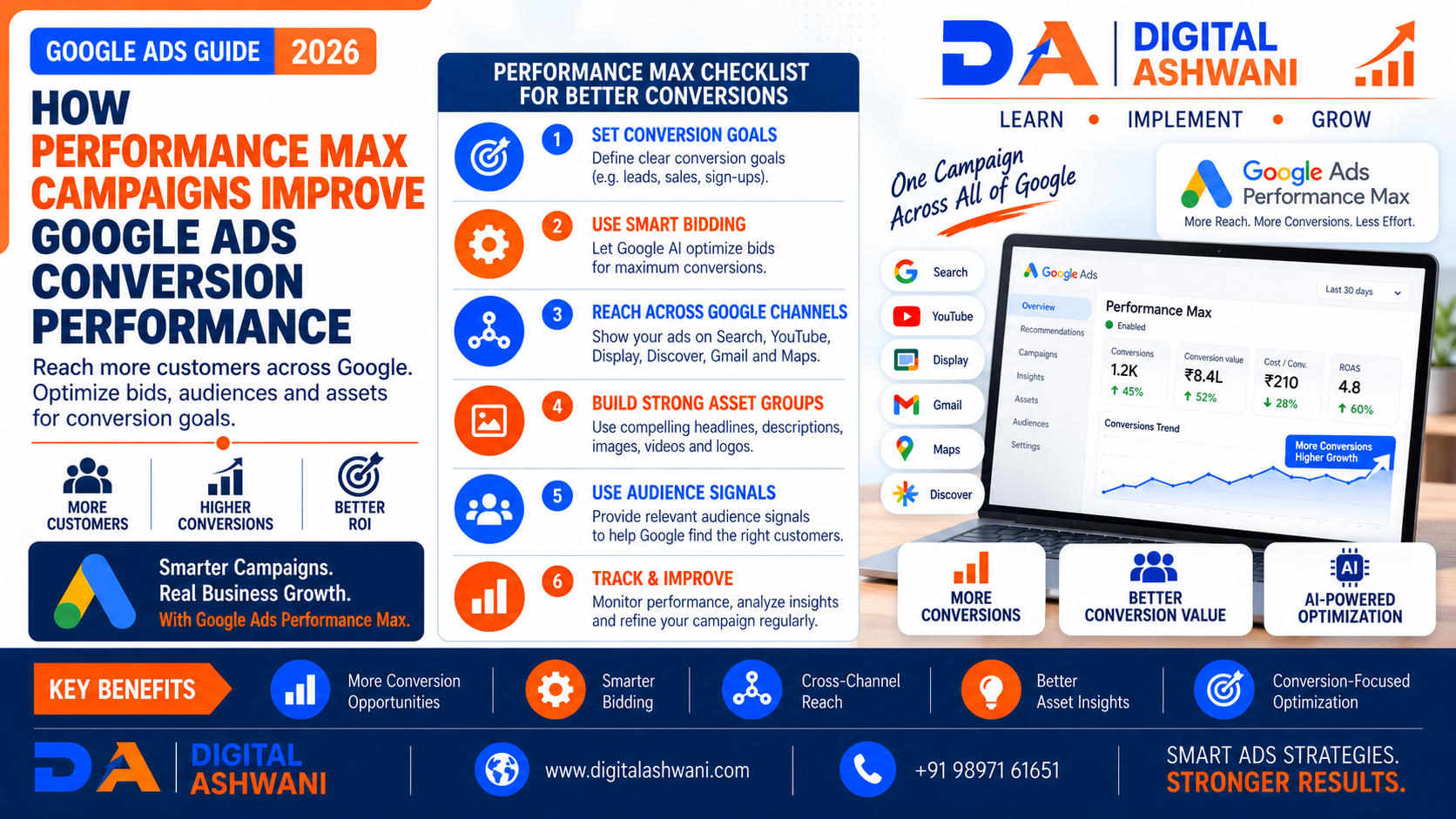
How Performance Max Campaigns Improve Google Ads Conversion Performance
Google Ads has evolved beyond traditional keyword-based search advertising. Businesses today can reach potential customers across multiple Google properties using campaign types designed around specific marketing goals.
One of the most important options for conversion-focused advertisers is Performance Max.
Performance Max is a goal-based Google Ads campaign type that can access Google’s advertising inventory across channels such as Search, YouTube, Display, Discover, Gmail, and Maps from a single campaign. Google uses AI and Smart Bidding to optimize toward the conversion goals selected by the advertiser.
But simply creating a Performance Max campaign does not automatically guarantee better results.
The quality of your conversion tracking, creative assets, audience signals, landing pages, bidding strategy, budget, and campaign structure can all influence performance.
So, how exactly can Performance Max campaigns improve Google Ads conversion performance?
Let’s explore how the campaign type works and the practical strategies businesses can use to get more value from it.
What Is a Performance Max Campaign?
Performance Max is a Google Ads campaign type designed around business goals such as sales, leads, online conversions, and conversion value.
Instead of requiring advertisers to create separate campaigns for every Google advertising channel, Performance Max can use a single campaign to access multiple types of inventory.
Depending on the campaign setup and eligibility, ads can reach potential customers across:
- Google Search
- YouTube
- Display
- Discover
- Gmail
- Google Maps
- Shopping inventory
This broader reach gives Google’s systems more opportunities to identify users and situations that may contribute to the campaign’s conversion goal.
Why Performance Max Is Different
Traditional search campaigns are heavily centered around keywords and search queries.
Performance Max takes a broader approach.
Advertisers provide Google with:
- Conversion goals
- Budget
- Bidding targets
- Text assets
- Images
- Videos
- Audience signals
- Landing pages
- Product feeds where applicable
Google AI then uses these inputs to determine where and when ads should appear and how bids should be adjusted toward the selected goal.
How Performance Max Campaigns Work
The basic process can be understood in five steps.
Step 1: Define the Business Goal
The first step is telling Google what outcome matters.
Depending on the campaign, this could include:
- Purchases
- Qualified leads
- Sign-ups
- Phone calls
- Store-related actions
- Conversion value
The campaign then uses these goals to guide optimization.
Step 2: Provide High-Quality Assets
Advertisers provide creative assets such as:
- Headlines
- Descriptions
- Images
- Logos
- Videos
These assets are organized into asset groups around particular themes.
Step 3: Add Audience Signals
Audience signals can provide Google with useful information about the types of users likely to be valuable customers.
They help accelerate campaign learning, although they are not necessarily strict audience targeting restrictions.
Step 4: Select Bidding Goals
Depending on the objective, advertisers can optimize toward goals such as:
- Maximize Conversions
- Target CPA
- Maximize Conversion Value
- Target ROAS
The appropriate option depends on what the business is trying to achieve and the quality of available conversion data.
Step 5: Google AI Optimizes Across Auctions
Performance Max uses Smart Bidding to adjust bids in real time based on the likelihood and value of conversions.
Google states that Performance Max can automatically distribute budget across available inventory based on predicted performance and advertiser-defined goals.
How Performance Max Improves Conversion Performance
Performance Max can support conversion performance through several mechanisms.
1. AI-Powered Smart Bidding
One of the most important components of Performance Max is automated bidding.
Instead of manually setting bids for every individual auction, Smart Bidding uses signals available at auction time to estimate conversion probability and adjust bids accordingly.
This can help Google focus spending on opportunities it predicts are more likely to contribute to the selected conversion goal.
For example, two users may search for similar products.
One user may have signals suggesting a higher probability of completing a purchase, while another may be less likely to convert.
Automated bidding can account for such contextual signals when determining bids.
2. Access to Multiple Google Channels
Performance Max is not limited to one advertising placement.
It can access Google’s broader advertising inventory through a single campaign, including Search, YouTube, Display, Discover, Gmail, Maps, and other eligible inventory.
This matters because customers do not always convert immediately after a search.
A customer might:
Search → Watch a video → Visit a website → Return later → Convert
Performance Max can help advertisers reach users at different points across Google’s ecosystem.
3. Finding Additional Conversion Opportunities
A major purpose of Performance Max is to find conversion opportunities beyond the reach of individual keyword-based campaigns.
Google describes Performance Max as a way to complement keyword-based Search campaigns and help advertisers find more converting customers across Google’s channels.
This can be particularly useful when businesses want to expand beyond their existing search traffic.
4. Audience Signals Help Guide Campaign Learning
Audience signals allow advertisers to provide information about potentially valuable audiences.
Examples can include:
- Existing customers
- Website visitors
- Previous purchasers
- Users interested in relevant categories
- Custom audience information
- Customer intent signals
Google can use these signals to accelerate learning and identify additional users who demonstrate similar conversion potential.
The important point is that audience signals should be treated as guidance rather than assuming they function exactly like traditional restrictive targeting.
How Creative Assets Affect Performance Max Conversions
Performance Max relies heavily on creative assets.
Advertisers can provide multiple headlines, descriptions, images, videos, and other assets. Google AI can combine these assets into different ad formats across eligible inventory.
Use Multiple High-Quality Assets
Instead of providing only one image or a couple of headlines, advertisers should build a diverse collection of relevant assets.
Useful assets may include:
- Multiple headline variations
- Different descriptions
- Product images
- Lifestyle images
- Brand graphics
- Videos
- Logos
- Strong calls to action
Google recommends providing diverse, high-quality assets and monitoring asset performance.
Why Creative Variety Matters
Different users respond to different messages.
One customer may respond to:
“Get a Free Consultation”
while another may be more interested in:
“Grow Your Business With Google Ads”
Multiple relevant assets give the system more combinations to test across different contexts.
Conversion Goals and Conversion Values
Performance Max is designed around conversion goals.
This makes accurate conversion tracking extremely important.
Google recommends using conversion tracking with Performance Max so the system can optimize toward meaningful actions such as purchases, sign-ups, and other business outcomes.
Track Meaningful Conversions
For a lead-generation business, possible conversions could include:
- Completed enquiry forms
- Phone calls
- Consultation bookings
- Qualified lead submissions
For an e-commerce business:
- Purchases
- Revenue
- Purchase value
- Repeat customer value where appropriate
The more accurately your conversion setup represents real business value, the more useful the optimization signals can become.
Why Poor Conversion Tracking Can Hurt Performance
Suppose a business tells Google that every form submission is equally valuable.
But in reality:
- 20% are highly qualified
- 50% are moderately qualified
- 30% are irrelevant
The campaign may optimize toward volume without understanding the difference in lead quality.
This is why businesses should carefully define which conversion actions should be included as campaign goals.
Performance Max for Lead Generation
Performance Max can be useful for businesses whose primary goal is generating leads.
Examples include:
- Digital marketing agencies
- Real estate companies
- Education businesses
- Professional services
- Home services
- B2B companies
- Local service businesses
Lead Generation Example
Consider a digital marketing agency targeting businesses looking for Google Ads services.
The campaign could use:
Goal: Lead generation
Landing Page: Google Ads Management service page
Assets: Service-focused headlines, images, videos, and calls to action
Audience Signals: Relevant business and marketing audiences
Conversion: Qualified enquiry form or phone call
The campaign can then optimize toward the selected conversion goal.
However, advertisers should not judge success only by the number of leads. Lead quality and eventual sales matter too.
Performance Max for E-commerce
Performance Max is also widely used for online sales campaigns.
For e-commerce businesses, product data can be an important part of campaign setup.
A retailer can provide product information through a Merchant Center feed and use creative assets and conversion goals to help promote products across eligible Google inventory.
Important E-commerce Metrics
E-commerce advertisers should monitor:
- Purchases
- Conversion value
- ROAS
- Average order value
- Cost per purchase
- Product performance
- Revenue
- New customer performance where applicable
This helps businesses understand whether additional advertising spend is creating meaningful commercial value.
8 Practical Ways to Improve Performance Max Conversion Performance
1. Set Up Accurate Conversion Tracking
Before optimizing a campaign, make sure important conversion actions are being tracked correctly.
Google specifically recommends accurate conversion tracking for Performance Max.
Check:
- Conversion action settings
- Primary vs secondary actions
- Attribution settings
- Conversion values
- Phone-call tracking
- Form tracking
- Purchase tracking
2. Use Strong and Diverse Creative Assets
Provide enough high-quality assets to give Google different combinations to work with.
Google recommends using a diverse range of high-quality assets and improving asset quality where necessary.
3. Improve Your Landing Pages
Performance Max can bring users to your website, but the landing page is responsible for helping turn those visitors into customers.
A good landing page should have:
- Clear messaging
- Strong relevance to the ad
- Fast loading
- Mobile-friendly design
- Visible CTA
- Trust signals
- Easy navigation
- Simple conversion process
4. Use Relevant Audience Signals
Use customer and audience information that genuinely represents your potential buyers.
Avoid treating audience signals as a substitute for a complete campaign strategy.
5. Give the Campaign Enough Data and Time
Machine-learning campaigns need data to learn.
Google’s current guidance recommends allowing Performance Max campaigns sufficient time to ramp up and gather data, and advises against frequent changes during the initial learning period.
This means advertisers should avoid changing budgets, targeting, assets, and bidding settings every few days without a clear reason.
6. Set Realistic CPA or ROAS Targets
Overly restrictive targets can limit campaign reach.
Google specifically notes that overly restrictive Target CPA or Target ROAS settings can limit reach and recommends considering gradual adjustments when performance is low.
7. Monitor Asset Performance
Performance Max now provides conversion-related reporting for assets and asset groups.
Advertisers can use these insights to understand which assets are contributing to conversions or conversion value.
Replace weaker assets over time while continuing to provide sufficient creative variety.
8. Evaluate Performance Over Meaningful Time Periods
Performance can fluctuate because of auction dynamics, conversion delays, campaign changes, budgets, bidding targets, and other factors.
Google advises against judging Performance Max based on single-day performance and recommends evaluating performance over a longer period such as two weeks or a complete conversion cycle.
Performance Max Metrics You Should Monitor
A conversion-focused campaign should be evaluated using business-relevant metrics.
Conversion Rate
Conversion Rate = Conversions ÷ Interactions × 100
This helps indicate how effectively traffic or interactions turn into tracked conversions.
Cost Per Conversion
Cost Per Conversion = Total Cost ÷ Conversions
This helps businesses understand how much they are spending to generate each tracked conversion.
Conversion Value
Conversion value measures the value assigned to the conversions generated by the campaign.
ROAS
ROAS = Conversion Value ÷ Advertising Cost
For example, if a campaign spends ₹20,000 and generates ₹80,000 in tracked conversion value:
ROAS = ₹80,000 ÷ ₹20,000 = 4
That means ₹4 of tracked conversion value was generated for every ₹1 spent.
The interpretation depends on the business’s margins, customer value, and measurement setup.
How to Analyze Performance Max Campaigns
Performance Max reporting has become more detailed, with reporting available across assets, asset groups, and channels.
Google’s channel performance reporting can show metrics such as interactions, conversions, conversion value, cost, and performance across channels.
Businesses can review:
- Overall campaign performance
- Channel performance
- Asset performance
- Search impact
- Audience trends
- Conversion data
- Creative combinations
- Budget performance
This allows advertisers to look beyond a single campaign-level number.
Common Performance Max Mistakes
Mistake 1: Launching Without Proper Conversion Tracking
If conversion tracking is inaccurate, the campaign may optimize toward the wrong signals.
Mistake 2: Using Poor Creative Assets
Weak images, repetitive headlines, or irrelevant messaging can reduce the quality of available creative combinations.
Mistake 3: Changing the Campaign Too Frequently
Constant changes can interfere with the learning process and make performance difficult to evaluate.
Mistake 4: Setting Unrealistic Targets
An excessively restrictive CPA or ROAS target can limit delivery.
Mistake 5: Measuring Only Clicks
Clicks are not the final objective for a conversion campaign.
Focus on:
Conversions → Qualified Leads → Sales → Revenue → Profitability
Mistake 6: Ignoring Landing-Page Experience
A campaign can generate highly relevant traffic but still produce weak results if the landing page does not meet user expectations.
Mistake 7: Ignoring Conversion Lag
Some users convert immediately while others take longer.
Evaluating campaigns before enough conversion data has matured can lead to incorrect conclusions. Google specifically recommends accounting for conversion lag when evaluating Performance Max.
Performance Max vs Traditional Search Campaigns
Performance Max and Search campaigns are not necessarily replacements for each other.
| Feature | Performance Max | Search Campaign |
|---|---|---|
| Google Channels | Multiple | Primarily Search |
| Keyword Dependence | Lower | Higher |
| Automation | High | Variable |
| Creative Formats | Multiple formats | Primarily search ads |
| Audience Signals | Available | Available |
| Search Intent | Included | Core focus |
| Cross-Channel Optimization | Yes | No |
| Conversion Optimization | Goal-based | Goal-based |
Google describes Performance Max as a campaign type that can complement keyword-based Search campaigns rather than simply replacing them.
When Should Businesses Consider Performance Max?
Performance Max can be worth considering when:
- Your primary objective is sales or leads.
- You have reliable conversion tracking.
- You want access to multiple Google channels.
- You want Google AI to optimize bids across inventory.
- You have sufficient creative assets.
- You want to expand beyond keyword-based Search campaigns.
- You have enough conversion data to support optimization.
It may require more careful setup when a business has limited conversion data, unclear goals, poor tracking, or insufficient creative assets.
Can Performance Max Increase Conversions Automatically?
Performance Max uses automation and AI to optimize toward advertiser-defined goals, but it should not be viewed as a guarantee of increased conversions.
Results depend on several factors, including:
- Conversion tracking
- Budget
- Bidding targets
- Creative quality
- Audience signals
- Landing pages
- Offer
- Competition
- Search demand
- Account history
Google’s documentation specifically emphasizes conversion tracking, asset quality, audience signals, and appropriate bidding and budget settings as important parts of successful Performance Max campaigns.
Frequently Asked Questions
What is Performance Max in Google Ads?
Performance Max is a goal-based Google Ads campaign type that can access multiple Google advertising channels from a single campaign and use AI-powered optimization toward conversion or conversion-value goals.
Does Performance Max improve conversion rates?
Performance Max is designed to optimize toward conversions or conversion value, but actual results vary by campaign. Accurate tracking, strong creative assets, relevant landing pages, appropriate bidding, and sufficient data all influence performance.
Is Performance Max better than Search Ads?
They serve different purposes. Performance Max provides broader cross-channel access, while Search campaigns focus primarily on users actively searching Google. Google positions Performance Max as a complement to keyword-based Search campaigns in appropriate situations.
How long should a Performance Max campaign run?
There is no universal duration for every campaign, but Google’s current guidance recommends giving campaigns enough time to ramp up and gather data and avoiding frequent changes during the initial learning period.
What assets are needed for Performance Max?
Depending on the campaign, advertisers can use headlines, descriptions, images, logos, videos, and other relevant assets. Providing diverse, high-quality assets gives Google more creative combinations to work with.
What is the most important metric for Performance Max?
There is no single metric that fits every business. Lead-generation campaigns may focus on qualified leads and cost per qualified lead, while e-commerce businesses may focus on conversion value, ROAS, purchases, and profitability.
Can Performance Max be used for lead generation?
Yes. Google lists lead generation among the objectives for which Performance Max can be used.
Should I change my Performance Max campaign every few days?
Frequent changes are generally not recommended during the learning period. Google advises allowing campaigns sufficient time to gather data and recommends evaluating performance over meaningful periods rather than reacting to individual days.
Internal Linking Suggestions for Digital Ashwani
This article can naturally link to relevant Digital Ashwani resources such as:
- Google Ads Management
- Google Ads Calculator
- ROI Calculator
- ROAS Calculator
- CPC Calculator
- CPA Calculator
- Conversion Rate Calculator
- Digital Marketing services
- SEO services
- Social Media Marketing
These internal links can help readers move from educational content toward related Digital Ashwani tools and services.
External Resources
For authoritative information about Performance Max and Google Ads, consider linking to:
- Google Ads Help — Performance Max campaigns
- Google Ads Help — Creating Performance Max campaigns
- Google Ads Help — Performance Max optimization
- Google Ads Help — Evaluating Performance Max results
Google’s official documentation provides current guidance on campaign setup, conversion tracking, asset optimization, bidding, reporting, and performance evaluation.
Final Thoughts
Performance Max campaigns can play an important role in Google Ads conversion strategies by combining broad Google inventory with AI-powered bidding, audience signals, creative assets, and conversion-focused optimization.
However, automation does not remove the need for strategy.
The strongest Performance Max campaigns begin with the fundamentals:
Accurate conversion tracking + clear goals + quality assets + relevant landing pages + realistic bidding targets + sufficient data.
Businesses should also avoid judging campaign performance from clicks or a single day’s results.
Instead, focus on meaningful business outcomes such as:
Conversions → Qualified Leads → Sales → Revenue → ROAS
When these elements are properly aligned, Performance Max can give Google AI better signals to optimize toward the outcomes that matter to the business.
