
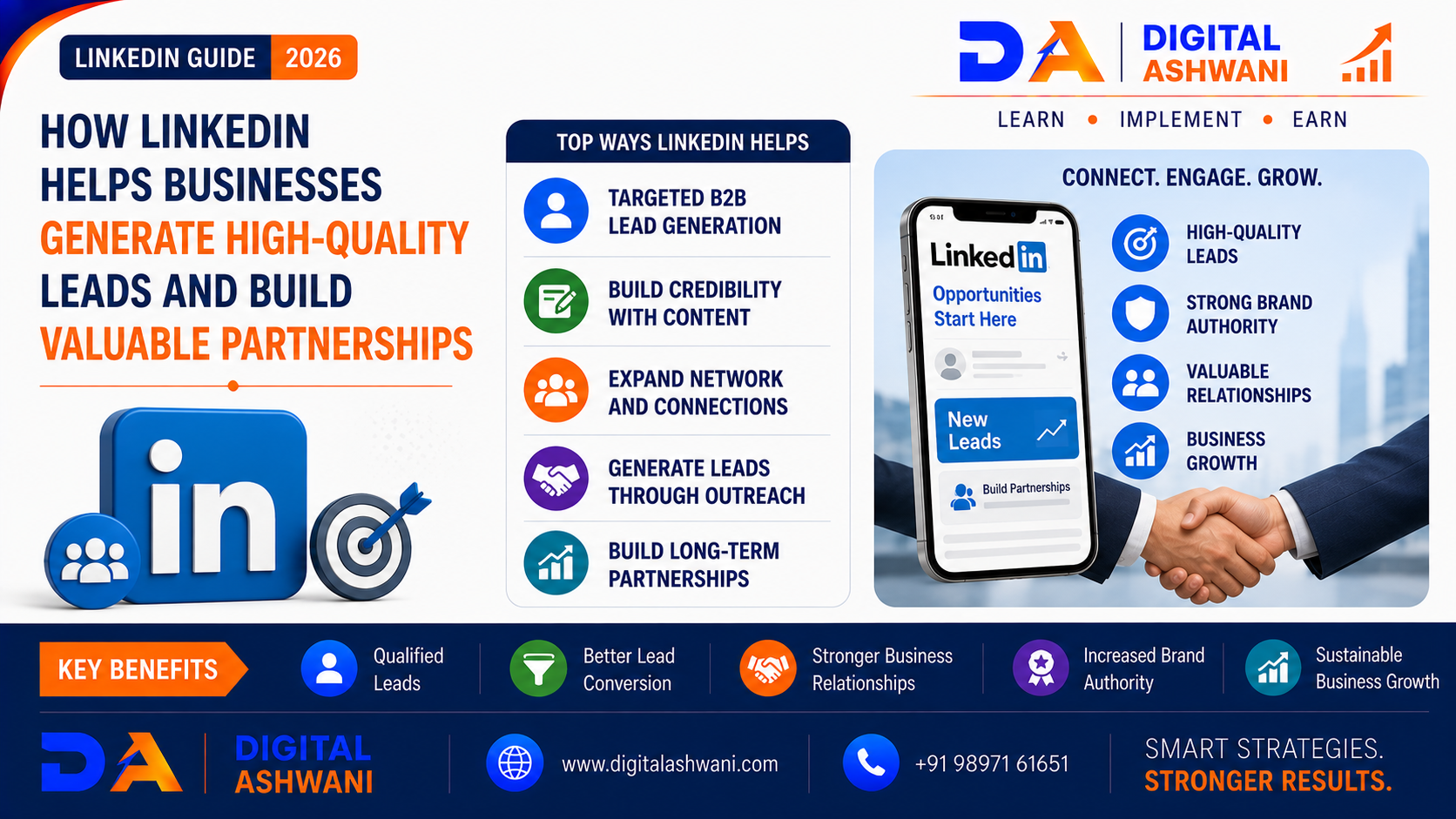
How LinkedIn Helps Businesses Generate High-Quality Leads and Build Valuable Partnerships
LinkedIn has evolved from a professional networking website into a powerful platform for B2B marketing, lead generation, thought leadership, recruitment, sales, and business partnerships.
Unlike many social platforms where users primarily consume entertainment content, LinkedIn is centered around professional relationships and business conversations.
This makes it particularly valuable for:
- B2B Companies
- Digital Marketing Agencies
- SaaS Businesses
- Consultants
- Technology Companies
- Professional Services
- Manufacturers
- Recruiters
- Business Coaches
- Startups
However, simply creating a LinkedIn company page and posting occasionally isn’t enough to generate consistent business opportunities.
Successful LinkedIn Lead Generation requires a combination of strong positioning, valuable content, targeted networking, relationship building, social selling, and consistent follow-up.
LinkedIn’s own business resources position the platform around B2B marketing, professional audiences, lead generation, and business growth. (business.linkedin.com)
In this comprehensive guide by Digital Ashwani, you’ll learn how businesses can use LinkedIn to attract qualified prospects, connect with decision-makers, build authority, generate leads, and develop valuable partnerships.
Why LinkedIn Matters for Businesses
LinkedIn provides businesses with access to a professional audience across industries and job roles.
Businesses can use the platform to:
- Find Decision-Makers
- Build Brand Authority
- Generate B2B Leads
- Promote Services
- Recruit Talent
- Find Partners
- Develop Industry Relationships
- Share Expertise
For businesses selling high-value services or products, professional trust can be just as important as visibility.
LinkedIn gives companies an environment where expertise and credibility can be demonstrated publicly.
What Makes LinkedIn Valuable for B2B Lead Generation
Reach Decision-Makers
LinkedIn allows businesses and professionals to identify people by factors such as:
- Job Title
- Industry
- Company
- Location
- Professional Experience
This can make prospecting more focused than broad social-media advertising.
Build Professional Trust
People are more likely to start business conversations with companies they understand and trust.
Regularly publishing useful content can demonstrate:
- Expertise
- Experience
- Industry Knowledge
- Problem-Solving Ability
- Business Results
The goal is to become recognizable before making a sales pitch.
Optimize Your LinkedIn Company Page
Create a Clear Business Positioning
Your company page should quickly explain:
- What Your Business Does
- Who You Serve
- What Problems You Solve
- What Makes You Different
Avoid vague descriptions such as:
“Providing innovative solutions for modern businesses.”
Be specific about your services and target market.
Use Relevant Keywords
Naturally include relevant terms in your company description and page content.
For example:
- Digital Marketing
- SEO
- Google Ads
- B2B Marketing
- SaaS Marketing
- Lead Generation
Don’t overuse keywords.
The goal is to make the page clear to people and searchable within LinkedIn.
Optimize Employee Profiles
Turn Team Members Into Brand Representatives
Your employees’ personal profiles can play an important role in company visibility.
Optimize profiles with:
- Professional Headshots
- Clear Headlines
- Relevant Experience
- Skills
- Company Information
- Portfolio or Website Links
A strong employee presence can humanize the company and expand its reach.
Create Content That Attracts Prospects
Share Educational Content
Instead of constantly promoting services, publish content that solves customer problems.
Examples include:
- Industry Guides
- Case Studies
- Research Insights
- How-To Content
- Data Analysis
- Expert Opinions
- Market Trends
Educational content helps attract people during the research stage.
Use Different Content Formats
Experiment with:
- Text Posts
- Images
- Documents
- Short Videos
- Carousels
- Polls
- Case Studies
Track which formats generate meaningful engagement from your target audience.
Use LinkedIn Thought Leadership
Share Real Expertise
Thought leadership isn’t simply posting motivational quotes.
Strong thought leadership can include:
- Original Opinions
- Industry Analysis
- Lessons From Projects
- Customer Insights
- Practical Frameworks
- Data-Based Observations
- Predictions Supported by Evidence
The objective is to give potential customers a reason to remember your brand.
Build Relationships Before Selling
Don’t Immediately Send Sales Pitches
One of the biggest LinkedIn mistakes is connecting with someone and immediately sending a promotional message.
Instead:
- Identify Relevant Prospects.
- Connect Professionally.
- Engage With Their Content.
- Share Useful Insights.
- Start a Relevant Conversation.
- Understand Their Needs.
- Introduce Your Solution When Appropriate.
Relationship-first outreach generally creates a better experience than aggressive selling.
Use LinkedIn Social Selling
Focus on Conversations
Social selling is about using professional networks and content to build relationships that can eventually lead to business opportunities.
Instead of:
“We provide the best SEO services. Book a call now.”
Try starting with a relevant business conversation.
For example:
“I noticed your company recently expanded into a new market. Are you also focusing on increasing organic visibility in that region?”
The objective is to begin a useful conversation rather than immediately push a sales offer.
Target the Right Prospects
Create an Ideal Customer Profile
Define:
- Industry
- Company Size
- Location
- Job Role
- Business Challenge
- Budget Range
- Buying Intent
For example:
Target: B2B SaaS companies
Decision-Makers: Marketing Heads, Growth Managers, Founders
Problem: Low qualified organic traffic
Solution: SEO and content strategy
A defined ICP makes LinkedIn prospecting much more efficient.
Use LinkedIn Lead Generation Ads
Lead Gen Forms
LinkedIn provides advertising tools designed for lead generation, including Lead Gen Forms that can simplify the process of collecting professional information from interested users. (business.linkedin.com)
Businesses can promote:
- Webinars
- eBooks
- Case Studies
- Product Demos
- Consultations
- Reports
- Free Assessments
Make the offer valuable enough to justify submitting contact information.
Create Lead Magnets
Offer Something Useful
Examples include:
- SEO Checklist
- Industry Report
- Marketing Guide
- Free Audit
- Case Study
- Template
- Research Report
A good lead magnet attracts prospects who are already interested in solving a relevant problem.
Use LinkedIn for Partnership Opportunities
LinkedIn isn’t only useful for customer acquisition.
It can also help businesses find:
- Technology Partners
- Agencies
- Suppliers
- Distributors
- Consultants
- Resellers
- Strategic Partners
- Industry Experts
Partnership opportunities often begin with simple professional conversations.
Build Strategic Partnerships
Look for Complementary Businesses
A good partnership often exists between businesses serving similar audiences without directly competing.
For example:
SEO Agency + Web Development Company
CRM Provider + Marketing Agency
Accounting Firm + Business Consultant
Travel Company + Hospitality Brand
These relationships can generate referrals, joint campaigns, and new business opportunities.
Use LinkedIn Groups and Professional Communities
Participate Instead of Spamming
Where relevant communities exist, contribute useful information rather than repeatedly promoting your services.
Share:
- Insights
- Answers
- Resources
- Industry Experiences
- Solutions
Community participation can strengthen professional relationships over time.
Use LinkedIn Events and Webinars
Turn Expertise Into Conversations
Businesses can use professional events and webinars to attract relevant audiences.
Topics might include:
- Industry Trends
- Marketing Strategies
- Technology Updates
- Business Growth
- Case Studies
- Professional Training
After an event, follow up with attendees appropriately and provide additional value.
Measure LinkedIn Lead Generation Performance
Track Business Metrics
Don’t measure success only through likes and impressions.
Track:
- Profile Visits
- Website Traffic
- Leads
- Qualified Leads
- Meetings
- Partnership Conversations
- Conversion Rate
- Customer Acquisition Cost
- Revenue
The most important metric is whether LinkedIn contributes to actual business growth.
LinkedIn Lead Generation Funnel
A practical LinkedIn funnel can look like:
Content → Profile Visit → Connection → Conversation → Lead → Meeting → Customer
For partnerships:
Content → Industry Connection → Conversation → Collaboration → Referral/Partnership
This approach turns LinkedIn from a publishing platform into a relationship-building channel.
How Often Should Businesses Post on LinkedIn?
Focus on Consistency
There is no universal number of posts that guarantees results.
A better approach is to create a sustainable publishing schedule.
For example:
- Educational Content
- Industry Insights
- Case Studies
- Customer Stories
- Company Updates
- Expert Opinions
Consistency matters more than posting large amounts of low-value content.
Common LinkedIn Marketing Mistakes
Posting Only Promotional Content
Constant sales messages can reduce engagement and trust.
Sending Mass Connection Requests
Large volumes of irrelevant connections rarely create quality relationships.
Using Generic Messages
Personalize outreach around genuine context.
Ignoring Personal Profiles
Employees and founders can often provide significant organic reach and credibility.
Buying Engagement
Artificial engagement does not create meaningful business relationships.
Measuring Likes Instead of Leads
High engagement doesn’t necessarily mean high revenue.
Selling Too Early
Build context and understand the prospect before making a sales pitch.
LinkedIn Lead Generation Checklist
Before starting your strategy, make sure you have:
- Optimized Company Page
- Strong Employee Profiles
- Defined Ideal Customer Profile
- Clear Value Proposition
- Content Strategy
- Lead Magnet
- Prospecting Process
- Relationship-Building Strategy
- Follow-Up Process
- LinkedIn Analytics
- CRM Integration Where Appropriate
- Lead Qualification Process
- Partnership Strategy
- Conversion Tracking
Internal Linking Suggestions (Digital Ashwani)
Strengthen your LinkedIn and B2B marketing content cluster by linking this article with:
- Social Media Marketing vs Digital Marketing: Key Differences Explained Clearly
- Social Media Marketing Trends Every Business Owner Should Know in 2026
- Facebook Lead Ads Strategy That Converts Visitors Into Paying Customers
- Meta Ads Optimization Tips to Lower Cost Per Lead and Generate Better-Quality Leads
- Complete YouTube Marketing Guide for Business Growth and Brand Awareness
- Digital Marketing Career in 2026: Skills, Salary & Future Scope
- How to Increase Website Conversion Rates Using Data-Driven Optimization Methods
- Google Ads Terminology Every Digital Marketer Should Understand Before Advertising
These internal links connect LinkedIn marketing with social media strategy, paid advertising, lead generation, conversion optimization, and broader digital marketing topics.
External Resources
For current LinkedIn marketing and advertising information, refer to:
- LinkedIn Marketing Solutions
- LinkedIn Business
- LinkedIn Help
Platform features, advertising options, audience tools, and policies can change, so businesses should verify current LinkedIn documentation before implementing campaigns.
Frequently Asked Questions
Is LinkedIn good for business lead generation?
Yes, LinkedIn can be particularly valuable for B2B businesses because it provides access to professional audiences and tools designed around business marketing, networking, and lead generation. (business.linkedin.com)
What type of businesses benefit most from LinkedIn?
B2B companies, SaaS businesses, consultants, agencies, professional services, technology companies, manufacturers, recruiters, and businesses selling high-value products or services can particularly benefit from LinkedIn.
How can I generate leads without LinkedIn Ads?
Publish useful content, optimize your profile, connect with relevant prospects, participate in conversations, share valuable resources, and build relationships before making sales offers.
Should I use my personal LinkedIn profile or company page?
Both can be useful. Company pages provide official brand presence, while founders and employees can add a human perspective and expand organic reach.
How do LinkedIn partnerships help businesses grow?
Strategic partnerships can generate referrals, joint marketing opportunities, new distribution channels, complementary services, and access to new audiences.
How long does LinkedIn lead generation take?
Results depend on your industry, audience, offer, content quality, network, outreach strategy, and consistency. Relationship-based LinkedIn marketing generally requires ongoing effort rather than producing instant results.
Final Thoughts
LinkedIn Lead Generation is most effective when businesses stop treating LinkedIn as simply another social media platform and start using it as a professional relationship-building channel.
The strongest strategy combines:
Expert Content + Targeted Networking + Genuine Conversations + Social Selling + Strategic Partnerships
Don’t focus only on collecting connections.
Build relationships with people who can become:
- Customers
- Partners
- Referrers
- Collaborators
- Industry Advocates
For B2B businesses especially, LinkedIn can become a valuable part of a broader digital marketing funnel when content, networking, lead generation, and follow-up work together.
At Digital Ashwani, we regularly publish practical guides on SEO, Google Ads, Meta Ads, LinkedIn Marketing, Social Media Marketing, AI Marketing, Local SEO, and Digital Marketing to help businesses build stronger online visibility and generate sustainable growth.
