
How Google Ads Works and Why Businesses Should Invest in Paid Advertising
Every day, billions of searches are performed on Google by people looking for products, services, and solutions. Whether someone searches for “SEO agency near me,” “buy running shoes,” “best digital marketing company,” or “dentist in Delhi,” Google instantly displays the most relevant search results—including paid advertisements.
These advertisements are powered by Google Ads, one of the world’s largest and most effective online advertising platforms.
Unlike traditional advertising, Google Ads helps businesses reach potential customers exactly when they are actively searching for a product or service. This makes it one of the most effective channels for generating leads, increasing website traffic, driving phone calls, and boosting sales.
With Google’s AI-driven features like Smart Bidding, Performance Max, Demand Gen campaigns, and AI-powered audience targeting, paid advertising has become smarter and more efficient than ever.
In this comprehensive guide by Digital Ashwani, you’ll learn how Google Ads works, how the ad auction system functions, and why businesses of every size should consider investing in paid advertising in 2026.
What Is Google Ads?
Google Ads is Google’s online advertising platform that allows businesses to display advertisements across:
- Google Search
- Google Shopping
- YouTube
- Gmail
- Google Maps
- Google Discover
- Google Display Network
Most campaigns operate using a Pay-Per-Click (PPC) model, meaning advertisers generally pay when someone clicks on their ad.
Businesses can also optimize campaigns for:
- Phone calls
- Website visits
- Leads
- Sales
- App installs
- Store visits
How Google Ads Works
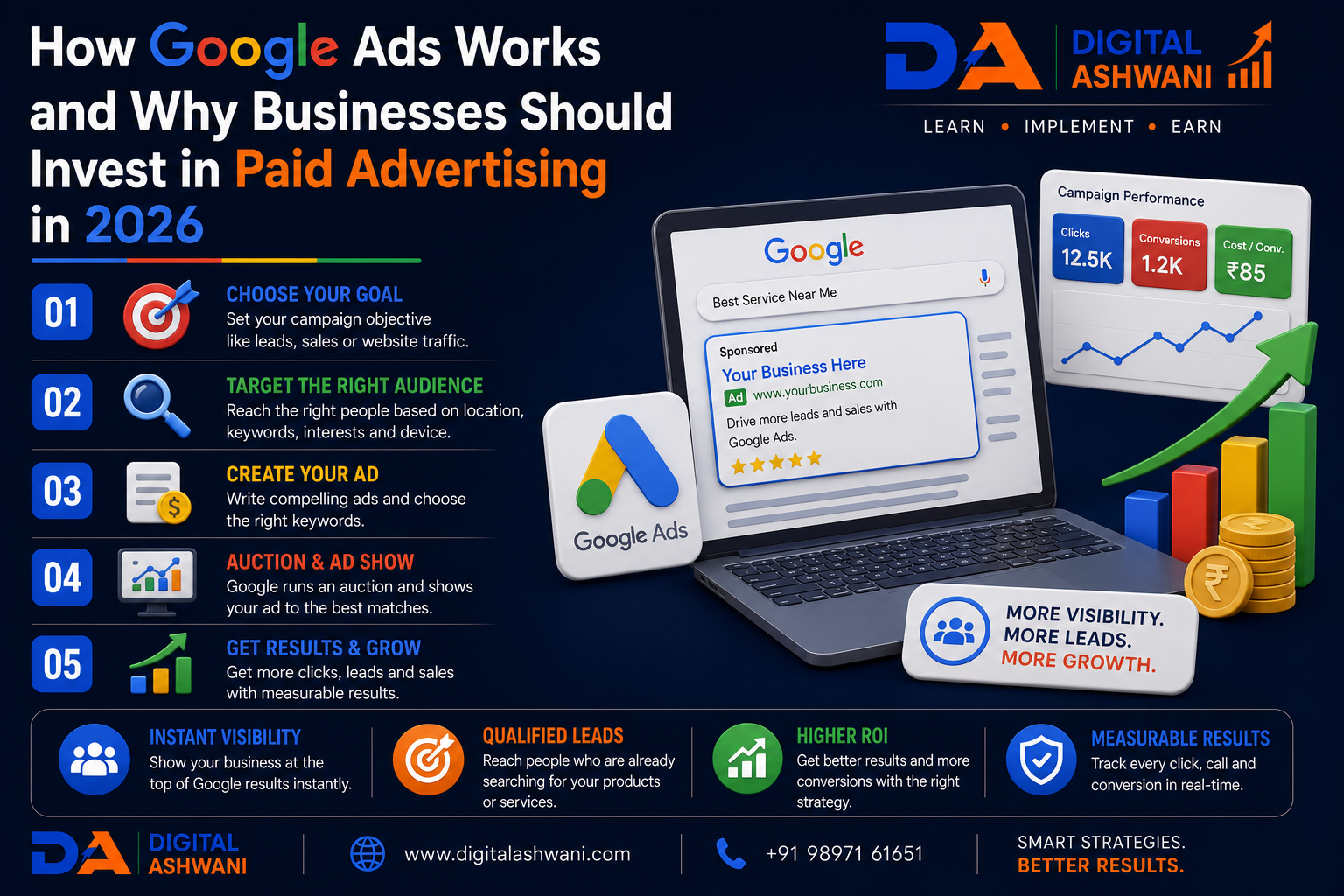
Google Ads uses an automated auction that runs every time a user performs a search.
Several factors determine which ads appear.
Step 1: Choose Keywords
Advertisers select keywords relevant to their products or services.
Examples include:
- SEO Services
- Google Ads Agency
- Best Laptop Under ₹60,000
- Travel Agency Delhi
- Dentist Near Me
When users search using these keywords, eligible ads can enter the auction.
Step 2: Set Your Budget
Businesses control:
- Daily budget
- Monthly spend
- Maximum CPC bids
- Campaign priorities
This flexibility allows businesses of all sizes to advertise within their budget.
Step 3: Create Advertisements
Google Ads allows advertisers to create:
- Responsive Search Ads
- Display Ads
- Shopping Ads
- Video Ads
- Call Ads
- Demand Gen Ads
- Performance Max Campaigns
Compelling ads improve click-through rates and conversions.
Step 4: Enter the Google Ads Auction
Every eligible advertisement participates in Google’s ad auction.
Winning isn’t determined solely by the highest bid.
Google evaluates:
- Bid amount
- Ad relevance
- Landing page quality
- Expected CTR
- Ad assets
- User experience
This ensures users see helpful, relevant advertisements.
Step 5: Calculate Ad Rank
Google combines multiple factors to calculate an Ad Rank.
Businesses with excellent ad quality often outrank competitors spending significantly more.
Why Businesses Should Invest in Paid Advertising
Paid advertising delivers immediate visibility.
Instead of waiting months for SEO results, businesses can begin attracting qualified traffic shortly after campaigns launch.
Google Ads helps businesses:
- Generate leads
- Increase sales
- Reach local customers
- Promote products
- Build brand awareness
- Measure ROI
It is one of the fastest ways to connect with high-intent customers.
15 Powerful Reasons Businesses Should Invest in Google Ads
1. Reach Customers with High Purchase Intent
Google Ads targets users actively searching for solutions.
Examples:
- Buy iPhone Online
- SEO Company Delhi
- Emergency Plumber
- Hotel Near Airport
These users often have strong purchase intent.
2. Generate Immediate Website Traffic
Unlike SEO, Google Ads can begin driving visitors within hours after campaign approval.
This makes it ideal for:
- Product launches
- Seasonal offers
- New businesses
- Time-sensitive campaigns
3. Highly Targeted Advertising
Advertisers can target audiences using:
- Location
- Age
- Gender
- Interests
- Device
- Language
- Audience segments
- Previous website visitors
Precise targeting reduces wasted advertising spend.
4. Flexible Budget Control
Businesses decide exactly how much they want to spend.
Budgets can be increased or reduced at any time.
This makes Google Ads suitable for startups and enterprises alike.
5. AI Improves Campaign Performance
Google’s AI continuously optimizes campaigns using:
- Smart Bidding
- Audience Signals
- Conversion Predictions
- Performance Max
- Responsive Search Ads
AI helps improve efficiency and return on investment.
6. Reach Local Customers
Businesses serving specific areas can advertise locally.
Examples:
- Dentist in Noida
- Restaurant Near Me
- Lawyer Delhi
- SEO Company Gurgaon
Local targeting increases lead quality.
7. Detailed Performance Reporting
Google Ads provides measurable insights including:
- Clicks
- Impressions
- Conversions
- CPC
- CPA
- ROAS
- Quality Score
These reports help advertisers improve campaign performance over time.
8. Improve Brand Awareness
Even when users don’t click immediately, repeated ad exposure increases brand recognition and trust.
Consistent visibility supports long-term marketing success.
9. Increase Sales with Shopping & Performance Max Campaigns
For eCommerce businesses, Google Ads provides highly effective campaign types that showcase products across Google’s ecosystem.
Best Campaign Types for Online Stores
- Google Shopping Campaigns
- Performance Max Campaigns
- Search Campaigns
- Dynamic Remarketing
- YouTube Shopping Ads
These campaigns help businesses reach customers who are actively comparing products and are closer to making a purchase.
10. Bring Back Lost Visitors with Remarketing
Most visitors don’t convert during their first website visit.
Remarketing helps businesses reconnect with users who have already interacted with their website or ads.
Remarketing Can Target
- Website visitors
- Cart abandoners
- Previous customers
- YouTube viewers
- Mobile app users
- Email audiences
Remarketing campaigns generally achieve higher conversion rates because users already recognize your brand.
11. Improve Landing Page Performance
An excellent advertisement alone won’t generate results if the landing page doesn’t meet user expectations.
Landing Page Best Practices
Include:
- Fast loading speed
- Mobile-friendly design
- Clear value proposition
- Strong Call-to-Action (CTA)
- Contact forms
- Trust badges
- Customer testimonials
- Relevant content
A high-quality landing page improves both conversions and Google’s Quality Score.
12. Understand Quality Score
Quality Score is Google’s estimate of how relevant and useful your ads, keywords, and landing pages are.
A higher Quality Score often leads to:
- Lower Cost Per Click (CPC)
- Better Ad Rank
- Higher click-through rates
- Improved campaign efficiency
Quality Score Depends On
- Expected CTR
- Ad relevance
- Landing page experience
Improving these areas helps reduce advertising costs while increasing performance.
13. Track Every Marketing Metric
Google Ads provides detailed analytics that help businesses make informed decisions.
Important KPIs
Monitor:
- Impressions
- Clicks
- Click-Through Rate (CTR)
- Cost Per Click (CPC)
- Cost Per Acquisition (CPA)
- Conversion Rate
- Return on Ad Spend (ROAS)
- Impression Share
- Quality Score
Regular monitoring allows continuous campaign optimization.
14. Scale Campaigns with Data
Once campaigns become profitable, businesses can expand strategically.
Growth Strategies
- Increase budgets gradually
- Expand into new locations
- Add new keyword groups
- Test new ad creatives
- Launch seasonal campaigns
- Use audience segmentation
Scaling based on performance data reduces risk and improves profitability.
15. Combine Google Ads with SEO for Maximum Growth
Google Ads and SEO are complementary strategies—not competitors.
Why Use Both?
Google Ads provides:
- Immediate traffic
- Fast lead generation
- Quick testing
- Seasonal promotion support
SEO provides:
- Long-term organic traffic
- Sustainable visibility
- Brand authority
- Lower long-term acquisition costs
Businesses that invest in both channels often achieve stronger overall marketing performance.
Types of Google Ads Campaigns
Google Ads offers multiple campaign types designed for different business objectives.
Search Campaigns
Text-based advertisements shown on Google Search results.
Best for:
- Lead generation
- Service businesses
- Local businesses
Display Campaigns
Banner advertisements displayed across millions of partner websites.
Best for:
- Brand awareness
- Remarketing
- Product promotion
Shopping Campaigns
Product listings featuring images, prices, and merchant details.
Best for:
- eCommerce
- Retail stores
- Product sales
Performance Max Campaigns
AI-powered campaigns that automatically optimize placements across:
- Search
- Display
- YouTube
- Gmail
- Discover
- Maps
Ideal for businesses looking to maximize conversions across Google’s entire inventory.
Video Campaigns
Video ads primarily displayed on YouTube and partner platforms.
Best for:
- Brand awareness
- Product launches
- Customer education
- Storytelling
Common Google Ads Mistakes
Choosing Broad Keywords Only
Broad keywords often attract irrelevant clicks and increase costs.
Use a balanced keyword strategy that includes exact, phrase, and long-tail keywords.
Ignoring Negative Keywords
Negative keywords prevent ads from showing for unrelated searches and help reduce wasted spend.
Poor Landing Page Experience
Sending users to slow or irrelevant landing pages lowers conversion rates and Quality Score.
Match the landing page closely with the ad message.
Skipping Conversion Tracking
Without conversion tracking, it’s difficult to measure campaign success or optimize effectively.
Implement accurate conversion tracking before scaling campaigns.
Not Testing Ad Variations
Continuously test different:
- Headlines
- Descriptions
- CTAs
- Landing pages
- Audience segments
Regular testing improves campaign performance over time.
Google Ads Optimization Checklist
| Google Ads Task | Status |
|---|---|
| Keyword Research | ✅ |
| Campaign Structure | ✅ |
| Responsive Search Ads | ✅ |
| Negative Keywords | ✅ |
| Conversion Tracking | ✅ |
| Landing Page Optimization | ✅ |
| Quality Score Monitoring | ✅ |
| AI Smart Bidding | ✅ |
| Audience Targeting | ✅ |
| Ongoing Optimization | ✅ |
Internal Linking Suggestions (Digital Ashwani)
Strengthen your PPC and digital marketing content cluster by linking this article with:
- What Is Google Ads and How Does It Help Businesses Generate More Leads?
- Google Marketing Live 2026: Top AI Features Every Marketer Should Know
- Google Ads AI Features Explained
- Performance Marketing vs Digital Marketing
- What Is Search Engine Optimization?
- Keyword Research Guide
- Landing Page Optimization Guide
- Conversion Rate Optimization (CRO) Guide
- Google Analytics Guide
- Best AI Tools for Digital Marketing
These internal links improve topical authority, user navigation, and help readers build a complete understanding of paid advertising.
External Resources
For official learning and campaign management, explore:
- Google Ads Help Center
- Google Ads Skillshop
- Google Analytics Help Center
- Google Tag Manager Help
- Google Search Central
These official resources provide up-to-date guidance on Google Ads features, tracking, and optimization.
Frequently Asked Questions
How does Google Ads work?
Google Ads works through an automated auction system. Advertisers choose keywords, create ads, set budgets, and bid for placements. Google evaluates bids along with ad relevance, Quality Score, and landing page experience to determine which ads appear.
What is PPC in Google Ads?
PPC (Pay-Per-Click) is an advertising model where businesses typically pay only when someone clicks on their ad rather than simply viewing it.
How much should a business spend on Google Ads?
There is no fixed budget. Businesses can start with a modest daily budget and increase spending as campaigns prove profitable and deliver a positive return on investment.
Is Google Ads better than SEO?
Both serve different purposes. Google Ads delivers immediate traffic and leads, while SEO builds sustainable organic visibility over time. Using both together often produces the strongest results.
Can small businesses benefit from Google Ads?
Yes. Google Ads provides flexible budgeting, local targeting, and measurable performance, making it suitable for startups, local businesses, and enterprises alike.
Final Thoughts
Understanding how Google Ads works helps businesses make smarter advertising decisions and maximize their marketing investment. By combining keyword targeting, AI-powered bidding, compelling ad copy, optimized landing pages, and continuous performance analysis, businesses can attract qualified customers and generate consistent leads.
Google Ads is most effective when it’s part of a broader digital marketing strategy that also includes SEO, content marketing, conversion rate optimization (CRO), and analytics. While paid advertising delivers immediate visibility, combining it with long-term organic growth strategies creates a sustainable system for attracting customers and increasing revenue.
At Digital Ashwani, we regularly publish practical guides on Google Ads, PPC, AI Marketing, SEO, Google Updates, and Digital Marketing to help businesses stay ahead in Google’s rapidly evolving advertising landscape.
How Google Ads Works, Google Ads Guide, Google Ads PPC, Paid Advertising, Google Ads Campaigns, Google Ads Quality Score, Performance Max, PPC Marketing, Digital Marketing, Google Ads 2026
