

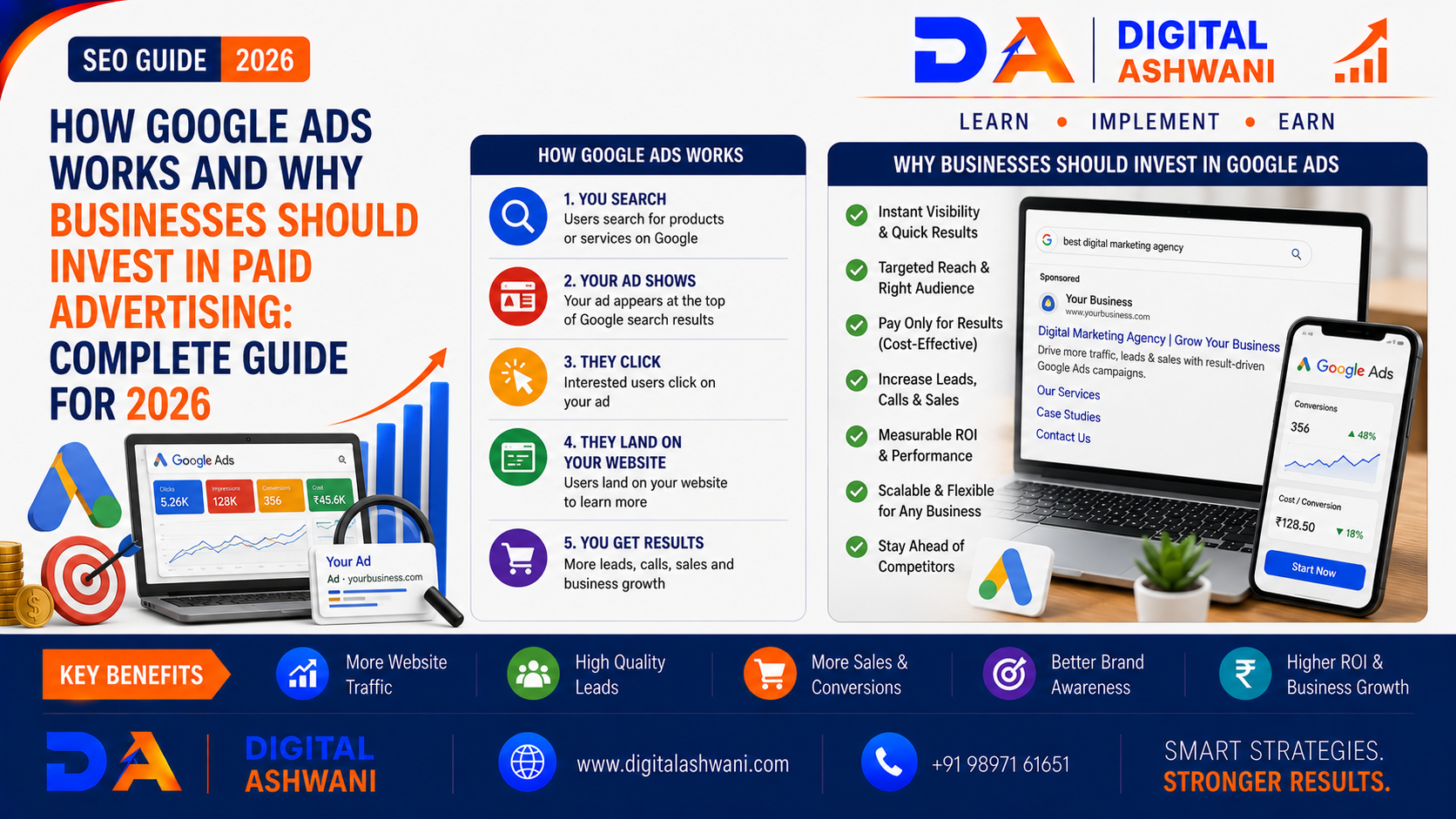
How Google Ads Works and Why Businesses Should Invest in Paid Advertising
Businesses today compete for attention across search engines, social media, websites, and countless digital platforms.
Among these channels, Google Ads remains one of the most powerful ways to reach people who are actively searching for products and services.
For example, a customer searching for:
- SEO Company Near Me
- Dentist in Delhi
- Best Digital Marketing Agency
- Buy Running Shoes Online
- Property Dealer in Noida
already has a specific need.
Google Ads allows businesses to place relevant advertisements in front of potential customers at the moment they are searching.
However, Google Ads is not simply about paying money to appear at the top of Google.
Campaign performance depends on factors such as:
- Keyword Relevance
- Ad Quality
- Bidding
- Landing Page Experience
- Search Intent
- Competition
- Conversion Performance
Understanding how the advertising system works is essential before investing a significant budget.
In this comprehensive guide by Digital Ashwani, you’ll learn How Google Ads Works, how the Google Ads auction operates, what businesses pay for, the major benefits of paid advertising, and how to build campaigns that generate measurable business results in 2026.
What Is Google Ads?
Google Ads is Google’s online advertising platform that allows businesses to promote products and services across Google’s advertising ecosystem.
Depending on the campaign type, advertisements can appear across:
- Google Search
- YouTube
- Google Display Network
- Google Maps
- Shopping Experiences
- Discover and other eligible Google surfaces
Businesses can use Google Ads to achieve objectives such as:
- Lead Generation
- Online Sales
- Website Traffic
- Phone Calls
- App Promotion
- Brand Awareness
The exact campaign options and placements available can change as Google updates its advertising products.
How Google Ads Works
The basic process is straightforward.
A user searches for something on Google.
For example:
“Local SEO Agency Delhi”
Google identifies advertisers whose targeting and ads may be eligible for that search.
An automated auction then determines which eligible ads can appear and in what order.
The outcome depends on multiple factors, including:
- Bid
- Ad Quality
- Relevance
- Search Context
- Competition
- Landing Page Experience
The winning advertisers don’t necessarily pay their maximum bid.
Google calculates the actual cost based on the auction and other applicable factors.
How the Google Ads Auction Works
Google Ads uses an automated auction whenever an eligible advertising opportunity becomes available.
The auction considers factors such as:
Your Bid
Your bid represents how much you’re willing to compete for a desired result.
Ad Quality
Google evaluates the expected usefulness and relevance of your ad.
Search Context
Factors surrounding the search can influence ad eligibility and performance.
These may include:
- Search Terms
- Location
- Device
- Time
- Other Contextual Signals
Ad Rank
Ad Rank helps determine whether and where an ad can appear.
Higher-quality and more relevant advertising can perform strongly without simply relying on the highest possible bid.
Why Google Ads Is Different From Organic SEO
SEO and Google Ads can both generate website traffic, but they work differently.
SEO
SEO focuses on earning organic visibility through:
- Helpful Content
- Technical SEO
- Website Authority
- Search Intent
- Internal Linking
- User Experience
Google Ads
Paid advertising allows businesses to compete for eligible ad placements through an advertising auction.
SEO can take time to build.
Google Ads can provide visibility much faster once campaigns are approved and eligible to serve.
The two strategies can work together rather than being treated as alternatives.
Google Ads Campaign Types
Google provides different campaign types for different business objectives.
Search Campaigns
Search campaigns can show text ads when users search for relevant terms.
They are particularly useful for:
- Lead Generation
- Service Businesses
- Local Businesses
- High-Intent Searches
Performance Max
Performance Max campaigns can access multiple Google advertising channels through a unified campaign structure.
They can be useful when advertisers want automated optimization across Google’s available inventory.
Display Campaigns
Display advertising can help businesses reach audiences across websites and apps within Google’s advertising ecosystem.
These campaigns can support:
- Awareness
- Remarketing
- Product Promotion
Shopping Campaigns
Shopping advertising is particularly relevant to ecommerce businesses.
Product information can appear in shopping-related experiences when campaigns and products are eligible.
Video Campaigns
Video campaigns allow businesses to promote video content, including advertising on YouTube.
How Google Ads Targeting Works
Targeting determines which audiences and search opportunities your advertisements can reach.
Depending on the campaign type, advertisers may use:
- Keywords
- Locations
- Languages
- Devices
- Audiences
- Demographics
- Remarketing Signals
- Search Themes or Other Automated Signals
The available targeting options vary by campaign type.
Keyword Targeting in Search Ads
Search campaigns can target keywords that relate to what potential customers search for.
Examples:
SEO Services Delhi
Google Ads Agency Delhi
Digital Marketing Company Delhi
Keyword research should focus on:
- Search Intent
- Commercial Value
- Relevance
- Competition
- Expected Conversion Potential
Don’t choose keywords simply because they have high search volume.
Understanding Search Intent
Search intent describes what a person is trying to accomplish with a search.
Informational Intent
Examples:
- What is SEO?
- How does Google Ads work?
Commercial Intent
Examples:
- Best SEO agency
- Google Ads management services
Transactional Intent
Examples:
- Hire SEO agency
- Buy running shoes online
Paid advertising often performs particularly well when campaigns align with strong commercial or transactional intent.
How Google Ads Bidding Works
Bidding tells Google how your campaign should compete for advertising opportunities.
Common strategies include:
- Maximize Clicks
- Maximize Conversions
- Target CPA
- Target ROAS
- Manual CPC in supported campaign setups
The best strategy depends on:
- Campaign Objective
- Conversion Data
- Budget
- Business Model
- Campaign Maturity
Don’t automatically choose a bidding strategy simply because it sounds advanced.
How Much Does Google Ads Cost?
There is no universal Google Ads price.
Costs depend on:
- Industry
- Keyword Competition
- Location
- Audience
- Campaign Type
- Quality
- Bidding Strategy
- Budget
- Conversion Performance
For example, highly competitive industries can have significantly higher costs than less competitive markets.
Understanding Cost Per Click
For many Search campaigns, advertisers pay when users click their ads.
A simple CPC calculation is:
CPC = Advertising Cost ÷ Clicks
For example:
- Ad Spend = ₹10,000
- Clicks = 500
Average CPC = ₹20
However, the lowest CPC isn’t always the best result.
A campaign generating fewer but highly qualified clicks can be more profitable than one generating thousands of inexpensive visitors who never convert.
Why Businesses Should Invest in Paid Advertising
Paid advertising can provide several strategic advantages.
Reach High-Intent Customers
Google Ads can connect businesses with users actively searching for their products or services.
This makes search advertising particularly useful for demand capture.
Generate Leads Faster
Unlike SEO, which generally requires time to build organic visibility, paid campaigns can begin generating traffic after campaigns become eligible to serve.
This makes Google Ads useful for:
- New Businesses
- Product Launches
- Seasonal Offers
- Local Services
- Lead Generation Campaigns
Control Advertising Budgets
Businesses can define campaign budgets and adjust spending according to performance.
Budget control makes paid advertising more measurable than many traditional advertising channels.
Target Specific Locations
Local businesses can focus advertising on relevant geographic areas.
For example:
- Delhi
- Noida
- Gurgaon
- Ghaziabad
Location targeting helps reduce exposure to audiences outside the intended market.
Measure Marketing Performance
Google Ads provides extensive performance data.
Businesses can monitor:
- Impressions
- Clicks
- CTR
- CPC
- Conversions
- Conversion Rate
- Cost Per Conversion
- Conversion Value
- ROAS Where Applicable
This allows businesses to make data-driven decisions.
Scale Successful Campaigns
When a campaign consistently generates profitable conversions, businesses can test increased budgets, additional keywords, new locations, or new campaign structures.
Scaling should be gradual rather than simply doubling spending without analyzing performance.
Support Brand Visibility
Even when users don’t immediately click, paid search can increase exposure to your brand for relevant searches.
Repeated exposure can contribute to brand recognition, although businesses should evaluate performance based on their actual objectives.
Test New Products and Services
Paid advertising can provide useful market feedback.
Businesses can test:
- New Offers
- Keywords
- Landing Pages
- Pricing Messages
- Customer Segments
- Product Categories
This information can also inform broader marketing strategies.
How Google Ads and SEO Work Together
Businesses don’t necessarily have to choose between SEO and Google Ads.
A combined strategy can provide:
Paid Visibility + Organic Visibility
Google Ads can generate immediate qualified traffic while SEO builds long-term organic visibility.
Search query data from paid campaigns can also provide useful insights for SEO keyword research.
Create High-Converting Landing Pages
Sending all paid traffic to your homepage isn’t always the best strategy.
Create landing pages that match the advertisement.
A strong landing page should include:
- Relevant Headline
- Clear Benefits
- Strong CTA
- Trust Signals
- Simple Navigation
- Mobile-Friendly Design
- Fast Loading Speed
The message should remain consistent from:
Search → Ad → Landing Page → Conversion
Set Up Conversion Tracking
Conversion tracking is essential for understanding whether advertising produces business results.
Track valuable actions such as:
- Form Submissions
- Phone Calls
- Purchases
- Appointment Bookings
- Quote Requests
- Sign-Ups
Avoid optimizing campaigns around low-value actions when your actual business objective is generating qualified customers.
Use Negative Keywords
Negative keywords can help prevent ads from appearing for irrelevant searches.
For example, a paid SEO service may exclude searches related to:
- Free
- Jobs
- Internship
- Course
Regularly review search terms and identify irrelevant traffic.
Write Relevant Ad Copy
Effective ad copy should match the customer’s search intent.
Include:
- Relevant Keywords
- Benefits
- Unique Selling Proposition
- Clear CTA
- Trust Signals Where Appropriate
Avoid exaggerated promises or misleading claims.
Monitor Search Terms
Search term analysis helps identify:
- Irrelevant Searches
- New Keyword Opportunities
- High-Converting Queries
- Low-Quality Traffic
This is one of the most useful optimization activities for Search campaigns.
Common Google Ads Mistakes
Running Ads Without Conversion Tracking
Without conversion data, it becomes difficult to determine which campaigns generate meaningful business results.
Targeting Too Broadly
Broad targeting without sufficient control can result in wasted spending.
Ignoring Negative Keywords
Irrelevant searches can consume budget without producing valuable leads.
Sending Traffic to Poor Landing Pages
Even good ads cannot compensate for a confusing or slow landing page.
Focusing Only on Clicks
Clicks are not the final objective for most businesses.
Focus on:
Clicks → Leads → Customers → Revenue
Changing Campaigns Too Frequently
Constant changes can make performance difficult to evaluate.
Allow sufficient time and data for meaningful analysis.
Ignoring Mobile Users
Many searches happen on smartphones.
Ensure your landing pages and conversion paths work well on mobile devices.
Google Ads Investment Checklist
Before investing in paid advertising, make sure you have:
- Clear Campaign Objective
- Defined Target Audience
- Keyword Research
- Appropriate Campaign Type
- Conversion Tracking
- Relevant Landing Pages
- Strong Ad Copy
- Negative Keyword Strategy
- Suitable Bidding Strategy
- Realistic Budget
- Analytics Setup
- Performance Monitoring
- Regular Optimization
Internal Linking Suggestions (Digital Ashwani)
Strengthen the Google Ads content cluster by linking this article with:
- Complete Google Search Ads Campaign Setup Guide for Better Lead Generation
- Best Google Search Campaign Bidding Strategies Explained
- Google Ads Terminology Every Digital Marketer Should Understand Before Advertising
- Negative Keywords Strategy to Reduce Wasted Google Ads Spending
- PPC Audit Checklist Every Business Should Complete Before Scaling Campaigns
- What Is Cost Per Click (CPC)? 15 Powerful Ways to Reduce CPC and Improve ROI
- How Artificial Intelligence Is Changing Google Ads Campaign Optimization
- Google Ads Strategy for Doctors to Increase Patient Appointments
- Meta Ads Optimization Tips for Lower Cost Per Lead
These internal links connect Google Ads fundamentals with campaign setup, bidding, CPC, negative keywords, audits, AI optimization, and industry-specific advertising.
External Resources
For current Google Ads guidance, refer to official resources such as:
- Google Ads Help
- Google Ads Policies
- Google Ads Learning Center
- Google Analytics Help
- Google Search Central
Advertising features, policies, and campaign options can change over time, so review current official documentation before launching campaigns.
Frequently Asked Questions
How does Google Ads work?
Google Ads uses an automated auction to determine which eligible advertisements can appear and where they may appear. Factors such as bids, ad quality, relevance, search context, and landing page experience can influence the outcome.
Is Google Ads worth it for small businesses?
It can be, particularly when campaigns target relevant customers, conversion tracking is configured correctly, and spending is managed according to profitable business outcomes.
How much should a business spend on Google Ads?
There is no universal budget. Start with an amount the business can comfortably test and optimize, then adjust spending based on conversion volume, lead quality, customer value, and profitability.
Is Google Ads better than SEO?
Neither is universally better. Google Ads can provide paid visibility quickly, while SEO can build organic visibility over time. Many businesses benefit from using both.
Does Google Ads guarantee the first position?
No. Paying more does not guarantee a particular position. Ad eligibility and position depend on the auction and multiple quality and contextual factors.
How long does Google Ads take to work?
Campaigns can begin serving once they are approved and eligible, but meaningful optimization requires sufficient performance data. The timeline for profitable results varies by industry, competition, budget, and conversion rate.
Can Google Ads generate leads?
Yes. Search advertising can generate qualified leads when campaigns target relevant searches and are supported by strong landing pages, conversion tracking, compelling offers, and effective optimization.
Should I use Google Ads and SEO together?
Yes. Paid and organic search can complement each other. Google Ads can provide immediate paid visibility while SEO works toward sustainable organic growth.
Final Thoughts
Understanding How Google Ads Works is essential before investing in paid advertising.
Google Ads is not simply a system where the highest bidder automatically wins.
Successful campaigns depend on:
Intent → Relevance → Ad Quality → Landing Page Experience → Conversion Tracking → Continuous Optimization
Businesses should focus less on generating the maximum number of clicks and more on attracting the right customers.
A profitable campaign is one that turns advertising investment into measurable business outcomes.
When combined with strong SEO, conversion-focused landing pages, accurate tracking, and continuous optimization, Google Ads can become a powerful growth channel for businesses in 2026.
At Digital Ashwani, we regularly publish practical guides on Google Ads, PPC, SEO, AI Marketing, Digital Marketing, Local SEO, and Conversion Optimization to help businesses make smarter marketing decisions and generate sustainable growth.
