

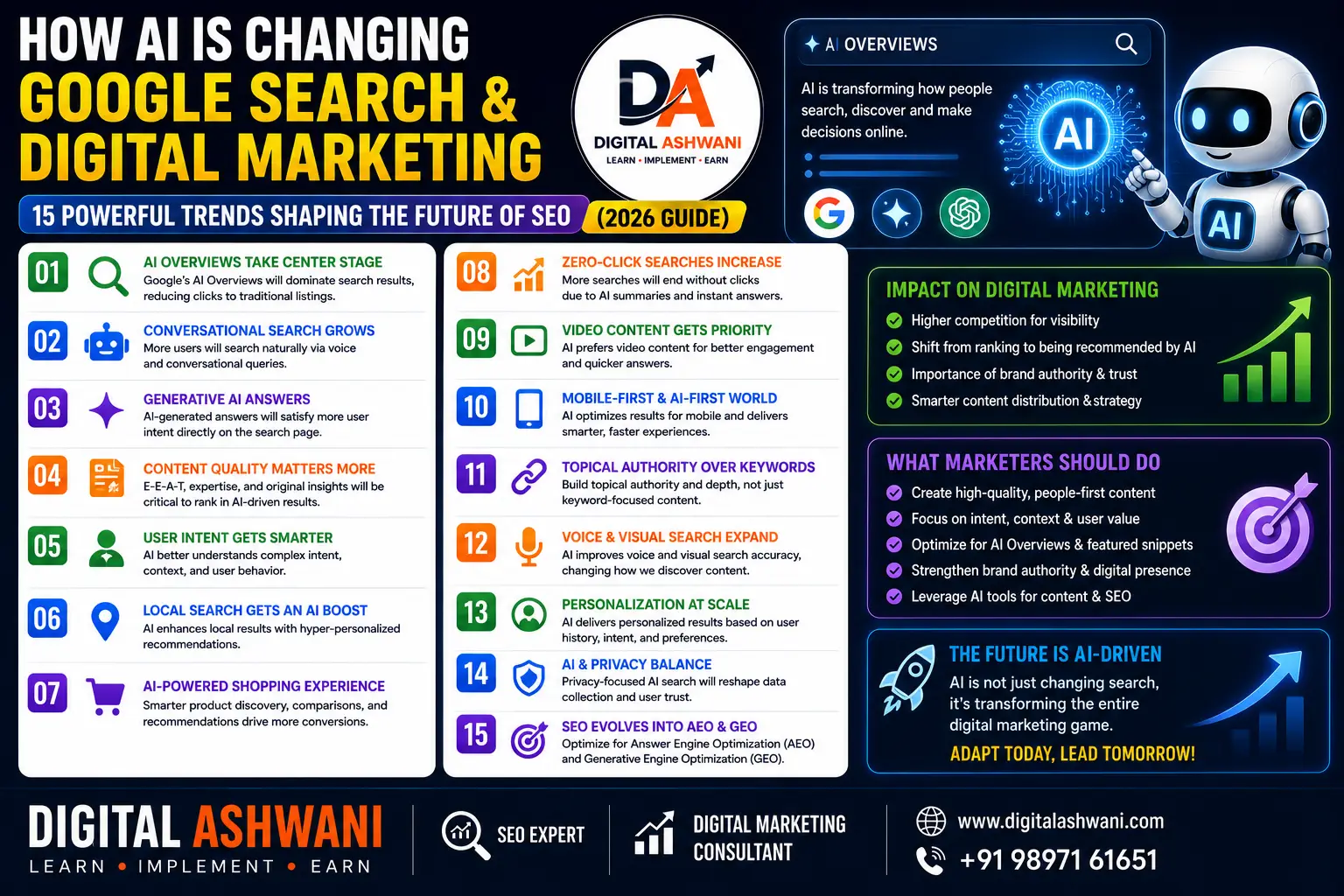
Artificial Intelligence is reshaping the internet faster than any technology since the rise of smartphones. Search engines are evolving from simply listing web pages to providing direct, AI-generated answers. At the same time, digital marketers are using AI to create content, automate campaigns, analyze data, and personalize customer experiences.
For businesses, bloggers, agencies, and marketers, this shift creates both opportunities and challenges. Traditional SEO remains important, but success in 2026 also requires understanding AI Google Search, AI Overviews, AI Search, and the Future of SEO.
In this comprehensive guide by Digital Ashwani, we’ll explain how AI is changing Google Search, how it affects digital marketing, and what you should do today to prepare for the future.
What Is AI Google Search?
AI Google Search refers to Google’s use of artificial intelligence to better understand search queries, summarize information, and provide more useful answers.
Instead of showing only a list of links, Google increasingly combines traditional search results with AI-generated summaries, recommendations, and contextual information.
The goal is to help users find answers more quickly while improving the overall search experience.
Why Google Is Using AI
People now ask longer, more conversational questions such as:
- “Which laptop is best for students under ₹60,000?”
- “How do I recover from a Google ranking drop?”
- “What’s the difference between SEO and AEO?”
AI helps Google understand complex questions, compare information from multiple sources, and generate more complete responses.
This shift reflects changing user expectations for faster and more helpful answers.
What Are AI Overviews?
AI Overviews are AI-generated summaries that may appear at the top of Google Search for certain queries.
Instead of immediately presenting a list of websites, Google may provide:
- A concise summary
- Key points
- Step-by-step explanations
- Product comparisons
- Follow-up questions
- Links to supporting sources
For users, AI Overviews can save time. For publishers, they create a new opportunity to earn visibility when content is considered authoritative and helpful.
What Is AI Search?
AI Search goes beyond matching keywords.
Modern AI-powered search systems analyze:
- User intent
- Context
- Natural language
- Relationships between topics
- Content quality
- Authority
- Freshness
This allows search engines to provide more personalized and conversational responses.
15 Ways AI Is Changing Google Search & Digital Marketing
1. Search Is Becoming Conversational
Users increasingly type or speak complete questions instead of short keyword phrases.
Content should answer questions naturally.
2. AI Overviews Reduce Simple Search Clicks
For straightforward informational queries, users may find answers directly within AI-generated summaries.
To remain competitive, publishers should create comprehensive, high-value content that encourages deeper engagement.
3. User Intent Matters More Than Keywords
Modern SEO focuses on solving user problems rather than repeating exact keywords.
Helpful, relevant content is more important than keyword density.
4. AEO Is Becoming Essential
Answer Engine Optimization (AEO) helps content become more suitable for AI-generated answers.
Best practices include:
- Clear headings
- FAQ sections
- Structured content
- Direct answers
- Strong EEAT signals
5. AI Improves Content Research
Marketers now use AI tools to:
- Brainstorm topics
- Analyze competitors
- Summarize research
- Generate outlines
- Identify content gaps
AI speeds up research but should always be combined with human review.
6. Content Quality Matters More Than Quantity
Publishing hundreds of low-quality articles is becoming less effective.
Original insights, expertise, and trustworthy information are increasingly rewarded.
7. EEAT Continues to Grow in Importance
Experience, Expertise, Authoritativeness, and Trustworthiness remain key quality signals.
Businesses should demonstrate real knowledge and practical experience.
8. AI Is Transforming Google Ads
Artificial intelligence now supports:
- Smart bidding
- Audience targeting
- Creative generation
- Campaign optimization
- Performance forecasting
Automation saves time while improving efficiency.
9. Personalization Is Increasing
AI helps deliver more relevant content and advertisements based on user behavior and preferences.
This improves engagement and customer experiences.
10. AI Supports Better Analytics
Modern AI tools help marketers:
- Identify trends
- Predict performance
- Analyze customer journeys
- Detect opportunities
Data-driven decisions become faster and more accurate.
11. Voice Search Continues to Grow
Voice assistants encourage conversational search behavior.
Businesses should optimize for natural language and question-based queries.
12. Video SEO Is More Important
Video content continues to grow across search engines and social platforms.
Optimized videos improve discoverability and audience engagement.
13. First-party Data Is Becoming Critical
As privacy regulations evolve and third-party cookies decline, businesses increasingly rely on:
- Email subscribers
- CRM systems
- Customer accounts
- Loyalty programs
Owning customer relationships becomes a strategic advantage.
14. AI Helps Improve Productivity
AI can automate repetitive marketing tasks such as:
- Drafting content
- Creating reports
- Generating ad copy
- Organizing workflows
However, strategic decisions still require human expertise.
15. The Future of SEO Includes AI Collaboration
The Future of SEO isn’t about replacing human marketers with AI.
Instead, success will come from combining:
- Human expertise
- Original content
- Technical SEO
- AI-assisted workflows
- Strong brand authority
Future of SEO
SEO is evolving rather than disappearing.
Future SEO strategies will focus on:
AI Search Optimization
Creating content that AI systems can easily understand and summarize.
Topic Clusters
Building authority by covering subjects comprehensively instead of publishing isolated articles.
Brand Authority
Trusted brands are more likely to be recognized across both traditional search and AI-powered experiences.
Helpful Content
Content should solve real problems, answer user questions, and provide unique value.
Continuous Updates
Refreshing evergreen articles helps maintain relevance as information changes.
How Businesses Should Adapt
To succeed in the era of AI Google Search, businesses should:
Create Helpful Content
Prioritize usefulness over volume.
Invest in Technical SEO
Fast, secure, and mobile-friendly websites remain essential.
Optimize for AI Overviews
Use concise answers, structured headings, and FAQ sections.
Build EEAT
Show expertise through original research, case studies, and practical experience.
Diversify Traffic Sources
Relying solely on organic search is risky.
Develop audiences through:
- Email marketing
- Social media
- Communities
- Video platforms
- Direct traffic
Internal Linking Suggestions (Digital Ashwani)
Strengthen topical authority by linking this article with:
- AI SEO vs Traditional SEO
- How to Rank in ChatGPT, Gemini & AI Search Results (AEO Guide)
- Google Marketing Live 2026
- Google Ads AI Features 2026
- Digital Marketing Trends 2026
- SEO Checklist 2026
- Cloudflare AI Crawler Blocking
- Best AI Tools for Digital Marketing
Internal links improve navigation and reinforce your expertise across related topics.
External Resources
For additional learning, explore:
- Google Search Central
- Google Search Central Blog
- Google AI
- Google Ads Help Center
- Google Analytics Help Center
Official resources provide the latest guidance on AI-powered search, SEO, and digital marketing best practices.
Frequently Asked Questions
What is AI Google Search?
AI Google Search refers to Google’s use of artificial intelligence to better understand search queries, generate summaries, and improve search results.
What are AI Overviews?
AI Overviews are AI-generated summaries that may appear at the top of Google Search, helping users find answers more quickly.
Is SEO still important in 2026?
Yes. SEO remains essential, but it now works alongside AI Search Optimization and Answer Engine Optimization (AEO).
Will AI replace digital marketers?
No. AI improves productivity and automates repetitive tasks, but strategy, creativity, ethical judgment, and business understanding still require human expertise.
How should businesses prepare for AI Search?
Focus on helpful content, strong EEAT signals, technical SEO, structured formatting, topical authority, and ongoing content updates.
Final Thoughts
Artificial intelligence is fundamentally changing how people search for information and how businesses reach their audiences. AI Google Search, AI Overviews, and modern AI Search experiences are pushing marketers to focus less on manipulating rankings and more on creating genuinely valuable, trustworthy content.
The Future of SEO is not about choosing between humans and AI—it’s about using both effectively. Businesses that combine AI-powered efficiency with strong expertise, technical SEO, and user-focused content will be best positioned to succeed.
Rather than fearing these changes, marketers should embrace them as an opportunity to build stronger brands, publish better content, and connect with audiences in more meaningful ways.
At Digital Ashwani, we continue to share practical insights on AI, SEO, Google updates, PPC, and digital marketing so you can stay ahead in an increasingly AI-driven search landscape.
