

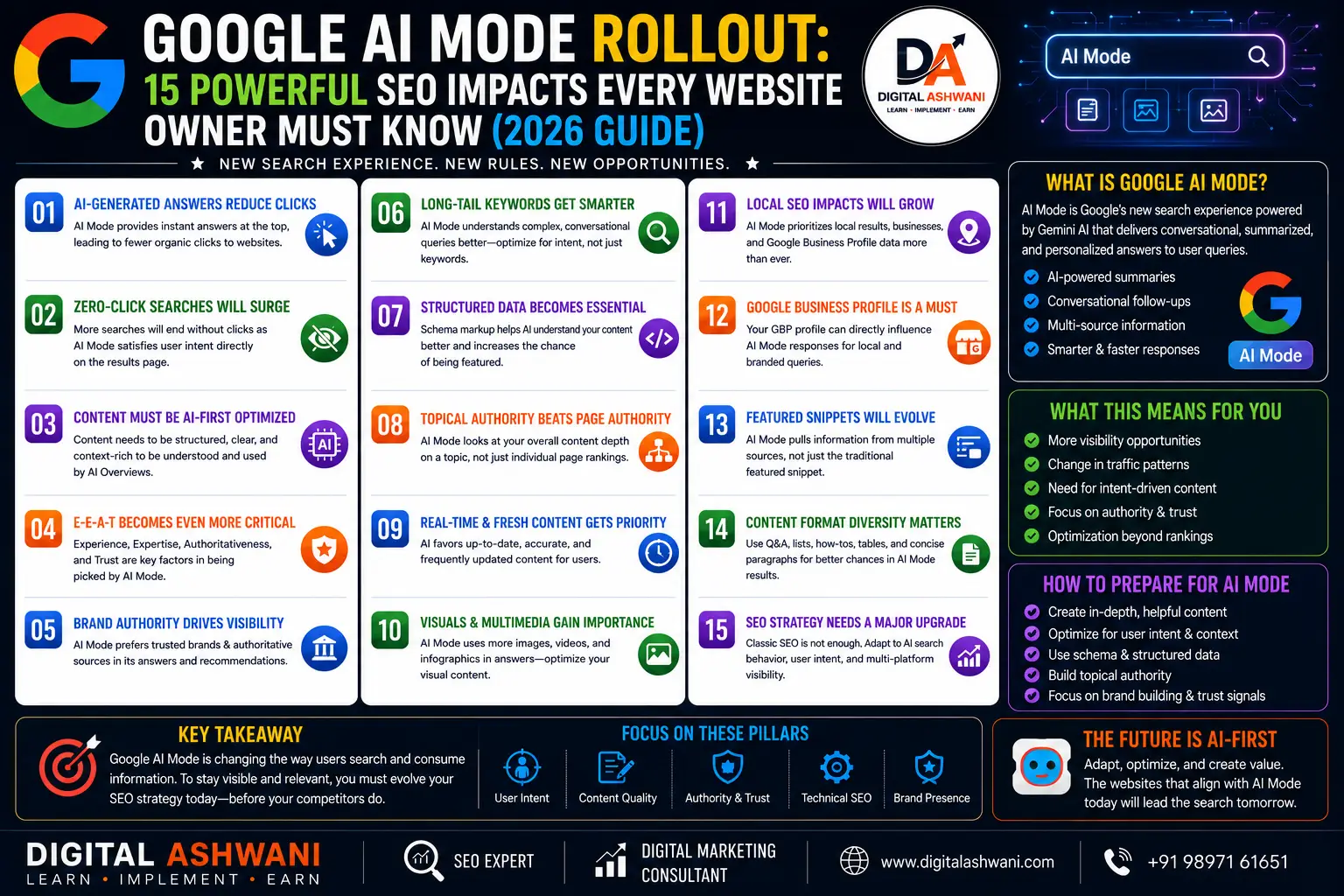
Google Search is entering a new era with the Google AI Mode Rollout. Instead of showing only traditional blue links, Google is increasingly providing AI-generated answers, follow-up conversations, and personalized search experiences.
For website owners, bloggers, digital marketers, and SEO professionals, this is one of the biggest search updates in recent years. The way users discover information, interact with search results, and visit websites is changing rapidly.
Many businesses are asking important questions:
- Will Google AI Mode reduce organic traffic?
- Is traditional SEO still effective?
- How can websites appear in AI-generated answers?
- What content performs best in AI Search?
- How should businesses prepare for the future?
The good news is that SEO is not disappearing—it is evolving.
In this complete guide by Digital Ashwani, you’ll learn how the Google AI Mode Rollout affects SEO, what changes you should expect, and the strategies that can help your website remain visible in Google’s AI-powered search experience.
What Is Google AI Mode?
Google AI Mode is an AI-powered search experience that allows users to receive conversational, detailed, and context-aware answers directly within Google Search.
Instead of typing multiple searches, users can ask complex questions and continue the conversation naturally.
The experience combines:
- Artificial Intelligence
- Google’s Search Index
- Real-time web information
- Context-aware responses
- Follow-up conversations
This creates a faster and more interactive search experience.
Why Google Introduced AI Mode
Google’s goal is to make search more helpful by reducing the time users spend searching across multiple websites.
Today’s users expect:
- Instant answers
- Personalized responses
- Follow-up conversations
- Rich summaries
- Multi-step problem solving
AI Mode helps users complete these tasks without repeatedly refining their searches.
How Google AI Mode Changes Search
Traditional Google Search focused on showing a ranked list of webpages.
Google AI Mode introduces a more conversational experience where users receive:
- AI-generated summaries
- Contextual recommendations
- Follow-up suggestions
- Multiple source references
- Interactive search sessions
This changes how users interact with search results and how websites earn visibility.
15 Powerful SEO Impacts of Google AI Mode
1. AI Answers Reduce Traditional Clicks
Users Get Answers Faster
Many informational questions are answered directly inside Google AI Mode.
Instead of opening several websites, users may receive a summarized response immediately.
This can reduce clicks for simple informational queries.
What Website Owners Should Do
Focus on:
- Original research
- Expert opinions
- In-depth guides
- Case studies
- Practical examples
Unique content gives users a reason to visit your website.
2. EEAT Becomes Even More Important
Trust Signals Matter More
Google AI Mode prioritizes content that demonstrates:
- Experience
- Expertise
- Authoritativeness
- Trustworthiness
Websites with strong EEAT are more likely to be referenced in AI-generated responses.
How to Improve EEAT
- Publish expert-written content.
- Add author biographies.
- Include trustworthy sources.
- Keep articles updated.
- Share real-world experiences.
3. Topical Authority Will Beat Individual Keywords
Content Clusters Matter
Instead of publishing isolated articles, websites should build complete topic clusters.
For example, if your niche is Digital Marketing, create related content covering:
- AI SEO
- Google Ads
- Blogging
- Technical SEO
- Content Marketing
- AI Tools
- Social Media Marketing
A connected content ecosystem helps Google understand your expertise.
Internal Linking Is Essential
Link related articles naturally to strengthen topical authority and improve user navigation.
4. Search Intent Is More Important Than Ever
Answer Real Questions
Google AI Mode focuses on satisfying user intent rather than simply matching keywords.
Create content that directly answers:
- What?
- Why?
- How?
- When?
- Which?
Clear answers increase the likelihood of being referenced by AI.
Write for Humans First
Avoid keyword stuffing.
Focus on solving real problems with clear and practical explanations.
5. Long-Form Content Gains More Value
Comprehensive Content Performs Better
Detailed guides often provide the context AI systems need to generate accurate summaries.
Cover topics thoroughly with:
- Examples
- Comparisons
- FAQs
- Statistics
- Actionable advice
Maintain Readability
Use:
- Short paragraphs
- Bullet points
- Tables
- Descriptive headings
Structured content improves both user experience and AI readability.
6. Brand Mentions Become Stronger Signals
AI Understands Brands
Google increasingly recognizes entities rather than just websites.
Consistent brand mentions across:
- News websites
- Blogs
- Podcasts
- Social media
- Online communities
can strengthen your online authority.
Build Brand Recognition
Publish consistently, engage with your audience, and create valuable resources that encourage others to mention your brand.
7. Featured Snippets Remain Valuable
AI Uses Structured Content
Well-structured pages with concise answers, lists, and FAQs are easier for AI systems to interpret.
Optimize for:
- Featured Snippets
- People Also Ask
- FAQ sections
These elements can increase visibility within AI-powered search experiences.
Use Clear Formatting
Present information in a logical structure that helps both users and search engines.
8. Zero-Click Searches Continue to Increase
Visibility Matters Beyond Clicks
Not every successful search results in a website visit.
Even when users don’t click, appearing in AI-generated answers increases brand awareness and credibility.
Measure More Than Traffic
Monitor additional metrics such as:
- Brand searches
- Impressions
- Engagement
- Returning visitors
- Leads
- Conversions
Modern SEO success extends beyond page views.
9. Conversational Search Is the New Normal
Google AI Mode allows users to ask follow-up questions without starting a new search. Instead of entering separate keywords, users interact with Google like they would with an AI assistant.
Why This Matters for SEO
Your content should answer multiple related questions within a single article. This increases the chances of your page being used as a source for AI-generated responses.
For example, if your article is about Google AI Mode Rollout, also answer questions such as:
- How does Google AI Mode work?
- Will AI Mode replace traditional Google Search?
- Does AI Mode reduce organic traffic?
- How can websites rank in AI Mode?
Covering related questions helps search engines understand the depth of your content.
10. Answer Engine Optimization (AEO) Becomes Essential
Traditional SEO focuses on ranking web pages, while Answer Engine Optimization (AEO) focuses on making your content easy for AI systems to understand and reference.
How to Optimize for AEO
- Write direct answers at the beginning of sections.
- Use question-based headings.
- Include FAQ sections.
- Keep explanations simple and structured.
- Add bullet points and numbered lists.
AEO complements traditional SEO and increases the likelihood of appearing in AI-generated responses.
11. User Experience (UX) Influences AI Visibility
Google continues to prioritize websites that offer a great user experience.
Improve User Experience
Focus on:
- Fast loading speed
- Mobile-friendly design
- Easy navigation
- Clean layouts
- Readable typography
- Secure HTTPS connection
Users who enjoy your website are more likely to stay longer, engage with your content, and return in the future.
12. Multimedia Content Gains More Importance
AI-powered search increasingly references different content formats—not just text.
Include Multiple Content Types
Enhance your articles with:
- Infographics
- Images
- Videos
- Charts
- Comparison tables
- Screenshots
Multimedia improves user engagement and makes complex topics easier to understand.
Optimize Image ALT Text
Use descriptive ALT text containing your focus keyword where appropriate.
Example:
Google AI Mode Rollout infographic
13. Fresh Content Performs Better
Search trends change rapidly, especially in AI and digital marketing.
Update Existing Articles
Refresh your content regularly by:
- Adding new examples
- Updating statistics
- Replacing outdated screenshots
- Including recent Google announcements
- Expanding FAQs
Fresh content signals that your website remains relevant.
14. Brand Authority Becomes a Competitive Advantage
Google AI Mode prefers trustworthy and recognizable sources.
How to Build Brand Authority
- Publish consistently.
- Earn quality backlinks.
- Get mentioned on reputable websites.
- Build an active social media presence.
- Share original research and case studies.
- Encourage branded searches.
Strong brands are more likely to be referenced across Google’s AI-powered search experiences.
15. SEO Success Will Be Measured Differently
For years, SEO success meant higher rankings and more clicks.
In the AI era, businesses should also measure:
- AI visibility
- Brand mentions
- Organic impressions
- Branded searches
- User engagement
- Lead generation
- Conversion rates
- Returning visitors
The focus is shifting from traffic volume to business outcomes.
How to Optimize for Google AI Mode
Businesses should adapt their SEO strategy by focusing on quality, authority, and user experience.
Create Helpful Content
Write comprehensive articles that genuinely solve users’ problems instead of targeting keywords alone.
Build Topic Clusters
Publish multiple related articles and connect them through internal links.
For example, on Digital Ashwani, articles about AI SEO, Google Updates, Blogging, Google Ads, and Content Marketing naturally reinforce one another.
Strengthen EEAT
Improve trust by:
- Showing author expertise.
- Citing reliable sources.
- Sharing practical experience.
- Publishing original insights.
Optimize for Featured Snippets
Answer important questions in concise paragraphs before expanding into detailed explanations.
Monitor Performance
Track important SEO metrics such as:
- Organic impressions
- Click-through rate (CTR)
- Average engagement time
- Conversions
- Brand searches
- AI-driven referrals (when available)
Common SEO Mistakes After Google AI Mode Rollout
Publishing Thin AI-Generated Content
Generic articles without unique insights are less likely to perform well.
Ignoring Search Intent
Always focus on solving user problems instead of repeating keywords.
Weak Internal Linking
Connect related articles to strengthen topical authority.
Neglecting Technical SEO
AI-friendly content still requires a technically sound website.
Failing to Update Existing Content
SEO is an ongoing process. Regular updates keep your content accurate and competitive.
Internal Linking Suggestions (Digital Ashwani)
Strengthen your AI SEO content cluster by linking this article with:
- Google Search Ranking Fluctuation 2026
- Google June 2026 Spam Update
- Why Organic Traffic Is Dropping Even When Rankings Stay the Same
- AI SEO vs Traditional SEO
- Zero-Click SEO Strategy
- Why SEO Is No Longer Just About Google
- How to Rank in ChatGPT Search Results
- Gemini AI Search vs Google Search
- Brand Mentions vs Backlinks
- SEO Checklist for 2026
- Top Digital Marketing Trends in 2026
- Future of Blogging in the AI Era
These internal links improve navigation, increase session duration, and strengthen topical authority.
External Resources
For trusted information about Google’s AI-powered search, follow these official resources:
- Google Search Central
- Google Search Central Blog
- Google AI
- Google Search Console Help
- Google Analytics Help Center
- Google Ads Help Center
Regularly reviewing official documentation helps you stay aligned with the latest SEO best practices.
Frequently Asked Questions
What is Google AI Mode?
Google AI Mode is an AI-powered search experience that provides conversational answers, supports follow-up questions, and combines Google’s search index with advanced AI to deliver more detailed and contextual responses.
Will Google AI Mode replace traditional Google Search?
No. Traditional search results continue to exist, but AI Mode enhances the search experience by adding AI-generated summaries and conversational interactions.
Can Google AI Mode reduce website traffic?
For some informational searches, AI-generated answers may reduce clicks. However, websites that publish original, authoritative, and comprehensive content can still attract qualified visitors and gain brand visibility.
How can I optimize my website for Google AI Mode?
Focus on creating people-first content, improving EEAT, answering user questions clearly, building topical authority, strengthening internal linking, and maintaining an excellent user experience.
Is traditional SEO still important?
Yes. Traditional SEO remains the foundation of online visibility. AI Search Optimization and Answer Engine Optimization should complement—not replace—technical SEO, on-page SEO, and quality content.
Final Thoughts
The Google AI Mode Rollout marks one of the most significant changes in search since the introduction of mobile-first indexing.
While AI-powered search changes how users interact with search results, it does not eliminate the need for SEO. Instead, it rewards websites that provide trustworthy information, demonstrate real expertise, and create content that genuinely helps users.
Businesses that continue relying only on keyword optimization may struggle as AI becomes more sophisticated. Those that invest in comprehensive content, strong EEAT signals, topical authority, Answer Engine Optimization, and brand building will be better positioned to succeed.
At Digital Ashwani, we recommend embracing AI as an opportunity rather than viewing it as a threat. By combining traditional SEO best practices with AI Search Optimization, you can build a resilient strategy that continues to generate visibility, trust, and sustainable organic growth in 2026 and beyond.
