
Google Ads vs SEO: Which Marketing Strategy Delivers Better Business Results?
When businesses want more website traffic, leads, sales, and online visibility, two marketing strategies often come into the conversation: Google Ads and SEO.
Both strategies can help businesses reach potential customers on Google, but they work in very different ways.
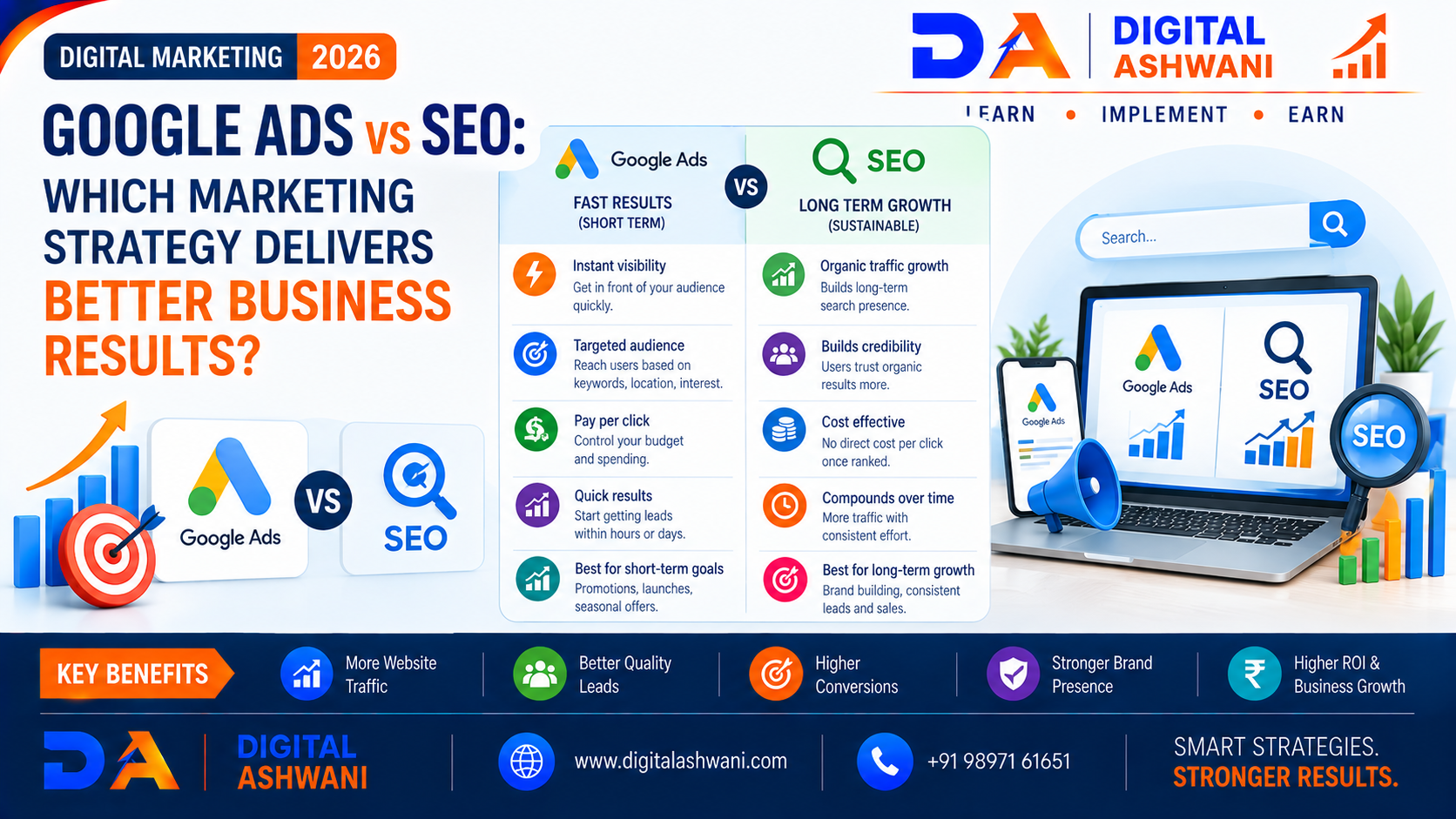
Google Ads allows businesses to pay for advertising placements and reach potential customers quickly, while SEO (Search Engine Optimization) focuses on improving a website’s organic visibility so it can attract relevant traffic without paying for every click.
The important question is not simply whether Google Ads or SEO is better. The real question is:
Which strategy is more suitable for your business goals, budget, competition, and timeline?
In this guide, we will compare Google Ads vs SEO based on speed, cost, traffic, conversions, long-term value, ROI, targeting, scalability, and business growth.
Table of Contents
- What Is Google Ads?
- What Is SEO?
- Google Ads vs SEO: Key Differences
- Google Ads vs SEO: Speed of Results
- Google Ads vs SEO: Cost Comparison
- Google Ads vs SEO: Traffic and Visibility
- Which Strategy Generates Better Leads?
- Google Ads vs SEO for Local Businesses
- Google Ads vs SEO for E-commerce Businesses
- Google Ads vs SEO: Long-Term Business Value
- Can Google Ads and SEO Work Together?
- Common Mistakes Businesses Should Avoid
- How to Choose the Right Strategy for Your Business
- Frequently Asked Questions
- Final Thoughts
What Is Google Ads?
Google Ads is Google’s paid advertising platform that allows businesses to display advertisements to people searching for specific products, services, or information.
For example, if someone searches for:
“digital marketing agency near me”
businesses can use Google Ads to appear in sponsored search results for relevant searches.
Google Ads can be used for several advertising objectives, including:
- Website traffic
- Lead generation
- Phone calls
- Online sales
- App promotion
- Brand awareness
- Local business promotion
One of the biggest advantages of Google Ads is speed. Once a campaign is properly configured and approved, businesses can start receiving impressions and clicks without waiting months for organic rankings.
How Google Ads Works
Google Ads generally operates through an auction system.
When a person searches for a keyword, Google evaluates eligible advertisements based on multiple factors, including bid, ad relevance, landing-page experience, and other auction signals.
This means simply paying more does not automatically guarantee the best position.
A successful Google Ads campaign requires:
- Relevant keywords
- Strong ad copy
- Appropriate targeting
- Effective bidding
- High-quality landing pages
- Conversion tracking
- Continuous optimization
What Is SEO?
SEO stands for Search Engine Optimization.
It involves improving a website and its content to increase visibility in unpaid, organic search results.
SEO can involve several areas, including:
- Keyword research
- On-page SEO
- Technical SEO
- Content optimization
- Internal linking
- Website performance
- Local SEO
- Backlink development
- User experience
- Structured content
For example, a business targeting the keyword “Google Ads management services” may create a useful, optimized service page designed to appear in Google’s organic results.
Unlike paid advertising, businesses do not pay Google every time someone clicks an organic result.
However, SEO requires investment in content, technical improvements, expertise, and ongoing optimization.
How SEO Works
SEO is designed around helping search engines understand a website and determine how relevant and useful its pages are for particular searches.
A strong SEO strategy usually focuses on three broad areas:
On-Page SEO:
Improving content, headings, keywords, internal links, titles, descriptions, and page structure.
Technical SEO:
Improving crawling, indexing, website architecture, performance, mobile usability, and technical accessibility.
Off-Page SEO:
Building authority and credibility through relevant mentions, links, digital PR, citations, and other signals.
SEO generally takes longer to build than paid advertising, but successful organic visibility can continue generating traffic over an extended period.
Google Ads vs SEO: Key Differences
| Factor | Google Ads | SEO |
|---|---|---|
| Traffic Type | Paid | Organic |
| Speed | Fast | Usually slower |
| Cost Model | Generally pay per click/impression depending on campaign | Investment in SEO work/content/tools |
| Immediate Visibility | Possible | Usually requires time |
| Long-Term Traffic | Stops when campaigns stop | Can continue if rankings and content remain strong |
| Keyword Targeting | Highly controllable | Based on relevance and search intent |
| Testing | Fast | Slower |
| Scalability | Can increase budget | Requires additional SEO investment |
| Local Visibility | Strong | Strong |
| Brand Authority | Can support awareness | Can build organic authority over time |
The key difference is simple:
Google Ads can buy immediate visibility, while SEO aims to earn sustainable organic visibility.
Google Ads vs SEO: Speed of Results
If your business needs traffic quickly, Google Ads can provide a faster route to search visibility.
For example, a new business launching a service may not have enough organic authority to rank immediately for competitive keywords.
With Google Ads, the business can create campaigns around relevant search terms and potentially start receiving traffic soon after launch.
SEO works differently.
A new website may need time for search engines to crawl, index, evaluate, and rank its content.
This does not mean SEO cannot produce results quickly in certain situations. Less competitive keywords, strong existing websites, and technically sound pages can sometimes gain visibility faster.
However, SEO should generally be viewed as a long-term marketing investment rather than an instant traffic source.
When Speed Matters
Google Ads can be useful when:
- You are launching a new product.
- You need leads quickly.
- You are running a limited-time offer.
- You want to test keyword demand.
- You are entering a new market.
- Your organic rankings are not yet strong.
SEO can be more suitable when:
- You want sustainable organic traffic.
- You are building a content-driven website.
- You want to increase organic visibility.
- You want to reduce long-term dependence on paid traffic.
Google Ads vs SEO: Cost Comparison
Cost is one of the biggest differences between Google Ads and SEO.
With Google Ads, businesses generally pay when users interact with ads depending on the campaign’s bidding model.
For search campaigns, cost per click (CPC) is a major consideration.
If a keyword is highly competitive, clicks can become expensive.
For example, keywords related to insurance, finance, legal services, real estate, and other competitive industries can have significantly different advertising costs than less competitive searches.
SEO does not charge a fee for every organic click.
However, that does not make SEO completely free.
Businesses may need to invest in:
- SEO professionals
- Content writers
- SEO tools
- Developers
- Link-building activities
- Content production
- Technical optimization
Therefore, the correct comparison is not:
Paid = expensive, SEO = free.
A more accurate comparison is:
Google Ads often produces variable advertising costs directly connected to campaign activity, while SEO requires investment in building and maintaining organic search visibility.
Google Ads vs SEO: Traffic and Visibility
Google Ads can place a business in prominent advertising positions for targeted searches.
SEO can help a business earn visibility in Google’s organic search results.
Both can therefore contribute to search visibility, but the user experience is different.
Paid advertisements are clearly identified as ads.
Organic results are not paid placements.
A strong search strategy can use both channels to occupy more search-result real estate.
For example, a business could appear through:
- A Google Ad
- An organic search result
- A Google Business Profile listing
- Supporting informational content
This can create multiple opportunities for potential customers to discover the business.
Which Strategy Generates Better Leads?
Lead generation depends on much more than the marketing channel.
Important factors include:
- Search intent
- Keyword selection
- Offer
- Landing-page quality
- Pricing
- Competition
- Brand trust
- Website experience
- Conversion process
- Follow-up speed
Google Ads can be particularly useful for high-intent searches.
For example:
“hire SEO agency”
shows stronger commercial intent than:
“what is SEO”
SEO can also generate valuable leads by targeting informational, commercial, and transactional searches throughout the customer journey.
A business might attract a user through an educational article and later convert that visitor through a service page.
Focus on Conversion Rate, Not Just Traffic
Getting more visitors does not automatically mean getting more customers.
Suppose one marketing channel produces 5,000 visitors but very few qualified inquiries, while another produces 500 highly relevant visitors who generate multiple sales opportunities.
The second channel may provide greater business value despite lower traffic.
Businesses should therefore monitor:
- Leads
- Qualified leads
- Sales
- Conversion rate
- Cost per lead
- Customer acquisition cost
- Revenue
- Return on advertising spend
- Organic traffic quality
Google Ads vs SEO for Local Businesses
Local businesses often benefit from using both SEO and Google Ads.
For example, a local:
- Dentist
- Builder
- Digital marketing agency
- Restaurant
- Real estate company
- Plumber
- Coaching institute
- Home-service provider
may target searches containing local intent.
Examples include:
“dentist near me”
“digital marketing agency in Delhi”
“builders in Delhi NCR”
Google Ads can provide immediate paid visibility for relevant local searches.
SEO can support long-term visibility through local landing pages, useful content, Google Business Profile optimization, citations, reviews, and locally relevant signals.
Local SEO and Google Ads Can Complement Each Other
A business does not necessarily have to choose only one.
A coordinated strategy can use:
Google Ads → Immediate lead generation
Local SEO → Sustainable organic visibility
Content → Informational discovery
Google Business Profile → Local search visibility
This creates multiple touchpoints across the customer journey.
Google Ads vs SEO for E-commerce Businesses
E-commerce businesses can use both channels for different purposes.
Google Ads can help promote products to users who are actively searching for them.
Paid campaigns can be useful for:
- Product launches
- Seasonal promotions
- High-demand products
- Shopping campaigns
- Remarketing
- Testing product demand
SEO can help e-commerce websites attract organic traffic through:
- Product pages
- Category pages
- Buying guides
- Comparison content
- Informational articles
- Long-tail keywords
For example, an online store selling watches could target transactional searches through paid advertising while building organic visibility around searches related to watch types, buying guides, features, and comparisons.
Google Ads vs SEO: Long-Term Business Value
This is one of the most important differences.
Google Ads traffic is directly connected to advertising activity. If campaigns are paused, the associated paid traffic can decrease or stop.
SEO works differently.
A page that earns strong organic rankings can potentially continue attracting visitors after the initial content and optimization work has been completed.
However, SEO is not completely passive.
Rankings can change because of:
- Search algorithm changes
- New competitors
- Content becoming outdated
- Changing search behavior
- Technical problems
- Declining content quality
Therefore, SEO should also be maintained over time.
SEO Can Become a Compounding Asset
One benefit of SEO is that businesses can build an interconnected collection of valuable pages.
For example:
Blog content → Service page → Lead form → Customer
Over time, a website may build authority across an entire topic.
A business publishing consistently useful content can potentially attract traffic from hundreds or thousands of related search queries.
Can Google Ads and SEO Work Together?
Yes.
In many cases, Google Ads and SEO can complement one another rather than being treated as competing channels.
1. Use Google Ads for Immediate Visibility
Paid search can help businesses reach potential customers while their SEO strategy is developing.
2. Use SEO for Long-Term Organic Growth
At the same time, businesses can publish and optimize content to build organic visibility.
3. Use Paid Data to Improve SEO Research
Google Ads can provide useful information about search queries, ad performance, and conversion behavior.
Businesses can use these insights to inform broader keyword and content strategies.
4. Use SEO Data to Improve Paid Campaigns
Organic search data can reveal valuable search terms and customer questions that may also be useful for paid campaigns.
5. Test Before Scaling
Businesses can use paid campaigns to test an offer or keyword theme before investing heavily in long-term content around it.
7 Practical Strategies for Using Google Ads and SEO Together
1. Target High-Intent Keywords With Google Ads
Focus paid campaigns on keywords that demonstrate strong purchase or inquiry intent.
2. Build SEO Content Around Valuable Topics
Create helpful pages targeting informational and commercial searches related to your products or services.
3. Optimize Landing Pages
Your advertising and organic traffic both benefit from clear, relevant, fast-loading landing pages.
4. Track Conversions
Install accurate conversion tracking so you know which campaigns, keywords, pages, and channels contribute to business outcomes.
5. Build Topic Clusters
Connect related blog posts and service pages through logical internal linking.
6. Retarget Relevant Visitors
Where appropriate and compliant with applicable privacy requirements, remarketing can help reconnect with users who previously interacted with your business.
7. Review Performance Regularly
Do not judge either strategy using traffic alone.
Review business metrics such as leads, sales, revenue, conversion rate, and acquisition cost.
Common Mistakes Businesses Should Avoid
Mistake 1: Expecting Instant SEO Results
SEO generally requires time and consistent optimization.
Publishing one article does not guarantee a top Google ranking.
Mistake 2: Running Google Ads Without Conversion Tracking
Without conversion tracking, businesses may know how many clicks they received but not which clicks generated meaningful business outcomes.
Mistake 3: Targeting Broad Keywords Without Strategy
Broad keywords can generate irrelevant traffic and increase advertising costs.
Keyword intent should be considered carefully.
Mistake 4: Ignoring Landing Pages
A strong advertisement cannot compensate for a confusing or poorly optimized landing page.
Mistake 5: Measuring Only Rankings
SEO rankings are useful indicators, but they are not the final business objective.
Businesses should connect SEO performance to traffic quality, leads, conversions, and revenue wherever possible.
Mistake 6: Stopping SEO Completely After Starting Google Ads
Paid advertising and organic search solve different problems.
Depending on business goals, using both may create a more balanced search marketing strategy.
How to Choose the Right Strategy for Your Business
Instead of asking only “Google Ads vs SEO—which is better?”, consider these questions.
Do You Need Results Quickly?
If immediate search visibility is important, Google Ads can provide a faster route to traffic.
Do You Want Long-Term Organic Growth?
SEO is designed to build sustainable organic search visibility over time.
Do You Have a Monthly Advertising Budget?
Google Ads requires ongoing advertising spend to maintain paid traffic.
Is Your Website New?
A new website may use Google Ads to generate visibility while simultaneously developing its SEO foundation.
Are Your Customers Searching for Your Services?
If customers actively search for your products or services, both paid search and SEO may have strong potential.
Is Your Business Highly Competitive?
In competitive markets, businesses may need a combination of paid advertising, SEO, strong content, brand building, and conversion optimization.
Google Ads vs SEO: A Simple Decision Framework
| Business Goal | Strategy to Consider |
|---|---|
| Need immediate traffic | Google Ads |
| Build organic visibility | SEO |
| Test keywords quickly | Google Ads |
| Build long-term content assets | SEO |
| Promote a limited-time offer | Google Ads |
| Improve sustainable search visibility | SEO |
| Generate visibility for a new service | Google Ads + SEO |
| Build local search presence | Local SEO + Google Ads |
| E-commerce product promotion | Google Ads + SEO |
| Reduce reliance on one channel | Google Ads + SEO |
This framework is not a universal rule. The right mix depends on the business model, market, competition, budget, customer journey, and available resources.
Frequently Asked Questions
Is Google Ads better than SEO?
Google Ads and SEO serve different purposes. Google Ads can provide faster paid visibility, while SEO focuses on building organic visibility over time. The more appropriate strategy depends on the business’s objectives and resources.
Is SEO cheaper than Google Ads?
SEO does not charge businesses for each organic click, but professional SEO requires investment in content, technical optimization, tools, and ongoing work. Google Ads requires advertising expenditure based on campaign activity.
How long does SEO take to show results?
SEO timelines vary significantly depending on website authority, competition, content quality, technical condition, search intent, and other factors. Some pages can gain visibility relatively quickly, while competitive terms can take considerably longer.
Can I use Google Ads and SEO together?
Yes. Many businesses use Google Ads for immediate paid visibility while developing SEO to build organic search visibility over the longer term.
Does Google Ads improve SEO rankings?
Google Ads does not directly purchase higher organic rankings. Paid advertising and organic search rankings are separate systems.
Which is better for a new business: Google Ads or SEO?
A new business may consider using Google Ads when it needs immediate visibility while building its SEO foundation for longer-term organic growth.
Which strategy is better for local businesses?
Local businesses can use both Google Ads and local SEO. Google Ads can help generate paid visibility, while local SEO can support organic search and Google Business Profile visibility.
Can SEO generate more traffic than Google Ads?
SEO can generate substantial organic traffic when a website ranks for many relevant searches. However, traffic volume alone does not determine business success. Relevance, conversions, customer value, and acquisition cost are also important.
Internal Linking Suggestions for Digital Ashwani
For this article, consider adding internal links to relevant Digital Ashwani pages such as:
- Google Ads Management
- SEO Services
- Local SEO
- Google Business Optimization
- Google Ads Calculator
- ROI Calculator
- ROAS Calculator
- Conversion Rate Calculator
- Digital Marketing services
- Social Media Marketing
These internal links can help readers move from informational content to relevant services and supporting resources.
External Resources
For authoritative information, businesses can refer to:
- Google Ads documentation for campaign and advertising guidance.
- Google Search Central for official SEO and search documentation.
- Google Analytics documentation for measurement and website analytics.
- Google Business Profile resources for local business visibility.
Final Thoughts
The Google Ads vs SEO debate is not simply about choosing one marketing channel.
Google Ads and SEO have different strengths.
Google Ads can help businesses gain paid search visibility quickly, making it useful for immediate campaigns, product launches, lead generation, and keyword testing.
SEO focuses on building organic visibility and long-term search traffic, making it valuable for businesses that want to develop sustainable search presence and content assets.
For many businesses, the most practical approach is to understand how both channels work and use them according to specific business objectives.
The key is not simply generating more traffic.
The goal is to attract the right audience, generate qualified leads, increase conversions, and create measurable business value.
