

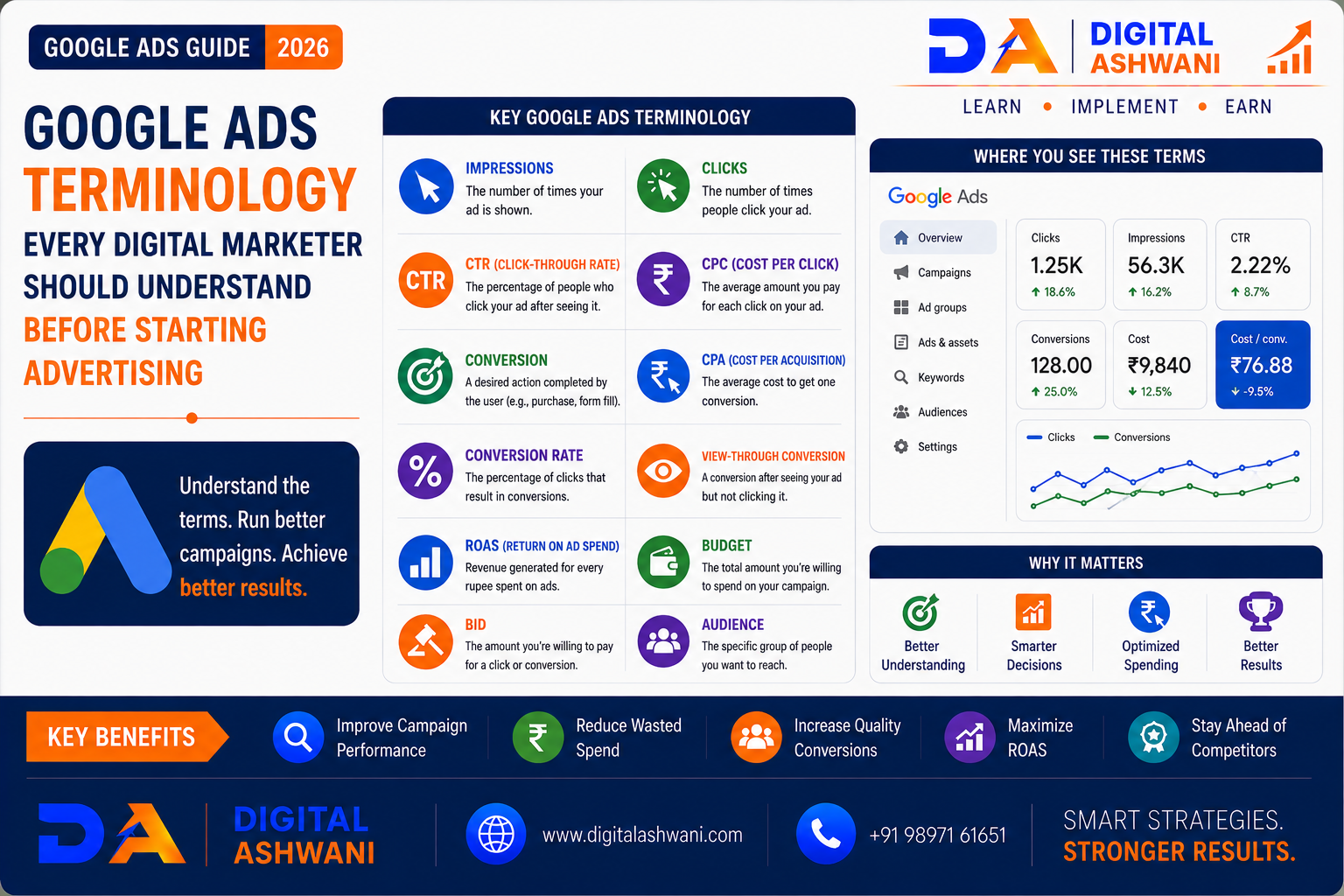
Google Ads Terminology Every Digital Marketer Should Understand Before Advertising
Google Ads can be one of the most effective platforms for generating leads, sales, website traffic, and brand awareness.
However, beginners often find Google Ads confusing because the platform uses dozens of technical terms and performance metrics.
Terms such as CPC, CTR, CPA, ROAS, Quality Score, Ad Rank, Conversion Rate, Impression Share, Match Types, and Search Terms appear frequently inside Google Ads accounts.
Understanding these terms is essential before launching or managing advertising campaigns.
Without knowing what these metrics mean, advertisers may make poor decisions, such as increasing budgets for unprofitable campaigns, pausing valuable keywords, or optimizing for clicks instead of actual business results.
In this comprehensive guide by Digital Ashwani, you’ll learn the most important Google Ads terminology digital marketers should understand before creating, managing, or optimizing paid advertising campaigns.
Why Google Ads Terminology Matters
Google Ads isn’t simply about creating an advertisement and waiting for customers.
Successful advertising requires understanding:
- Who Sees Your Ads
- Which Keywords Trigger Ads
- How Much You Pay
- How Many Users Click
- Which Clicks Convert
- How Much Revenue Campaigns Generate
Understanding terminology makes it easier to:
- Analyze Campaign Performance
- Control Advertising Costs
- Improve Conversion Rates
- Communicate With Clients
- Optimize Campaigns
- Measure ROI
Google Ads Campaign Terminology
Campaign
A campaign is a major organizational level in a Google Ads account.
Campaigns typically contain:
- Budget
- Bidding Strategy
- Targeting
- Ad Groups
- Ads
- Keywords or Other Targeting Signals
Different campaigns can be created for different business objectives.
Ad Group
An ad group contains related ads and targeting elements.
For Search campaigns, keywords within an ad group should generally have a close relationship with the ads and landing page.
Well-organized ad groups make optimization easier.
Search Campaign
A Search campaign allows advertisers to show ads to people searching for relevant terms on Google and eligible search-related placements.
Search campaigns are commonly used for:
- Lead Generation
- Service Businesses
- Product Searches
- Local Businesses
- Online Sales
Display Campaign
Display campaigns can help advertisers reach audiences across websites, apps, and other Google Display Network placements.
They are often used for:
- Brand Awareness
- Remarketing
- Audience Reach
- Visual Advertising
Performance Max
Performance Max is a Google Ads campaign type designed to access multiple Google advertising channels from a single campaign.
It uses Google’s automation and machine learning to optimize toward advertiser goals.
Keyword Terminology
Keyword
A keyword is a term or phrase used to help determine when an advertisement may be eligible to show in Search campaigns.
Examples include:
- SEO Agency Delhi
- Dental Clinic Near Me
- Google Ads Management
- Digital Marketing Services
Search Term
A search term is the actual query entered by a user that triggered an advertisement.
This distinction is important:
Keyword = advertiser’s targeting input
Search Term = user’s actual query
Search-term analysis helps identify relevant and irrelevant traffic.
Keyword Match Types
Google Ads provides different keyword matching options.
Common match types include:
- Broad Match
- Phrase Match
- Exact Match
Each provides a different balance between reach and control.
Negative Keyword
A negative keyword helps prevent ads from showing for unwanted searches.
For example, a paid service provider might exclude searches related to:
- Free
- Jobs
- Internship
- Course
- Training
Negative keywords can help reduce irrelevant traffic and wasted spend.
Google Ads Bidding Terminology
Bid
A bid represents how much you’re willing to pay or how much you’re asking Google Ads to optimize toward for an advertising auction, depending on the bidding strategy.
Manual CPC
Manual CPC allows advertisers to set maximum cost-per-click bids for eligible Search or Display campaigns where this bidding option is available.
Maximize Clicks
An automated bidding strategy designed to obtain as many clicks as possible within a specified budget.
It is focused primarily on traffic rather than directly optimizing for conversions.
Maximize Conversions
An automated bidding strategy designed to generate as many conversions as possible within the available budget.
Accurate conversion tracking is therefore extremely important.
Target CPA
Target CPA is an automated bidding approach that attempts to generate conversions around a specified average cost per acquisition.
Actual results can vary.
Target ROAS
Target ROAS is an automated bidding strategy designed to optimize toward a specified return on advertising spend when sufficient conversion-value data is available.
Important Google Ads Performance Metrics
Impressions
An impression occurs when your advertisement is shown.
Impressions indicate visibility but don’t necessarily mean users interacted with the advertisement.
Clicks
A click occurs when a user interacts with your advertisement in a way that is counted as a click by Google Ads.
Clicks are useful for measuring traffic but don’t necessarily represent valuable business outcomes.
Click-Through Rate (CTR)
CTR measures how often users click after seeing an advertisement.
A simplified formula is:
CTR = Clicks ÷ Impressions × 100
For example:
If an ad receives 100 clicks from 2,000 impressions:
CTR = 5%
CTR can help evaluate ad relevance and messaging.
Cost Per Click (CPC)
CPC represents the average amount paid for clicks.
Average CPC = Total Cost ÷ Total Clicks
A lower CPC isn’t automatically better.
The more important question is whether the clicks generate valuable outcomes.
Cost
Cost is the amount spent on advertising during the selected reporting period.
Always compare spend against conversions, revenue, and business objectives.
Conversion
A conversion is a valuable action that an advertiser chooses to track.
Examples include:
- Form Submission
- Purchase
- Phone Call
- Appointment
- Quote Request
- Lead
- Sign-Up
Conversion Rate
Conversion rate measures how frequently interactions result in conversions.
The exact calculation can depend on the reporting setup, but a common simplified formula is:
Conversion Rate = Conversions ÷ Interactions × 100
Cost Per Conversion
Cost per conversion shows the average advertising cost associated with a conversion.
Cost Per Conversion = Total Cost ÷ Conversions
For lead generation, this metric can help evaluate acquisition efficiency.
Google Ads Revenue and Profitability Terms
Conversion Value
Conversion value represents the value assigned to tracked conversions.
For eCommerce, this might represent purchase revenue.
For lead generation, businesses may assign values to different types of leads.
ROAS
ROAS means Return on Ad Spend.
A simplified formula is:
ROAS = Conversion Value ÷ Advertising Cost
For example, if ₹50,000 in tracked conversion value comes from ₹10,000 in advertising spend:
ROAS = 5
ROAS does not necessarily equal profit because it doesn’t account for all business costs.
ROI
ROI measures return relative to investment and can incorporate broader business costs.
For many businesses, profitability is a more meaningful measure than ROAS alone.
Google Ads Quality and Ranking Terminology
Quality Score
Quality Score is a diagnostic metric reported for certain Search keywords.
It is based on Google’s assessment of components including:
- Expected CTR
- Ad Relevance
- Landing Page Experience
Quality Score is not itself a direct input into every auction, but it can provide useful diagnostic information.
Ad Rank
Ad Rank is used by Google to determine an ad’s eligibility and position in the auction.
It incorporates multiple factors, including:
- Bid
- Ad Quality
- Context
- Thresholds
- Other auction-related signals
A higher bid alone doesn’t guarantee the top position.
Ad Relevance
Ad relevance reflects how closely an advertisement aligns with a user’s search intent.
Relevant messaging generally creates a better experience.
Landing Page Experience
Landing page experience refers to the quality and relevance of the webpage users reach after clicking an advertisement.
Important considerations include:
- Relevance
- Mobile Experience
- Page Speed
- Useful Content
- Clear Navigation
Google Ads Visibility Terminology
Impression Share
Impression Share represents the percentage of eligible impressions your ads received.
A simplified interpretation is:
Actual Impressions ÷ Eligible Impressions
It helps advertisers understand how much potential visibility they’re capturing.
Search Lost IS (Budget)
This metric can indicate the percentage of eligible Search impressions lost because of insufficient budget, where reported.
Search Lost IS (Rank)
This can indicate the percentage of eligible Search impressions lost because of Ad Rank, where reported.
Top of Page
Top-of-page placement refers to advertisements shown near the top of the search results page.
It does not necessarily mean the absolute first ad position.
Google Ads Optimization Terminology
Conversion Tracking
Conversion tracking records valuable actions generated through advertising.
Accurate tracking is the foundation of effective campaign optimization.
Search Terms Report
The Search Terms report shows queries that triggered your ads and can help identify:
- New Keyword Opportunities
- Irrelevant Searches
- Negative Keywords
- Search Intent Trends
A/B Testing
A/B testing involves comparing different versions of advertising elements to understand which performs better.
You can test:
- Headlines
- Landing Pages
- Offers
- Calls-to-Action
Tests should be structured so results can be interpreted meaningfully.
Remarketing
Remarketing allows advertisers to reconnect with people who have previously interacted with their business, subject to platform eligibility, privacy requirements, and available audience features.
It can be useful for users who:
- Visited a Website
- Viewed Products
- Started an Application
- Didn’t Complete a Purchase
Attribution
Attribution refers to how credit for conversions is assigned across customer interactions.
Understanding attribution is important when users interact with multiple marketing channels before converting.
Google Ads Terminology for Lead Generation
Lead
A lead is a potential customer who expresses interest in your business.
Examples include someone who:
- Submits a Form
- Calls Your Business
- Requests a Quote
- Books an Appointment
- Sends an Enquiry
Qualified Lead
Not every lead is equally valuable.
A qualified lead meets criteria defined by the business and has a stronger likelihood of becoming a customer.
Customer Acquisition Cost
Customer Acquisition Cost, or CAC, measures the broader cost of acquiring customers.
For businesses using multiple marketing channels, CAC provides a more complete picture than PPC cost per conversion alone.
Common Google Ads Mistakes Beginners Make
Focusing Only on Clicks
Clicks are useful, but the ultimate objective is usually leads, sales, revenue, or another meaningful business outcome.
Ignoring Search Terms
Search terms can reveal significant amounts of irrelevant traffic and new opportunities.
Not Tracking Conversions
Without reliable conversion tracking, campaign optimization becomes much harder.
Chasing the Lowest CPC
Cheap clicks aren’t necessarily valuable clicks.
Ignoring Landing Pages
Even excellent advertisements can fail when the landing page is slow, confusing, or irrelevant.
Changing Campaigns Too Frequently
Constant changes can make it difficult to determine which optimization actually improved or damaged performance.
Google Ads Terminology Quick Reference
| Term | Simple Meaning |
|---|---|
| Campaign | Main advertising structure |
| Ad Group | Group of related ads and targeting |
| Keyword | Advertiser-selected targeting term |
| Search Term | User’s actual search query |
| Negative Keyword | Prevents unwanted searches |
| CPC | Average cost per click |
| CTR | Click rate after impressions |
| Conversion | Valuable tracked action |
| CPA | Cost associated with acquiring a conversion |
| ROAS | Revenue/value generated per advertising cost |
| Quality Score | Diagnostic keyword-quality metric |
| Ad Rank | Determines ad eligibility and position |
| Impression Share | Share of eligible impressions received |
| Conversion Tracking | Measurement of valuable actions |
| Remarketing | Reaching previous website or customer audiences |
Google Ads Beginner Checklist
Before launching or managing campaigns, make sure you understand:
- Campaign Structure
- Ad Groups
- Keywords
- Search Terms
- Match Types
- Negative Keywords
- Bidding Strategies
- CPC
- CTR
- Conversions
- CPA
- ROAS
- Quality Score
- Ad Rank
- Impression Share
- Conversion Tracking
- Landing Page Experience
- Search Term Reports
- Attribution
Internal Linking Suggestions (Digital Ashwani)
Strengthen your Google Ads content cluster by linking this guide with:
- Complete Google Search Ads Campaign Setup Guide for Better Lead Generation
- Best Google Search Campaign Bidding Strategies Explained
- How Artificial Intelligence Is Changing Google Ads Campaign Optimization
- What Is Cost Per Click (CPC)? Powerful Ways to Reduce CPC and Improve ROI
- PPC Audit Checklist Every Business Should Complete Before Scaling Campaigns
- Google Ads Strategy for Doctors to Increase Patient Appointments
- Facebook Lead Ads Strategy That Converts Visitors Into Paying Customers
- How Google Analytics 4 Tracks Website Visitors and User Behavior
These internal links connect Google Ads terminology with campaign setup, bidding, PPC auditing, AI optimization, analytics, and lead generation.
External Resources
For current Google Ads terminology and platform guidance, refer to:
- Google Ads Help
- Google Ads Help Center
- Google Search Central
- Google Analytics Help
Google Ads features, metrics, and campaign options can change over time, so always verify current platform documentation.
Frequently Asked Questions
What is the most important Google Ads terminology for beginners?
Start with Campaign, Ad Group, Keyword, Search Term, Match Type, CPC, CTR, Conversion, CPA, ROAS, Quality Score, Ad Rank, and Conversion Tracking.
What is the difference between CPC and CPA?
CPC measures the average cost of a click, while CPA measures the average cost associated with acquiring a conversion.
What is the difference between a keyword and a search term?
A keyword is the targeting input selected by the advertiser, while a search term is the actual query entered by the user.
What does CTR mean in Google Ads?
CTR means Click-Through Rate. It measures the percentage of impressions that resulted in clicks.
What is ROAS in Google Ads?
ROAS means Return on Ad Spend. It compares tracked conversion value with advertising cost.
Is Quality Score a ranking factor?
Quality Score is a diagnostic metric for Search keywords rather than a direct auction ranking factor. Google uses multiple signals to determine Ad Rank.
Final Thoughts
Understanding Google Ads Terminology is one of the first steps toward becoming a confident digital marketer.
You don’t need to memorize every Google Ads term before launching your first campaign. However, you should understand the core concepts that influence targeting, costs, conversions, and profitability.
The most important principle is simple:
Don’t optimize Google Ads for clicks alone—optimize campaigns for meaningful business results.
Once you understand keywords, search terms, bidding, CPC, CTR, conversions, CPA, ROAS, Quality Score, Ad Rank, and attribution, you’ll be in a much stronger position to analyze campaigns and make smarter advertising decisions.
At Digital Ashwani, we regularly publish practical guides on Google Ads, PPC, SEO, AI Marketing, Analytics, Conversion Optimization, and Digital Marketing to help marketers and businesses improve their online advertising performance.
