

Google Ads Campaign Structure Explained for Better Performance and Lower Costs
A well-organized Google Ads account can make campaign management easier and help businesses use their advertising budget more effectively.
Many advertisers create campaigns without properly separating products, services, locations, audiences, or business objectives. As a result, unrelated keywords may end up in the same ad group, advertisements may become less relevant, and campaign performance can become difficult to analyze.
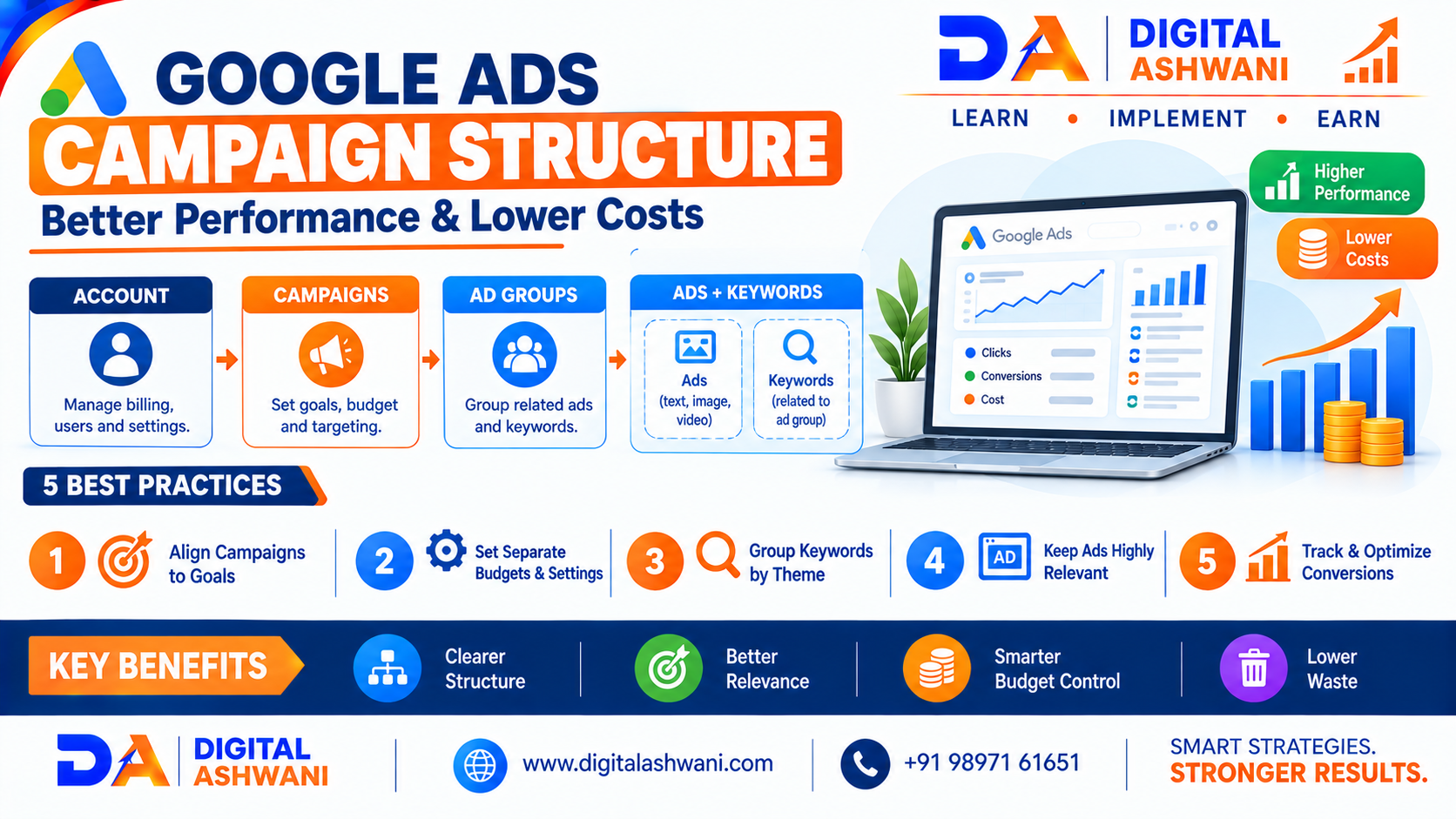
Google Ads uses a three-level structure consisting of account, campaigns, and ad groups. Campaigns control settings such as budget and targeting, while ad groups contain related ads and keywords.
A simple structure looks like this:
Account → Campaign → Ad Group → Keywords + Ads
Understanding this structure can help businesses build campaigns that are easier to manage, measure, and optimize.
Table of Contents
- What Is Google Ads Campaign Structure?
- Account-Level Organization
- How to Structure Campaigns
- How to Create Effective Ad Groups
- Organize Keywords by Theme
- Create Relevant Ads
- Use Separate Landing Pages
- Control Budget and Targeting
- Use Negative Keywords
- Track Conversions
- Common Structure Mistakes
- Frequently Asked Questions
- Final Thoughts
What Is Google Ads Campaign Structure?
Google Ads campaign structure is the way an advertising account is organized into different levels.
The basic hierarchy is:
- Account
- Campaign
- Ad Group
- Ads
- Keywords
Each level has a specific purpose.
Account
The account contains your overall Google Ads setup, billing information, users, and campaigns.
Campaign
A campaign controls important settings such as:
- Budget
- Location targeting
- Campaign objective
- Network
- Bidding strategy
- Other campaign-level settings
Ad Group
An ad group contains closely related keywords and advertisements.
For example, a digital marketing agency could have:
Campaign: Digital Marketing Services
Ad Groups:
- SEO Services
- Google Ads Management
- Social Media Marketing
- Website Development
This structure makes it easier to connect search terms with relevant advertisements.
How to Structure Google Ads Campaigns
The first step is to separate campaigns based on meaningful differences in business objectives, budget, targeting, or campaign settings.
Google recommends creating separate campaigns when different groups require different settings such as budgets or location targeting.
For example:
Campaign 1: Google Ads Services – Delhi
Campaign 2: Google Ads Services – Noida
Campaign 3: Google Ads Services – Other Cities
This can make location-based performance easier to monitor.
However, unnecessary segmentation can also make campaigns difficult to manage. Google’s current account-structure guidance recommends simpler, consolidated structures where appropriate, particularly when using automated bidding.
Structure Campaigns Around Business Goals
A campaign should have a clear objective.
For example:
- Lead Generation
- Online Sales
- Website Traffic
- Brand Awareness
- Local Store Visits
If different groups of keywords have completely different objectives or conversion goals, separating them into appropriate campaigns can make performance data easier to interpret.
Google’s account-setup guidance recommends basing campaigns on objectives and avoiding unnecessary fragmentation.
Create Tightly Themed Ad Groups
Ad groups are where keyword and ad relevance becomes especially important.
Instead of putting every keyword into one ad group, organize related keywords around a common theme.
For example:
Ad Group: SEO Services
Keywords could include:
- SEO services
- SEO agency
- SEO company
- SEO services for business
Ad Group: Google Ads Services
Keywords could include:
- Google Ads management
- Google Ads agency
- PPC management services
- Google advertising agency
Google recommends organizing ad groups around a narrow theme and using closely related keywords so advertisements can be more relevant to searches.
Organize Keywords by Search Intent
Keyword grouping should consider what customers are actually searching for.
For example:
Commercial Intent
- best SEO agency
- SEO services company
Transactional Intent
- hire SEO agency
- buy SEO services
Local Intent
- SEO agency near me
- SEO company in Delhi
Keeping closely related intent together can make it easier to create advertisements that directly address what the customer wants.
Create Relevant Ads for Each Ad Group
Your ad should match the keywords in its ad group.
If an ad group contains keywords related to Google Ads management, the advertisement should clearly mention Google Ads or PPC services.
For example:
Headline:
Google Ads Management Services
Headline:
Generate More Qualified Leads
Description:
Improve your Google Ads campaigns with targeted keywords, conversion tracking, and data-driven optimization.
Google recommends making ads directly relevant to the products or services customers are searching for.
Use Multiple Ads
Google recommends having at least three ads in each ad group so the system can evaluate different messages and advertisers can learn what resonates with their audience.
Match Ads With Landing Pages
Campaign structure should not stop at keywords and advertisements.
The landing page should also match the ad group.
For example:
Ad Group: Google Ads Management
Ad: Google Ads Management Services
Landing Page: Google Ads Management Service Page
This creates a consistent journey from search to conversion.
Google notes that ads, keywords, and landing pages should be closely related because relevance can affect both user experience and campaign performance.
Control Budget and Targeting
Campaign-level settings give you control over where and how your budget is used.
Depending on the business, campaigns may be separated by:
- Location
- Product category
- Service category
- Business objective
- Budget requirements
However, do not create a separate campaign for every small variation.
The goal should be clear separation where it matters and consolidation where it does not.
Use Negative Keywords
Negative keywords can help prevent advertisements from showing for irrelevant searches.
For example, a paid SEO service may want to review searches containing:
- Free
- Course
- Tutorial
- Jobs
- Salary
The exact negative keyword list depends on the business.
Regularly reviewing the Search Terms Report can reveal irrelevant searches and new opportunities for campaign optimization. Google specifically recommends monitoring search terms and adding negative keywords where appropriate.
Track Conversions at the Campaign Level
A good campaign structure should make it easy to understand which campaigns and ad groups are generating results.
Track meaningful conversions such as:
- Lead forms
- Phone calls
- Purchases
- Quote requests
- Appointment bookings
- Sign-ups
Then compare:
| Metric | Purpose |
|---|---|
| Impressions | Measures visibility |
| Clicks | Measures traffic |
| CTR | Measures ad engagement |
| CPC | Measures click cost |
| Conversions | Measures valuable actions |
| Conversion Rate | Measures efficiency |
| Cost per Lead | Measures acquisition cost |
| ROAS | Measures return on ad spend |
Conversion tracking is especially important when using automated bidding strategies focused on conversions.
A Simple Google Ads Structure Example
Suppose a business offers digital marketing services.
A practical structure could look like:
Account: Digital Marketing Agency
Campaign 1: SEO Services
- Ad Group: SEO Agency
- Ad Group: Local SEO
- Ad Group: Ecommerce SEO
Campaign 2: Google Ads Services
- Ad Group: Google Ads Management
- Ad Group: Search Ads
- Ad Group: PPC Management
Campaign 3: Social Media Marketing
- Ad Group: Social Media Services
- Ad Group: Instagram Marketing
- Ad Group: Facebook Marketing
Each ad group can then have relevant keywords, advertisements, assets, and landing pages.
Common Google Ads Structure Mistakes
Putting Every Keyword in One Ad Group
This can make ads too generic and reduce relevance.
Creating Too Many Campaigns
Over-segmentation can split data and make management unnecessarily complicated.
Separating Every Match Type Into Different Campaigns
Google’s current guidance emphasizes simpler structures and warns against unnecessary segmentation when using Smart Bidding.
Using the Same Ad for Every Service
Different services need different messages.
Sending Every Ad to the Homepage
Relevant service-specific landing pages can provide a better experience.
Ignoring Conversion Data
A campaign should be evaluated based on meaningful business results, not only clicks and impressions.
Frequently Asked Questions
What is the best Google Ads campaign structure?
A strong structure usually separates campaigns based on meaningful differences in business objectives, budget, targeting, or other important settings, while keeping ad groups tightly themed.
How many ad groups should a Google Ads campaign have?
There is no universal number. Create enough ad groups to separate meaningful themes without unnecessarily fragmenting your data.
How many keywords should be in an ad group?
The number depends on the business and keyword themes. The important point is that the keywords should be closely related and support the same advertising message.
How many ads should I have in each ad group?
Google recommends at least three ads per ad group for Search campaigns.
Does campaign structure reduce Google Ads costs?
A well-organized structure does not automatically guarantee lower CPCs. However, better relevance, cleaner targeting, stronger landing-page alignment, and more efficient optimization can help improve campaign performance and reduce wasted spend.
Final Thoughts
A strong Google Ads campaign structure creates a clear connection between business objective, campaign settings, ad groups, keywords, advertisements, and landing pages.
The goal is not to create the largest number of campaigns or ad groups. The goal is to create a structure that is relevant, manageable, measurable, and aligned with your business objectives.
A practical structure can look like:
Account → Campaign → Ad Group → Keywords → Ads → Landing Page → Conversion
Start with your business goals, group related services or products, create tightly themed ad groups, use relevant keywords and advertisements, track conversions, and regularly remove unnecessary complexity.
When your Google Ads account is structured properly, it becomes easier to identify what is working, optimize campaigns, control wasted spend, and make better advertising decisions.
