
Artificial Intelligence is no longer just a trend in digital marketing—it’s now at the core of how Google Ads campaigns are created, optimized, and scaled. With the latest Google Ads AI innovations announced in 2026, advertisers have access to smarter automation, better audience targeting, AI-generated creatives, and more transparent campaign insights.
Whether you’re a small business owner, an eCommerce brand, a digital marketing agency, or a PPC specialist, understanding the latest Google Ads AI features can help you improve campaign performance, reduce wasted ad spend, and increase return on investment (ROI).
In this in-depth guide by Digital Ashwani, we’ll explore the newest Google Ads AI features, explain how they work, discuss their benefits, and share practical tips to help you stay ahead of the competition.
What is Google Ads AI?
Google Ads AI refers to the artificial intelligence technologies built into Google’s advertising platform. These tools analyze billions of signals in real time to automate campaign management, optimize bids, generate ad assets, and improve targeting.
Instead of manually adjusting every campaign setting, advertisers can use AI to make smarter decisions based on user behavior, search intent, device type, location, time of day, and many other factors.
The goal is simple: achieve better advertising results with less manual effort.
Why AI is Transforming Google Ads
Traditional PPC management required marketers to manually:
- Select keywords
- Write ad copy
- Adjust bids
- Analyze reports
- Test creatives
- Optimize targeting
Today’s Google Ads AI features automate much of this work while still giving advertisers strategic control.
Major advantages include:
- Faster campaign setup
- Improved conversion rates
- Better audience targeting
- Smarter bidding
- Enhanced reporting
- Increased ROI
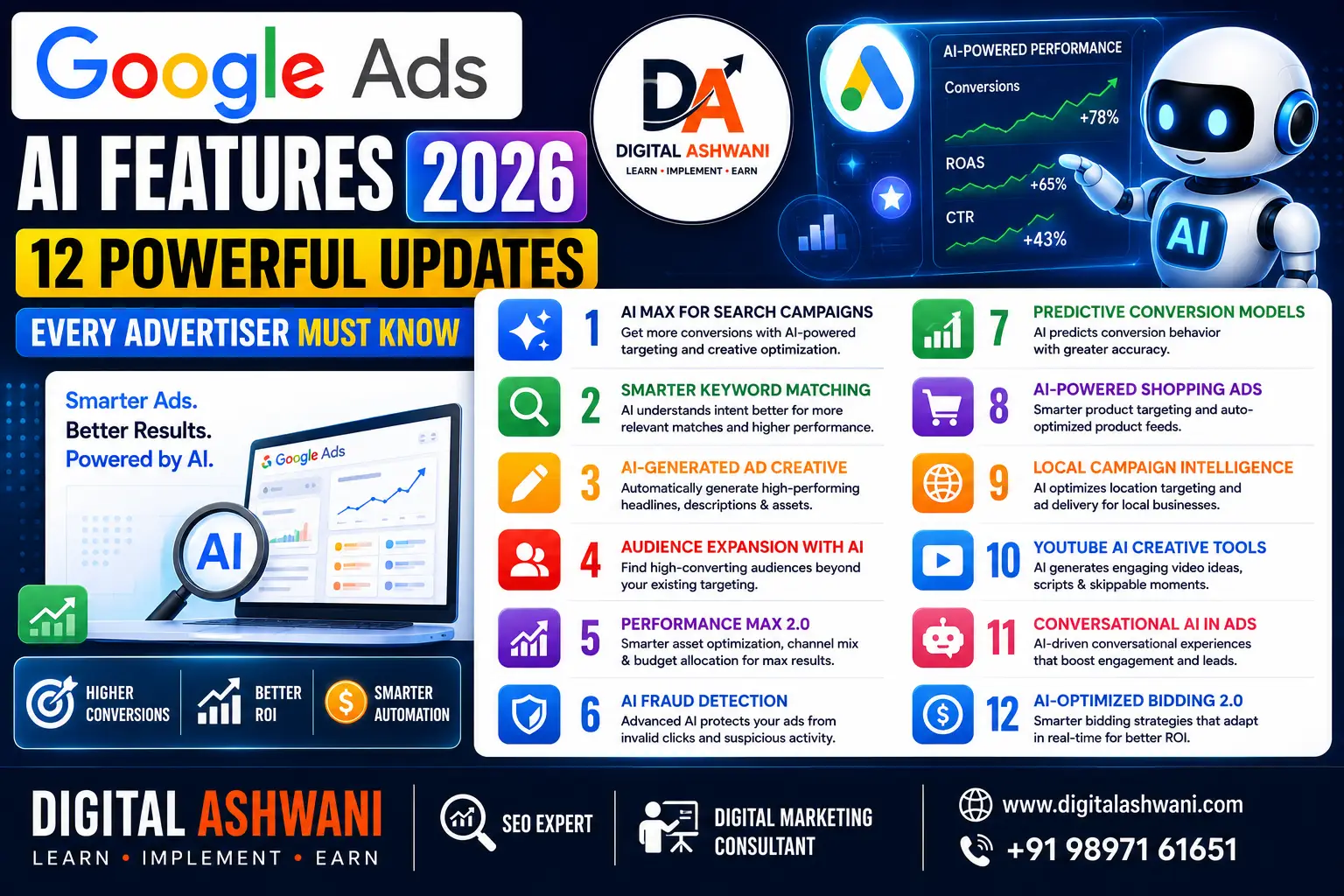
12 Powerful Google Ads AI Features in 2026
1. AI-Powered Campaign Creation
Google Ads can now help generate campaign structures using business information, landing pages, and marketing goals.
Benefits include:
- Faster setup
- Better ad organization
- Reduced manual work
- Improved campaign consistency
2. AI-Generated Headlines and Descriptions
Creating compelling ad copy is easier than ever.
Google Ads AI can suggest:
- Headlines
- Descriptions
- Calls-to-action
- Value propositions
Advertisers should still review and refine AI-generated content to ensure it matches their brand voice.
3. AI Image Generation
One of the most exciting updates is AI-assisted image creation.
Businesses can generate high-quality promotional images directly within Google Ads, reducing design time and improving creative testing.
Ideal for:
- Display campaigns
- Demand Gen campaigns
- Performance Max
- Shopping ads
4. AI Video Generation
Video ads no longer require expensive production.
Google Ads AI can transform existing product images and marketing assets into short promotional videos suitable for YouTube and other Google platforms.
5. Smarter Performance Max Campaigns
Performance Max continues to evolve with stronger AI capabilities.
New improvements include:
- Better asset recommendations
- Improved reporting
- Enhanced audience insights
- Increased transparency
- Smarter optimization
These updates help advertisers understand what drives campaign success.
6. Advanced Smart Bidding
Google’s Smart Bidding system now evaluates even more real-time signals, including:
- Search intent
- Device type
- Location
- Browser
- Time of day
- Historical behavior
The result is more efficient bidding and improved conversion potential.
7. AI Audience Expansion
Google Ads AI identifies new customer segments likely to convert based on campaign performance and behavioral patterns.
This helps advertisers discover untapped audiences without extensive manual research.
8. AI Asset Recommendations
The platform continuously analyzes campaign performance and suggests improvements such as:
- Better headlines
- New descriptions
- Fresh images
- Additional creative assets
These recommendations help maintain campaign freshness.
9. Enhanced Conversion Measurement
Google has improved attribution and reporting with AI-driven insights.
Advertisers gain better visibility into:
- Conversion paths
- Customer journeys
- Cross-device behavior
- Incremental conversions
More accurate measurement supports smarter budget allocation.
10. AI-Powered Shopping Ads
E-commerce advertisers benefit from AI enhancements that optimize:
- Product titles
- Shopping creatives
- Product visibility
- Campaign performance
Combined with Merchant Center, these updates simplify product advertising.
11. Predictive Budget Recommendations
AI now provides recommendations on budget allocation based on campaign goals, expected performance, and seasonal trends.
This helps advertisers avoid overspending while maximizing ROI.
12. Privacy-First AI Optimization
As digital privacy regulations evolve, Google Ads AI is focusing on privacy-safe optimization using aggregated and consent-based data.
This allows advertisers to maintain strong performance while respecting user privacy.
Benefits of Google Ads AI for Advertisers
Businesses using Google Ads AI can experience several advantages:
Better ROI
Smarter automation helps allocate budgets more effectively.
Higher Conversion Rates
AI improves targeting and bidding, increasing the likelihood of conversions.
Faster Campaign Management
Automated workflows reduce repetitive tasks.
Improved Creative Testing
AI-generated assets make it easier to test multiple ad variations.
Stronger Audience Insights
Advertisers gain a better understanding of customer behavior and campaign performance.
Best Practices for Using Google Ads AI
To get the best results:
Set Clear Campaign Goals
AI performs better when your objectives are well defined.
Provide High-Quality Assets
Upload strong images, videos, logos, and landing pages.
Monitor AI Recommendations
Review suggestions regularly instead of accepting every recommendation automatically.
Continue A/B Testing
Even with AI, testing different creatives and messaging remains important.
Track Performance
Use Google Analytics and conversion tracking to measure results accurately.
Common Mistakes to Avoid
Many advertisers expect AI to replace strategy completely.
Avoid these mistakes:
- Ignoring campaign reports
- Uploading poor-quality creative assets
- Setting unrealistic budgets
- Neglecting landing page optimization
- Overrelying on automation without human oversight
AI works best when combined with experienced marketing decisions.
Internal Linking Suggestions (Digital Ashwani)
Strengthen your topical authority by linking this article with:
- Google Marketing Live 2026: Top AI Features Every Marketer Should Know
- AI SEO vs Traditional SEO
- How to Rank in ChatGPT, Gemini & AI Search Results
- Google Ranking Drop 2026 Recovery Guide
- Google Ads Beginner Guide
- Performance Max Campaign Tutorial
- Keyword Research Guide
These internal links improve navigation and reinforce your site’s expertise in digital marketing.
External Resources
For official information and best practices, explore:
- Google Ads Help Center
- Google Marketing Live
- Google Merchant Center Help
- Google Analytics Help Center
- Google Search Central
Staying updated with official documentation helps advertisers make informed decisions as Google Ads continues to evolve.
Future of Google Ads AI
Artificial intelligence will continue to reshape digital advertising through:
- More predictive campaign optimization
- Better audience modeling
- Improved creative generation
- Advanced measurement capabilities
- Greater personalization
- Increased automation with enhanced transparency
Advertisers who embrace AI while maintaining strategic oversight will be better positioned for long-term success.
Frequently Asked Questions
What is Google Ads AI?
Google Ads AI refers to the artificial intelligence technologies within Google Ads that automate bidding, targeting, creative generation, reporting, and campaign optimization.
Is Google Ads AI suitable for small businesses?
Yes. AI features help small businesses save time, improve efficiency, and compete more effectively with limited marketing resources.
Does AI replace PPC specialists?
No. AI automates repetitive tasks, but marketers remain responsible for strategy, budgeting, creative direction, and business goals.
Which campaign types benefit the most?
Performance Max, Search, Shopping, Demand Gen, and Display campaigns all benefit from Google’s latest AI capabilities.
Should advertisers fully automate campaigns?
Automation is powerful, but it should be monitored regularly. Human oversight remains essential for achieving the best long-term results.
Final Thoughts
The latest Google Ads AI features demonstrate how artificial intelligence is transforming digital advertising. From AI-generated creatives and smarter bidding to advanced measurement and predictive insights, Google’s advertising platform is becoming more intelligent and efficient each year.
However, successful advertising still depends on clear strategy, compelling messaging, high-quality landing pages, and continuous optimization. AI should be viewed as a powerful assistant—not a replacement for thoughtful marketing decisions.
For businesses and advertisers looking to maximize ROI in 2026, combining AI-powered automation with strong marketing fundamentals is the most effective path forward.
At Digital Ashwani, we regularly publish the latest insights on Google Ads, AI, SEO, and digital marketing to help businesses grow their online presence and stay ahead of industry changes.
