
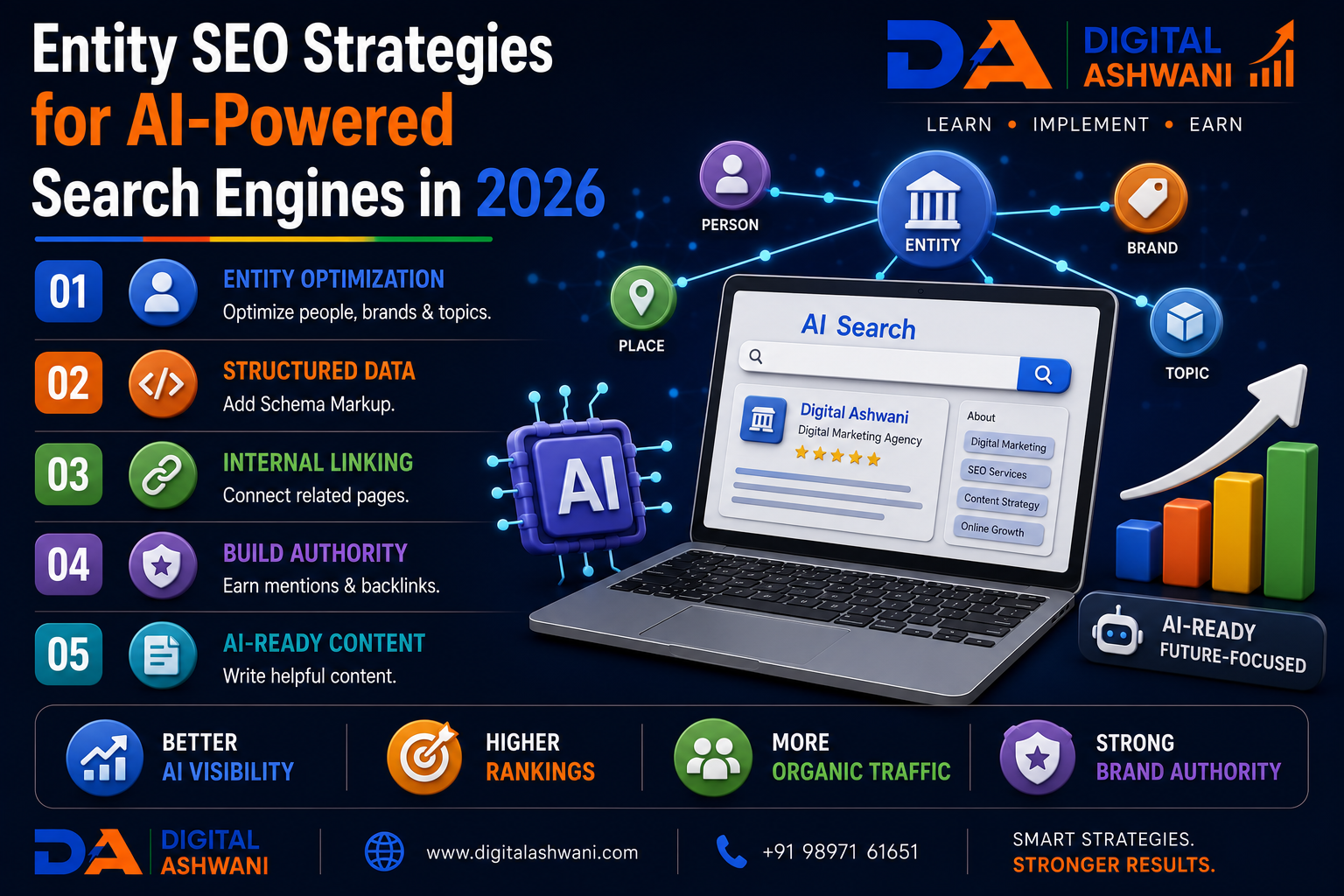
Entity SEO Strategies for AI-Powered Search Engines
Search Engine Optimization is evolving rapidly. For years, SEO revolved around keywords, backlinks, and technical optimization. While these elements remain important, modern search engines increasingly rely on entities rather than just keywords to understand content.
Google’s AI Overviews, AI Mode, ChatGPT, Gemini, Perplexity, and other AI-powered search platforms are designed to understand the meaning behind people, places, organizations, products, events, and concepts. Instead of matching exact keywords, they connect related entities to deliver more accurate and context-aware answers.
This shift has made Entity SEO one of the most important SEO strategies for businesses, bloggers, publishers, and digital marketers in 2026.
If your content clearly defines entities, demonstrates topical authority, and provides structured information, AI-powered search engines are more likely to understand, reference, and recommend your content.
In this comprehensive guide by Digital Ashwani, you’ll learn what Entity SEO is, why it matters, and the proven strategies to optimize your website for AI-powered search engines.
What Is Entity SEO?
Entity SEO is the process of optimizing content around clearly identifiable people, businesses, products, locations, organizations, concepts, and events instead of relying only on keywords.
An entity has a unique meaning that search engines can understand regardless of the exact wording used.
Examples of entities include:
- ChatGPT
- Digital Marketing
- Search Engine Optimization
- New Delhi
- WordPress
- Google Ads
- Artificial Intelligence
Search engines connect these entities through relationships, making search results more intelligent and context-aware.
Why AI-Powered Search Engines Use Entities
Modern AI search systems aim to understand meaning, not just words.
Instead of matching exact keyword phrases, AI analyzes:
- Relationships between topics
- Context
- User intent
- Knowledge Graph connections
- Semantic meaning
- Topical authority
This enables AI-powered search engines to deliver more accurate and conversational answers.
Keywords vs Entity SEO
Traditional SEO focused heavily on repeating target keywords.
Entity SEO focuses on demonstrating expertise around an entire topic.
Traditional Keyword SEO
- Exact keyword targeting
- Keyword density
- Individual pages
- Search volume focus
Entity SEO
- Topic relationships
- Semantic relevance
- Knowledge Graph understanding
- Comprehensive topical coverage
Modern SEO combines both approaches for the best results.
Benefits of Entity SEO
Entity optimization helps businesses:
- Improve AI Search visibility
- Strengthen topical authority
- Increase semantic relevance
- Support EEAT
- Improve Google understanding
- Enhance AI Overviews visibility
- Build long-term organic traffic
Entity SEO also supports future AI search developments.
15 Proven Entity SEO Strategies
1. Build Strong Topical Authority
Rather than publishing isolated articles, create complete content clusters around important topics.
Example:
Digital Marketing
↓
SEO
↓
Technical SEO
↓
Local SEO
↓
AI SEO
↓
Entity SEO
Covering related subjects helps search engines understand your expertise.
2. Clearly Define Important Entities
Whenever introducing a major topic, explain what it is before discussing it further.
For example:
- Define Google Ads
- Explain EEAT
- Introduce AI Search
- Describe Schema Markup
Clear definitions improve AI comprehension.
3. Use Structured Headings
Logical heading structures improve readability and semantic understanding.
Organize content using:
- H1
- H2
- H3
- H4
Each section should focus on one primary topic.
4. Implement Schema Markup
Structured data helps search engines identify important entities.
Useful schema types include:
- Organization
- Person
- Article
- FAQ
- Breadcrumb
- Product
- Local Business
Schema strengthens entity recognition.
5. Build Brand Authority
Brands themselves are entities.
Increase brand recognition through:
- Consistent branding
- Author profiles
- About pages
- Case studies
- Customer reviews
- Industry mentions
Strong brands are more likely to appear in AI-generated answers.
6. Optimize Internal Linking
Internal links connect related entities throughout your website.
Example:
AI SEO → Technical SEO → Schema → Google Search Console
Strong internal linking reinforces topic relationships.
7. Write Naturally
Avoid keyword stuffing.
Instead, use natural language that explains concepts comprehensively.
AI understands context much better than repeated keywords.
8. Answer Related Questions
Include FAQs and naturally answer related user questions throughout your content.
This improves semantic coverage and increases opportunities to appear in AI-generated responses.
9. Create Comprehensive Topic Clusters
AI-powered search engines prefer websites that demonstrate expertise across an entire subject rather than isolated articles.
Example Topic Cluster
Digital Marketing
→ Search Engine Optimization (SEO)
→ Technical SEO
→ Local SEO
→ Entity SEO
→ AI SEO
→ Google Search Console
→ Google Ads
→ Content Marketing
Interlink every related article to strengthen semantic relationships and topical authority.
10. Optimize for Google’s Knowledge Graph
Google’s Knowledge Graph helps search engines understand entities and their relationships.
Improve Knowledge Graph Signals
Include:
- Organization details
- Author profiles
- Business information
- Social media profiles
- Consistent branding
- Structured data
- About Us page
These signals help search engines recognize your brand as a distinct entity.
11. Build Strong EEAT Signals
Entity SEO and EEAT (Experience, Expertise, Authoritativeness, and Trustworthiness) work together.
Strengthen EEAT By
- Publishing expert-written content
- Displaying author biographies
- Sharing original research
- Including customer testimonials
- Showing business credentials
- Updating content regularly
Websites with strong EEAT are more likely to be referenced by AI-powered search systems.
12. Optimize for AI Search Conversations
Modern AI search platforms answer conversational questions rather than relying only on keyword matching.
Write Content That Answers Questions Like
- What is Entity SEO?
- Why is Entity SEO important?
- How does Entity SEO work?
- How can businesses improve Entity SEO?
Use concise answers followed by detailed explanations.
13. Build Entity Relationships Across Your Website
Search engines understand websites better when related concepts are connected.
Link Related Topics
For example:
- Entity SEO ↔ Semantic SEO
- Semantic SEO ↔ Technical SEO
- Technical SEO ↔ Schema Markup
- Schema Markup ↔ AI Search
- AI Search ↔ Google AI Overviews
These relationships strengthen contextual understanding.
14. Earn Brand Mentions Beyond Backlinks
Modern search engines evaluate more than hyperlinks.
Brand mentions across trusted websites help reinforce entity recognition.
Increase Brand Mentions Through
- Guest articles
- Industry interviews
- Podcasts
- Press releases
- Community participation
- Expert roundups
- Digital PR
Consistent brand mentions help strengthen your online authority.
15. Continuously Update Entity Information
Entities evolve over time.
Keep your content current by updating:
- Company information
- Industry statistics
- AI developments
- Product features
- Service offerings
- Case studies
- FAQs
Fresh, accurate information helps maintain search visibility.
Entity SEO Checklist
| Entity SEO Task | Status |
|---|---|
| Topic Clusters Created | ✅ |
| Entity Definitions Added | ✅ |
| Internal Linking Optimized | ✅ |
| Schema Markup Implemented | ✅ |
| Brand Entity Strengthened | ✅ |
| Author Profiles Published | ✅ |
| EEAT Signals Improved | ✅ |
| Knowledge Graph Optimization | ✅ |
| AI-Friendly Content | ✅ |
| Regular Content Updates | ✅ |
Common Entity SEO Mistakes
Focusing Only on Keywords
Keyword optimization remains important, but relying solely on keywords limits your visibility in AI-powered search.
Build content around topics, entities, and user intent.
Weak Internal Linking
Disconnected articles make it difficult for search engines to understand topical relationships.
Create logical internal links between related content.
Ignoring Structured Data
Without Schema Markup, search engines receive fewer signals about your content and business entities.
Implement appropriate structured data wherever applicable.
Publishing Thin Content
Short, surface-level articles rarely establish entity authority.
Create comprehensive content that thoroughly covers each topic.
Neglecting Brand Building
Your brand itself is an important entity.
Invest in consistent branding, expert content, reviews, and digital PR to strengthen brand recognition.
Internal Linking Suggestions (Digital Ashwani)
Strengthen your AI SEO and Semantic SEO content cluster by linking this article with:
- AI SEO vs Traditional SEO
- How to Rank in ChatGPT, Gemini & AI Search Results
- What Is Search Engine Optimization?
- Technical SEO Guide
- Google AI Overviews Explained
- Schema Markup Complete Guide
- Keyword Research Guide
- Google Search Ranking Guide
- Content Marketing Strategy
- Digital Marketing Trends 2026
These internal links improve semantic relationships, reinforce topical authority, and help AI-powered search engines understand your website more effectively.
External Resources
For official guidance and further learning, explore:
- Google Search Central
- Google Search Central Blog
- Google AI
- Schema.org
- Google Search Console Help
These trusted resources provide up-to-date information on search, structured data, and AI-powered search technologies.
Frequently Asked Questions
What is Entity SEO?
Entity SEO is the practice of optimizing content around clearly identifiable people, organizations, products, places, and concepts so search engines can better understand their meaning and relationships.
How is Entity SEO different from traditional SEO?
Traditional SEO focuses primarily on keywords, while Entity SEO emphasizes semantic meaning, topical authority, structured data, and relationships between concepts.
Why is Entity SEO important for AI-powered search?
AI-powered search engines rely on entities and contextual relationships to generate accurate answers. Well-structured, entity-focused content is easier for these systems to interpret and reference.
Does Schema Markup improve Entity SEO?
Yes. Structured data provides additional context that helps search engines identify entities, understand relationships, and interpret website content more accurately.
Can small businesses benefit from Entity SEO?
Absolutely. By building topical authority, maintaining consistent business information, using structured data, and creating high-quality content, small businesses can improve their visibility in both traditional and AI-powered search results.
Final Thoughts
Entity SEO is becoming a core component of modern search optimization as AI-powered search engines move beyond simple keyword matching to understand real-world concepts and their relationships. Businesses that organize their websites around topics, entities, structured data, and user intent are better positioned to earn visibility in Google’s AI Overviews, AI Mode, and conversational search experiences.
Rather than optimizing individual pages in isolation, focus on building a complete knowledge ecosystem through topic clusters, internal linking, Schema Markup, strong EEAT signals, and consistent brand authority. This approach not only improves traditional SEO but also prepares your website for the future of AI-driven search.
At Digital Ashwani, we regularly publish practical guides on Entity SEO, AI SEO, Technical SEO, Google Updates, Google Ads, and Digital Marketing to help businesses stay ahead in the rapidly evolving search landscape.
