

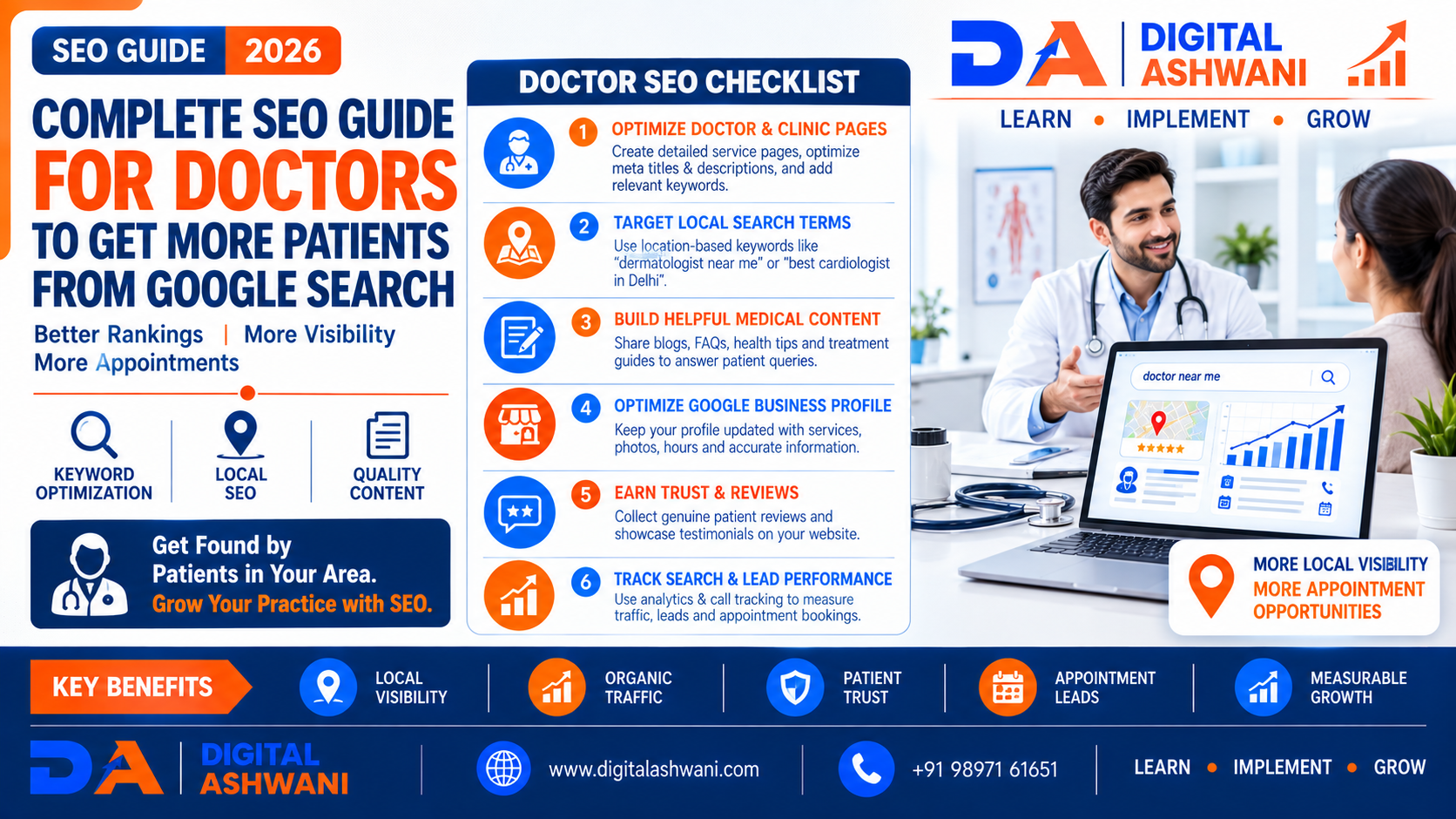
Complete SEO Guide for Doctors to Get More Patients From Google Search
Today, many patients use Google before deciding which doctor, clinic, hospital, or healthcare provider to contact.
They may search for:
“best dermatologist near me”
“dentist in Delhi”
“cardiologist near me”
“skin specialist in Noida”
“orthopedic doctor near me”
“gynecologist in Delhi”
These searches create an important opportunity for doctors and medical practices.
If your website and Google Business Profile appear when potential patients search for relevant services, you can increase visibility and create more opportunities for appointment enquiries.
This is where SEO for doctors becomes important.
Doctor SEO is not simply about adding medical keywords to a website. Healthcare websites deal with topics that can significantly affect people’s health and well-being, so useful, reliable, expert-led information and clear trust signals are particularly important. Google says its systems place more weight on strong E-E-A-T for topics that can significantly affect health, safety, or financial stability.
In this complete guide, we will explain how doctors can use SEO to improve Google visibility, strengthen their online presence, attract relevant local searches, and create more opportunities for patients to discover their practice.
What Is SEO for Doctors?
SEO for doctors is the process of improving a doctor’s website and online presence so that relevant patients can discover the practice through Google Search and other search experiences.
A medical SEO strategy can include:
- Keyword research
- Doctor profile optimization
- Service-page optimization
- Local SEO
- Google Business Profile optimization
- Medical content creation
- Technical SEO
- Internal linking
- Reputation management
- Relevant digital PR and link acquisition
- Search performance tracking
The objective is not simply to get more website visitors.
The objective is to attract relevant people who are actually looking for the medical services or information the practice provides.
Why SEO Is Important for Doctors and Clinics
Search visibility can be valuable because Google often becomes part of a patient’s research process.
A potential patient might first search for a symptom or condition.
Later, they may search for a specialist.
Then they may compare doctors, locations, reviews, qualifications, services, consultation information, and appointment options.
For example:
Search 1:
“persistent back pain treatment”
Search 2:
“orthopedic doctor near me”
Search 3:
“best orthopedic clinic in Delhi”
A doctor who has useful, relevant content across these stages can create multiple opportunities to be discovered.
SEO Can Support Patient Discovery
A well-optimized medical website can help patients find:
- Doctor information
- Medical specialties
- Treatment information
- Clinic location
- Consultation details
- Appointment options
- Frequently asked questions
- Educational resources
Google’s SEO guidance emphasizes making content easy for both search engines and users to understand, while focusing on helpful, people-first information.
How Patients Search for Doctors on Google
Before developing an SEO strategy, doctors should understand search intent.
Patients do not always search for a doctor’s name.
They may search based on:
Specialty
Examples:
- Cardiologist near me
- Dermatologist in Delhi
- Pediatrician near me
- ENT specialist in Noida
Condition
Examples:
- Acne treatment doctor
- Migraine specialist
- Arthritis doctor
- Diabetes specialist
Treatment
Examples:
- Laser hair removal clinic
- Knee replacement doctor
- Root canal dentist
- Cataract surgery specialist
Location
Examples:
- Dentist in South Delhi
- Skin specialist in Gurgaon
- Orthopedic doctor in Noida
Appointment Intent
Examples:
- Doctor appointment near me
- Book dermatologist appointment
- Clinic open today
- Doctor consultation near me
Each type of search represents a different stage of the patient journey.
Keyword Research for Doctors
Keyword research is one of the foundations of medical SEO.
Instead of selecting keywords only because they have high search volume, doctors should consider:
- Search intent
- Relevance
- Location
- Specialty
- Competition
- Patient needs
- Business value
Build Keyword Groups
A doctor website can organize keywords into several groups.
Primary service keywords
- Dermatologist in Delhi
- Cardiologist in Delhi
- Dentist in Noida
Treatment keywords
- Acne treatment
- Root canal treatment
- Knee pain treatment
Condition-related keywords
- PCOS treatment
- Migraine specialist
- Diabetes management
Local keywords
- Doctor near me
- Clinic in [city]
- Specialist in [area]
Informational keywords
- Symptoms of [condition]
- Causes of [condition]
- When to see a doctor for [condition]
Use Search Intent
Not every keyword should lead to a service page.
For example:
“what causes acne”
is primarily informational.
A detailed educational article may be appropriate.
But:
“dermatologist for acne in Delhi”
has stronger local and commercial intent.
A relevant doctor or clinic service page may be more appropriate.
Create a Professional Doctor Website
Your website is the central asset of your SEO strategy.
A medical website should make it easy for both patients and search engines to understand:
- Who the doctor is
- What specialty they practice
- Where they practice
- Which services they provide
- What qualifications they have
- How patients can contact them
- How appointments can be requested
Essential Doctor Website Pages
A strong medical website can include:
- Home
- About the Doctor
- Specialties
- Treatments
- Individual Service Pages
- Conditions
- Blog / Medical Resources
- Contact
- Appointment Page
- Clinic Locations
- FAQs
- Privacy Policy
- Terms and relevant medical disclaimers
Create a Strong Doctor Profile
The doctor’s profile should clearly communicate relevant professional information.
Depending on what is accurate and appropriate to publish, this may include:
- Full professional name
- Specialty
- Qualifications
- Certifications
- Professional experience
- Areas of practice
- Clinic affiliations
- Professional memberships
- Publications or research
- Relevant professional achievements
The information should be factual and kept up to date.
Optimize Doctor Service Pages
One of the most important SEO opportunities for doctors is creating dedicated pages for important services.
Instead of placing every service on one generic page, consider creating useful individual pages where there is enough unique information to justify them.
For example, a dermatologist may have:
- Acne Treatment
- Hair Loss Treatment
- Skin Allergy Treatment
- Chemical Peels
- Laser Treatments
A dentist may have:
- Dental Implants
- Root Canal Treatment
- Teeth Whitening
- Orthodontics
- Wisdom Tooth Treatment
What Should a Medical Service Page Include?
A useful service page can explain:
- What the service is
- Who it may be relevant for
- What the consultation or treatment involves
- Common questions
- Preparation information where appropriate
- Recovery information where appropriate
- Risks or limitations where medically appropriate
- When professional evaluation may be needed
- Doctor credentials
- Location
- Appointment information
Medical content should not make unsupported guarantees or present generalized information as a diagnosis.
Local SEO for Doctors
For doctors who serve patients at a physical clinic, local SEO can be one of the most important parts of the strategy.
Google says local results are primarily based on relevance, distance, and prominence, and businesses can improve their local presence by keeping their Business Profile information complete and accurate.
Optimize for Local Search
Include relevant location information throughout the website naturally.
For example:
Doctor + Specialty + City
Specialty + Area
Treatment + City
Clinic + Location
Avoid unnecessarily repeating the same city or keyword in every sentence.
The content should remain natural and useful.
Optimize Your Google Business Profile
A verified and accurately maintained Google Business Profile can help eligible doctors appear on Google Search and Maps. Google specifically provides guidance for individual practitioners such as doctors and dentists.
Important Google Business Profile Information
Make sure the profile contains accurate:
- Doctor/practitioner name
- Business or practitioner information
- Category
- Address
- Phone number
- Website
- Opening hours
- Appointment information
- Photos
Google’s guidelines say individual practitioners can have dedicated profiles when they operate in a public-facing role and can be contacted directly at the verified location during stated hours.
Keep Business Information Consistent
Your website, Google Business Profile, and other legitimate business listings should provide consistent information.
Important details include:
- Doctor name
- Clinic name where applicable
- Address
- Phone number
- Website
- Hours
Do not create duplicate profiles simply to target different keywords or specialties. Google’s practitioner guidelines specifically address profile eligibility and multiple-practitioner situations.
Build High-Quality Medical Content
Content marketing can help doctors capture searches that happen before a patient is ready to book an appointment.
For example, a dermatologist could publish:
- What causes adult acne?
- When should you see a dermatologist for hair loss?
- Common causes of skin irritation
- What is eczema?
- How is acne evaluated?
A cardiologist could publish:
- Common risk factors for heart disease
- When chest discomfort requires urgent medical attention
- Questions to ask during a cardiology consultation
- Understanding common heart-health tests
Medical Content Needs Extra Care
Healthcare content should prioritize accuracy, clarity, and appropriate professional expertise.
Google’s guidance says trust is the most important aspect of E-E-A-T and that its systems give greater weight to strong E-E-A-T for topics affecting health and safety.
Therefore, medical content should ideally make it clear:
- Who wrote or reviewed it
- What their relevant expertise is
- When it was reviewed or updated
- What sources support important claims
- What the article is intended to provide
- When readers should seek professional medical advice
Use E-E-A-T Effectively
E-E-A-T stands for:
Experience
Expertise
Authoritativeness
Trustworthiness
Google explains that E-E-A-T itself is not a single ranking factor, but these qualities are useful when evaluating whether content is helpful and reliable.
Demonstrate Expertise
Medical websites should clearly identify qualified professionals and their relevant expertise.
Demonstrate Authority
Use accurate professional information, credible references, professional affiliations, publications, and other legitimate evidence where appropriate.
Build Trust
Trust can be strengthened through:
- Clear doctor profiles
- Accurate contact information
- Transparent clinic details
- Clear privacy information
- Secure website experience
- Appropriate medical disclaimers
- Evidence-based references
- Updated information
Show Who Created the Content
For medical articles, consider including:
Written by:
Author name and role
Medically reviewed by:
Qualified doctor or relevant medical professional
Last reviewed/updated:
Date
This gives readers more context about the content.
Technical SEO for Medical Websites
Good medical content needs a technically accessible website.
Google’s Search Essentials include technical requirements, spam policies, and best practices intended to help websites appear and perform well in Search.
Important Technical SEO Areas
Check:
- Mobile usability
- Page speed
- HTTPS
- Crawlability
- Indexability
- XML sitemap
- Robots.txt
- Canonical URLs
- Broken links
- Redirects
- Structured data
- Core website architecture
Make the Website Mobile-Friendly
Many local healthcare searches happen on mobile devices.
Your website should make it easy for users to:
- Read information
- Call the clinic
- Find directions
- Request an appointment
- Navigate between pages
A slow or difficult mobile experience can create unnecessary friction.
On-Page SEO for Doctors
Every important medical page should have a clear SEO structure.
Optimize the SEO Title
For example:
Dermatologist in Delhi | Acne & Skin Treatment
Instead of:
Welcome to Our Website
Optimize the Meta Description
A useful meta description should clearly communicate what the page offers and why it may be relevant to the searcher.
Use One Clear Main Heading
The page’s primary heading should accurately describe its topic.
Use Relevant Subheadings
Break complex medical information into clear sections.
For example:
What Is Acne?
Common Causes
When Should You See a Dermatologist?
Treatment Options
Frequently Asked Questions
Optimize Images
Use descriptive image filenames and appropriate ALT text.
For example:
dermatologist-consultation-delhi.jpg
ALT text:
Dermatologist consultation in Delhi
ALT text should describe the image accurately rather than stuffing keywords.
Internal Linking for Medical Websites
Internal links help users discover related information and help search engines understand the relationship between pages.
For example:
Acne Treatment page → Dermatologist page → Doctor profile → Appointment page
A blog article about migraine could link naturally to:
Neurologist page → Doctor profile → Appointment page
Create Topic Clusters
A strong medical website can organize content around major specialties.
For example:
Dermatology
→ Acne
→ Eczema
→ Hair Loss
→ Psoriasis
→ Skin Allergy
This structure helps create a more organized information architecture.
Build Local Authority and Relevant Links
Backlinks can contribute to a website’s authority, but quality and relevance matter more than simply collecting a large number of links.
Doctors can consider legitimate opportunities such as:
- Professional associations
- Medical organizations
- Hospital affiliations
- Local publications
- Healthcare directories
- Educational institutions
- Professional interviews
- Industry publications
- Relevant local organizations
Avoid buying large numbers of low-quality links or participating in manipulative link schemes.
Google’s Search Essentials specifically include spam policies that websites should follow.
Online Reviews and Patient Trust
Reviews are an important part of the local search experience.
Google states that responding to reviews can show customers that a business values feedback, and reviews can contribute to how a business stands out in local results.
Encourage Genuine Reviews
Healthcare practices should build review processes around genuine patient experiences and applicable professional, legal, and platform requirements.
Do not:
- Buy fake reviews
- Create fake patient accounts
- Write reviews pretending to be patients
- Offer misleading incentives
- Reveal confidential patient information in replies
Respond Carefully to Reviews
Healthcare providers should be particularly careful about patient privacy.
A response should not reveal confidential medical information or confirm sensitive details simply because someone mentioned them publicly.
SEO for Different Medical Specialties
SEO strategies can be adapted according to the specialty.
SEO for Dermatologists
Focus areas may include:
- Dermatologist + city
- Acne treatment
- Hair loss
- Skin allergy
- Cosmetic dermatology
- Skin conditions
SEO for Dentists
Potential topic clusters include:
- Dentist + location
- Dental implants
- Root canal
- Teeth whitening
- Braces
- Wisdom teeth
SEO for Cardiologists
Content may include:
- Cardiologist + city
- Heart-health information
- Cardiology consultation
- Common cardiovascular conditions
- Diagnostic procedures
SEO for Orthopedic Doctors
Potential areas include:
- Orthopedic doctor near me
- Knee pain
- Joint problems
- Sports injuries
- Orthopedic consultation
- Rehabilitation information
SEO for Gynecologists
Potential content areas can include:
- Gynecologist + city
- Women’s health
- Menstrual health
- Pregnancy-related care
- PCOS
- Reproductive health
Each specialty requires medically accurate content appropriate to the doctor’s actual scope of practice.
How to Track SEO Performance
SEO should be measured using business-relevant metrics rather than rankings alone.
Google Search Console
Google Search Console can help website owners understand how their websites perform in Google Search and identify search-related issues.
Monitor:
- Search impressions
- Clicks
- Queries
- Average position
- Pages receiving traffic
- Indexing issues
Website Analytics
Use analytics to understand:
- Organic visitors
- Appointment-page visits
- Contact interactions
- Phone clicks
- Form submissions
- Engagement
- Conversion paths
Google Business Profile Performance
Monitor relevant local interactions such as:
- Calls
- Website visits
- Directions
- Search visibility
The exact reporting available can change over time.
Common SEO Mistakes Doctors Should Avoid
Mistake 1: Keyword Stuffing
Repeating phrases such as “best doctor in Delhi” excessively does not create useful content.
Use keywords naturally.
Mistake 2: Publishing Generic AI Content Without Medical Review
AI can assist with content production, but medical information should be carefully reviewed for accuracy, context, and appropriateness.
Google’s guidance focuses on content quality and usefulness rather than simply whether AI was used to create it.
Mistake 3: Making Unrealistic Medical Claims
Avoid claims such as:
- Guaranteed cure
- 100% success
- Best doctor in the city
- Guaranteed results
unless there is a legitimate, substantiated basis and the wording complies with applicable professional and advertising requirements.
Mistake 4: Creating Thin Location Pages
Creating dozens of nearly identical pages for different cities without genuinely useful local information can produce poor-quality content.
Each location page should exist for a real reason and provide useful information.
Mistake 5: Ignoring Google Business Profile
For eligible doctors serving patients locally, the Business Profile can be an important part of local search visibility.
Mistake 6: Ignoring Doctor Credentials
Medical websites should make professional qualifications and relevant expertise easy to understand.
Mistake 7: Publishing Medical Content Without Updates
Medical information can change.
Important healthcare content should be reviewed periodically and updated when necessary.
10-Step SEO Strategy for Doctors
Step 1: Define Your Main Services
Identify the specialties, treatments, and services you actually provide.
Step 2: Research Patient Search Queries
Find relevant searches around:
Specialty + Location
Treatment + Location
Condition + Specialist
Doctor + Location
Step 3: Build a Clear Website Structure
Create dedicated pages for important services and specialties.
Step 4: Optimize Doctor Profiles
Make qualifications, expertise, experience, and relevant professional information clear.
Step 5: Improve Local SEO
Optimize your website and Google Business Profile for genuine local relevance.
Step 6: Publish Helpful Medical Content
Answer real patient questions with accurate, understandable information.
Step 7: Strengthen E-E-A-T
Clearly communicate authorship, medical review, professional expertise, and trustworthy sources.
Step 8: Improve Technical SEO
Make sure Google can crawl, understand, and index the important pages.
Step 9: Build Legitimate Online Authority
Develop relevant professional and local references naturally.
Step 10: Measure Patient-Focused Outcomes
Track:
Organic Visibility → Website Visits → Calls/Enquiries → Appointment Requests → Patients
This gives a more meaningful view of SEO performance than rankings alone.
Frequently Asked Questions
Is SEO important for doctors?
Yes. SEO can help doctors and medical practices become more discoverable when potential patients search for relevant specialties, services, conditions, and local healthcare providers.
How long does SEO for doctors take?
There is no fixed timeline. Results depend on factors such as website authority, competition, location, content quality, technical SEO, existing online presence, and the search terms being targeted.
Can doctors get patients through Google Search?
Google Search can help potential patients discover doctors and clinics. However, SEO does not guarantee a specific number of patients or appointments.
What keywords should doctors target?
Doctors should generally focus on keywords closely related to their real specialty, services, treatments, conditions, and locations. Search intent should be considered rather than targeting keywords solely because they have high volume.
Is Google Business Profile important for doctors?
For eligible doctors with a local patient-facing practice, a Google Business Profile can help the practice appear on Google Search and Maps. Google provides specific guidance for individual practitioners.
Should a doctor have a separate page for every treatment?
Not necessarily. Important treatments can have dedicated pages when there is enough useful, unique information to justify them. Creating many thin or nearly identical pages is not a good SEO strategy.
How can doctors improve local Google rankings?
Start with accurate and complete Business Profile information, relevant website content, genuine reviews, and a strong local presence. Google says local results are primarily influenced by relevance, distance, and prominence.
Does E-E-A-T matter for medical SEO?
E-E-A-T is especially relevant conceptually for healthcare content because health is a YMYL topic. Google says its systems place greater weight on strong E-E-A-T for topics that can significantly affect health and safety.
Should medical articles be reviewed by doctors?
For medical content, professional review can help ensure that information is accurate, appropriately contextualized, and trustworthy. Clearly identifying who created or reviewed content can also help readers understand its expertise.
Can AI-generated medical content rank on Google?
Google says its focus is on rewarding high-quality, original, helpful content rather than whether content was produced by AI or another method. For healthcare topics, accuracy, expertise, trustworthiness, and usefulness remain especially important.
Internal Linking Suggestions for Digital Ashwani
This article can naturally link to relevant Digital Ashwani resources such as:
- Local SEO Services
- Google Business Optimization
- Google Business Management
- SEO Services
- SEO Audit Tool
- Keyword Difficulty Checker
- Meta Description Generator
- Digital Marketing Services
- Conversion Rate Calculator
- Google Ads Management
These links can help readers move from educational SEO information to relevant tools and digital marketing services.
External Resources
For authoritative SEO and local-search guidance, useful resources include:
- Google Search Central SEO documentation
- Google Search Essentials
- Google Business Profile Help
- Google Search Console documentation
- Google’s guidance on helpful, reliable, people-first content
Google’s official SEO documentation explains that there are no guaranteed shortcuts to first position; SEO is primarily about helping search engines understand content and helping users find useful information.
Final Thoughts
SEO for doctors is about much more than ranking for “doctor near me.”
A successful medical SEO strategy connects several elements:
Useful medical content + Doctor expertise + Local SEO + Google Business Profile + Technical SEO + Patient-focused website experience
Doctors should focus on making their online presence accurate, trustworthy, useful, and easy to navigate.
The goal is not simply to generate website traffic.
The real objective is to help relevant patients discover the right information, understand the doctor’s services, find the practice, and take the appropriate next step toward contacting or booking with the provider.
For healthcare websites, trust and accuracy should remain central to every SEO decision.
