
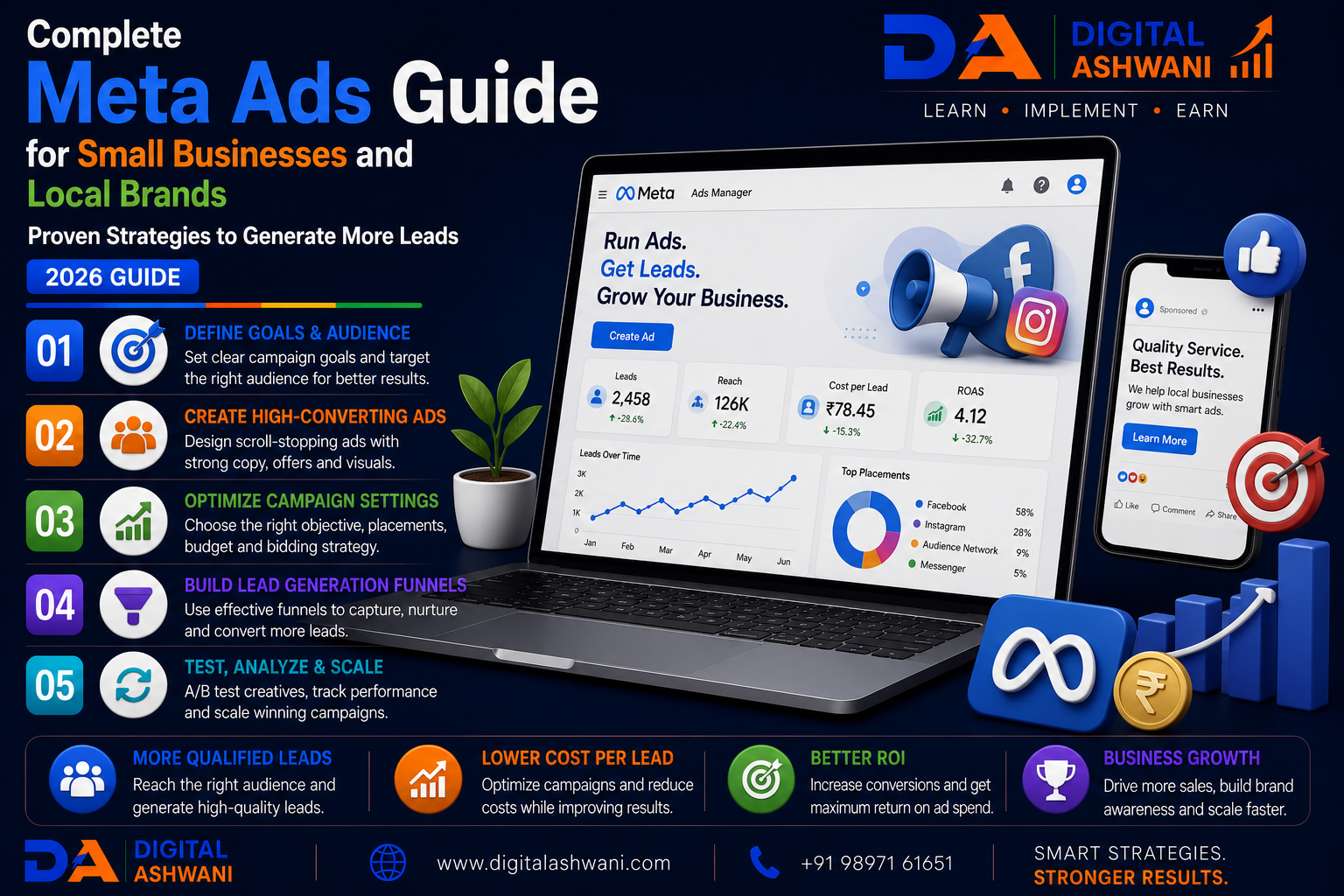
Complete Meta Ads Guide for Small Businesses and Local Brands
Meta Ads have become one of the most powerful digital advertising platforms for businesses looking to generate leads, increase sales, and build brand awareness. Through Facebook, Instagram, Messenger, and the Meta Audience Network, businesses can reach highly targeted audiences based on interests, demographics, online behavior, and purchase intent.
Unlike traditional advertising, Meta Ads allow even small businesses with limited budgets to compete with larger brands by delivering highly personalized advertisements to potential customers. Whether you own a retail store, restaurant, healthcare clinic, salon, gym, educational institute, travel agency, real estate business, or eCommerce website, Meta Ads can help you attract qualified customers and achieve measurable business growth.
Today’s Meta advertising platform also uses Artificial Intelligence to optimize campaign delivery, identify high-converting audiences, improve bidding strategies, and maximize return on ad spend (ROAS). Businesses that understand how to combine AI automation with strong creatives, persuasive ad copy, and effective audience targeting can consistently generate high-quality leads at a lower cost.
In this complete guide by Digital Ashwani, you’ll learn 15 proven Meta Ads strategies to improve campaign performance, reduce advertising costs, increase conversions, and grow your business successfully in 2026.
What Are Meta Ads?
Meta Ads are paid advertisements displayed across Meta’s digital ecosystem, including:
- Facebook Feed
- Instagram Feed
- Instagram Reels
- Facebook Stories
- Instagram Stories
- Messenger
- Meta Audience Network
Businesses can promote products, services, events, mobile apps, and websites while reaching highly relevant audiences.
Why Meta Ads Matter for Small Businesses
Millions of people use Facebook and Instagram every day to discover businesses, compare products, and make purchasing decisions.
Meta Ads help businesses:
- Generate qualified leads
- Increase website traffic
- Improve online sales
- Build brand awareness
- Promote local businesses
- Increase store visits
- Grow social media followers
- Retarget interested customers
Even businesses with modest budgets can achieve excellent results through precise audience targeting and campaign optimization.
How Meta Ads Work
Meta Ads use machine learning and audience signals to show advertisements to users who are most likely to engage or convert.
A typical customer journey includes:
- User sees an advertisement.
- Watches the image or video.
- Clicks the ad.
- Visits the landing page.
- Fills out a form, calls the business, or makes a purchase.
Optimizing every stage of this journey improves campaign performance.
15 Powerful Meta Ads Strategies
1. Define Clear Campaign Objectives
Every successful Meta Ads campaign begins with a clear objective.
Choose objectives such as:
- Brand Awareness
- Traffic
- Engagement
- Lead Generation
- Website Conversions
- App Promotion
- Sales
Selecting the right campaign objective helps Meta optimize delivery more effectively.
2. Understand Your Target Audience
Successful advertising starts with knowing your ideal customer.
Consider:
- Age
- Gender
- Location
- Interests
- Income Level
- Occupation
- Buying Behavior
- Device Usage
Well-defined audiences improve click-through rates and reduce advertising costs.
3. Install Meta Pixel and Conversion API
Tracking is essential for campaign optimization.
Meta Pixel and Conversion API help monitor:
- Page Views
- Leads
- Purchases
- Contact Form Submissions
- Add-to-Cart Events
- Checkout Activity
Accurate conversion tracking improves AI optimization and remarketing performance.
4. Create High-Converting Landing Pages
Your advertisement attracts visitors, but your landing page converts them into customers.
Every landing page should include:
- Clear Headline
- Strong Value Proposition
- Fast Loading Speed
- Mobile Optimization
- Customer Reviews
- Trust Badges
- Simple Contact Form
- Strong Call-to-Action
An optimized landing page significantly improves conversion rates.
5. Design Scroll-Stopping Creatives
Creative quality has a major impact on campaign success.
Use:
- Professional Images
- Vertical Videos
- Instagram Reels
- Carousel Ads
- Before-and-After Photos
- Product Demonstrations
- Customer Testimonials
High-quality visuals capture attention and improve engagement.
6. Write Benefit-Focused Ad Copy
Instead of focusing only on product features, explain how your solution helps customers.
Strong ad copy should:
- Solve a problem
- Highlight benefits
- Build trust
- Create urgency
- Include a clear CTA
Simple, conversational messaging usually performs better than complicated sales language.
7. Test Multiple Ad Variations
Never rely on one creative.
Test different:
- Headlines
- Primary Text
- Images
- Videos
- CTA Buttons
- Audience Segments
- Placements
A/B testing helps identify the best-performing combinations while reducing advertising costs.
8. Build Remarketing Campaigns
Most people don’t convert during their first visit.
Retarget users who have:
- Visited your website
- Watched your videos
- Engaged with your social pages
- Added products to cart
- Started filling forms
- Viewed important pages
Remarketing campaigns usually generate higher conversion rates because they target warm audiences already familiar with your business.
9. Use AI-Powered Campaign Optimization
Meta’s AI has become much more advanced and can automatically optimize campaigns to improve performance.
AI Can Help With
- Audience Expansion
- Budget Allocation
- Bid Optimization
- Ad Delivery
- Creative Recommendations
- Performance Forecasting
- Dynamic Ad Placement
- Conversion Optimization
Combine AI automation with regular human monitoring to achieve the best results.
10. Set a Realistic Advertising Budget
A successful Meta Ads campaign doesn’t always require a large budget.
Start with a manageable daily or monthly budget and gradually increase spending based on campaign performance.
Budget Tips
- Test campaigns with smaller budgets first.
- Allocate more budget to high-performing ads.
- Pause underperforming campaigns.
- Scale gradually after consistent results.
- Monitor Cost Per Lead (CPL) and Return on Ad Spend (ROAS).
A data-driven budgeting approach helps maximize ROI.
11. Optimize Ad Placements
Meta offers multiple ad placements across its ecosystem.
Examples include:
- Facebook Feed
- Instagram Feed
- Instagram Reels
- Facebook Stories
- Instagram Stories
- Messenger
- Audience Network
Automatic Placements often perform well, but review reports regularly and adjust based on results.
12. Monitor Campaign Performance
Successful advertisers continuously analyze campaign data.
Use Meta Ads Manager to track important performance metrics.
Important KPIs
- Impressions
- Reach
- Click-Through Rate (CTR)
- Cost Per Click (CPC)
- Cost Per Lead (CPL)
- Conversion Rate
- Return on Ad Spend (ROAS)
- Frequency
- Purchases
- Revenue
Review campaign reports weekly and make optimization decisions based on data rather than assumptions.
13. Generate High-Quality Leads
Lead quality matters more than lead quantity.
Improve lead generation by:
- Using clear offers
- Asking only essential form fields
- Creating dedicated landing pages
- Offering free consultations
- Providing downloadable resources
- Responding quickly to enquiries
Fast follow-up significantly increases conversion rates.
14. Refresh Creatives Regularly
Showing the same ad repeatedly can lead to ad fatigue, reducing engagement and increasing advertising costs.
Refresh your campaigns by updating:
- Images
- Videos
- Headlines
- Primary Text
- Offers
- CTA Buttons
Testing fresh creatives keeps campaigns effective and improves long-term performance.
15. Continuously Test and Scale Winning Campaigns
Never stop optimizing.
Scale campaigns that consistently produce strong results by:
- Increasing budgets gradually
- Expanding audience targeting
- Testing Lookalike Audiences
- Launching new creative variations
- Improving landing pages
- Refining conversion tracking
Continuous optimization helps businesses achieve sustainable growth while maintaining profitable advertising costs.
Complete Meta Ads Checklist
Before launching any campaign, verify that you’ve completed the following:
- Campaign Objective Selected
- Target Audience Defined
- Meta Pixel & Conversion API Installed
- Landing Page Optimized
- High-Quality Creatives Prepared
- Persuasive Ad Copy Written
- A/B Tests Planned
- Remarketing Audience Created
- Budget Allocated
- Analytics Tracking Enabled
Following this checklist reduces wasted ad spend and improves campaign performance.
Common Meta Ads Mistakes
Choosing the Wrong Campaign Objective
Selecting an objective that doesn’t match your business goal can reduce campaign effectiveness.
Always align objectives with the desired outcome, such as leads, sales, or traffic.
Targeting Too Broad or Too Narrow an Audience
An audience that’s too broad may attract irrelevant users, while one that’s too narrow can limit reach.
Balance relevance with sufficient audience size.
Ignoring Landing Page Experience
Even high-performing ads can fail if the landing page is slow, confusing, or lacks a strong call-to-action.
Optimize pages for speed, clarity, and conversions.
Not Testing Creatives
Running only one image or video limits learning opportunities.
Continuously test multiple creatives to discover what resonates with your audience.
Ignoring Campaign Data
Making decisions without reviewing analytics often leads to wasted budget.
Use performance data to optimize targeting, creatives, and bidding strategies.
Internal Linking Suggestions (Digital Ashwani)
Strengthen your Paid Advertising and Digital Marketing content cluster by linking this article with:
- What Is Google Ads and How Does It Work?
- How Google Ads Works and Why Businesses Should Invest in Paid Advertising
- Complete Social Media Marketing Checklist for Small and Medium Businesses
- What Is Social Media Marketing and Why Does Every Business Need It?
- Instagram Reels Strategy That Increases Reach and Brand Engagement Quickly
- How to Increase Website Conversion Rates Using Data-Driven Optimization Methods
- Google Analytics 4 and Why Every Business Should Use It
- ChatGPT for SEO: How to Create High-Quality Content That Ranks
- Digital Marketing Trends 2026
- Best AI Tools for Digital Marketing
These internal links strengthen topical authority, improve user navigation, and help search engines better understand your website’s content relationships.
External Resources
For official guidance and platform documentation, explore:
- Meta Business Help Center
- Meta Ads Manager Help Center
- Meta Blueprint
- Google Analytics Help Center
- Google Tag Manager Documentation
These resources provide up-to-date best practices for campaign setup, optimization, measurement, and advertising success.
Frequently Asked Questions
What are Meta Ads?
Meta Ads are paid advertisements that run across Facebook, Instagram, Messenger, and the Meta Audience Network, helping businesses reach targeted audiences and achieve marketing objectives.
Are Meta Ads suitable for small businesses?
Yes. Meta Ads allow businesses of all sizes to advertise with flexible budgets, advanced targeting, and measurable performance metrics.
What is the difference between Meta Ads and Google Ads?
Meta Ads target users based on interests, demographics, and behavior, while Google Ads primarily target users based on search intent. Both platforms complement each other in a complete digital marketing strategy.
How much should a small business spend on Meta Ads?
The ideal budget depends on your goals, industry, competition, and location. Start with a manageable budget, analyze results, and scale campaigns that consistently deliver positive ROI.
Can AI improve Meta Ads performance?
Yes. Meta uses AI to optimize bidding, audience targeting, placements, creative delivery, and campaign performance. Businesses should combine AI automation with strategic oversight for the best results.
Final Thoughts
A successful Complete Meta Ads Guide is built on strategic planning, audience research, compelling creatives, optimized landing pages, AI-powered campaign management, continuous testing, and data-driven optimization. Businesses that consistently analyze performance and adapt their campaigns are more likely to generate qualified leads, improve conversions, and maximize return on ad spend.
As Meta’s advertising platform continues to evolve with AI and automation, businesses that focus on customer value, relevant messaging, and continuous improvement will stay ahead of the competition. Instead of relying on guesswork, build a repeatable Meta Ads strategy that supports long-term business growth.
At Digital Ashwani, we regularly publish practical guides on Meta Ads, Google Ads, SEO, AI Marketing, Social Media Marketing, and Digital Marketing to help businesses generate more leads and grow sustainably.
