

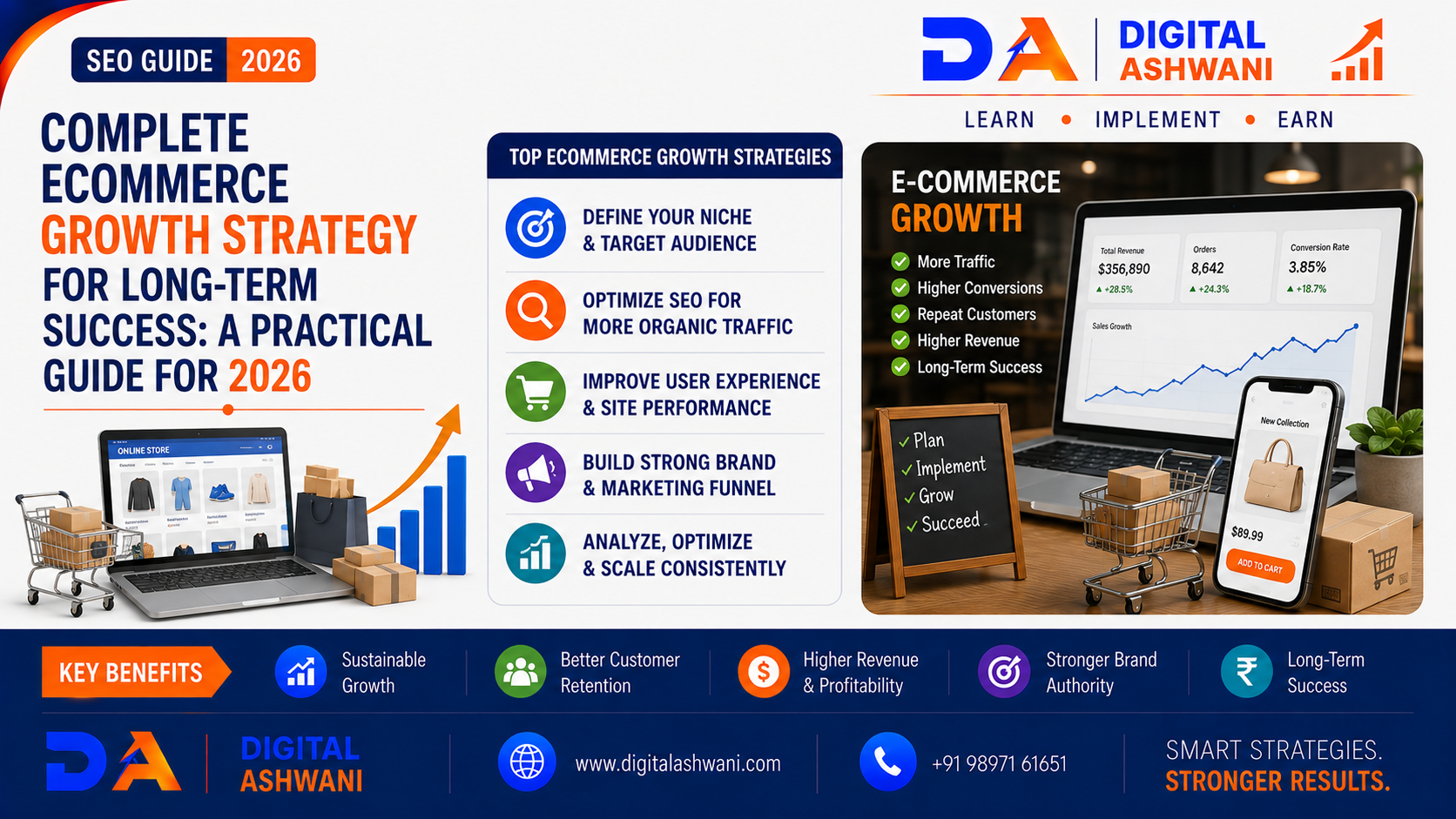
Complete Ecommerce Growth Strategy for Long-Term Success
Growing an ecommerce business is no longer as simple as launching an online store and running advertisements.
Competition is increasing, customers have more choices, acquisition costs can put pressure on margins, and shoppers now discover products through Google, social media, marketplaces, video platforms, and AI-powered search experiences.
A successful ecommerce business therefore needs more than traffic.
It needs a complete growth system that connects:
- Customer Acquisition
- Conversion Optimization
- Product Experience
- Customer Retention
- Repeat Purchases
- Brand Building
- SEO
- Paid Advertising
- Analytics
- Operational Efficiency
Current ecommerce growth guidance also emphasizes conversion optimization, retention, repeat revenue, expansion, and unified commerce as major growth levers.
In this comprehensive guide by Digital Ashwani, you’ll learn how to build an Ecommerce Growth Strategy that focuses not only on increasing sales today but also on creating sustainable revenue and stronger customer relationships over the long term.
What Is an Ecommerce Growth Strategy?
An ecommerce growth strategy is a structured plan for increasing revenue, profitability, customer acquisition, conversion rates, and repeat purchases.
Unlike a strategy that focuses only on generating website traffic, a complete growth strategy considers the entire customer journey:
Discovery → Visit → Product Research → Purchase → Delivery → Experience → Repeat Purchase → Loyalty
The goal is to improve every important stage of this journey.
A healthy ecommerce growth strategy should measure more than revenue alone. Important metrics include:
- Conversion Rate
- Average Order Value
- Customer Acquisition Cost
- Repeat Purchase Rate
- Customer Lifetime Value
- Revenue
- Contribution Margin
- Return on Ad Spend
- Cart Abandonment Rate
Why Ecommerce Businesses Struggle to Grow
Many ecommerce businesses make the mistake of focusing on only one growth channel.
For example:
More Ads → More Traffic → More Sales
This can work temporarily, but it becomes difficult when acquisition costs rise or conversion rates remain weak.
Common growth problems include:
- Poor Product Pages
- Weak Brand Positioning
- Low Conversion Rates
- High Cart Abandonment
- Expensive Customer Acquisition
- Low Repeat Purchases
- Poor SEO
- Weak Customer Experience
- Limited Analytics
- Operational Problems
A better approach is to identify where revenue is being lost before increasing marketing spend.
Start With an Ecommerce Growth Audit
Before implementing new strategies, analyze your current business.
Review:
Traffic
Identify which channels generate visitors.
- Organic Search
- Google Ads
- Meta Ads
- Social Media
- Direct Traffic
- Marketplaces
- Referral Traffic
Conversion
Analyze how visitors behave after arriving on your store.
Check:
- Product Page Views
- Add-to-Cart Rate
- Checkout Rate
- Purchase Rate
- Mobile Conversion
- Desktop Conversion
Customer Retention
Measure:
- Repeat Purchase Rate
- Returning Customers
- Customer Lifetime Value
- Time Between Purchases
- Subscription Retention Where Applicable
Profitability
Don’t focus only on revenue.
Analyze:
- Gross Margin
- Marketing Costs
- Shipping Costs
- Returns
- Discounts
- Payment Fees
- Contribution Margin
A growth strategy should increase profitable revenue, not simply order volume.
Understand Your Target Customers
Successful ecommerce growth starts with understanding who actually buys from you.
Research:
- Customer Problems
- Buying Motivations
- Price Sensitivity
- Product Preferences
- Search Behavior
- Preferred Platforms
- Objections
- Purchase Frequency
Create clear customer segments based on meaningful differences.
For example:
New Customer
Needs education and trust.
Returning Customer
May respond better to personalized recommendations.
High-Value Customer
May be suitable for loyalty programs and exclusive offers.
Create a Strong Product Strategy
Your product is the foundation of ecommerce growth.
Before increasing marketing spend, evaluate:
- Product Demand
- Pricing
- Quality
- Reviews
- Differentiation
- Profit Margin
- Competition
- Repeat Purchase Potential
A product with weak demand cannot be fixed simply by increasing advertising.
Optimize Product Pages
Product pages should answer the questions customers have before purchasing.
Include:
- Clear Product Title
- Detailed Description
- High-Quality Images
- Product Videos
- Benefits
- Specifications
- Size Information
- Pricing
- Availability
- Delivery Information
- Return Policy
- Reviews
- FAQs
- Clear CTA
Product pages should remove uncertainty and make purchasing easier.
Improve Ecommerce Website Conversion Rate
Getting visitors is only part of the growth process.
If your website receives 100,000 visitors but converts poorly, increasing traffic may simply increase wasted marketing spend.
Focus on:
Clear Calls-to-Action
Examples:
- Buy Now
- Add to Cart
- Shop Now
- Get Started
- Subscribe & Save
Trust Signals
Use:
- Customer Reviews
- Ratings
- Secure Payment Information
- Return Policy
- Delivery Information
- Product Guarantees Where Applicable
- Customer Support Details
Simple Navigation
Customers should quickly find:
- Categories
- Products
- Offers
- Account
- Cart
- Contact Information
Optimize the Mobile Shopping Experience
Mobile experience is critical for ecommerce businesses.
Your website should provide:
- Fast Loading
- Responsive Design
- Easy Navigation
- Large Tap Targets
- Readable Text
- Simple Product Browsing
- Easy Checkout
Current ecommerce guidance highlights mobile UX as a major conversion factor because mobile accounts for a large share of ecommerce browsing and orders.
Reduce Cart Abandonment
Customers may abandon carts because of:
- Unexpected Costs
- Complicated Checkout
- Slow Delivery
- Limited Payment Options
- Lack of Trust
- Forced Account Creation
- Poor Mobile Experience
Improve checkout by making the process:
Simple → Transparent → Fast → Trustworthy
Show important costs and delivery information early rather than surprising customers at the final step.
Build a Long-Term Ecommerce SEO Strategy
SEO can become a sustainable source of ecommerce traffic when implemented consistently.
Focus on:
- Keyword Research
- Product SEO
- Category SEO
- Technical SEO
- Internal Linking
- Content Marketing
- Image SEO
- Structured Data
- Backlinks
- Search Intent
Modern ecommerce SEO also increasingly needs to account for AI-powered search and product discovery, not just traditional search rankings.
Optimize Category and Collection Pages
Category pages can target valuable commercial keywords.
For example:
Running Shoes
can target broader searches than an individual product page.
Optimize category pages with:
- Descriptive Titles
- Useful Introductory Content
- Relevant Products
- Internal Links
- Filters
- FAQs Where Useful
- Appropriate Structured Data
Create Helpful Content
Content can attract potential customers before they are ready to purchase.
Examples:
- Buying Guides
- Product Comparisons
- How-to Guides
- Product Care Guides
- Industry Trends
- FAQs
- Product Education
- Size Guides
For example:
How to Choose the Best Running Shoes for Beginners
can introduce potential customers to your brand before they search for a specific product.
Build Topic Clusters
Connect informational content with commercial pages.
Example:
Running Shoes Guide
→ Best Running Shoes
→ Running Shoes Collection
→ Individual Product Pages
This structure creates a stronger customer journey from research to purchase.
Use Google Ads Strategically
Paid search can capture customers with high purchase intent.
Target relevant searches such as:
- Buy Product Online
- Product Near Me
- Best Product Brand
- Product Price
- Product Deals
Focus on profitable searches rather than maximizing clicks.
Use Shopping Campaigns Where Appropriate
Product-based advertising can help ecommerce businesses showcase products directly to shoppers.
Keep product information accurate:
- Product Title
- Price
- Availability
- Images
- Brand
- Product Identifiers
- Product Category
The quality of your product data can influence how effectively products are represented across shopping experiences.
Build a Meta Ads Strategy
Meta platforms can help ecommerce brands reach potential customers based on interests, behavior, and other available signals.
Use different creative approaches for:
- New Customers
- Website Visitors
- Product Viewers
- Cart Abandoners
- Existing Customers
Creative quality is especially important.
Test:
- Product Videos
- UGC
- Demonstrations
- Testimonials
- Before-and-After Where Appropriate
- Problem-Solution Creatives
- Product Benefits
Use Social Media for Brand Discovery
Social media should not be used only to publish promotional posts.
Create content that:
- Educates
- Demonstrates Products
- Answers Questions
- Shows Behind the Scenes
- Builds Community
- Shares Customer Experiences
Social content can create demand that later converts through search, direct traffic, email, or other channels.
Increase Average Order Value
Increasing AOV can improve revenue without requiring the same proportional increase in customer acquisition.
Strategies include:
Product Bundles
Combine complementary products into a useful package.
Cross-Selling
Recommend related products.
Upselling
Offer a higher-value alternative when appropriate.
Free Shipping Thresholds
For example:
Free Shipping Above ₹1,499
can encourage customers to add more products when the economics make sense.
Volume Offers
Examples:
- Buy 2, Save More
- Buy 3, Get a Discount
Discounts should always be evaluated against margin.
Build Customer Retention
Long-term ecommerce growth depends heavily on repeat customers.
Retention strategies can include:
- Personalized Emails
- Product Recommendations
- Loyalty Programs
- Reorder Reminders
- Exclusive Offers
- Post-Purchase Education
- Customer Support
- Subscription Models Where Appropriate
Acquiring a customer is only the beginning of the relationship.
Use Email Marketing
Email remains valuable for ecommerce retention.
Create automated flows such as:
Welcome Series
Introduce your brand and products.
Abandoned Cart Flow
Remind customers about products they left behind.
Post-Purchase Flow
Help customers use or care for their purchase.
Cross-Sell Flow
Recommend relevant complementary products.
Win-Back Flow
Reconnect with customers who haven’t purchased recently.
Use WhatsApp Marketing Responsibly
For businesses where customers have opted in and applicable messaging rules are followed, WhatsApp can support:
- Order Updates
- Customer Support
- Product Notifications
- Promotional Messages
- Reorder Reminders
Don’t send unwanted promotional messages or purchase customer contact lists.
Build Customer Reviews and User-Generated Content
Real customer experiences can improve trust.
Encourage customers to share:
- Product Reviews
- Photos
- Videos
- Testimonials
- Product Experiences
Display authentic UGC on relevant product pages and marketing channels.
Build a Strong Brand
Long-term ecommerce growth isn’t only about performance marketing.
A recognizable brand can improve:
- Direct Traffic
- Repeat Purchases
- Customer Trust
- Organic Searches
- Referral Traffic
- Customer Loyalty
Develop consistent:
- Brand Voice
- Visual Identity
- Product Positioning
- Customer Experience
- Messaging
Build an Omnichannel Growth Strategy
Customers may discover your business through one channel and purchase through another.
For example:
Instagram → Google Search → Website → Email → Purchase
Your channels should therefore work together instead of operating as isolated marketing campaigns.
Current ecommerce strategy guidance increasingly emphasizes unified commerce and channel expansion as part of sustainable growth.
Expand to Marketplaces Carefully
Marketplaces can provide additional customer reach.
Depending on your business, these may include:
- Amazon
- Flipkart
- Myntra
- Other Relevant Marketplaces
However, don’t depend entirely on marketplaces.
Your own ecommerce website helps you build:
- Brand Equity
- Customer Relationships
- First-Party Data
- Repeat Purchases
- Long-Term Customer Value
Use Analytics for Better Decisions
Track ecommerce performance across the complete customer journey.
Important metrics include:
- Revenue
- Conversion Rate
- AOV
- CAC
- ROAS
- Repeat Purchase Rate
- Customer Lifetime Value
- Cart Abandonment
- Return Rate
- Contribution Margin
Don’t optimize one metric in isolation.
Understand Customer Acquisition Cost
CAC measures how much it costs to acquire customers.
For example:
Marketing Spend = ₹1,00,000
New Customers = 500
Approximate CAC:
₹200 per customer
But CAC should be evaluated alongside customer value.
A ₹500 CAC may be sustainable for a customer who generates ₹5,000 in profitable lifetime value but problematic for a customer who generates only ₹600 in margin.
Focus on Customer Lifetime Value
Customer Lifetime Value helps you understand the longer-term economic value of customers.
Improve LTV through:
- Repeat Purchases
- Cross-Selling
- Upselling
- Loyalty
- Subscriptions
- Better Customer Experience
The objective is to build customers who stay valuable over time.
Improve Ecommerce Operations
Marketing cannot compensate for poor operations.
Review:
- Inventory
- Shipping
- Delivery Times
- Returns
- Customer Support
- Packaging
- Product Availability
Operational problems can damage reviews, retention, and profitability.
Use AI Carefully in Ecommerce Growth
AI can support ecommerce teams with:
- Product Description Drafting
- Customer Segmentation
- Content Ideas
- Data Analysis
- Ad Creative Variations
- Customer Support
- Product Recommendations
However, human review remains important for accuracy, brand voice, product information, and customer communication.
AI-powered shopping and discovery are also becoming increasingly relevant to ecommerce visibility, making structured and accurate product data more important.
Test Before Scaling
Don’t immediately scale every successful-looking campaign.
Use controlled testing for:
- Product Pages
- Offers
- Pricing
- Headlines
- CTAs
- Checkout
- Ad Creatives
- Email Campaigns
Before every test, define:
- Current Baseline
- Expected Improvement
- Success Metric
- Testing Period
Then make decisions based on evidence.
Common Ecommerce Growth Mistakes
Focusing Only on Traffic
More visitors don’t guarantee more revenue.
Scaling Ads Before Fixing Conversion Problems
Sending more traffic to a poor website can increase wasted spend.
Ignoring Existing Customers
Repeat customers can be a valuable source of revenue.
Discounting Too Much
Excessive discounts can reduce margins and weaken brand positioning.
Ignoring Profitability
High revenue doesn’t necessarily mean a profitable business.
Using Too Many Marketing Channels
Being everywhere isn’t always better.
Choose channels that match your customers and business economics.
Ignoring Product Experience
Poor product information can reduce conversions even when traffic is strong.
Making Decisions Without Data
Use reliable analytics before making major growth investments.
Ecommerce Growth Strategy Checklist
Before scaling your ecommerce business, review:
- Product-Market Fit
- Customer Research
- Website UX
- Mobile Optimization
- Product Pages
- Category Pages
- SEO
- Google Ads
- Meta Ads
- Social Media
- Email Marketing
- Customer Retention
- AOV
- CAC
- LTV
- Conversion Rate
- Cart Abandonment
- Reviews
- Customer Support
- Inventory
- Shipping
- Returns
- Analytics
- Profitability
Internal Linking Suggestions (Digital Ashwani)
Strengthen the ecommerce marketing and SEO content cluster by linking this article with:
- Shopify SEO Tips to Increase Organic Traffic
- Product Page SEO Best Practices for Higher Conversions
- How to Increase Website Conversion Rates Using Data-Driven Optimization Methods
- How Search Engines Crawl, Index, and Rank Websites
- Schema Markup Guide to Improve Rich Results and Organic Click Through Rates
- What Is Canonical URL and Why Should You Use It?
- Complete Google Ads Setup Guide for Beginners With Practical Examples
- Negative Keywords Strategy to Reduce Wasted Google Ads Spending
- How Artificial Intelligence Is Changing Google Ads Campaign Optimization
These internal links connect ecommerce growth with Shopify SEO, product optimization, CRO, technical SEO, structured data, Google Ads, and AI-powered marketing.
External Resources
For current ecommerce, SEO, and growth guidance, refer to official resources such as:
- Shopify Ecommerce Growth Guide
- Google Search Central
- Google Search Console Help
- Google Analytics Help
- Google Ads Help
Ecommerce platforms, advertising systems, and search features continue to evolve, so always review current official documentation before implementing major technical or advertising changes.
Frequently Asked Questions
What is the best ecommerce growth strategy?
There is no single strategy that works for every store. A strong ecommerce growth strategy combines customer acquisition, conversion optimization, retention, product experience, SEO, paid advertising, analytics, and operational efficiency.
How can I grow my ecommerce business without increasing ad spend?
Improve conversion rates, increase average order value, strengthen SEO, generate repeat purchases, improve email marketing, build organic social visibility, and reduce customer churn.
Is SEO important for ecommerce growth?
Yes. Ecommerce SEO can help attract shoppers who are actively searching for products and can create long-term organic visibility. Product pages, category pages, technical SEO, internal linking, and helpful content should work together.
How can I increase ecommerce sales?
Focus on the complete customer journey. Improve product pages, website conversion rates, checkout, offers, customer trust, traffic quality, retention, and repeat purchases instead of relying on one tactic.
What is more important: traffic or conversion rate?
Both matter, but traffic without conversions has limited business value. Fix major conversion and customer-experience problems before aggressively scaling acquisition.
How can ecommerce businesses increase repeat purchases?
Use high-quality customer service, personalized email campaigns, loyalty programs, relevant product recommendations, reorder reminders, subscriptions where appropriate, and a strong post-purchase experience.
Should ecommerce businesses focus on Google Ads or SEO?
Both can play different roles. Google Ads can provide immediate access to relevant demand, while SEO can build longer-term organic visibility. The right balance depends on margins, competition, customer journey, and business objectives.
How long does an ecommerce growth strategy take to work?
There is no universal timeline. Some conversion improvements can produce results quickly, while SEO, brand building, retention, and customer acquisition improvements may require months of consistent work.
Final Thoughts
A successful Ecommerce Growth Strategy is not about finding one marketing trick that suddenly doubles sales.
Long-term growth comes from building a connected system:
Acquire Customers → Convert Visitors → Increase AOV → Retain Customers → Generate Repeat Revenue → Improve Profitability
Focus on the entire customer journey rather than a single channel.
Build a strong product experience, optimize your website, invest in SEO, use paid advertising intelligently, create valuable content, develop customer retention systems, and measure performance against profitability.
Most importantly, don’t confuse revenue growth with business growth.
A stronger ecommerce business is one that can acquire customers efficiently, convert them effectively, retain them longer, and generate profitable revenue consistently.
At Digital Ashwani, we regularly publish practical guides on Ecommerce SEO, Shopify SEO, Google Ads, Meta Ads, Conversion Optimization, AI Marketing, Local SEO, and Digital Marketing to help businesses build sustainable online growth.
