

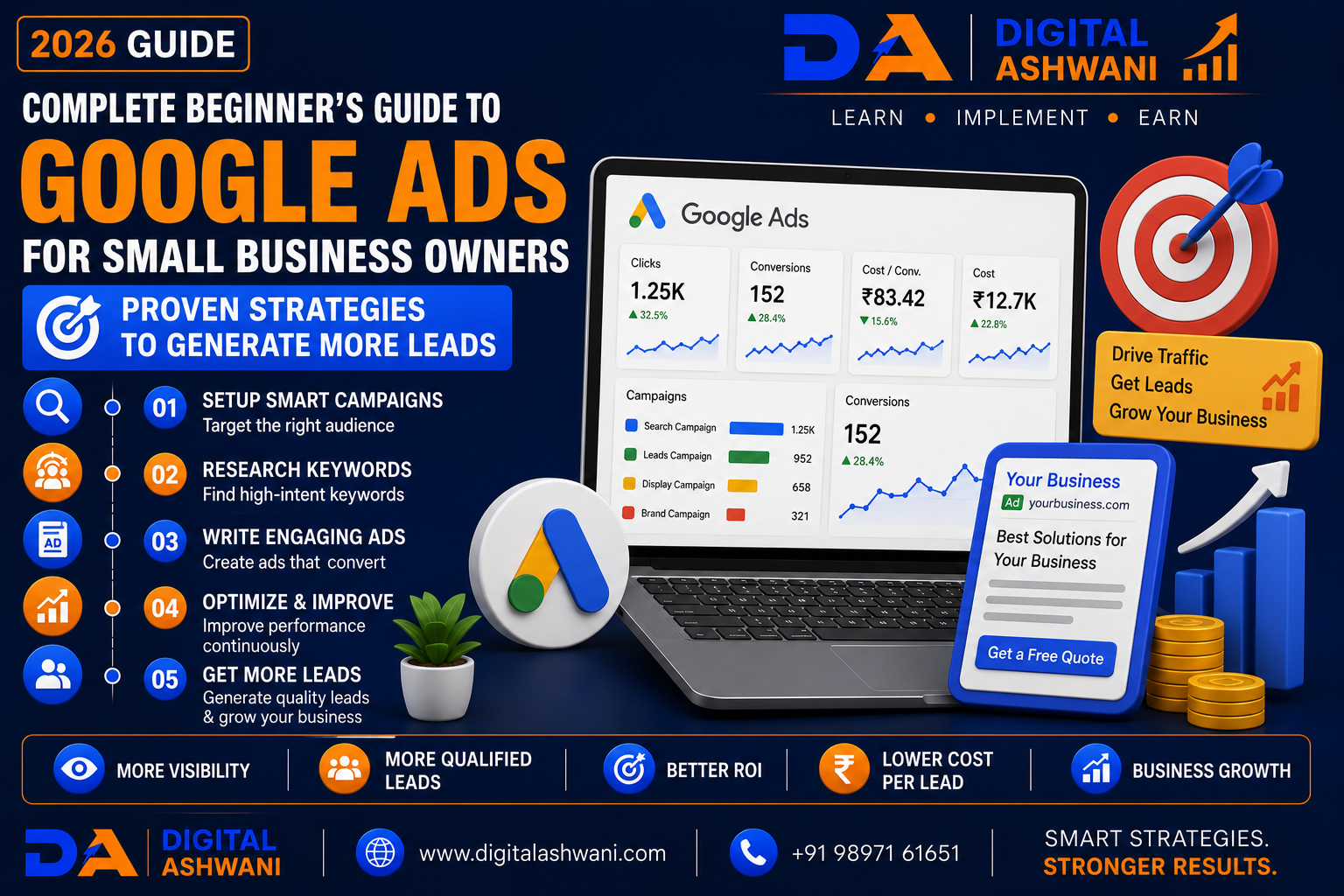
Complete Beginner’s Guide to Google Ads for Small Business Owners
For many small business owners, getting noticed online is one of the biggest challenges. Even with a professional website and quality products or services, potential customers may never find your business if it doesn’t appear when they search on Google.
That’s where Google Ads becomes a powerful marketing solution.
Google Ads enables businesses to display advertisements to people who are actively searching for relevant products or services. Unlike traditional advertising, where your message is shown to a broad audience, Google Ads focuses on users with clear buying intent, helping businesses generate qualified leads, phone calls, website visits, and sales.
Whether you own a local business, eCommerce store, coaching institute, dental clinic, law firm, real estate agency, or service-based company, Google Ads can help you reach potential customers at the right time.
In this comprehensive guide by Digital Ashwani, you’ll learn 15 proven Google Ads strategies that help small business owners launch successful advertising campaigns and maximize return on investment in 2026.
What Is Google Ads?
Google Ads is Google’s online advertising platform that allows businesses to promote products and services across:
- Google Search
- Google Display Network
- YouTube
- Google Maps
- Gmail
- Partner Websites
Advertisers typically pay when users click on their ads, making it a performance-focused advertising platform.
Why Small Businesses Should Use Google Ads
Google Ads helps businesses reach customers who are already searching for their services.
Benefits include:
- Immediate Visibility
- Qualified Leads
- Flexible Budgeting
- Measurable Results
- Local Customer Targeting
- Fast Campaign Launches
- Scalable Growth
- Better ROI Tracking
Unlike SEO, which usually takes time to produce results, Google Ads can begin generating traffic soon after campaigns go live.
Benefits of Google Ads
A well-managed Google Ads campaign helps businesses:
- Generate More Leads
- Increase Website Traffic
- Drive Phone Calls
- Improve Brand Awareness
- Increase Sales
- Reach Local Customers
- Measure Campaign Performance
- Support Business Growth
15 Proven Google Ads Strategies
1. Define Clear Business Goals
Before creating a campaign, decide what success looks like.
Common goals include:
- Lead Generation
- Online Sales
- Appointment Bookings
- Phone Calls
- Store Visits
- Brand Awareness
Clear objectives help you choose the right campaign settings.
2. Choose the Right Campaign Type
Google Ads offers several campaign options.
Examples include:
- Search Campaigns
- Display Campaigns
- Performance Max
- Shopping Campaigns
- Video Campaigns
- Demand Gen Campaigns
Choose the campaign type that aligns with your business objectives.
3. Research High-Intent Keywords
Target keywords that indicate strong purchase intent.
Examples:
- Dentist Near Me
- SEO Agency Delhi
- Digital Marketing Company
- Buy Running Shoes
- Real Estate Agent
Well-researched keywords improve lead quality.
4. Write Compelling Ad Copy
Your ads should clearly communicate value.
Include:
- Strong Headlines
- Unique Selling Points
- Relevant Keywords
- Clear Call-to-Action
- Benefits
- Trust Signals
Relevant ad copy can improve click-through rates.
5. Create Optimized Landing Pages
Sending visitors to a well-designed landing page improves conversions.
Include:
- Clear Headline
- Business Benefits
- Contact Form
- Call Button
- Testimonials
- Fast Loading Speed
Landing pages should match the promise made in your ads.
6. Use Location Targeting
Show your ads only where your customers are located.
Examples:
- Specific Cities
- Service Areas
- States
- Countries
- Radius Around Your Business
Accurate targeting helps reduce wasted ad spend.
7. Add Negative Keywords
Exclude searches that are not relevant to your business.
Examples:
- Free
- Jobs
- Course
- Internship
Negative keywords help improve campaign efficiency.
8. Track Conversions
Measure the actions that matter most.
Examples include:
- Contact Form Submissions
- Phone Calls
- Purchases
- Appointment Bookings
- Quote Requests
- Newsletter Signups
Accurate conversion tracking helps optimize advertising performance.
9. Choose the Right Bidding Strategy
Google Ads offers multiple bidding strategies depending on your campaign goals.
Common options include:
- Maximize Clicks
- Maximize Conversions
- Target CPA
- Target ROAS
- Manual CPC
- Maximize Conversion Value
Choose a bidding strategy that aligns with your business objectives and available conversion data.
10. Manage Your Advertising Budget Wisely
A larger budget doesn’t always guarantee better results.
To maximize your investment:
- Start with a Realistic Budget
- Monitor Daily Spend
- Focus on High-Performing Campaigns
- Pause Underperforming Ads
- Reallocate Budget Based on Results
Regular budget reviews help improve return on investment.
11. Use AI to Improve Campaign Performance
Artificial Intelligence plays an increasingly important role in Google Ads.
AI can assist with:
- Smart Bidding
- Audience Signals
- Ad Asset Recommendations
- Performance Forecasting
- Search Term Insights
- Campaign Optimization
AI improves efficiency, but campaign strategy and ongoing monitoring still require human expertise.
12. Improve Quality Score
Quality Score influences ad performance and advertising costs.
Improve it by focusing on:
- Relevant Keywords
- Helpful Ad Copy
- Strong Landing Pages
- Positive User Experience
- Fast Website Speed
- Expected Click-Through Rate
Higher-quality campaigns often achieve better results at lower costs.
13. Analyze Campaign Performance
Review campaign data regularly using:
- Google Ads Dashboard
- Google Analytics 4
- Looker Studio
- Google Search Console
Monitor important metrics such as:
- Impressions
- Clicks
- Click-Through Rate (CTR)
- Cost Per Click (CPC)
- Conversions
- Cost Per Conversion
- Return on Ad Spend (ROAS)
Performance analysis supports continuous optimization.
14. Test Multiple Ad Variations
Don’t rely on a single advertisement.
Experiment with:
- Different Headlines
- Alternative Descriptions
- Various Calls-to-Action
- Landing Pages
- Keyword Groups
- Ad Extensions
Testing helps identify the combinations that perform best.
15. Continuously Optimize Your Campaigns
Successful Google Ads campaigns require ongoing improvement.
Regularly:
- Review Search Terms
- Add Negative Keywords
- Adjust Bids
- Update Ad Copy
- Improve Landing Pages
- Refresh Ad Assets
- Analyze Competitors
- Monitor Conversion Data
Continuous optimization leads to stronger long-term campaign performance.
Google Ads Checklist for Small Business Owners
Before launching your campaign, confirm the following:
- Business Goals Defined
- Campaign Type Selected
- High-Intent Keywords Researched
- Negative Keywords Added
- Ad Copy Optimized
- Landing Page Ready
- Conversion Tracking Configured
- Budget Set
- Location Targeting Applied
- Campaign Testing Planned
Following this checklist helps create a solid foundation for successful advertising.
Common Google Ads Mistakes
Targeting Broad Keywords
Very broad keywords may attract irrelevant clicks and increase advertising costs.
Use specific, high-intent keywords whenever possible.
Ignoring Negative Keywords
Without negative keywords, your ads may appear for searches that are unlikely to generate business.
Sending Traffic to the Homepage
A dedicated landing page usually provides a better user experience and can improve conversion rates compared to a general homepage.
Not Tracking Conversions
Without conversion tracking, it is difficult to understand which campaigns are generating valuable business results.
Making Frequent Major Changes
Avoid changing bids, budgets, and targeting too frequently. Allow campaigns enough time to collect meaningful performance data before making significant adjustments.
Internal Linking Suggestions (Digital Ashwani)
Strengthen your Google Ads and PPC content cluster by linking this article with:
- What Is Google Ads and How Does It Help Businesses Generate More Leads?
- Complete Google Search Ads Campaign Setup Guide for Better Lead Generation
- Complete Google Display Ads Guide for Brand Awareness and Remarketing
- What Are Negative Keywords?
- Ultimate Analytics and Tracking Guide for Long-Term Business Growth
- What Is Looker Studio and How Does It Improve Marketing Reporting?
- How to Increase Website Conversion Rates Using Data-Driven Optimization Methods
- What Is First-Party Data?
- What Is Artificial Intelligence (AI) in Digital Marketing?
- Complete Beginner’s Guide to Understanding How Google Search Ranking Really Works
These internal links strengthen topical authority while helping readers explore related Google Ads, PPC, analytics, AI marketing, and conversion optimization topics.
External Resources
For trusted Google Ads guidance, refer to:
- Google Ads Help Center
- Google Skillshop
- Google Analytics Help Center
- Google Search Central
- Google Business Profile Help
These official resources provide current recommendations for campaign management, measurement, optimization, and advertising best practices.
Frequently Asked Questions
Is Google Ads good for small businesses?
Yes. Google Ads allows small businesses to reach people actively searching for their products or services, making it an effective channel for generating qualified leads and sales.
How much should a small business spend on Google Ads?
There is no fixed amount. Your ideal budget depends on your industry, competition, target audience, business goals, and expected return on investment.
Can Google Ads generate leads quickly?
Yes. Properly configured campaigns can begin generating traffic and inquiries soon after launch, although results depend on targeting, competition, ad quality, and landing page performance.
What is the most important Google Ads metric?
There isn’t a single most important metric. Businesses should evaluate clicks, conversions, cost per conversion, return on ad spend (ROAS), and overall business outcomes together.
Do I need a website to run Google Ads?
For most campaign types, a professional, mobile-friendly website or dedicated landing page is strongly recommended to provide a good user experience and improve conversion potential.
Final Thoughts
The Complete Beginner’s Guide to Google Ads for Small Business Owners demonstrates that successful advertising is about more than simply paying for clicks. Effective campaigns begin with clear business goals, high-intent keyword targeting, compelling advertisements, optimized landing pages, accurate conversion tracking, and ongoing performance analysis.
As Google Ads continues integrating Artificial Intelligence and automation, small business owners who combine AI-powered tools with strategic planning and regular optimization will be better positioned to generate qualified leads while managing advertising costs effectively.
Rather than trying to maximize traffic alone, focus on attracting the right customers, improving conversion rates, and measuring meaningful business outcomes. A well-managed Google Ads strategy can become one of the most reliable channels for sustainable business growth.
At Digital Ashwani, we regularly publish practical guides on Google Ads, SEO, AI Marketing, Google Analytics, Conversion Optimization, and Digital Marketing to help businesses generate more leads and achieve long-term online success.
