

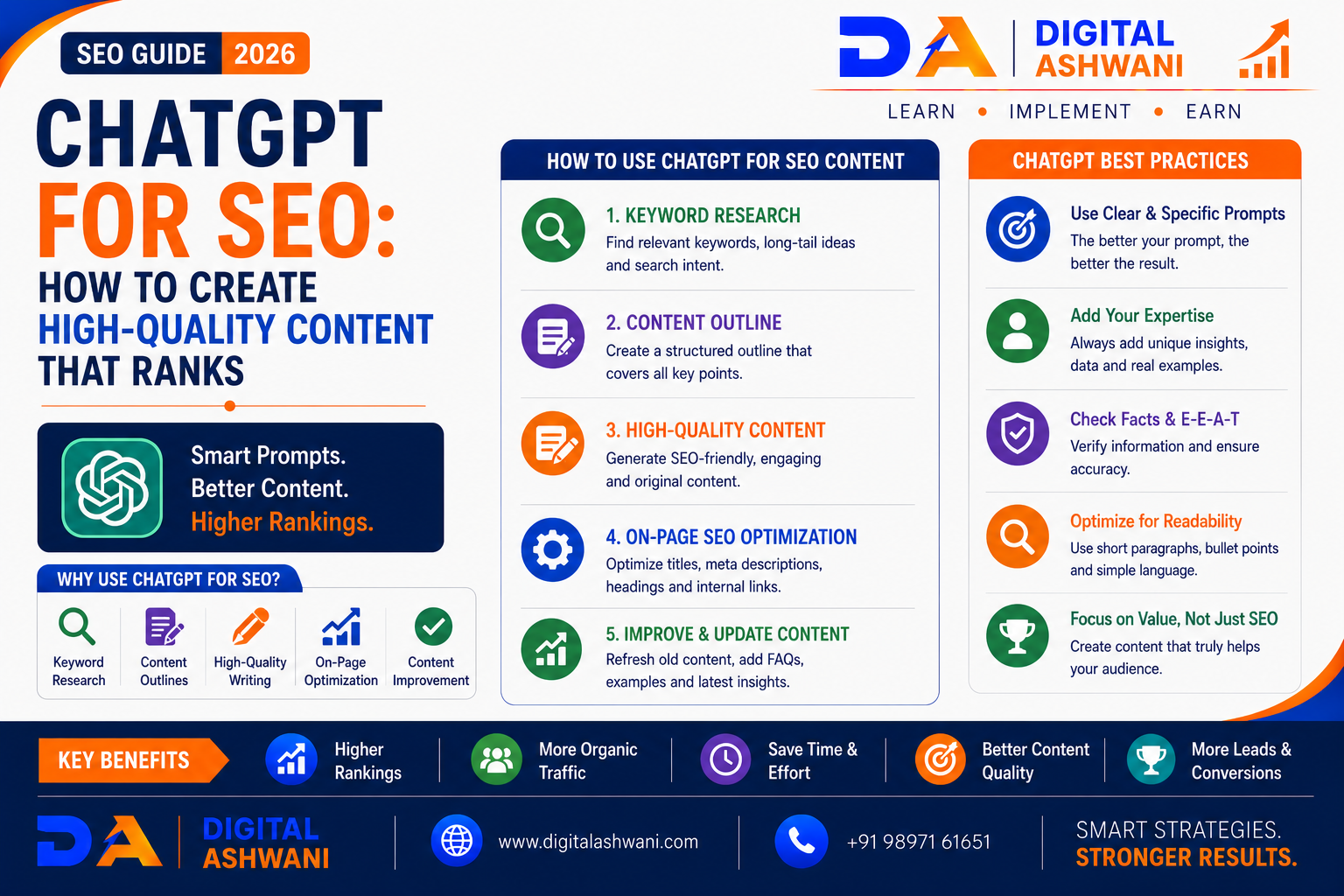
ChatGPT for SEO: How to Create High-Quality Content That Ranks
Artificial Intelligence has become a major part of modern SEO workflows. Among the most widely used AI tools, ChatGPT helps marketers, SEO professionals, bloggers, businesses, and content creators streamline research, planning, writing, editing, and content optimization.
However, using ChatGPT effectively for SEO requires more than simply asking it to write an article.
Many websites publish AI-generated content that lacks originality, expertise, search intent alignment, and real-world value. As a result, the content often struggles to rank, attract engagement, or generate conversions.
The most successful SEO professionals use ChatGPT as a research and productivity assistant rather than a complete replacement for strategy, expertise, and editorial review.
When combined with keyword research, search intent analysis, topical authority, E-E-A-T principles, and human expertise, ChatGPT can help create content that serves users while supporting SEO goals.
In this comprehensive guide by Digital Ashwani, you’ll learn how to use ChatGPT for SEO to create high-quality content that ranks and provides genuine value to readers.
What Is ChatGPT for SEO?
ChatGPT for SEO refers to using ChatGPT to support search engine optimization activities.
These activities may include:
- Keyword Research Ideas
- Search Intent Analysis
- Content Planning
- Topic Clustering
- Content Outlines
- SEO Titles
- Meta Descriptions
- Internal Linking Suggestions
- Content Editing
- FAQ Creation
- Content Refreshes
Rather than replacing SEO expertise, ChatGPT can help make SEO workflows more efficient.
Why SEO Professionals Use ChatGPT
SEO involves many repetitive tasks that require research, organization, and content development.
ChatGPT can help reduce time spent on:
- Brainstorming
- Topic Research
- Outline Creation
- Content Expansion
- Rewriting
- Optimization
- Content Audits
This allows marketers to focus more on strategy, analysis, and quality improvement.
ChatGPT Is Not a Replacement for SEO Strategy
AI Needs Direction
ChatGPT can generate content quickly, but it does not automatically know:
- Your Business Goals
- Your Audience
- Your Competitors
- Your Website Structure
- Current Search Trends
- Actual Search Volumes
The quality of the output depends heavily on the instructions and data provided.
Strong SEO results still require human decision-making.
Start With Keyword Research
Identify Real Search Opportunities
Before generating content, determine what users are actually searching for.
Research:
- Primary Keywords
- Secondary Keywords
- Long-Tail Keywords
- Related Topics
- Questions
- Search Intent
ChatGPT can help brainstorm keyword ideas, but keyword decisions should be validated using actual SEO tools and search data.
Understand Search Intent
Create the Right Type of Content
One of the biggest SEO mistakes is creating content that doesn’t match search intent.
Search intent usually falls into categories such as:
- Informational
- Commercial
- Transactional
- Navigational
- Local
For example:
“What Is SEO?”
requires educational content.
“Best SEO Agency in Delhi”
requires a different approach focused on service evaluation.
ChatGPT should be guided by the specific intent behind the keyword.
Build a Content Brief First
Plan Before Writing
Instead of immediately generating a full article, start with a content brief.
A good content brief can include:
- Target Keyword
- Search Intent
- Audience
- Main Topics
- Supporting Topics
- Entities
- Internal Links
- FAQs
- Content Goals
This creates a stronger foundation for the article.
Create Detailed Content Outlines
Organize Information Logically
ChatGPT can help structure content into clear sections before writing begins.
A strong outline should:
- Cover the Main Topic
- Answer Related Questions
- Address Search Intent
- Include Supporting Information
- Follow a Logical Flow
A detailed outline often leads to a more comprehensive article.
Focus on Topical Depth
Cover the Subject Thoroughly
High-quality SEO content should address the topic comprehensively.
Instead of only discussing one aspect of a topic, consider:
- Definitions
- Benefits
- Challenges
- Examples
- Best Practices
- Common Mistakes
- FAQs
- Related Concepts
ChatGPT can help identify supporting subtopics that improve topical coverage.
Add Real Expertise
Use Human Knowledge
One limitation of AI-generated content is the lack of personal experience.
Content often becomes stronger when it includes:
- First-Hand Experience
- Case Studies
- Examples
- Industry Knowledge
- Original Insights
- Unique Observations
This is particularly important for competitive industries and E-E-A-T-focused content.
Create Helpful Content Instead of Keyword-Stuffed Content
Write for Users First
Avoid creating content solely to repeat keywords.
Instead, focus on:
- Solving Problems
- Answering Questions
- Providing Clarity
- Helping Readers Make Decisions
Keywords should be included naturally within useful content.
Use ChatGPT for FAQ Research
Identify Common Questions
ChatGPT can help generate relevant questions readers may ask.
Examples include:
- What is it?
- How does it work?
- Why is it important?
- What are the benefits?
- What mistakes should be avoided?
Well-written FAQs can improve content completeness.
Use ChatGPT for Internal Linking Ideas
Strengthen Topical Authority
Internal links help search engines understand relationships between pages.
ChatGPT can assist by identifying:
- Related Articles
- Supporting Topics
- Relevant Resources
- Topic Clusters
This can improve website structure and user navigation.
Optimize Titles and Meta Descriptions
Improve Click-Through Rates
ChatGPT can help generate:
- SEO Titles
- Meta Descriptions
- Headline Variations
- Alternative Angles
The goal should be clarity and relevance rather than exaggerated clickbait.
Improve Readability
Make Content Easier to Consume
Content should be easy to read and understand.
Review:
- Sentence Length
- Paragraph Structure
- Headings
- Lists
- Formatting
- Flow
ChatGPT can help simplify complex explanations and improve readability.
Use ChatGPT for Content Refreshes
Update Existing Articles
Older articles can often be improved instead of replaced.
ChatGPT can help identify:
- Missing Sections
- Outdated Information
- Weak Explanations
- New FAQs
- Better Headings
- Internal Linking Opportunities
Refreshing content can help maintain relevance over time.
Review Everything Before Publishing
Human Editing Is Essential
AI-generated content should always be reviewed for:
- Accuracy
- Clarity
- Search Intent
- Brand Voice
- Originality
- User Value
Never publish important content without reviewing it.
Recommended SEO Workflow Using ChatGPT
A practical workflow may look like:
Keyword Research → Search Intent Analysis → Content Brief → Outline → Draft → Human Review → On-Page Optimization → Internal Linking → Publish → Update
This combines AI efficiency with human expertise.
Common ChatGPT SEO Mistakes
Publishing Raw AI Content
Unedited AI content often lacks originality and expertise.
Ignoring Search Intent
Even well-written content can fail if it targets the wrong intent.
Skipping Fact Verification
Always verify important claims and statistics.
Creating Generic Content
Content that looks similar to hundreds of other articles often struggles to stand out.
Overusing Keywords
Keyword stuffing can hurt readability and user experience.
Neglecting E-E-A-T
Experience, Expertise, Authoritativeness, and Trustworthiness remain important quality signals.
ChatGPT SEO Checklist
Before publishing content, check:
- Keyword Research Completed
- Search Intent Verified
- Content Brief Created
- Detailed Outline Prepared
- Topic Covered Thoroughly
- Original Insights Added
- Internal Links Added
- FAQs Included
- Title Optimized
- Meta Description Written
- Content Reviewed
- Accuracy Checked
- Readability Improved
- E-E-A-T Strengthened
Internal Linking Suggestions (Digital Ashwani)
Strengthen your AI and SEO content cluster by linking this article with:
- Best ChatGPT Prompts for SEO Experts and Content Writers
- What Is ChatGPT for Marketing?
- How AI Is Transforming Modern SEO Strategies for Business Growth
- Artificial Intelligence (AI) in Digital Marketing
- Building Topical Authority Through Strategic Content Clusters and Internal Linking
- Competitor Analysis Techniques to Discover New SEO Growth Opportunities Quickly
- Top On-Page SEO Techniques to Improve Rankings and Organic Website Traffic
- Meta Titles and Descriptions Best Practices for Higher Click-Through Rates
- How Search Engines Crawl, Index, and Rank Websites
- How to Rank in ChatGPT, Gemini & AI Search Results
These internal links strengthen topical authority around AI, SEO, content marketing, and search optimization.
External Resources
For reliable SEO guidance, refer to:
- Google Search Central
- Google Search Console Help
- Google Analytics Help
- Google Search Quality Guidelines
Official resources should be used alongside AI-generated recommendations.
Frequently Asked Questions
Can ChatGPT create SEO content?
Yes. ChatGPT can help create content drafts, outlines, FAQs, titles, meta descriptions, and content briefs. Human review remains important for quality and accuracy.
Can ChatGPT replace SEO experts?
No. SEO strategy, search intent analysis, technical SEO, competitor analysis, and business decisions still require human expertise.
Is AI-generated content good for SEO?
AI-assisted content can perform well when it is accurate, useful, original, properly optimized, and reviewed by humans.
How should ChatGPT be used for SEO?
It is most effective when used for research assistance, planning, outlining, editing, optimization, and content improvement rather than as a fully automated publishing tool.
Does Google allow AI-generated content?
Search engines generally focus on content quality and usefulness rather than whether AI was used during the creation process. Content should provide genuine value and meet quality expectations.
Final Thoughts
Using ChatGPT for SEO can significantly improve content production efficiency, but rankings are not achieved through AI alone.
The strongest SEO content combines:
- Search Intent Understanding
- Keyword Research
- Topic Expertise
- Human Experience
- E-E-A-T Principles
- Strong Editing
- Helpful Information
ChatGPT works best as a powerful assistant that helps organize, accelerate, and improve content workflows while humans remain responsible for strategy, accuracy, originality, and quality.
When AI is combined with genuine expertise and a user-first approach, businesses can create content that ranks, attracts qualified visitors, and supports long-term organic growth.
At Digital Ashwani, we regularly publish practical guides on AI SEO, ChatGPT, content marketing, Google Ads, Local SEO, and digital marketing to help businesses stay ahead in an evolving search landscape.
