

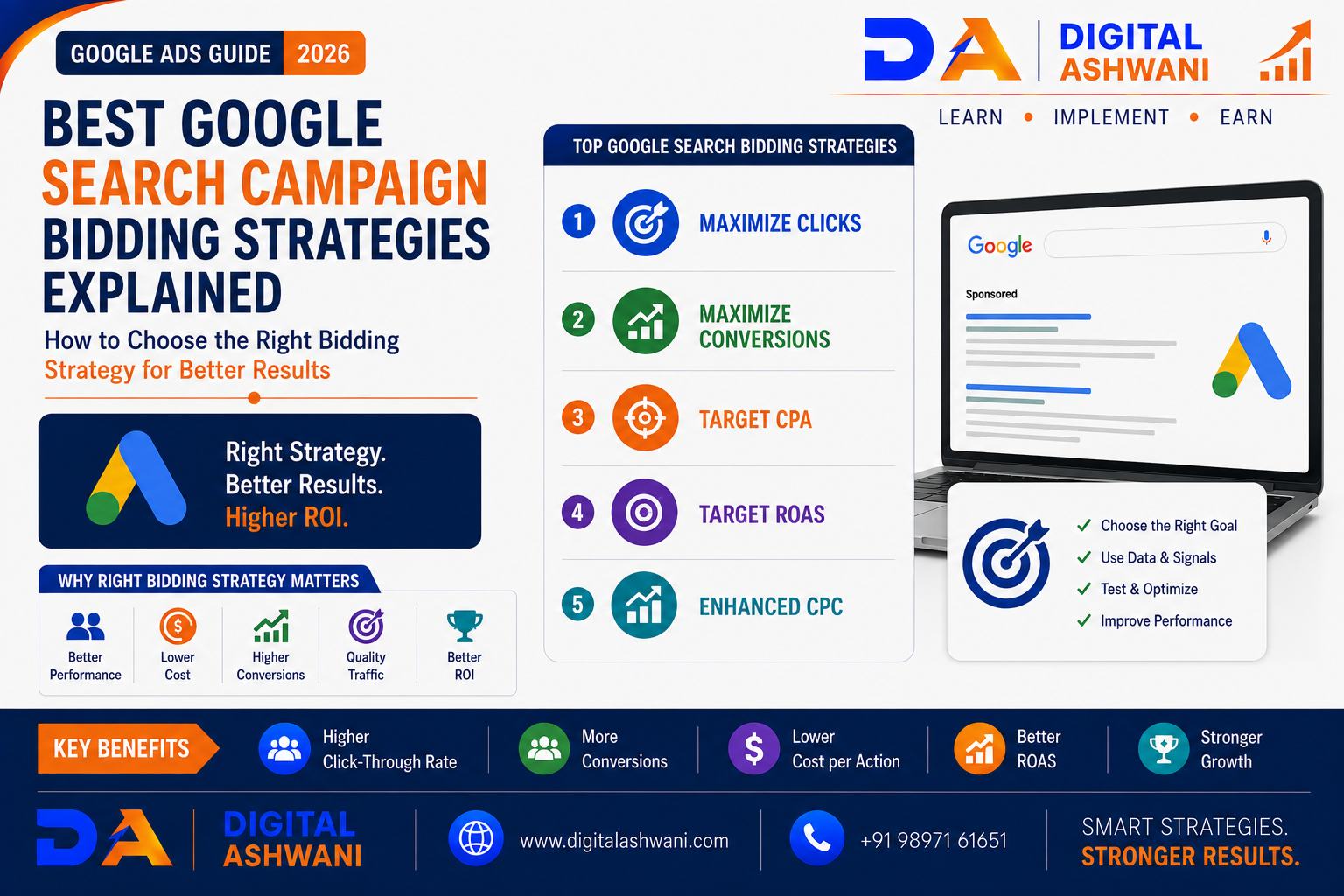
Best Google Search Campaign Bidding Strategies Explained
Choosing the right bidding strategy is one of the most important decisions when setting up a Google Search campaign.
Your bidding strategy determines how Google uses your advertising budget to compete for clicks, conversions, or revenue. Selecting the wrong strategy can lead to wasted spend, limited traffic, expensive conversions, or insufficient data for optimization.
For example, a new campaign with very little conversion data may require a different approach from an established campaign generating consistent leads every month.
Google Ads offers several automated and manual bidding approaches, and the best option depends on your campaign objective, conversion data, budget, competition, and business goals.
In this comprehensive guide by Digital Ashwani, you’ll learn how Google Search campaign bidding works, the major bidding strategies available, when to use each approach, and how to choose a strategy that supports better campaign performance.
What Is Google Ads Bidding?
Google Ads bidding is the process of deciding how much you’re willing to pay for an opportunity to show your advertisement when someone searches for a relevant term.
Google’s auction considers multiple factors when determining ad placement and pricing.
Your bid is only one part of the equation.
Other factors can include:
- Ad Quality
- Search Context
- Competition
- Relevance
- Landing Page Experience
- Expected Performance
The goal isn’t always to bid the highest amount.
The goal is to achieve the best possible business result within your available budget.
Why Your Bidding Strategy Matters
Your bidding strategy influences how Google attempts to spend your campaign budget.
A suitable strategy can help you:
- Increase Qualified Traffic
- Generate More Leads
- Improve Conversion Efficiency
- Control Acquisition Costs
- Increase Sales
- Improve Return on Ad Spend
However, automated bidding works best when Google has sufficient and reliable conversion data to learn from.
Maximize Clicks
What Is Maximize Clicks?
Maximize Clicks is designed to get as many clicks as possible within your campaign budget.
It can be useful when your immediate objective is increasing website traffic or when you’re still gathering initial campaign data.
When to Consider Maximize Clicks
This strategy may be appropriate for:
- Website Traffic Campaigns
- New Campaigns
- Initial Data Collection
- Low-Conversion Accounts
- Campaigns Where Click Volume Matters
Limitations
More clicks do not automatically mean more customers.
A campaign can generate inexpensive traffic that produces very few leads or sales.
Monitor search terms and conversion quality carefully.
Maximize Conversions
What Is Maximize Conversions?
Maximize Conversions tells Google to use your budget to try to generate as many conversions as possible.
This can be useful for businesses primarily focused on:
- Lead Generation
- Appointment Bookings
- Form Submissions
- Phone Calls
- Online Purchases
When to Consider It
Maximize Conversions can be a strong option when:
- Conversion Tracking Is Correct
- Your Campaign Has Conversion Data
- Your Conversion Actions Are Meaningful
- Your Budget Is Sufficient
The quality of your conversion tracking directly affects the quality of automated optimization.
Target CPA
What Is Target CPA?
Target CPA, or Target Cost Per Action, is designed to help achieve conversions around a desired average acquisition cost.
For example, if your business can sustainably acquire a qualified lead for approximately ₹800, you might use a target CPA around that level.
However, setting the target too aggressively can restrict traffic and reduce conversion volume.
When to Consider Target CPA
It can be useful when:
- You Have Reliable Conversion Data
- Acquisition Cost Is Important
- Conversion Tracking Is Accurate
- Your Campaign Has Stable Performance
Start with realistic targets based on historical performance rather than arbitrary numbers.
Target ROAS
What Is Target ROAS?
Target ROAS is designed for campaigns where conversion values can be measured and the objective is to achieve a particular return on advertising spend.
For example, an eCommerce business may assign revenue values to purchases and optimize toward a desired return.
When to Consider Target ROAS
It may be appropriate when:
- Purchase Values Are Tracked
- Revenue Data Is Reliable
- The Campaign Generates Enough Conversion Data
- Profitability Is More Important Than Conversion Volume Alone
Target ROAS is generally more useful for value-based businesses than lead-generation campaigns where all leads are treated equally.
Manual CPC
What Is Manual CPC?
Manual CPC gives advertisers more direct control over keyword or ad-group bids, depending on the campaign setup and available controls.
It can be useful when an advertiser wants greater manual control over bidding.
However, Google’s automated bidding systems can use contextual signals that are difficult to reproduce manually.
For many advertisers, automated strategies can be more efficient when reliable conversion data is available.
How to Choose the Right Google Search Bidding Strategy
Start With Your Campaign Goal
Ask what your campaign is primarily trying to achieve.
Traffic Goal:
Consider a click-focused strategy.
Lead Generation Goal:
Consider conversion-focused bidding when reliable conversion tracking and sufficient data are available.
eCommerce Sales Goal:
Consider value-based bidding when purchase values are accurately tracked.
Cost-Controlled Lead Generation:
A Target CPA approach may be appropriate once enough historical conversion data exists.
Consider Your Conversion Data
New Campaign
If there is little or no reliable conversion data, avoid setting overly restrictive automated targets too early.
Focus first on:
- Correct Tracking
- Search Intent
- Keyword Quality
- Ad Relevance
- Landing Page Experience
Established Campaign
Once your campaign has consistent conversion activity, automated conversion-focused strategies can make better use of Google’s machine-learning signals.
Consider Your Budget
Your budget should be realistic relative to your expected conversion cost.
For example, if your target acquisition cost is ₹1,000 but your daily budget is only ₹300, generating consistent conversion volume may be difficult.
Avoid changing budgets and bidding targets too frequently because campaigns need time to adapt.
Compare Google Search Bidding Strategies
| Strategy | Primary Goal | Best Use Case |
|---|---|---|
| Maximize Clicks | Traffic | Website Visits |
| Maximize Conversions | Conversions | Lead Generation |
| Target CPA | Cost Efficiency | Stable Lead Generation |
| Target ROAS | Revenue Value | eCommerce |
| Manual CPC | Bid Control | Specific Manual Management |
The ideal strategy depends on campaign maturity, conversion tracking, budget, and business objectives.
Bidding Strategy for Lead Generation
For service businesses, the objective is usually not simply getting the most clicks.
The objective is getting qualified enquiries.
Track meaningful actions such as:
- Qualified Form Submissions
- Phone Calls
- Appointment Requests
- Consultation Bookings
- Quote Requests
Avoid optimizing toward low-value actions such as accidental clicks or visits that don’t represent genuine business intent.
Bidding Strategy for eCommerce
For online stores, conversion value becomes especially important.
Track:
- Purchases
- Revenue
- Average Order Value
- Product-Level Performance
- Return on Ad Spend
Value-based bidding can help Google optimize toward higher-value conversions when the data is reliable.
Common Google Ads Bidding Mistakes
Choosing a Strategy Without a Clear Goal
Don’t choose a bidding strategy simply because it is popular.
Start with the business objective.
Using Incorrect Conversion Tracking
If Google receives inaccurate conversion data, automated bidding can optimize toward the wrong actions.
Setting Targets Too Aggressively
Very low CPA or extremely high ROAS targets can restrict traffic and reduce conversion volume.
Changing Strategies Too Frequently
Frequent changes can make it difficult to evaluate performance and may interfere with the learning process.
Optimizing for Clicks Instead of Business Results
Cheap clicks aren’t necessarily valuable clicks.
Focus on leads, sales, revenue, and profitability.
How to Improve Google Search Campaign Bidding Performance
Improve Conversion Tracking
Track meaningful business actions accurately.
Improve Landing Pages
Ensure landing pages match the user’s search intent and advertisement.
Use Relevant Keywords
Focus on high-intent searches that align with your products or services.
Review Search Terms
Identify irrelevant searches and add negative keywords where appropriate.
Monitor Lead Quality
Connect advertising performance with actual sales outcomes whenever possible.
Internal Linking Suggestions (Digital Ashwani)
Strengthen the Google Ads content cluster by linking this article with:
- Complete Google Search Ads Campaign Setup Guide for Better Lead Generation
- What Is Cost Per Click (CPC)? 15 Powerful Ways to Reduce CPC and Improve ROI
- Facebook Lead Ads Strategy That Converts Visitors Into Paying Customers
- Digital Marketing Career in 2026
- Website Conversion Rate Optimization Guide
- How Google Analytics 4 Tracks Website Visitors and User Behavior
- AI Marketing Strategies for Dental Clinics
- Google Ads AI Features 2026
- How Google Ads Works and Why Businesses Should Invest in Paid Advertising
These links help build topical authority around Google Ads, PPC, conversion optimization, analytics, and paid lead generation.
External Resources
For current Google Ads guidance, refer to:
- Google Ads Help
- Google Ads Documentation
- Google Search Central
- Google Analytics Help
Google Ads features and bidding options can change, so always verify the latest options in the Google Ads interface and official documentation.
Frequently Asked Questions
Which bidding strategy is best for Google Search Ads?
There is no single best strategy for every campaign. The right choice depends on your goal, conversion data, budget, competition, and business model.
Is Maximize Clicks good for new campaigns?
It can be useful when traffic or initial data collection is the priority, but it doesn’t necessarily produce the highest number of qualified leads or sales.
Is Maximize Conversions better than Maximize Clicks?
If your primary objective is generating meaningful conversions and tracking is reliable, Maximize Conversions may be more suitable than a click-focused strategy.
When should I use Target CPA?
Target CPA is generally more appropriate once a campaign has sufficient reliable conversion data and a realistic historical acquisition cost.
When should I use Target ROAS?
Target ROAS is most useful when conversion values such as purchase revenue are accurately tracked and the campaign has enough value-based conversion data.
Should I use Manual CPC?
Manual CPC can provide more direct bid control, but automated strategies may be more effective when sufficient conversion data is available.
Final Thoughts
The best Google Search Campaign Bidding Strategies are not determined by which option sounds most advanced. The right strategy depends on your campaign objective, conversion tracking, budget, historical performance, and business model.
For traffic-focused campaigns, click-based bidding can make sense. For lead generation, conversion-focused bidding can be more appropriate once reliable data exists. For eCommerce businesses with accurate revenue tracking, value-based bidding can help optimize toward sales value.
Most importantly, don’t judge your bidding strategy by clicks alone.
Measure:
Spend → Clicks → Conversions → Qualified Leads → Sales → Revenue
When bidding strategy, keyword targeting, ad relevance, landing pages, and conversion tracking work together, Google Search campaigns can become a more predictable and scalable source of business growth.
At Digital Ashwani, we regularly publish practical guides on Google Ads, SEO, AI Marketing, PPC, Conversion Optimization, Analytics, and Digital Marketing to help businesses improve their online advertising performance.
