
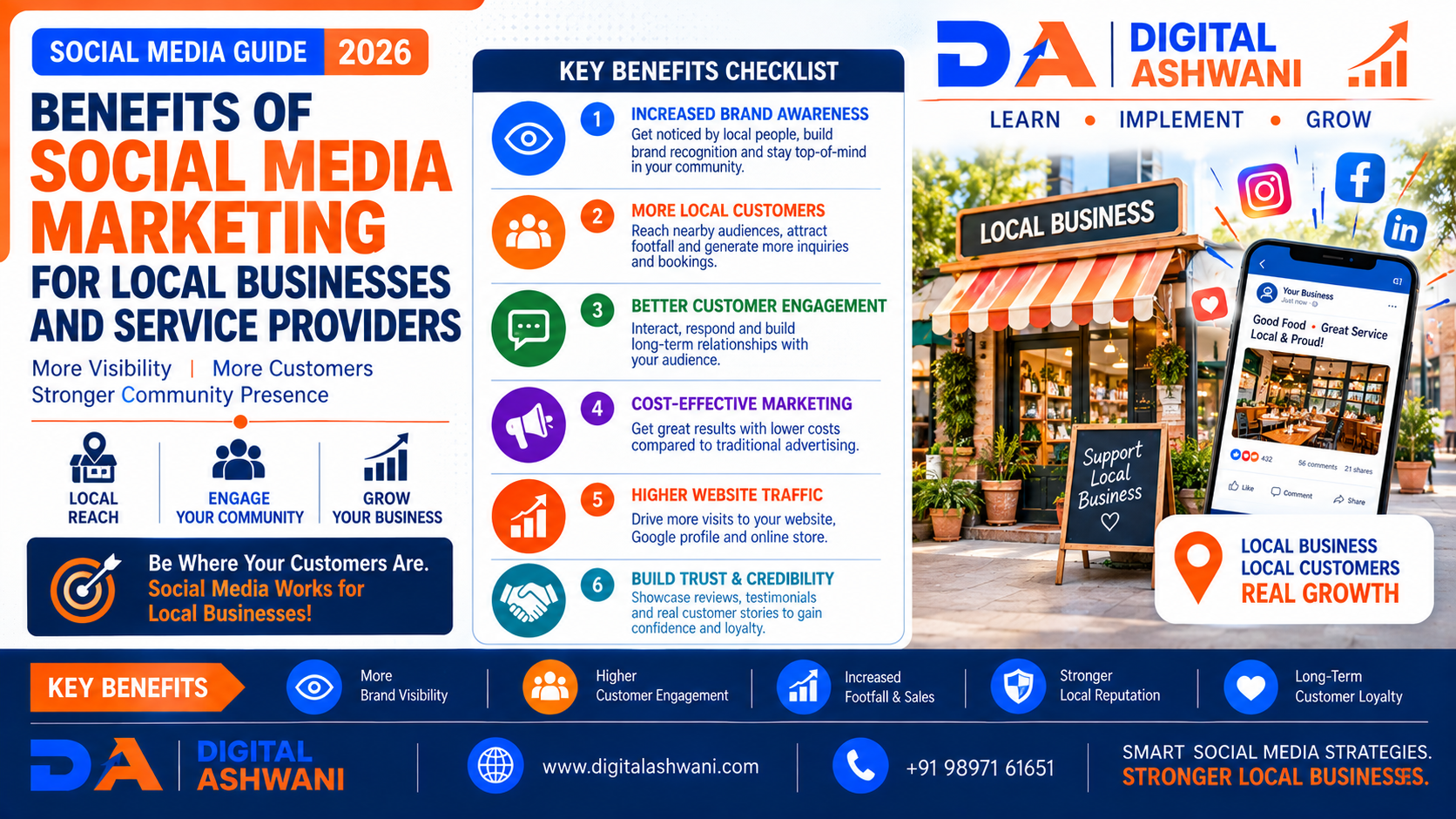
Benefits of Social Media Marketing for Local Businesses and Service Providers
Social media has become an important part of how local businesses and service providers attract customers, build relationships, and generate leads. Whether you run a restaurant, salon, clinic, real estate business, coaching service, home-service company, agency, or professional service, social media can help you reach people who are actively looking for products and services in their area.
For local businesses, social media marketing is not only about posting photos or gaining followers. A well-planned strategy can improve brand visibility, establish trust, showcase expertise, encourage customer engagement, and support lead generation.
In 2026, customers often research a business online before making a purchase or contacting a service provider. This makes a strong and active social media presence an important part of a broader digital marketing strategy.
What Is Social Media Marketing for Local Businesses?
Social media marketing for local businesses is the process of using platforms such as Facebook, Instagram, LinkedIn, YouTube, and other relevant social networks to promote a business, communicate with potential customers, showcase products or services, and generate business opportunities.
Unlike traditional advertising, social media allows businesses to communicate directly with their audience.
For example, a local salon can share hairstyle transformations, customer reviews, service information, and special offers. A real estate agent can publish property tours and market updates. A digital marketing agency can share SEO tips, campaign results, and educational content.
The goal is to create useful and relevant content that helps people remember the business and take action when they need its products or services.
Why Social Media Marketing Matters for Local Businesses
Local businesses usually compete within a specific geographic area. This means building recognition and trust among people in the target location is especially important.
Social media can support this process by helping businesses consistently communicate with potential customers.
Customers Research Businesses Before Contacting Them
People may check a business’s social profiles to understand:
- What the business offers
- Where it is located
- What customers say about it
- Whether the business is active
- What products or services are available
- How the business communicates with customers
An updated social media presence can therefore complement a website, Google Business Profile, and other digital marketing channels.
15 Benefits of Social Media Marketing for Local Businesses
1. Increases Local Brand Awareness
One of the biggest benefits of social media marketing is increased brand awareness.
When a business consistently publishes useful and relevant content, people in its target market can become familiar with the brand.
For example, a local bakery can regularly post:
- New products
- Behind-the-scenes content
- Customer experiences
- Festival offers
- Product videos
- Store updates
Even when someone is not ready to purchase immediately, repeated exposure can help the business stay recognizable.
2. Helps Reach Local Customers
Social media platforms provide businesses with opportunities to reach audiences based on interests, demographics, and other targeting factors.
For local businesses, this can be particularly useful when combined with location-focused content and advertising.
Use Location-Relevant Content
Businesses can naturally mention their service areas in appropriate posts.
For example:
Digital Marketing Services for Businesses in Delhi
or
Professional Home Cleaning Services in Noida
This makes the content more relevant to the intended audience without unnecessarily stuffing location keywords.
3. Builds Customer Trust
Trust is extremely important for local businesses and service providers.
Customers want to know whether a business is reliable before spending money.
Social media provides a place to demonstrate credibility through:
- Customer testimonials
- Reviews
- Case studies
- Before-and-after results
- Team introductions
- Educational content
- Business updates
- Frequently asked questions
Consistent and transparent communication can help potential customers understand the business better.
4. Generates More Leads
Social media can become a useful lead-generation channel when the content has a clear purpose.
A service provider can encourage users to:
- Send a direct message
- Visit the website
- Fill out a form
- Request a quotation
- Book an appointment
- Call the business
- Download a resource
Create Clear Calls to Action
A post should make it easy for interested users to understand what they should do next.
For example:
Need help with your local SEO strategy? Contact our team to discuss your requirements.
The CTA should match the purpose of the post instead of appearing unnecessarily promotional.
5. Supports Customer Engagement
Social media gives businesses a direct communication channel with their audience.
Customers can comment, ask questions, send messages, and share feedback.
Businesses can use these interactions to understand common customer concerns and improve their communication.
Responding professionally and consistently can also create a more positive customer experience.
6. Helps Showcase Products and Services
Social media is an effective visual platform for demonstrating what a business offers.
A restaurant can publish food videos.
A construction company can showcase completed projects.
A fitness professional can share educational content.
A photographer can display recent work.
A web development company can showcase website projects.
Show the Result, Not Just the Service
Instead of simply writing:
We provide website development services.
A business can show:
- Website screenshots
- Project examples
- Design processes
- Performance improvements
- Client requirements
- Before-and-after comparisons
This gives potential customers a better understanding of the actual value being offered.
7. Improves Brand Credibility
An active social media profile can provide additional information about a business.
Businesses can use their profiles to communicate:
- Company expertise
- Industry knowledge
- Customer success stories
- Team experience
- Achievements
- Educational information
However, credibility should be supported by genuine information rather than exaggerated claims.
8. Provides a Platform for Educational Content
Local businesses can use social media to educate their audience.
For example:
A dentist can explain basic oral-care practices.
A real estate professional can explain property-buying steps.
An accountant can explain common tax concepts.
A digital marketing agency can explain SEO fundamentals.
Educational content can attract people who are researching a problem before contacting a service provider.
9. Supports Local Community Engagement
Local businesses are part of their communities.
Social media can help businesses communicate about:
- Local events
- Community activities
- Business milestones
- Partnerships
- Local initiatives
- Seasonal updates
This can help create stronger connections with people in the area.
10. Helps Promote Offers and Promotions
Businesses can use social media to communicate time-sensitive offers.
Examples include:
- Seasonal discounts
- New-service launches
- Limited-time packages
- Festival promotions
- First-time customer offers
- Event announcements
Promotional content should still provide clear information and avoid making misleading claims.
11. Provides Customer Insights
Social media interactions can provide useful information about what customers care about.
Businesses can observe:
- Frequently asked questions
- Popular posts
- Customer comments
- Common objections
- Frequently requested services
- Content engagement patterns
These insights can help businesses improve their marketing and customer communication.
12. Supports Website Traffic
Social media can also support website traffic.
Businesses can share useful resources such as:
- Blog posts
- Service pages
- Case studies
- Guides
- Product pages
- Contact pages
For example, a business publishing an article about local SEO can share it through relevant social media channels and direct interested users to the website.
Social media should therefore work as part of a broader digital marketing ecosystem rather than operating separately.
13. Helps Strengthen Brand Identity
Consistent branding can make a business easier to recognize.
Businesses can maintain consistency through:
- Brand colors
- Logo usage
- Typography
- Visual style
- Tone of voice
- Content themes
A consistent identity can help create a more professional and recognizable online presence.
14. Can Support Cost-Effective Marketing
Compared with some traditional advertising methods, social media provides businesses with flexible ways to publish organic content and run targeted campaigns.
Organic social media does not guarantee reach or leads, but businesses can begin by creating useful content consistently and then use paid campaigns where appropriate.
Start With a Sustainable Content Plan
Instead of trying to publish content several times every day, a small business can create a realistic schedule.
For example:
- 2 educational posts per week
- 1 customer-focused post
- 1 service/product post
- 1 short-form video
- Regular stories or updates
The exact frequency should depend on the business, audience, resources, and platform.
15. Supports Long-Term Business Growth
Social media marketing can contribute to long-term brand building.
A business that consistently shares useful content can gradually develop:
- Brand recognition
- Audience relationships
- Customer trust
- Website traffic
- Leads
- Customer feedback
- Social proof
Social media should therefore be viewed as an ongoing marketing channel rather than a short-term campaign only.
Social Media Platforms Local Businesses Can Use
Different businesses may benefit from different platforms.
Facebook can be useful for local businesses that want to share business updates, offers, community information, customer content, and longer-form posts.
Instagram is particularly useful for visually driven businesses.
Examples include:
- Restaurants
- Fashion businesses
- Salons
- Fitness services
- Interior designers
- Photographers
- Travel businesses
Reels, Stories, carousels, and visual posts can all be part of an Instagram strategy.
LinkedIn can be useful for B2B companies and professional service providers.
Examples include:
- Digital marketing agencies
- Consultants
- Software companies
- Recruitment firms
- Financial professionals
- Business coaches
YouTube
YouTube can help businesses explain complex services through longer videos, tutorials, demonstrations, FAQs, and educational content.
How Service Providers Can Use Social Media
Service businesses often need to demonstrate expertise and reliability because customers are purchasing knowledge, experience, or a professional outcome.
Create Problem-Solving Content
Instead of only promoting the service, answer questions that potential customers commonly ask.
For example:
A plumber can explain common plumbing problems.
An SEO agency can explain how local search works.
A lawyer can publish general educational information about relevant legal processes.
A home-service company can share maintenance tips.
This approach can help attract users during the research stage.
Share Customer Experiences
With appropriate permission, businesses can showcase customer experiences, testimonials, project results, or case studies.
This can provide potential customers with more context about the service.
Demonstrate Expertise
Professional service providers can publish:
- Tips
- Guides
- FAQs
- Industry updates
- Tutorials
- Case studies
- Common mistakes
The content should remain accurate and relevant to the audience.
How to Create a Local Social Media Marketing Strategy
A successful strategy requires more than simply posting whenever there is free time.
Define Your Target Audience
Start by identifying:
- Location
- Customer type
- Age range where relevant
- Needs
- Problems
- Buying behavior
- Preferred platforms
The more clearly you understand the target audience, the easier it becomes to create relevant content.
Set Clear Marketing Goals
Your social media goals could include:
- Increasing brand awareness
- Generating leads
- Driving website traffic
- Promoting a service
- Increasing engagement
- Supporting customer retention
Choose measurable goals instead of simply focusing on follower growth.
Create Content Pillars
Content pillars are recurring topics that help maintain consistency.
For a local service business, content pillars could include:
- Educational content
- Services
- Customer success stories
- Behind-the-scenes content
- Frequently asked questions
- Local/community content
Create a Content Calendar
A content calendar helps businesses plan posts in advance.
For example:
| Day | Content Type |
|---|---|
| Monday | Educational Tip |
| Tuesday | Service Highlight |
| Wednesday | Customer Story |
| Thursday | Short Video |
| Friday | FAQ |
| Saturday | Local/Community Content |
| Sunday | Business Update |
The schedule should be adjusted according to the business’s capacity and audience response.
Track Performance
Use platform analytics and website analytics to understand what is working.
Important metrics can include:
- Reach
- Engagement
- Website visits
- Leads
- Clicks
- Video views
- Conversion rate
- Cost per lead for paid campaigns
Follower count alone does not show the complete business impact of social media.
Common Social Media Marketing Mistakes
Posting Without a Strategy
Random posts can make a business profile inconsistent.
A clear strategy helps connect content with actual business objectives.
Focusing Only on Followers
A large audience does not automatically mean more customers.
Businesses should also consider engagement quality, website visits, inquiries, leads, and conversions.
Ignoring Comments and Messages
Social media is designed for communication.
If potential customers repeatedly ask questions and receive no response, opportunities may be lost.
Using Too Much Promotional Content
If every post is an advertisement, people may lose interest.
A balanced strategy should combine educational, engaging, community-focused, and promotional content.
Inconsistent Branding
Different logos, colors, messaging styles, or business information across platforms can create confusion.
Keep important business information accurate and consistent.
Buying Followers or Engagement
Artificial engagement may increase visible numbers temporarily but does not create genuine customer relationships.
Businesses should focus on real audiences and meaningful interactions.
How to Measure Social Media Marketing Performance
The right metrics depend on the business objective.
For Brand Awareness
Track:
- Reach
- Impressions
- Video views
- Profile visits
For Engagement
Track:
- Comments
- Shares
- Saves
- Replies
- Engagement rate
For Lead Generation
Track:
- Form submissions
- Direct inquiries
- Calls
- Consultation requests
- Qualified leads
For Sales
Where tracking is available, measure:
- Website conversions
- Purchases
- Revenue
- Conversion rate
- Return on advertising spend
This helps businesses understand whether social media activity is contributing to measurable business outcomes.
Frequently Asked Questions
Is social media marketing useful for local businesses?
Yes. Social media can help local businesses build awareness, communicate with customers, showcase products or services, and support lead generation.
Which social media platform is best for a local business?
There is no single platform that is appropriate for every business. The right platform depends on the target audience, industry, content format, and business goals.
How often should a local business post on social media?
There is no universal posting frequency. A sustainable schedule with useful and consistent content is generally more practical than posting excessively and inconsistently.
Can social media generate leads for service providers?
Yes. Service providers can use educational content, case studies, testimonials, offers, lead forms, direct messages, and clear calls to action to support lead generation.
Should local businesses use paid social media advertising?
Paid advertising can be useful when businesses have clearly defined audiences, offers, goals, and conversion tracking. Organic and paid social strategies can also be used together.
Is social media marketing enough for local SEO?
No. Social media should not be treated as a replacement for local SEO. Businesses should also maintain their website, Google Business Profile, reviews, local citations, relevant content, and other appropriate local search activities.
Final Thoughts
Social media marketing for local businesses is about more than publishing regular posts. It is an opportunity to build visibility, communicate with customers, demonstrate expertise, showcase products and services, and support business growth.
For service providers, educational content, customer experiences, case studies, and helpful answers can be particularly valuable because they help potential customers understand the business before making contact.
The most effective approach is to connect social media with the rest of your digital marketing strategy. Your website, local SEO, Google Business Profile, content marketing, paid advertising, and social media should work together toward measurable business goals.
If you are a local business or service provider, start with a clear target audience, choose the platforms that make sense for your business, create useful content consistently, and measure the results that matter to your business.
Internal Linking Suggestions for Digital Ashwani
Consider adding relevant internal links to these Digital Ashwani topics:
- Local SEO for Higher Google Maps Rankings
- Google Business Profile Optimization
- Social Media Marketing for Qualified Leads
- Google Ads for Small Businesses
- SEO Guide for Small Businesses
- Content Marketing Strategies
- Digital Marketing Strategies for Local Businesses
External Resources
For authoritative information and platform guidance, consider referencing official resources from:
- Google Business Profile
- Google Search Central
- Meta for Business
- LinkedIn Marketing Solutions
- YouTube for Business
Categories
Digital Marketing, Social Media Marketing, Local SEO
Tags
SEO Details
Focus Keyword:
Social Media Marketing for Local Businesses
SEO Title:
15 Powerful Benefits of Social Media Marketing for Local Businesses in 2026
Meta Description:
Discover 15 powerful benefits of social media marketing for local businesses and service providers to increase visibility, build trust, generate leads, and grow in 2026.
URL Slug:
social-media-marketing-for-local-businesses
ALT Text:
Benefits of social media marketing for local businesses and service providers
Secondary Keywords:
social media marketing for small businesses, local business social media marketing, social media marketing benefits, social media for service providers, social media marketing strategy, local business marketing, social media lead generation, social media branding, social media advertising
Benefits of Social Media Marketing for Local Businesses and Service Providers
Social media has become an important part of how local businesses and service providers attract customers, build relationships, and generate leads. Whether you run a restaurant, salon, clinic, real estate business, coaching service, home-service company, agency, or professional service, social media can help you reach people who are actively looking for products and services in their area.
For local businesses, social media marketing is not only about posting photos or gaining followers. A well-planned strategy can improve brand visibility, establish trust, showcase expertise, encourage customer engagement, and support lead generation.
In 2026, customers often research a business online before making a purchase or contacting a service provider. This makes a strong and active social media presence an important part of a broader digital marketing strategy.
Table of Contents
- What Is Social Media Marketing for Local Businesses?
- Why Social Media Marketing Matters for Local Businesses
- 15 Benefits of Social Media Marketing for Local Businesses
- Social Media Platforms Local Businesses Can Use
- How Service Providers Can Use Social Media
- How to Create a Local Social Media Marketing Strategy
- Common Social Media Marketing Mistakes
- How to Measure Social Media Marketing Performance
- Frequently Asked Questions
- Final Thoughts
What Is Social Media Marketing for Local Businesses?
Social media marketing for local businesses is the process of using platforms such as Facebook, Instagram, LinkedIn, YouTube, and other relevant social networks to promote a business, communicate with potential customers, showcase products or services, and generate business opportunities.
Unlike traditional advertising, social media allows businesses to communicate directly with their audience.
For example, a local salon can share hairstyle transformations, customer reviews, service information, and special offers. A real estate agent can publish property tours and market updates. A digital marketing agency can share SEO tips, campaign results, and educational content.
The goal is to create useful and relevant content that helps people remember the business and take action when they need its products or services.
Why Social Media Marketing Matters for Local Businesses
Local businesses usually compete within a specific geographic area. This means building recognition and trust among people in the target location is especially important.
Social media can support this process by helping businesses consistently communicate with potential customers.
Customers Research Businesses Before Contacting Them
People may check a business’s social profiles to understand:
- What the business offers
- Where it is located
- What customers say about it
- Whether the business is active
- What products or services are available
- How the business communicates with customers
An updated social media presence can therefore complement a website, Google Business Profile, and other digital marketing channels.
15 Benefits of Social Media Marketing for Local Businesses
1. Increases Local Brand Awareness
One of the biggest benefits of social media marketing is increased brand awareness.
When a business consistently publishes useful and relevant content, people in its target market can become familiar with the brand.
For example, a local bakery can regularly post:
- New products
- Behind-the-scenes content
- Customer experiences
- Festival offers
- Product videos
- Store updates
Even when someone is not ready to purchase immediately, repeated exposure can help the business stay recognizable.
2. Helps Reach Local Customers
Social media platforms provide businesses with opportunities to reach audiences based on interests, demographics, and other targeting factors.
For local businesses, this can be particularly useful when combined with location-focused content and advertising.
Use Location-Relevant Content
Businesses can naturally mention their service areas in appropriate posts.
For example:
Digital Marketing Services for Businesses in Delhi
or
Professional Home Cleaning Services in Noida
This makes the content more relevant to the intended audience without unnecessarily stuffing location keywords.
3. Builds Customer Trust
Trust is extremely important for local businesses and service providers.
Customers want to know whether a business is reliable before spending money.
Social media provides a place to demonstrate credibility through:
- Customer testimonials
- Reviews
- Case studies
- Before-and-after results
- Team introductions
- Educational content
- Business updates
- Frequently asked questions
Consistent and transparent communication can help potential customers understand the business better.
4. Generates More Leads
Social media can become a useful lead-generation channel when the content has a clear purpose.
A service provider can encourage users to:
- Send a direct message
- Visit the website
- Fill out a form
- Request a quotation
- Book an appointment
- Call the business
- Download a resource
Create Clear Calls to Action
A post should make it easy for interested users to understand what they should do next.
For example:
Need help with your local SEO strategy? Contact our team to discuss your requirements.
The CTA should match the purpose of the post instead of appearing unnecessarily promotional.
5. Supports Customer Engagement
Social media gives businesses a direct communication channel with their audience.
Customers can comment, ask questions, send messages, and share feedback.
Businesses can use these interactions to understand common customer concerns and improve their communication.
Responding professionally and consistently can also create a more positive customer experience.
6. Helps Showcase Products and Services
Social media is an effective visual platform for demonstrating what a business offers.
A restaurant can publish food videos.
A construction company can showcase completed projects.
A fitness professional can share educational content.
A photographer can display recent work.
A web development company can showcase website projects.
Show the Result, Not Just the Service
Instead of simply writing:
We provide website development services.
A business can show:
- Website screenshots
- Project examples
- Design processes
- Performance improvements
- Client requirements
- Before-and-after comparisons
This gives potential customers a better understanding of the actual value being offered.
7. Improves Brand Credibility
An active social media profile can provide additional information about a business.
Businesses can use their profiles to communicate:
- Company expertise
- Industry knowledge
- Customer success stories
- Team experience
- Achievements
- Educational information
However, credibility should be supported by genuine information rather than exaggerated claims.
8. Provides a Platform for Educational Content
Local businesses can use social media to educate their audience.
For example:
A dentist can explain basic oral-care practices.
A real estate professional can explain property-buying steps.
An accountant can explain common tax concepts.
A digital marketing agency can explain SEO fundamentals.
Educational content can attract people who are researching a problem before contacting a service provider.
9. Supports Local Community Engagement
Local businesses are part of their communities.
Social media can help businesses communicate about:
- Local events
- Community activities
- Business milestones
- Partnerships
- Local initiatives
- Seasonal updates
This can help create stronger connections with people in the area.
10. Helps Promote Offers and Promotions
Businesses can use social media to communicate time-sensitive offers.
Examples include:
- Seasonal discounts
- New-service launches
- Limited-time packages
- Festival promotions
- First-time customer offers
- Event announcements
Promotional content should still provide clear information and avoid making misleading claims.
11. Provides Customer Insights
Social media interactions can provide useful information about what customers care about.
Businesses can observe:
- Frequently asked questions
- Popular posts
- Customer comments
- Common objections
- Frequently requested services
- Content engagement patterns
These insights can help businesses improve their marketing and customer communication.
12. Supports Website Traffic
Social media can also support website traffic.
Businesses can share useful resources such as:
- Blog posts
- Service pages
- Case studies
- Guides
- Product pages
- Contact pages
For example, a business publishing an article about local SEO can share it through relevant social media channels and direct interested users to the website.
Social media should therefore work as part of a broader digital marketing ecosystem rather than operating separately.
13. Helps Strengthen Brand Identity
Consistent branding can make a business easier to recognize.
Businesses can maintain consistency through:
- Brand colors
- Logo usage
- Typography
- Visual style
- Tone of voice
- Content themes
A consistent identity can help create a more professional and recognizable online presence.
14. Can Support Cost-Effective Marketing
Compared with some traditional advertising methods, social media provides businesses with flexible ways to publish organic content and run targeted campaigns.
Organic social media does not guarantee reach or leads, but businesses can begin by creating useful content consistently and then use paid campaigns where appropriate.
Start With a Sustainable Content Plan
Instead of trying to publish content several times every day, a small business can create a realistic schedule.
For example:
- 2 educational posts per week
- 1 customer-focused post
- 1 service/product post
- 1 short-form video
- Regular stories or updates
The exact frequency should depend on the business, audience, resources, and platform.
15. Supports Long-Term Business Growth
Social media marketing can contribute to long-term brand building.
A business that consistently shares useful content can gradually develop:
- Brand recognition
- Audience relationships
- Customer trust
- Website traffic
- Leads
- Customer feedback
- Social proof
Social media should therefore be viewed as an ongoing marketing channel rather than a short-term campaign only.
Social Media Platforms Local Businesses Can Use
Different businesses may benefit from different platforms.
Facebook can be useful for local businesses that want to share business updates, offers, community information, customer content, and longer-form posts.
Instagram is particularly useful for visually driven businesses.
Examples include:
- Restaurants
- Fashion businesses
- Salons
- Fitness services
- Interior designers
- Photographers
- Travel businesses
Reels, Stories, carousels, and visual posts can all be part of an Instagram strategy.
LinkedIn can be useful for B2B companies and professional service providers.
Examples include:
- Digital marketing agencies
- Consultants
- Software companies
- Recruitment firms
- Financial professionals
- Business coaches
YouTube
YouTube can help businesses explain complex services through longer videos, tutorials, demonstrations, FAQs, and educational content.
How Service Providers Can Use Social Media
Service businesses often need to demonstrate expertise and reliability because customers are purchasing knowledge, experience, or a professional outcome.
Create Problem-Solving Content
Instead of only promoting the service, answer questions that potential customers commonly ask.
For example:
A plumber can explain common plumbing problems.
An SEO agency can explain how local search works.
A lawyer can publish general educational information about relevant legal processes.
A home-service company can share maintenance tips.
This approach can help attract users during the research stage.
Share Customer Experiences
With appropriate permission, businesses can showcase customer experiences, testimonials, project results, or case studies.
This can provide potential customers with more context about the service.
Demonstrate Expertise
Professional service providers can publish:
- Tips
- Guides
- FAQs
- Industry updates
- Tutorials
- Case studies
- Common mistakes
The content should remain accurate and relevant to the audience.
How to Create a Local Social Media Marketing Strategy
A successful strategy requires more than simply posting whenever there is free time.
Define Your Target Audience
Start by identifying:
- Location
- Customer type
- Age range where relevant
- Needs
- Problems
- Buying behavior
- Preferred platforms
The more clearly you understand the target audience, the easier it becomes to create relevant content.
Set Clear Marketing Goals
Your social media goals could include:
- Increasing brand awareness
- Generating leads
- Driving website traffic
- Promoting a service
- Increasing engagement
- Supporting customer retention
Choose measurable goals instead of simply focusing on follower growth.
Create Content Pillars
Content pillars are recurring topics that help maintain consistency.
For a local service business, content pillars could include:
- Educational content
- Services
- Customer success stories
- Behind-the-scenes content
- Frequently asked questions
- Local/community content
Create a Content Calendar
A content calendar helps businesses plan posts in advance.
For example:
| Day | Content Type |
|---|---|
| Monday | Educational Tip |
| Tuesday | Service Highlight |
| Wednesday | Customer Story |
| Thursday | Short Video |
| Friday | FAQ |
| Saturday | Local/Community Content |
| Sunday | Business Update |
The schedule should be adjusted according to the business’s capacity and audience response.
Track Performance
Use platform analytics and website analytics to understand what is working.
Important metrics can include:
- Reach
- Engagement
- Website visits
- Leads
- Clicks
- Video views
- Conversion rate
- Cost per lead for paid campaigns
Follower count alone does not show the complete business impact of social media.
Common Social Media Marketing Mistakes
Posting Without a Strategy
Random posts can make a business profile inconsistent.
A clear strategy helps connect content with actual business objectives.
Focusing Only on Followers
A large audience does not automatically mean more customers.
Businesses should also consider engagement quality, website visits, inquiries, leads, and conversions.
Ignoring Comments and Messages
Social media is designed for communication.
If potential customers repeatedly ask questions and receive no response, opportunities may be lost.
Using Too Much Promotional Content
If every post is an advertisement, people may lose interest.
A balanced strategy should combine educational, engaging, community-focused, and promotional content.
Inconsistent Branding
Different logos, colors, messaging styles, or business information across platforms can create confusion.
Keep important business information accurate and consistent.
Buying Followers or Engagement
Artificial engagement may increase visible numbers temporarily but does not create genuine customer relationships.
Businesses should focus on real audiences and meaningful interactions.
How to Measure Social Media Marketing Performance
The right metrics depend on the business objective.
For Brand Awareness
Track:
- Reach
- Impressions
- Video views
- Profile visits
For Engagement
Track:
- Comments
- Shares
- Saves
- Replies
- Engagement rate
For Lead Generation
Track:
- Form submissions
- Direct inquiries
- Calls
- Consultation requests
- Qualified leads
For Sales
Where tracking is available, measure:
- Website conversions
- Purchases
- Revenue
- Conversion rate
- Return on advertising spend
This helps businesses understand whether social media activity is contributing to measurable business outcomes.
Frequently Asked Questions
Is social media marketing useful for local businesses?
Yes. Social media can help local businesses build awareness, communicate with customers, showcase products or services, and support lead generation.
Which social media platform is best for a local business?
There is no single platform that is appropriate for every business. The right platform depends on the target audience, industry, content format, and business goals.
How often should a local business post on social media?
There is no universal posting frequency. A sustainable schedule with useful and consistent content is generally more practical than posting excessively and inconsistently.
Can social media generate leads for service providers?
Yes. Service providers can use educational content, case studies, testimonials, offers, lead forms, direct messages, and clear calls to action to support lead generation.
Should local businesses use paid social media advertising?
Paid advertising can be useful when businesses have clearly defined audiences, offers, goals, and conversion tracking. Organic and paid social strategies can also be used together.
Is social media marketing enough for local SEO?
No. Social media should not be treated as a replacement for local SEO. Businesses should also maintain their website, Google Business Profile, reviews, local citations, relevant content, and other appropriate local search activities.
Final Thoughts
Social media marketing for local businesses is about more than publishing regular posts. It is an opportunity to build visibility, communicate with customers, demonstrate expertise, showcase products and services, and support business growth.
For service providers, educational content, customer experiences, case studies, and helpful answers can be particularly valuable because they help potential customers understand the business before making contact.
The most effective approach is to connect social media with the rest of your digital marketing strategy. Your website, local SEO, Google Business Profile, content marketing, paid advertising, and social media should work together toward measurable business goals.
If you are a local business or service provider, start with a clear target audience, choose the platforms that make sense for your business, create useful content consistently, and measure the results that matter to your business.
Internal Linking Suggestions for Digital Ashwani
Consider adding relevant internal links to these Digital Ashwani topics:
- Local SEO for Higher Google Maps Rankings
- Google Business Profile Optimization
- Social Media Marketing for Qualified Leads
- Google Ads for Small Businesses
- SEO Guide for Small Businesses
- Content Marketing Strategies
- Digital Marketing Strategies for Local Businesses
External Resources
For authoritative information and platform guidance, consider referencing official resources from:
- Google Business Profile
- Google Search Central
- Meta for Business
- LinkedIn Marketing Solutions
- YouTube for Business
