

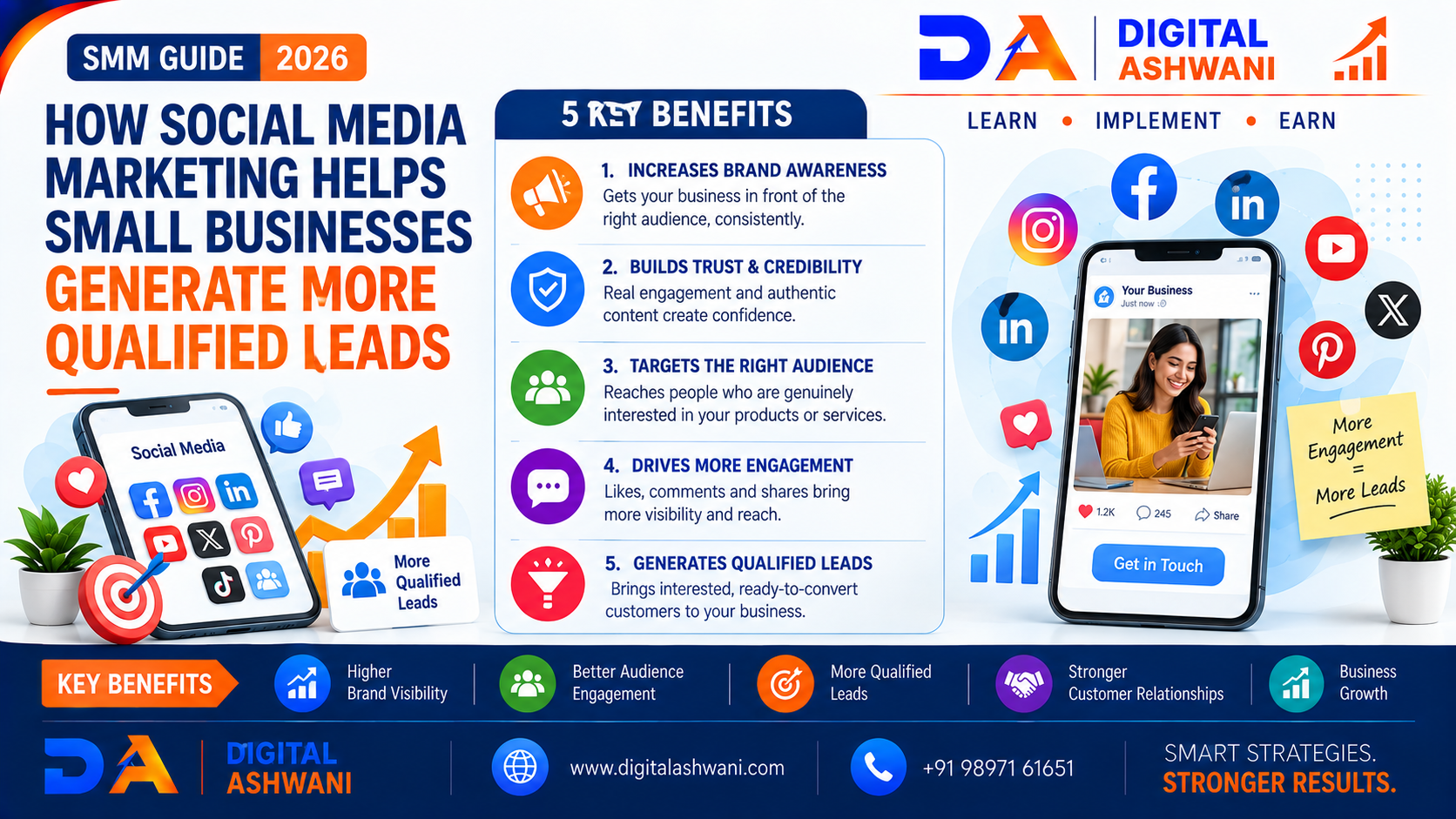
How Social Media Marketing Helps Small Businesses Generate More Qualified Leads
For small businesses, generating consistent and relevant leads is one of the most important parts of building sustainable growth. However, simply attracting a large number of visitors or social media followers does not always translate into genuine business opportunities.
This is where social media marketing for small businesses can play an important role. Platforms such as Facebook, Instagram, LinkedIn, and other social networks allow businesses to reach specific audiences, communicate directly with potential customers, demonstrate their expertise, and encourage interested prospects to take the next step.
The key is not to focus only on getting more followers or likes. A successful social media strategy should attract people who have a genuine interest in the products or services being offered.
When social media content, audience targeting, lead-generation campaigns, landing pages, and follow-up processes work together, small businesses can create a more focused path from audience discovery to qualified lead generation.
In this guide, Digital Ashwani explains how social media marketing helps small businesses generate qualified leads and which strategies can improve the quality of leads coming from social platforms.
What Are Qualified Leads?
A qualified lead is a potential customer who matches important characteristics of a business’s target audience and has shown meaningful interest in its product or service.
Not every person who likes a post, watches a video, or visits a website should automatically be considered a qualified lead.
For example, a digital marketing agency may receive 100 inquiries from social media. However, some people may not have the required budget, may not need the service, or may simply be looking for free information.
A smaller number of relevant prospects who actually need the service and are capable of becoming customers can be more useful for the business.
This is why small businesses should focus on lead quality as well as lead quantity.
Why Social Media Marketing Matters for Small Businesses
Social media provides small businesses with an opportunity to build visibility without depending entirely on traditional advertising channels.
A business can use social platforms to introduce its products or services, answer common customer questions, share educational information, publish customer experiences, and communicate its unique value proposition.
For a small business, this can help establish familiarity and trust before a potential customer makes direct contact.
Builds Brand Awareness
People are more likely to consider a business when they recognize and understand what it offers.
Consistent social media content can keep a business visible to its target audience and provide repeated opportunities for potential customers to learn about its products or services.
For example, a local home renovation company can publish project images, renovation tips, material comparisons, customer experiences, and explanations of its services.
Someone who repeatedly sees this useful content may become more familiar with the company and eventually contact it when they need renovation services.
Creates Direct Communication
Social media allows businesses to communicate directly with potential customers through comments, direct messages, forms, and other platform features.
This interaction can help businesses understand customer questions and identify people who are actively looking for a solution.
A conversation that begins with a simple question can sometimes develop into a genuine sales opportunity when the business provides a helpful and relevant response.
How Social Media Generates Qualified Leads
Social media lead generation generally works through several connected stages:
Target Audience → Useful Content → Engagement → Interest → Lead → Qualification → Sales Opportunity
The objective is not simply to push advertisements to as many people as possible.
Instead, businesses should create a system that attracts relevant users, provides useful information, builds confidence, and makes it easy for interested prospects to take action.
1. Define the Ideal Customer
The first step toward generating qualified leads is understanding who the business actually wants to attract.
A small business should identify characteristics such as:
- Location
- Age group where relevant
- Industry or profession
- Interests
- Common problems
- Purchasing needs
- Budget range where appropriate
- Buying intent
- Type of product or service required
The exact criteria depend on the business.
For example, a local accounting firm may target business owners in a specific geographic area, while an online software company may target businesses based on industry, company size, or professional role.
Why Audience Definition Matters
If the audience is too broad, social media activity may attract many people who have little chance of becoming customers.
A more clearly defined audience allows businesses to create content and campaigns around the problems and requirements of people they actually want to serve.
2. Create Content That Solves Customer Problems
Content is one of the strongest ways to attract relevant prospects organically.
Instead of constantly promoting products or services, small businesses can create content around questions that potential customers are already asking.
For example, a web development company could publish:
- How much does a business website cost?
- What should a small business website include?
- How long does website development take?
- What makes a website mobile-friendly?
- How can a website generate more inquiries?
Such content attracts people who are already researching solutions related to the company’s services.
Educational Content Builds Trust
Educational content gives potential customers an opportunity to evaluate a business before contacting it.
When a company consistently explains industry concepts, answers questions, and shares practical advice, prospective customers can better understand its expertise and approach.
This can make social media more useful as a lead-generation channel rather than simply a platform for promotional posts.
3. Use Strong Calls to Action
Even useful content may not generate leads if users do not know what to do next.
A clear call to action can guide interested users toward the next step.
Depending on the business, CTAs can include:
- Request a Quote
- Book a Consultation
- Get a Free Estimate
- Contact Us
- Send a Message
- Learn More
- Download the Guide
- Schedule a Call
- Visit the Website
The CTA should match the user’s level of interest.
Someone reading an educational post may not immediately be ready to make a purchase, so a lower-friction action can sometimes be more appropriate.
4. Use Social Proof to Increase Trust
Potential customers often want evidence that a business can deliver what it promises.
Social proof can help address this concern.
Businesses can showcase:
- Customer reviews
- Testimonials
- Case studies
- Completed projects
- Before-and-after examples
- Product demonstrations
- Customer experiences
- Certifications where relevant
For example, a local interior design business can showcase completed projects and explain the customer’s requirements, design approach, and final outcome.
This gives potential customers more context than a simple promotional advertisement.
5. Use Lead Generation Forms
Many social advertising platforms provide lead-generation options that can allow users to submit their information without completing a lengthy process on an external website.
A lead form may request information such as:
- Name
- Phone number
- Business name
- Service required
- Location
- Specific requirement
However, asking for too much information can create unnecessary friction.
Businesses should collect the information they actually need to determine whether the lead is relevant.
6. Ask Qualification Questions
One of the simplest ways to improve lead quality is to introduce relevant qualification questions.
For example, a service business could ask:
What service are you interested in?
What is your estimated project budget?
When do you plan to start?
Which location are you based in?
These questions can help separate casual inquiries from prospects with a more specific business requirement.
The questions should remain relevant and proportionate to the service. Asking for excessive information at the beginning can discourage genuine prospects from completing the form.
7. Create Different Content for Different Buyer Stages
Not every social media user is at the same stage of the buying journey.
Some people are discovering a problem for the first time. Others are actively comparing providers.
A useful content strategy can therefore address different stages.
Awareness Stage
Focus on:
- Educational content
- Industry information
- Common problems
- Tips
- Basic guides
Consideration Stage
Focus on:
- Comparisons
- Case studies
- Product/service explanations
- Testimonials
- FAQs
Decision Stage
Focus on:
- Offers
- Consultations
- Quotes
- Demonstrations
- Strong CTAs
- Detailed service information
This approach helps businesses avoid showing the same message to every audience.
8. Use Retargeting to Reconnect With Interested Users
Many potential customers do not convert during their first interaction with a business.
Someone may visit a website, watch a video, interact with an advertisement, or view a product and then leave without contacting the company.
Retargeting can help businesses reconnect with eligible audiences who have already interacted with their brand.
For example:
Social Ad → Website Visit → No Conversion → Retargeting Ad → Return Visit → Lead
This approach focuses advertising attention on users who have already demonstrated some level of interest.
9. Use Social Media Advertising
Organic social media can help businesses build an audience, while paid social advertising can provide additional targeting and reach options.
Small businesses can use advertising campaigns to promote:
- Lead forms
- Services
- Products
- Offers
- Webinars
- Consultations
- Downloads
- Landing pages
Paid campaigns should still be based on a clear audience and business objective.
Simply increasing advertising spend does not automatically improve lead quality.
10. Create Dedicated Landing Pages
Sending every social media visitor to the homepage can create unnecessary friction.
A dedicated landing page can continue the same message that the user saw in the social media advertisement.
For example:
Advertisement:
Get Professional Website Development for Your Small Business
Landing Page:
Small Business Website Development Services
CTA:
Request a Consultation
This creates a clearer connection between the advertisement and the conversion action.
11. Match the Offer With the Audience
Different audiences may respond to different offers.
For example, a B2B service company could offer:
- Free consultation
- Website audit
- Strategy session
- Business assessment
An ecommerce business may instead promote:
- Product discounts
- Bundles
- New product launches
- Free shipping
- Limited-time offers
The offer should provide a logical reason for the target customer to take action.
12. Respond Quickly to Social Media Leads
Generating a lead is only one part of the process.
A potential customer may contact multiple businesses at the same time. Delayed responses can make it harder to maintain the prospect’s interest.
Small businesses should therefore establish a consistent process for responding to:
- Direct messages
- Lead forms
- Comments
- Quote requests
- Consultation requests
- Phone inquiries
The response should be professional, relevant, and focused on understanding the customer’s requirement.
13. Track Lead Quality, Not Just Lead Volume
A campaign generating 200 leads may appear successful at first glance.
But suppose only 10 of those leads are genuinely relevant.
Another campaign might generate 60 leads, of which 20 are qualified prospects.
In this situation, simply comparing the number of leads would not provide enough information.
Businesses should track metrics such as:
| Metric | What It Shows |
|---|---|
| Leads | Total inquiries generated |
| Qualified Leads | Leads matching business criteria |
| Cost Per Lead | Advertising cost per lead |
| Cost Per Qualified Lead | Cost of generating relevant leads |
| Conversion Rate | Percentage of users taking the desired action |
| Sales Opportunities | Leads that move into the sales process |
| Customers | Leads that ultimately become customers |
This gives businesses a clearer understanding of whether social media marketing is contributing to actual business growth.
14. Use Analytics to Improve Campaign Performance
Data can help businesses understand which content and campaigns are producing meaningful results.
Monitor:
- Reach
- Engagement
- Website traffic
- Leads
- Qualified leads
- Conversion rate
- Cost per lead
- Cost per qualified lead
- Sales
- Revenue where measurable
Businesses should use this information to identify which audiences, messages, offers, and content formats are contributing to better-quality inquiries.
15. Build a Consistent Social Media Strategy
Qualified lead generation usually works better as an ongoing process rather than a one-time campaign.
A consistent strategy can combine:
Educational Content + Social Proof + Engagement + Paid Advertising + Retargeting + Landing Pages + Lead Qualification + Follow-Up
Each component supports a different part of the customer journey.
Social Media Lead Generation Strategy for Small Businesses
| Strategy | Main Purpose |
|---|---|
| Audience Research | Find relevant prospects |
| Educational Content | Build awareness and trust |
| Social Proof | Demonstrate credibility |
| Lead Forms | Capture prospect information |
| Qualification Questions | Improve lead relevance |
| Paid Advertising | Reach targeted audiences |
| Retargeting | Reconnect with interested users |
| Landing Pages | Improve conversion experience |
| Analytics | Measure results |
| Follow-Up | Move leads toward sales |
Common Social Media Lead Generation Mistakes
Focusing Only on Followers
Follower growth can be useful for understanding audience development, but it does not directly indicate how many qualified prospects a business is generating.
Businesses should connect social media metrics with actual lead and sales outcomes wherever possible.
Posting Only Promotional Content
Constantly promoting products or services can make a social media presence less useful to potential customers.
A balanced content strategy should provide information and value in addition to promotional messages.
Targeting Everyone
Broad targeting can sometimes result in large amounts of irrelevant traffic or inquiries.
Businesses should define the audience based on the characteristics of their actual customers.
Using Weak CTAs
If users do not understand the next step, interested prospects may leave without taking action.
Calls to action should be clear and relevant to the content.
Ignoring Lead Follow-Up
A generated lead has limited business value if there is no effective process for responding and qualifying it.
How Small Businesses Can Improve Qualified Leads From Social Media
A practical process can look like this:
Step 1: Define the ideal customer.
Step 2: Identify the customer’s major problems and questions.
Step 3: Create useful content around those topics.
Step 4: Add relevant calls to action.
Step 5: Use targeted advertising where appropriate.
Step 6: Send users to relevant landing pages or lead forms.
Step 7: Ask appropriate qualification questions.
Step 8: Respond to leads promptly.
Step 9: Track qualified leads and sales opportunities.
Step 10: Use performance data to improve future campaigns.
Internal Linking Suggestions for Digital Ashwani
Relevant Digital Ashwani pages can be connected naturally within this article, including:
- Social Media Marketing
- Digital Marketing
- Conversion Rate Optimization
- Local SEO
- Google Ads Management
- Google Ads Calculator
- Engagement Rate Calculator
- Conversion Rate Calculator
- Marketing Budget Calculator
Internal links should be placed where they provide additional information for the reader rather than adding links simply for SEO purposes.
External Resources
For platform-specific advertising and measurement guidance, businesses should refer to official resources from the relevant social media platforms and analytics providers.
Useful resources include official documentation from Meta, LinkedIn, Google Analytics, and other platforms used in the business’s marketing strategy.
Because advertising features, targeting options, privacy controls, and measurement systems can change, businesses should check current platform documentation before making campaign decisions.
Frequently Asked Questions
How does social media marketing help small businesses generate leads?
Social media can help small businesses reach relevant audiences, build trust through useful content and social proof, promote products or services, capture inquiries, and guide interested users toward conversion actions.
What is the difference between a lead and a qualified lead?
A lead is a person or organization that has shown some interest in a business. A qualified lead additionally meets relevant criteria and has a stronger potential to become a customer.
Which social media platform is best for small business lead generation?
There is no single platform that works equally well for every business. The appropriate platform depends on the target audience, industry, location, product or service, content format, and business objective.
How can small businesses improve lead quality from social media?
Businesses can improve lead quality by defining their ideal customer, creating relevant content, using appropriate audience targeting, asking qualification questions, improving landing pages, and tracking qualified leads rather than only total inquiries.
Is paid social media advertising necessary for lead generation?
No. Businesses can generate leads organically through useful content and audience engagement. Paid advertising can provide additional reach and targeting options when it fits the business’s goals and budget.
How often should a small business post on social media?
There is no universal posting frequency. A business should choose a sustainable schedule that allows it to consistently publish useful, relevant, and high-quality content.
How should businesses measure social media lead generation?
Businesses should measure more than likes and followers. Important metrics can include leads, qualified leads, cost per lead, cost per qualified lead, conversion rate, sales opportunities, customers, and revenue where measurable.
Final Thoughts
Social media marketing can give small businesses a practical way to connect with potential customers, demonstrate expertise, build trust, and generate new business opportunities.
However, the objective should not simply be to generate the largest possible number of inquiries. The focus should be on attracting people who genuinely match the business’s target audience and have a meaningful need for its products or services.
A strong qualified-lead strategy combines audience research, useful content, social proof, relevant calls to action, targeted advertising, effective landing pages, lead qualification, and consistent follow-up.
For small businesses, the most useful social media strategy is therefore one that connects visibility with measurable business outcomes.
