

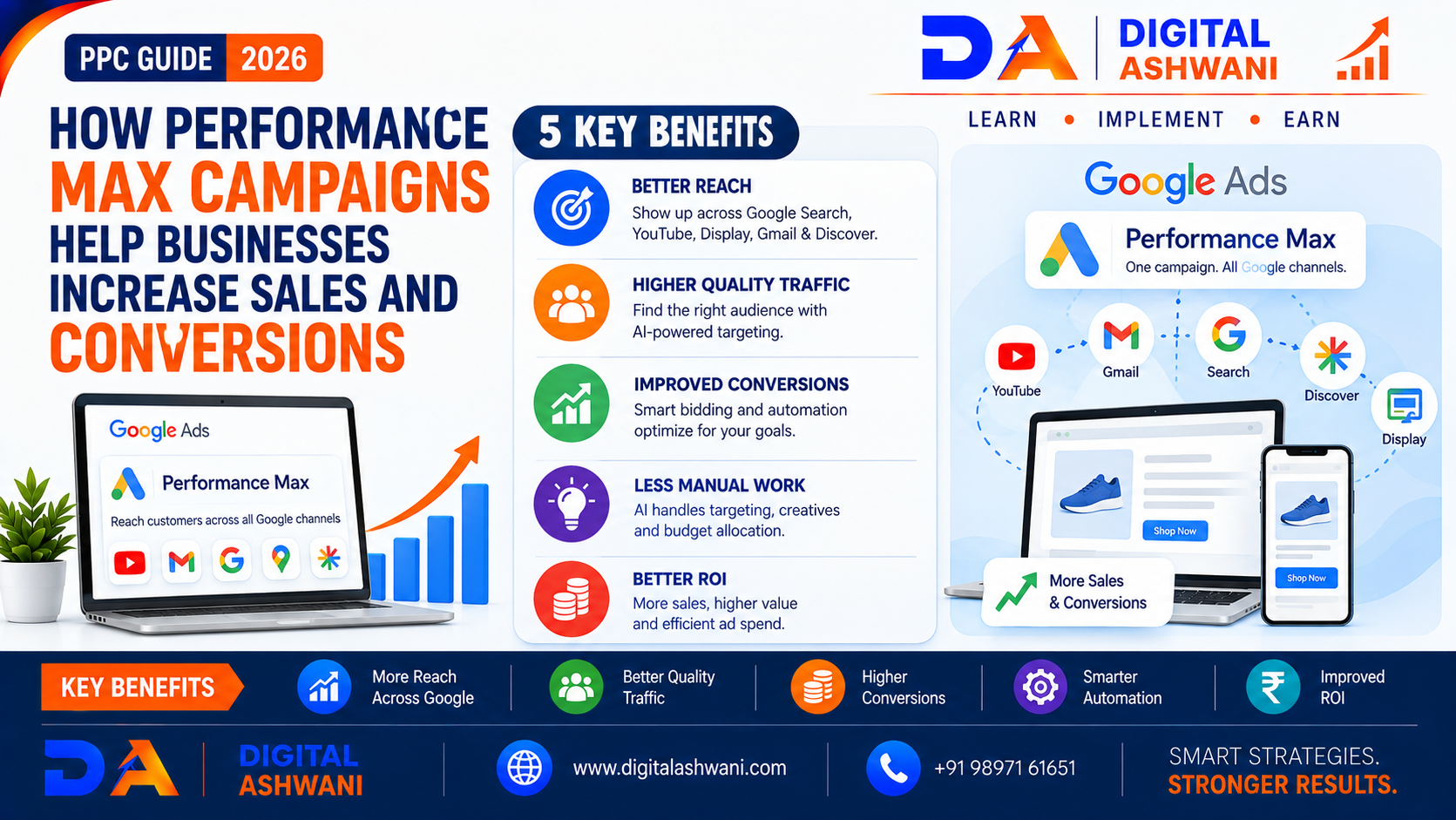
How Performance Max Campaigns Help Businesses Increase Sales and Conversions
Google Ads has evolved significantly as businesses increasingly use automation and artificial intelligence to reach potential customers across multiple digital touchpoints.
Traditional advertising campaigns often require advertisers to manage different campaigns and placements separately. Performance Max takes a different approach by allowing advertisers to access Google’s advertising inventory through a single goal-based campaign.
Performance Max can serve across eligible Google channels including Search, YouTube, Display, Discover, Gmail, and Maps. Google describes Performance Max as a campaign type designed to help advertisers optimize toward specific conversion goals and find additional opportunities for conversions and conversion value.
For businesses focused on online sales, lead generation, customer acquisition, or revenue growth, this cross-channel approach can provide more opportunities to connect with potential customers throughout their buying journey.
In this comprehensive guide by Digital Ashwani, you’ll learn what Performance Max campaigns are, how they work, how they can support sales and conversions, which bidding strategies businesses can use, and how to optimize Performance Max campaigns for better advertising performance.
What Are Performance Max Campaigns?
Performance Max is a goal-based Google Ads campaign type that gives advertisers access to multiple Google advertising channels through a single campaign.
Instead of creating separate campaigns for every available Google surface, advertisers can provide campaign goals, creative assets, audience information, conversion data, budgets, and other inputs. Google AI then uses these signals to determine where and how ads should be served based on the campaign’s objectives.
Performance Max is designed to complement keyword-based Search campaigns rather than simply replace them. It can help advertisers discover additional conversion opportunities across Google’s broader advertising ecosystem.
Where Can Performance Max Ads Appear?
Performance Max can access a broad range of Google advertising inventory.
Depending on the campaign and available inventory, ads can appear across:
- Google Search
- YouTube
- Google Display Network
- Google Discover
- Gmail
- Google Maps
- Search partners
- Shopping-related inventory where applicable
Google’s current channel documentation identifies Search, Display, YouTube, Discover, Maps, Gmail, and Search partners among Performance Max channels.
This broad reach is one of the major differences between Performance Max and campaigns that are restricted to a single advertising channel.
Why Businesses Are Using Performance Max
Businesses generally use Performance Max when they have clear conversion objectives and want Google’s automated systems to optimize across multiple eligible advertising surfaces.
Performance Max can be particularly relevant for:
- Ecommerce businesses
- Online retailers
- Lead generation businesses
- Service companies
- Local businesses
- Businesses focused on customer acquisition
- Brands looking to increase sales
- Businesses with measurable conversion goals
Google recommends Performance Max for advertisers with specific goals such as increasing online sales or generating leads, especially when they want access to Google’s broader advertising inventory.
How Performance Max Works
Performance Max combines advertiser-provided information with Google’s automated bidding and optimization systems.
The campaign can use inputs such as:
- Conversion goals
- Conversion values
- Creative assets
- Audience signals
- Product feeds where applicable
- Location information
- Budget
- Bidding targets
- Landing pages
- Business information
Google AI uses these inputs to make automated decisions about bidding, audiences, placements, and creative combinations with the objective of improving performance against the selected campaign goals.
The basic process can be understood as:
Business Goal → Conversion Data → Assets & Signals → Google AI → Cross-Channel Delivery → Conversion Optimization
This makes Performance Max particularly different from a campaign structure where advertisers manually control every individual placement.
Proven Ways Performance Max Campaigns Can Increase Sales and Conversions
1. Reach Customers Across Multiple Google Channels
One of the biggest advantages of Performance Max is its access to multiple Google advertising surfaces.
A potential customer may first discover a product through YouTube, later encounter an ad on the Display Network, and eventually search for the product on Google.
A cross-channel campaign can provide opportunities to reach customers during different stages of their decision-making process.
Performance Max can access Google Search, YouTube, Display, Discover, Gmail, and Maps through a unified campaign structure.
Why Cross-Channel Reach Matters
Customers do not always follow a single path before purchasing.
For example:
Discovery → Research → Comparison → Search → Purchase
A business that only focuses on one advertising surface may miss opportunities elsewhere in the customer journey.
Performance Max allows eligible inventory across multiple Google properties to participate in the campaign’s optimization process.
2. Use Google AI for Automated Bidding
Performance Max uses Google’s AI-powered bidding systems to make auction-time decisions.
Instead of manually setting individual bids for every advertising opportunity, Smart Bidding can use available signals to determine an appropriate bid based on the campaign’s optimization goal.
Signals can include factors related to the user, context, device, location, and likelihood of conversion.
This can be especially useful when thousands of advertising opportunities are available across different channels.
Focus on the Business Objective
The important point is that automation should be connected to the correct business objective.
If a company wants more leads, its campaign should optimize toward meaningful lead conversions.
If an ecommerce company wants more revenue, conversion values can help Google optimize toward higher-value sales rather than simply counting every purchase equally.
3. Optimize for More Conversions
Businesses can use Performance Max to optimize campaigns toward specific conversion goals.
For example, a lead-generation business might track:
- Contact form submissions
- Phone calls
- Consultation requests
- Quote requests
- Appointment bookings
An ecommerce business might track:
- Purchases
- Revenue
- Product sales
- Purchase value
Google’s Maximize Conversions bidding strategy aims to use the campaign budget to obtain as many conversions as possible, while Maximize Conversion Value aims to maximize the total conversion value within the budget.
4. Focus on Conversion Value Instead of Only Conversion Volume
Not every conversion has the same business value.
For example, an ecommerce company might receive:
- ₹500 order
- ₹2,000 order
- ₹5,000 order
- ₹15,000 order
Counting each purchase as simply “one conversion” does not show the difference in revenue.
Conversion value tracking allows businesses to communicate the relative business value of different conversions to Google Ads.
Google states that conversion values help advertisers measure and optimize the business impact of advertising and can be used with value-based bidding strategies such as Maximize Conversion Value and Target ROAS.
Example
Suppose two campaigns generate:
Campaign A: 100 purchases × ₹500 = ₹50,000 revenue
Campaign B: 60 purchases × ₹1,500 = ₹90,000 revenue
Campaign B generated fewer conversions but higher total revenue.
For businesses focused on revenue, conversion value provides a more useful optimization signal than conversion count alone.
5. Use Smart Bidding for Sales and Revenue Goals
Performance Max supports different bidding approaches depending on the campaign objective.
Maximize Conversions
Maximize Conversions focuses on getting as many conversions as possible within the campaign’s budget.
This can be useful when the primary objective is conversion volume rather than the value of each conversion.
Maximize Conversion Value
Maximize Conversion Value focuses on generating the highest possible total conversion value within the available budget.
This can be useful for businesses that have reliable conversion-value tracking and want to optimize toward revenue or another measurable business value.
Target CPA and Target ROAS
Google’s bidding terminology is also being updated in 2026. Google states that “Maximize conversions with a Target CPA” is being relabeled as “Target CPA,” while “Maximize conversion value with a Target ROAS” is being relabeled as “Target ROAS.” Google notes that the underlying bidding behavior remains the same during this naming transition.
6. Reach New Potential Customers
Performance Max can use Google’s analysis of consumer intent and other signals to find potential customers who may be likely to convert.
Audience signals can be added to help guide Google’s AI toward audiences that the advertiser believes are relevant.
However, audience signals are suggestions rather than strict targeting restrictions. Google explains that Performance Max may serve outside the provided signals when its systems predict that doing so can help achieve the campaign goal.
Useful Audience Signals
Businesses can provide information such as:
- Customer lists
- Website visitors
- Custom segments
- Relevant interests
- Demographic information
- Previous customer data
These signals can help provide additional context to the campaign’s optimization system.
7. Improve Ecommerce Sales with Product Data
For ecommerce businesses, Performance Max can combine advertising with product information where applicable.
Product-focused campaigns can help businesses promote products across Google’s advertising ecosystem and connect product information with potential buyers.
A well-maintained product feed can therefore become an important part of an ecommerce Performance Max strategy.
Optimize Product Information
Businesses should pay attention to:
- Product titles
- Product descriptions
- Product images
- Product categories
- Pricing
- Availability
- Product identifiers
- Landing pages
Accurate and complete product information gives advertising systems better information about what is being promoted.
8. Use Better Creative Assets
Performance Max relies heavily on advertiser-provided creative assets.
These can include:
- Headlines
- Long headlines
- Descriptions
- Images
- Logos
- Videos
- Product assets where applicable
Google can combine eligible assets into different creative formats and placements.
Businesses should therefore provide multiple high-quality assets rather than relying on a single image or headline.
Create Assets for Different Customer Needs
For example, an ecommerce company could create messaging around:
- Product benefits
- Price or offers
- Product quality
- Free shipping
- Customer support
- Product variety
A service business could focus on:
- Experience
- Service benefits
- Areas served
- Consultation
- Customer outcomes
- Clear calls-to-action
The messaging should remain accurate and consistent with the landing page.
9. Improve Landing Page Relevance
Getting an advertisement in front of a potential customer is only the first step.
The landing page must continue the same message.
For example:
Ad: Google Ads Management Services
Landing Page: Google Ads Management Services
CTA: Request a Consultation
If the advertisement promotes one offer but sends the user to an unrelated homepage, the customer journey becomes less clear.
A Strong Landing Page Should Include
- Relevant headline
- Clear value proposition
- Important service or product information
- Trust signals
- Strong CTA
- Easy navigation
- Mobile-friendly design
- Fast loading experience
- Simple conversion process
Performance Max cannot compensate for a fundamentally poor landing page or an unclear offer.
10. Optimize for Qualified Leads
For lead-generation businesses, generating a large number of form submissions does not necessarily mean the campaign is successful.
A better approach is to distinguish between:
Lead → Qualified Lead → Sales Opportunity → Customer
For example, a digital marketing agency may receive 100 inquiries but only 20 may match its service area, budget, or business requirements.
If possible, businesses should feed meaningful conversion information back into their advertising strategy so optimization moves closer to actual business outcomes.
Google’s lead-generation guidance recommends choosing conversion goals that are close to the actual sale or closed deal when using value-based bidding and ensuring that the selected conversion signals provide sufficient data.
11. Connect Performance Max with Strong Conversion Tracking
Conversion tracking is one of the most important components of a Performance Max campaign.
Without reliable conversion data, automated systems have less useful information about which actions represent success.
Track Valuable Actions
Depending on the business, useful conversions may include:
- Purchases
- Qualified leads
- Phone calls
- Form submissions
- Bookings
- Sign-ups
- Quote requests
- Revenue
Avoid treating every small interaction as the primary conversion if it does not represent meaningful business value.
12. Use Conversion Values for Better Optimization
Conversion values allow businesses to communicate the relative importance of different customer actions.
For example:
A phone call might be worth ₹1,000 on average.
A qualified consultation might be worth ₹3,000.
A completed purchase might be worth the actual transaction revenue.
This gives automated bidding more information about the business impact of different conversions.
Google explains that conversion values can help advertisers understand total business value and optimize bidding toward higher-value outcomes.
13. Use Performance Max Alongside Search Campaigns
Performance Max is designed to complement keyword-based Search campaigns.
Search campaigns can provide more direct control around keyword-based demand, while Performance Max can access a wider range of Google inventory and use automation to identify additional opportunities.
A broader strategy can therefore combine:
Search Campaigns + Performance Max + Remarketing/Other Relevant Campaigns
The right structure depends on the business objective, campaign data, products or services, and account setup.
14. Use Audience Signals to Guide Campaign Learning
Audience signals can provide useful information about the types of customers that a business considers valuable.
For example, an online furniture company could provide signals related to:
- Home improvement
- Furniture shoppers
- Website visitors
- Previous customers
- High-value customer lists
These signals do not function as strict audience restrictions in Performance Max. They help guide Google’s systems while allowing the campaign to discover other potentially valuable users.
15. Monitor Performance and Optimize Regularly
Performance Max is automated, but that does not mean advertisers should launch campaigns and ignore them.
Businesses should regularly review:
- Conversion volume
- Conversion value
- Cost per conversion
- ROAS
- Revenue
- Lead quality
- Asset performance
- Search trends
- Budget utilization
- Landing page performance
Google provides insights and reporting features to help advertisers understand campaign performance and identify opportunities for optimization.
Performance Max Optimization Checklist
| Optimization Area | Priority |
|---|---|
| Conversion Tracking | High |
| Conversion Values | High |
| Correct Campaign Goal | High |
| Creative Assets | High |
| Landing Page | High |
| Product Feed | High for Ecommerce |
| Audience Signals | Medium |
| Budget Management | High |
| Bidding Strategy | High |
| Lead Quality | High for Lead Generation |
| Asset Performance | Medium |
| Performance Monitoring | High |
Common Performance Max Mistakes
Launching Without Proper Conversion Tracking
If the campaign is optimizing toward actions that do not represent meaningful business outcomes, automated bidding may optimize for the wrong objective.
Always review which conversion actions are included in campaign optimization.
Using Poor-Quality Creative Assets
Low-quality images, generic headlines, and weak messaging can limit the effectiveness of advertising across visual placements.
Provide a useful variety of relevant creative assets.
Tracking Every Small Interaction as a Primary Conversion
Not every website action represents a valuable customer.
For example, tracking a button click as the primary conversion when the actual objective is a qualified lead can create misleading performance data.
Ignoring Conversion Value
For ecommerce and revenue-focused businesses, measuring only conversion count can hide the difference between high-value and low-value customers.
Use reliable conversion values where appropriate.
Setting Unrealistic Targets
A very aggressive CPA or ROAS target can restrict campaign delivery and make it harder to generate sufficient conversion volume.
Google specifically advises that Target ROAS should be realistic based on historical performance and notes that a target set too high can limit impressions and conversions.
Making Constant Changes
Performance Max uses automated systems and requires sufficient data to evaluate changes.
Frequent major changes can make it difficult to understand which adjustments are actually responsible for performance changes.
How to Create a Performance Max Campaign for Sales
A basic setup process involves several important stages.
Step 1: Define the Business Goal
Decide whether the campaign is primarily designed for:
- Online Sales
- Lead Generation
- Customer Acquisition
- Revenue Growth
- Other supported conversion objectives
Step 2: Configure Conversion Tracking
Make sure important conversions are being recorded accurately before relying heavily on automated optimization.
Step 3: Select the Appropriate Bidding Approach
Choose whether the campaign should prioritize:
- Conversion volume
- Conversion value
- Target CPA
- Target ROAS
The appropriate choice depends on business objectives and available conversion data.
Step 4: Add High-Quality Assets
Provide relevant:
- Headlines
- Descriptions
- Images
- Logos
- Videos
For ecommerce campaigns, provide accurate product data where required.
Step 5: Add Relevant Audience Signals
Use customer data and other relevant audience information to provide useful guidance to Google’s optimization systems.
Step 6: Review Landing Pages
Make sure the destination pages are relevant to the advertisement and provide a clear path toward conversion.
Step 7: Monitor Performance
Review campaign results regularly and optimize based on meaningful business metrics rather than clicks alone.
Performance Max for Ecommerce Businesses
Performance Max can be particularly relevant to ecommerce businesses because sales can be measured directly through purchases and transaction values.
An ecommerce company can optimize toward:
Product Discovery → Product Visit → Add to Cart → Purchase → Revenue
The most important part is reliable conversion and value tracking.
Businesses should also maintain accurate product information and ensure that product landing pages provide a strong buying experience.
Performance Max for Lead Generation Businesses
Lead-generation businesses should focus on the quality of leads rather than simply maximizing form submissions.
For example, businesses such as:
- Real Estate Companies
- Digital Marketing Agencies
- Construction Companies
- Education Providers
- Financial Services
- B2B Companies
- Professional Services
may receive leads with very different commercial values.
A campaign should therefore be structured around meaningful conversion actions wherever possible.
Performance Max for Local Businesses
Local businesses can also use Performance Max for relevant business goals and eligible local inventory.
Depending on the campaign setup and objective, Google’s advertising ecosystem can connect businesses with customers across surfaces such as Search, Maps, YouTube, Gmail, and Display.
For a local business, useful objectives may include:
- Calls
- Website inquiries
- Store visits where eligible
- Directions
- Bookings
- Local sales
The campaign should be supported by accurate business information and a strong conversion path.
How to Measure Performance Max Success
Performance should be measured according to the actual business objective.
For Ecommerce
Monitor:
- Revenue
- Conversion Value
- ROAS
- Purchases
- Average Order Value
- Cost per Purchase
For Lead Generation
Monitor:
- Leads
- Qualified Leads
- Cost per Lead
- Cost per Qualified Lead
- Sales Opportunities
- Customer Acquisition Cost
For Local Businesses
Monitor:
- Calls
- Website Leads
- Bookings
- Store Actions
- Qualified Inquiries
- Revenue
The most important metric is not always the highest number of conversions.
A business should determine whether the conversions generated by the campaign are creating meaningful commercial value.
Performance Max vs Search Campaigns
| Feature | Performance Max | Search Campaign |
|---|---|---|
| Google Search | Yes | Yes |
| YouTube | Yes | No |
| Display | Yes | No |
| Discover | Yes | No |
| Gmail | Yes | No |
| Maps | Yes | Limited/depends on setup |
| Keyword-based control | More automated | More direct |
| Cross-channel reach | Broad | Primarily Search |
| Automated optimization | High | Available |
| Best use | Cross-channel goal optimization | Search-intent targeting |
Performance Max and Search campaigns can serve different strategic purposes. Google specifically positions Performance Max as complementary to keyword-based Search campaigns.
Internal Linking Suggestions for Digital Ashwani
Strengthen the Digital Ashwani Google Ads content cluster by linking this article with relevant resources such as:
- [How Google Ads Works and Why Businesses Should Invest in Paid Advertising]
- [Google Search Ads Optimization Tips for Higher Conversion Rates]
- [Google Ads Management]
- [Google Ads Calculator]
- [CPC Calculator]
- [ROAS Calculator]
- [CPA Calculator]
- [Conversion Rate Calculator]
- [Marketing Budget Calculator]
- [How to Improve Google Ads Conversion Rates]
- [Google Ads Strategy for Small Businesses]
Use descriptive anchor text that naturally explains the destination page instead of repeatedly using the same exact keyword.
External Resources
For current and reliable Performance Max information, advertisers should refer primarily to Google’s official documentation:
- Google Ads Help – About Performance Max campaigns
- Google Ads Help – Performance Max setup
- Google Ads Help – Performance Max bidding
- Google Ads Help – Performance Max audience signals
- Google Ads Help – Performance Max lead-generation best practices
Google’s official documentation should be checked regularly because campaign features, bidding terminology, available inventory, and automation capabilities can change over time.
Frequently Asked Questions
What is a Performance Max campaign?
Performance Max is a goal-based Google Ads campaign type that allows advertisers to access multiple Google advertising channels from a single campaign and optimize toward selected conversion goals.
Does Performance Max increase sales?
Performance Max is designed to help advertisers optimize toward goals such as online sales and conversion value, but results vary depending on factors such as conversion tracking, budget, creative quality, product or service demand, competition, and landing-page experience.
Is Performance Max good for ecommerce?
Performance Max can be useful for ecommerce businesses because it can access multiple Google advertising surfaces and can optimize toward purchases and conversion value when appropriate tracking is configured.
What is the difference between Performance Max and Search Ads?
Search campaigns primarily focus on keyword-based search advertising, while Performance Max can access a wider range of Google advertising inventory and use automated optimization across those channels. Google positions Performance Max as complementary to Search campaigns.
What bidding strategy should I use for Performance Max?
The appropriate strategy depends on your business objective and conversion data. Maximize Conversions focuses on conversion volume, while Maximize Conversion Value focuses on the total value generated. Target CPA and Target ROAS can be used when appropriate targets and sufficient data are available.
Are audience signals mandatory in Performance Max?
No. Audience signals are optional suggestions that can help guide Google’s AI. Performance Max can still find customers outside those signals when the system predicts they may help achieve the campaign objective.
Can Performance Max generate leads?
Yes. Performance Max supports lead-generation objectives and can optimize toward selected lead conversions. For better results, businesses should focus on meaningful conversion actions and, where possible, provide value signals closer to actual sales outcomes.
How important is conversion tracking for Performance Max?
Conversion tracking is extremely important because automated bidding uses conversion-related signals to optimize campaign performance. Incorrect or low-value conversion tracking can lead to optimization toward actions that do not represent the actual business objective.
Can Performance Max work with Search campaigns?
Yes. Google describes Performance Max as a campaign type that complements keyword-based Search campaigns, allowing businesses to combine Search demand capture with broader Google inventory and automated optimization.
Final Thoughts
Performance Max campaigns have changed how businesses can approach Google Ads by combining multiple Google advertising channels with automated bidding, audience signals, creative optimization, and conversion-focused campaign objectives.
The real value of Performance Max is not simply its ability to show ads in more places. The campaign works best when businesses provide accurate conversion data, meaningful conversion values, high-quality creative assets, relevant landing pages, and realistic performance goals.
For ecommerce businesses, the focus can be on purchases, revenue, and ROAS. For lead-generation businesses, the focus should move beyond basic form submissions toward qualified leads and actual business opportunities.
A successful Performance Max strategy can therefore be summarized as:
Clear Goal → Accurate Tracking → Quality Assets → Relevant Audience Signals → Smart Bidding → Strong Landing Page → Continuous Optimization
Businesses should also remember that automation does not eliminate the need for strategy. Performance Max still requires accurate setup, meaningful conversion measurement, appropriate creative assets, realistic targets, and regular performance analysis.
When these elements work together, Performance Max can become an important part of a broader Google Ads strategy designed to reach potential customers, generate conversions, increase sales, and improve the measurable value of advertising investment.
At Digital Ashwani, we continue to publish practical resources covering Google Ads, SEO, Local SEO, AI marketing, PPC, conversion optimization, and digital marketing strategies to help businesses build stronger online visibility and achieve measurable growth.
