

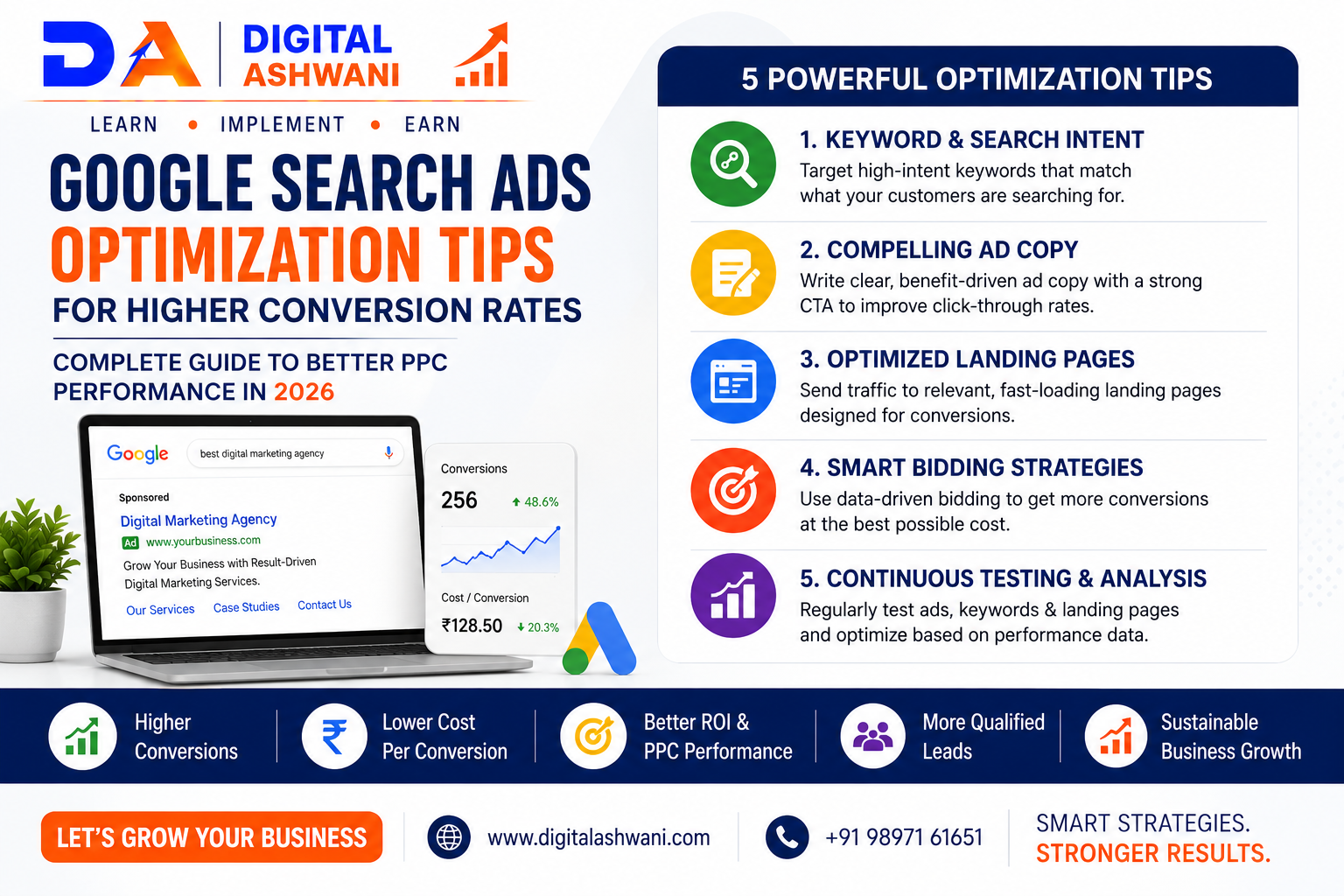
Google Search Ads Optimization Tips for Higher Conversion Rates
Getting clicks from Google Search Ads is only the beginning.
The real goal of a successful paid search campaign is to turn those clicks into valuable actions such as leads, phone calls, purchases, bookings, registrations, or quote requests.
A campaign can generate hundreds or thousands of clicks and still produce poor results if:
- Keywords are too broad
- Ads don’t match search intent
- Landing pages are weak
- Conversion tracking is inaccurate
- Irrelevant searches consume the budget
- Calls-to-action are unclear
- Campaign targeting is poorly structured
This is why Google Search Ads Optimization is essential.
Optimization involves continuously analyzing campaign data and improving keywords, advertisements, bidding, targeting, landing pages, conversion tracking, and budget allocation.
Instead of simply trying to get more traffic, the objective is to attract more qualified visitors who are likely to convert.
In this practical guide by Digital Ashwani, you’ll learn effective Google Search Ads optimization tips to improve conversion rates, increase lead quality, reduce wasted spending, and achieve better PPC performance in 2026.
What Is Google Search Ads Optimization?
Google Search Ads Optimization is the process of improving a Search campaign to generate better business results from available advertising spend.
Optimization can involve:
- Keyword Management
- Search Term Analysis
- Ad Copy Improvements
- Landing Page Optimization
- Conversion Tracking
- Bid Strategy
- Audience Targeting
- Geographic Targeting
- Budget Allocation
- Performance Analysis
The goal is not necessarily to achieve the lowest CPC.
The goal is to improve the relationship between:
Ad Spend → Qualified Traffic → Conversions → Revenue
Why Conversion Rate Matters
Conversion rate measures how effectively your website turns ad visitors into customers or leads.
A basic formula is:
Conversion Rate = (Conversions ÷ Clicks) × 100
For example:
- Clicks: 1,000
- Conversions: 50
Conversion Rate = 5%
Improving conversion rate can allow a business to generate more results from the same amount of traffic.
However, conversion quality matters too.
Ten highly qualified leads can be more valuable than 100 low-quality enquiries.
Start With Search Intent
Search intent should guide your campaign optimization.
Consider the difference between:
“What is SEO?”
and:
“SEO agency near me”
The second query generally indicates stronger commercial intent.
Search Ads should prioritize keywords and searches that align with your actual business objectives.
Target High-Intent Keywords
Focus on keywords that indicate a genuine need for your product or service.
Examples:
- Hire SEO Agency Delhi
- Google Ads Management Services
- Buy Running Shoes Online
- Best Dentist Near Me
- Web Design Company Delhi
Don’t automatically target every keyword with high search volume.
Relevance and conversion potential are more important.
Review Search Terms Regularly
The Search Terms Report can reveal the actual queries that triggered your advertisements.
Look for:
- High-Converting Searches
- Irrelevant Searches
- Unexpected Queries
- New Keyword Opportunities
- Expensive Low-Converting Searches
Use these insights to refine your campaign.
Use Negative Keywords
Negative keywords help prevent ads from showing for searches that aren’t relevant to your offer.
For example, a business selling professional SEO services might exclude:
- Free
- Jobs
- Internship
- Course
- Training
Review search terms regularly because new irrelevant queries can appear over time.
Improve Ad Relevance
Your advertisement should closely match the user’s search.
If someone searches:
“Local SEO Services Delhi”
the ad should clearly communicate that you provide Local SEO services in Delhi.
Relevant messaging creates a stronger connection between:
Search Query → Ad → Landing Page
This alignment can improve the overall user experience and campaign performance.
Write Strong Responsive Search Ads
Your ad copy should communicate the value of your offer quickly.
Include:
- Relevant Keywords
- Unique Selling Proposition
- Customer Benefits
- Location Where Relevant
- Trust Signals
- Strong Calls-to-Action
Examples:
Get Professional Local SEO Services
Generate More Local Leads With SEO
Book Your Free Consultation Today
Avoid misleading claims or unrealistic guarantees.
Test Different Ad Messages
Experiment with different messaging angles.
Test:
- Benefits
- Features
- Offers
- CTAs
- Trust Signals
- Customer Problems
- Differentiators
Use actual performance data to determine which messages attract valuable customers.
Optimize Landing Pages
A strong advertisement cannot compensate for a poor landing page.
Your landing page should match the promise made in the advertisement.
For example:
Ad: Google Ads Management Services
Landing Page: Google Ads Management Services
Don’t send every campaign to a generic homepage when a more relevant page is available.
Make Landing Pages Easy to Understand
Visitors should immediately understand:
- What You Offer
- Who It’s For
- Why They Should Choose You
- What Action They Should Take
A clear structure reduces confusion and unnecessary friction.
Use Strong Calls-to-Action
Your CTA should clearly communicate the next step.
Examples include:
- Get a Free Quote
- Book a Consultation
- Call Now
- Request Pricing
- Schedule an Appointment
- Buy Now
- Start Free Trial
Use CTAs that match the visitor’s intent and stage in the buying journey.
Simplify Lead Forms
Long forms can create unnecessary friction.
Only ask for information required to qualify or process the lead.
For many businesses, a simple form might request:
- Name
- Phone
- Requirement
Test different form lengths based on lead quality and conversion performance.
Improve Mobile Conversion Experience
Many users search and interact with ads from smartphones.
Check that your mobile landing page has:
- Fast Loading
- Readable Text
- Easy Navigation
- Large Tap Targets
- Click-to-Call Options Where Relevant
- Simple Forms
- Clear CTAs
A campaign can lose conversions even when the advertisements themselves perform well if the mobile experience is poor.
Set Up Accurate Conversion Tracking
Optimization depends on reliable data.
Track meaningful actions such as:
- Form Submissions
- Phone Calls
- Purchases
- Appointment Bookings
- Quote Requests
- Sign-Ups
- Qualified Leads
Don’t rely only on clicks and impressions to judge campaign success.
Separate Primary and Secondary Conversions
Not every tracked action has equal business value.
For example:
Primary Conversion
Completed purchase or qualified lead.
Secondary Action
Newsletter signup or brochure download.
Separating these actions can help keep campaign optimization focused on meaningful business outcomes.
Optimize Geographic Targeting
If your business serves specific locations, make sure your campaigns are aligned with your actual service area.
For example:
A Delhi-based local service business may focus on relevant areas such as:
- Delhi
- Noida
- Gurgaon
- Ghaziabad
Review location performance and adjust campaign targeting according to actual business results.
Analyze Device Performance
Compare performance across:
- Mobile
- Desktop
- Tablet
If mobile generates many clicks but very few conversions, investigate the mobile landing page and conversion process before making major campaign changes.
Optimize Ad Scheduling
Analyze when your advertisements generate valuable conversions.
Depending on the business, performance may differ by:
- Day
- Time
- Weekday
- Weekend
Don’t assume that every hour is equally valuable.
Use campaign data to identify periods that produce stronger business outcomes.
Improve Quality and Relevance
Search advertising performance depends on more than simply increasing bids.
Focus on improving:
- Keyword Relevance
- Ad Relevance
- Landing Page Experience
- Expected User Response
- Overall Search Intent Alignment
Better relevance can contribute to more efficient advertising performance.
Review Budget Allocation
Not every campaign deserves the same budget.
Compare campaigns based on:
- Conversion Volume
- Conversion Rate
- Cost Per Conversion
- Lead Quality
- Revenue
- Return on Ad Spend Where Applicable
Shift budget carefully toward campaigns that consistently produce valuable outcomes.
Use Smart Bidding Carefully
Automated bidding strategies can help optimize toward business objectives when sufficient conversion data and appropriate configuration are available.
Examples include:
- Maximize Conversions
- Target CPA
- Maximize Conversion Value
- Target ROAS
Don’t judge automated bidding after only a small amount of data.
Give the system enough quality conversion information and monitor results regularly.
Create Separate Campaigns When There Is a Clear Reason
Campaign segmentation can improve control.
Separate campaigns may be useful for:
- Different Locations
- Different Services
- Different Products
- Different Business Objectives
- Different Budgets
However, excessive segmentation can fragment data and make management unnecessarily complicated.
Use structure strategically rather than creating campaigns for every minor variation.
Improve Lead Quality
A higher conversion rate isn’t always better if the additional conversions are poor quality.
Monitor:
- Qualified Leads
- Sales Accepted Leads
- Appointments
- Closed Customers
- Revenue
The ultimate objective should be business growth, not simply increasing the number displayed in the conversion column.
Connect Google Ads With CRM Data
For lead-generation businesses, CRM information can reveal what happens after a form submission or phone call.
You may discover that:
Campaign A → 50 Leads → 10 Qualified → 4 Customers
while:
Campaign B → 80 Leads → 5 Qualified → 1 Customer
Campaign A may be significantly more valuable despite generating fewer total leads.
Use A/B Testing Carefully
Test one meaningful variable at a time where practical.
Examples include:
- Landing Page Headline
- CTA
- Form Length
- Offer
- Ad Message
Don’t make dozens of changes simultaneously if you want to understand what caused performance changes.
Monitor Performance Consistently
Create a regular optimization routine.
Daily Checks
Look for:
- Major Spending Changes
- Tracking Problems
- Sudden Performance Drops
- Disapproved Ads
Weekly Checks
Review:
- Search Terms
- Negative Keywords
- Conversion Performance
- Budget Distribution
- Ad Performance
Monthly Reviews
Analyze:
- Conversion Trends
- Lead Quality
- Cost Per Conversion
- Campaign Profitability
- Landing Page Performance
- Overall ROI
Common Google Search Ads Optimization Mistakes
Optimizing Only for CTR
A high CTR doesn’t guarantee profitable customers.
Ignoring Search Terms
You may continue paying for irrelevant searches without regular analysis.
Using the Same Landing Page Everywhere
Different searches often require different landing pages.
Ignoring Conversion Tracking
Without reliable conversion data, optimization becomes guesswork.
Chasing the Lowest CPC
Cheap clicks can still produce poor-quality traffic.
Changing Too Many Settings at Once
Large numbers of simultaneous changes make performance difficult to interpret.
Ignoring Lead Quality
A campaign generating many low-quality leads may look successful while producing little revenue.
Forgetting Mobile Users
Poor mobile experiences can reduce conversion rates significantly.
Google Search Ads Optimization Checklist
Before considering a campaign fully optimized, review:
- Clear Campaign Objective
- High-Intent Keywords
- Relevant Ad Groups
- Appropriate Match Types
- Negative Keywords
- Strong Ad Copy
- Relevant Landing Pages
- Clear CTAs
- Mobile Optimization
- Accurate Conversion Tracking
- Search Term Monitoring
- Geographic Targeting
- Device Performance
- Ad Scheduling
- Budget Allocation
- Bid Strategy
- Lead Quality
- CRM Data Where Available
- Regular Performance Reviews
Internal Linking Suggestions (Digital Ashwani)
Strengthen the Google Ads content cluster by linking this article with:
- How Google Ads Works and Why Businesses Should Invest in Paid Advertising
- Complete Google Search Ads Campaign Setup Guide for Better Lead Generation
- Best Google Search Campaign Bidding Strategies Explained
- Negative Keywords Strategy to Reduce Wasted Google Ads Spending
- What Is Cost Per Click (CPC)? 15 Powerful Ways to Reduce CPC and Improve ROI
- PPC Audit Checklist Every Business Should Complete Before Scaling Campaigns
- Google Ads Terminology Every Digital Marketer Should Understand Before Advertising
- How Artificial Intelligence Is Changing Google Ads Campaign Optimization
- Complete Website Conversion Rate Optimization Guide
- How to Increase Website Conversion Rates Using Data-Driven Optimization Methods
These internal links connect Search Ads optimization with campaign setup, bidding, CPC, negative keywords, PPC audits, AI optimization, and conversion rate optimization.
External Resources
For current Google Ads guidance, refer to official resources such as:
- Google Ads Help
- Google Ads Policies
- Google Ads Learning Center
- Google Analytics Help
- Google Search Central
Google Ads features, policies, bidding options, and reporting capabilities can change over time, so review current official documentation when making significant campaign changes.
Frequently Asked Questions
What is Google Search Ads Optimization?
Google Search Ads Optimization is the ongoing process of improving keywords, advertisements, targeting, landing pages, bidding, conversion tracking, and budgets to generate better business results.
How can I increase my Google Ads conversion rate?
Focus on high-intent keywords, relevant ad copy, optimized landing pages, strong CTAs, accurate conversion tracking, negative keywords, mobile usability, and continuous performance analysis.
Does increasing the Google Ads budget increase conversions?
Not necessarily. Increasing budget can create more opportunities, but if the campaign has poor targeting or low conversion efficiency, additional spending may simply increase wasted costs.
Why are my Google Ads getting clicks but no conversions?
Possible causes include poor landing pages, weak offers, incorrect targeting, low-intent keywords, tracking problems, unclear CTAs, or a mismatch between the advertisement and the landing page.
Should I focus on CPC or conversion rate?
Both metrics matter, but neither should be evaluated in isolation. A campaign with a higher CPC can still be more profitable if it generates better-qualified conversions.
How often should Google Search Ads be optimized?
Search terms, spending, and tracking issues should be monitored regularly. More substantial optimization decisions should be based on enough data to identify meaningful performance patterns.
What is a good Google Ads conversion rate?
There is no universal benchmark that applies to every business. Conversion rates vary significantly by industry, offer, traffic quality, device, location, and conversion definition.
Can landing page optimization improve Google Ads performance?
Yes. A relevant, fast, mobile-friendly landing page with clear messaging and a strong CTA can improve the likelihood that qualified ad visitors become leads or customers.
Final Thoughts
Effective Google Search Ads Optimization is not about making random changes every day.
It’s about creating a continuous improvement system:
Right Search → Relevant Ad → Strong Landing Page → Easy Conversion → Accurate Tracking → Continuous Optimization
Start by understanding what your customers are searching for.
Then improve keyword targeting, search terms, negative keywords, ad relevance, landing pages, conversion tracking, bidding, and budget allocation.
Most importantly, optimize for business outcomes rather than vanity metrics.
A campaign that generates fewer clicks but more qualified customers can be far more valuable than one that generates thousands of inexpensive visitors.
When Google Search Ads are combined with strong landing pages, accurate tracking, thoughtful targeting, and consistent optimization, businesses can turn paid search into a predictable and scalable source of leads and revenue.
At Digital Ashwani, we regularly publish practical guides on Google Ads, PPC, SEO, AI Marketing, Conversion Rate Optimization, Local SEO, and Digital Marketing to help businesses improve advertising performance and achieve sustainable online growth.
