

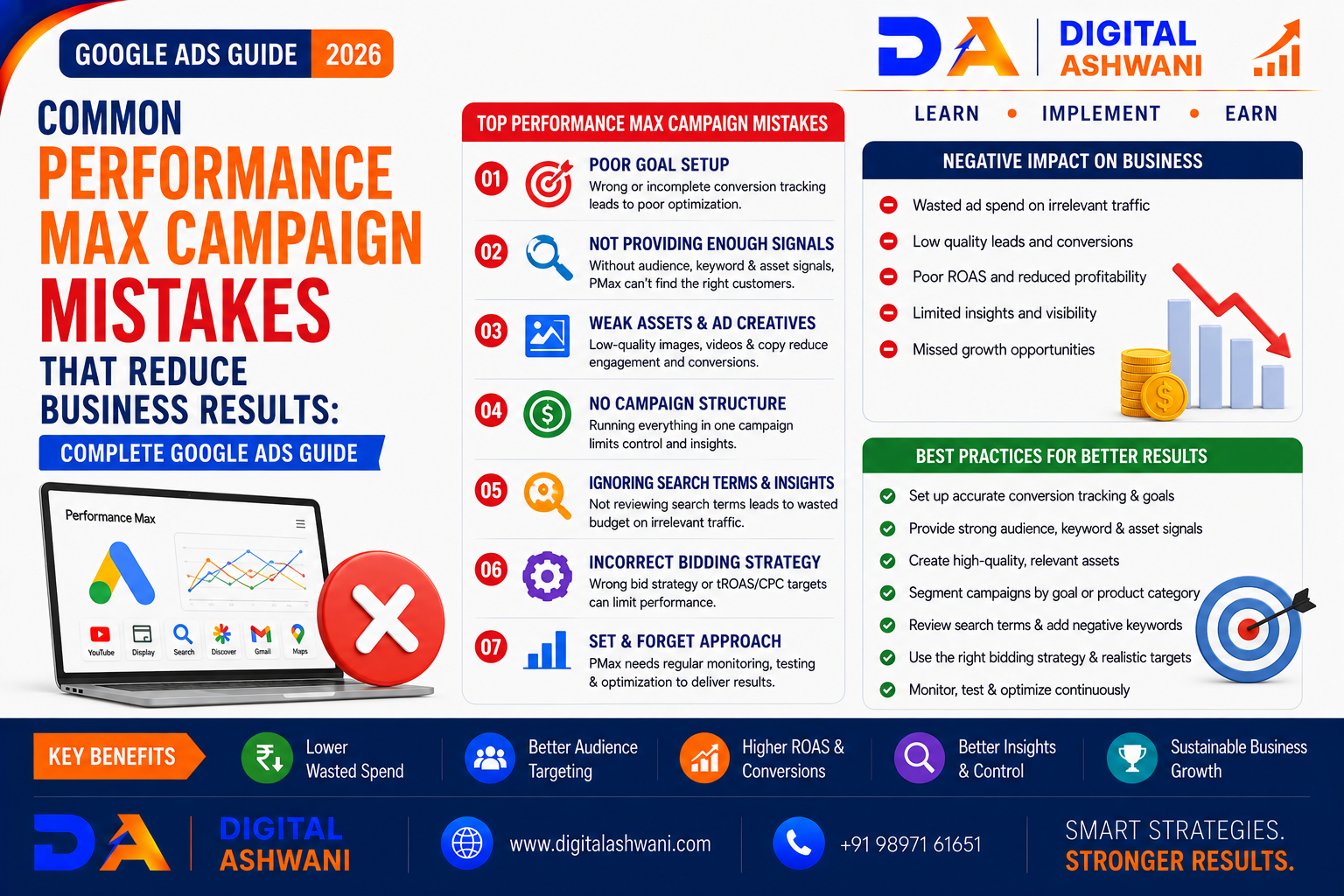
Common Performance Max Campaign Mistakes That Reduce Business Results
Performance Max has become an important campaign type within Google Ads because it can help advertisers reach customers across multiple Google channels through a unified campaign.
Depending on the campaign and available inventory, Performance Max can serve across Google’s advertising ecosystem, including Search, YouTube, Display, Discover, Gmail, and Maps.
However, simply launching a Performance Max campaign doesn’t guarantee strong results.
Many businesses experience disappointing performance because of poor conversion tracking, unclear campaign goals, weak creative assets, incorrect audience signals, unsuitable landing pages, insufficient data, or frequent unnecessary changes.
Performance Max relies heavily on Google’s automated systems, which makes accurate inputs and strong campaign foundations especially important.
In this practical guide by Digital Ashwani, you’ll learn the common Performance Max Campaign Mistakes that can reduce business results and how to avoid them.
What Is Performance Max?
Performance Max is a Google Ads campaign type designed to help advertisers access multiple Google advertising channels from a single campaign.
Google describes Performance Max as a goal-based campaign type that can complement keyword-based Search campaigns and use Google’s automation to optimize toward specified conversion goals.
Depending on the campaign setup, ads can appear across:
- Google Search
- YouTube
- Display
- Discover
- Gmail
- Google Maps
The campaign can use advertiser-provided assets, audience information, product data where applicable, and conversion goals to optimize delivery.
Why Performance Max Campaigns Fail
Performance Max depends on several important inputs.
If the inputs are inaccurate or incomplete, automation may optimize toward the wrong outcome.
Common problems include:
- Incorrect Conversion Tracking
- Poor Campaign Goals
- Weak Creative Assets
- Low-Quality Product Data
- Poor Landing Pages
- Wrong Audience Signals
- Limited Conversion Data
- Unrealistic Targets
- Frequent Campaign Changes
- Poor Lead Quality
The solution isn’t always to change the bidding strategy.
First, identify whether the campaign is receiving the right signals.
Common Performance Max Campaign Mistakes
1. Using the Wrong Conversion Goals
One of the most important Performance Max mistakes is optimizing toward actions that don’t represent real business value.
For example, a lead-generation business may accidentally optimize toward:
- Page Views
- Time on Site
- Button Clicks
- Low-Value Form Interactions
instead of meaningful leads.
Your primary conversion goals should reflect actions that matter to your business.
2. Poor Conversion Tracking
Automation is only as useful as the conversion data it receives.
If Google Ads receives inaccurate conversion information, the campaign may optimize toward users who complete actions that aren’t actually valuable.
Track meaningful actions such as:
- Qualified Leads
- Purchases
- Bookings
- Phone Calls
- Quote Requests
- High-Value Form Submissions
Where possible, connect campaign optimization with actual business outcomes.
3. Treating Every Lead as a Valuable Lead
A common mistake is counting every form submission as a successful conversion.
Suppose a campaign generates:
100 Leads
but only:
20 Qualified Leads
The campaign should not be evaluated solely on the 100-lead figure.
Monitor:
Leads → Qualified Leads → Sales
This provides a much clearer picture of campaign quality.
4. Uploading Weak Creative Assets
Performance Max relies on creative assets across different placements.
Weak images, videos, headlines, and descriptions can limit the campaign’s ability to communicate the offer effectively.
Provide a strong variety of relevant assets.
Examples include:
- High-Quality Images
- Product Photos
- Short Videos
- Benefit-Focused Headlines
- Clear Descriptions
- Strong Calls-to-Action
5. Using the Same Creative Everywhere
One generic creative approach may not work equally well across different placements.
Create multiple relevant asset variations while maintaining consistent brand messaging.
Test different:
- Headlines
- Images
- Videos
- Offers
- CTAs
- Value Propositions
6. Ignoring Video Assets
Performance Max can use video inventory.
If you don’t provide suitable video assets, Google may use automatically generated video formats depending on campaign setup and available assets.
Providing strong brand-controlled video assets can give advertisers more control over how their business is represented.
7. Sending Traffic to a Poor Landing Page
Even excellent ad targeting cannot compensate for a weak landing experience.
Common landing page problems include:
- Slow Loading
- Unclear Headlines
- Weak CTAs
- Poor Mobile Experience
- Irrelevant Content
- Long Forms
- Missing Trust Signals
The landing page should clearly match the advertisement and user intent.
8. Using Poor Audience Signals
Audience signals can help provide Google with information about the types of users likely to be valuable.
Useful inputs may include:
- Customer Lists
- Website Visitors
- Custom Segments
- Relevant Interests
- Search Themes Where Available
Audience signals should guide the system rather than being treated as rigid targeting in every situation.
9. Choosing Unrealistic ROAS Targets
Setting an aggressive Target ROAS too early can restrict the campaign if there isn’t enough conversion volume or historical data to support the target.
For example, demanding extremely high returns immediately may make it difficult for the campaign to find enough eligible opportunities.
Set targets based on:
- Historical Performance
- Profit Margins
- Conversion Data
- Customer Value
- Business Goals
10. Changing Campaign Settings Too Frequently
Performance Max uses automated optimization.
Constantly changing:
- Budget
- Bidding
- Target ROAS
- Assets
- Conversion Goals
- Targeting
can make performance analysis more difficult.
Make changes based on meaningful evidence rather than reacting to short-term fluctuations.
11. Setting the Budget Too Low
A budget that is too small relative to the campaign’s target and conversion costs may limit opportunities.
For example, if a business typically requires ₹1,500 to generate a qualified lead but the daily budget is only ₹500, the campaign may have limited room to generate meaningful volume.
Budget should be evaluated against:
- Expected CPA
- Customer Value
- Conversion Volume
- Market Demand
12. Ignoring Search Themes and Search Insights
Performance Max provides insights that can help advertisers understand how users are discovering and interacting with their campaigns.
Use available reporting to identify:
- Important Search Themes
- Customer Interests
- High-Value Queries
- Emerging Demand
- Weak Traffic Patterns
Use these insights to improve your broader advertising strategy.
13. Sending All Traffic to One Generic Page
A single generic homepage may not be the best destination for every audience or product.
Create relevant landing experiences for different:
- Products
- Services
- Locations
- Offers
- Customer Segments
Better relevance can improve the user journey.
14. Ignoring Product Feed Quality
For businesses running Performance Max campaigns with products, feed quality can significantly affect how products are represented.
Review:
- Product Titles
- Descriptions
- Images
- Prices
- Availability
- Product Categories
- Identifiers
Keep product information accurate and updated.
15. Measuring Only ROAS
ROAS is important, but it isn’t the only business metric.
A campaign can show attractive ROAS while generating:
- Low-Margin Sales
- Low-Quality Leads
- Poor Customer Retention
- Low Average Order Value
Consider broader metrics such as:
- Profit
- Customer Acquisition Cost
- Qualified Leads
- Revenue
- Customer Lifetime Value
- Conversion Rate
How to Improve Performance Max Results
Start With Accurate Tracking
Before optimizing campaigns, confirm that conversions are correctly configured.
Use Strong Creative Assets
Provide multiple high-quality images, videos, headlines, descriptions, and relevant CTAs.
Align Campaign Goals With Business Goals
If your objective is qualified leads, optimize toward qualified lead outcomes rather than superficial interactions.
Improve Landing Pages
Make sure landing pages are:
- Fast
- Mobile-Friendly
- Relevant
- Easy to Navigate
- Conversion-Focused
Give Automation Good Inputs
Performance Max works best when Google has useful information about:
- Conversion Goals
- Audience Data
- Creative Assets
- Product Data
- Business Value
Performance Max Optimization Checklist
Before launching or scaling a campaign, check:
- Correct Campaign Goal
- Accurate Conversion Tracking
- Qualified Conversion Actions
- Appropriate Budget
- Realistic Bidding Target
- Strong Headlines
- Quality Images
- Video Assets
- Relevant Landing Pages
- Audience Signals
- Product Feed Where Applicable
- Search Insights Review
- Lead Quality Tracking
- Profitability Tracking
- Regular Performance Analysis
Performance Max Example: Local Service Business
Suppose a dental clinic wants to generate appointment enquiries.
Campaign Setup
Goal: Leads
Location: Delhi
Primary Conversion: Qualified Appointment Request
Secondary Conversion: Qualified Phone Call
Assets:
- Dentist Photos
- Clinic Images
- Treatment Videos
- Service Headlines
- Appointment CTAs
Landing Page:
- Treatment Information
- Dentist Profile
- Clinic Location
- Appointment Form
- Phone Number
- Trust Signals
Instead of measuring success only by total form submissions, the clinic should evaluate how many enquiries actually become appointments.
Performance Max Example: eCommerce Business
Suppose an online store sells premium running shoes.
The campaign should have:
- Accurate Product Feed
- High-Quality Product Images
- Competitive Product Information
- Accurate Prices
- Conversion Tracking
- Appropriate Product Goals
Performance should be evaluated using:
- Revenue
- Conversion Value
- ROAS
- Profit Margin
- Average Order Value
- Customer Acquisition Cost
When Should You Optimize a Performance Max Campaign?
Don’t make major changes based on a single day of performance.
Instead, review trends over an appropriate period based on:
- Conversion Volume
- Budget
- Campaign Objective
- Seasonality
- Sales Cycle
- Business Size
High-volume eCommerce campaigns may generate useful data faster than low-volume B2B lead-generation campaigns.
Common Performance Max Optimization Mistakes
Optimizing Only for Cheap Traffic
Cheap traffic isn’t necessarily valuable traffic.
Ignoring Business Profitability
Revenue and ROAS don’t always equal profit.
Changing Everything at Once
If you change multiple variables simultaneously, it becomes difficult to determine what caused the performance change.
Ignoring Lead Quality
A high conversion count doesn’t guarantee high-quality customers.
Copying Competitor Campaigns
Every business has different customers, economics, offers, and conversion goals.
Internal Linking Suggestions (Digital Ashwani)
Strengthen the Google Ads content cluster by linking this article with:
- Complete Google Ads Setup Guide for Beginners With Practical Examples
- Complete Google Search Ads Campaign Setup Guide for Better Lead Generation
- Best Google Search Campaign Bidding Strategies Explained
- How Artificial Intelligence Is Changing Google Ads Campaign Optimization
- Google Ads Terminology Every Digital Marketer Should Understand Before Advertising
- PPC Audit Checklist Every Business Should Complete Before Scaling Campaigns
- Negative Keywords Strategy to Reduce Wasted Google Ads Spending
- What Is Cost Per Click (CPC)? Complete Guide to Reduce CPC and Improve ROI
These internal links connect Performance Max with Google Ads setup, Search campaigns, bidding, AI optimization, PPC auditing, negative keywords, and CPC optimization.
External Resources
For current Performance Max guidance, refer to Google’s official resources:
- Google Ads Help
- Performance Max Campaign Guide
- Google Ads Optimization Resources
- Google Ads Conversion Tracking Documentation
Google frequently updates Performance Max features, reporting, automation, and campaign controls, so always verify current platform guidance before making major account changes.
Frequently Asked Questions
What are the most common Performance Max campaign mistakes?
Common mistakes include incorrect conversion tracking, weak creative assets, poor landing pages, unrealistic bidding targets, insufficient data, weak audience inputs, poor product feeds, and optimizing for low-value conversions.
Why is my Performance Max campaign not generating leads?
Possible causes include incorrect conversion tracking, weak offers, poor landing pages, insufficient budget, limited conversion data, unsuitable targeting signals, or low demand. Review the complete conversion journey rather than changing one setting immediately.
Should I use Performance Max for lead generation?
Performance Max can be used for lead generation when the campaign has a clear conversion goal, accurate tracking, appropriate targeting, suitable creative assets, and a strong landing experience.
Is Performance Max better than Search Ads?
Neither is universally better. Search campaigns can provide strong control over keyword-based intent, while Performance Max can access multiple Google channels and use automated optimization. The right choice depends on the business objective.
How long should I wait before changing a Performance Max campaign?
There is no universal waiting period. Evaluate performance according to conversion volume, campaign objective, budget, sales cycle, and the amount of data available. Avoid making constant changes based on very short-term fluctuations.
Why are Performance Max leads low quality?
Low-quality leads can result from weak conversion definitions, broad targeting, unclear offers, poor landing pages, or optimizing toward low-value actions. Tracking qualified leads and sales can help improve optimization decisions.
Should I provide my own video assets?
Providing high-quality brand-controlled video assets can help ensure your message is represented consistently across eligible video placements.
Final Thoughts
Avoiding common Performance Max Campaign Mistakes is essential for getting meaningful business results from Google’s automated advertising system.
Performance Max should not be treated as a campaign that you simply launch and forget.
The strongest foundation is:
Accurate Conversion Tracking + Strong Assets + Relevant Landing Pages + Clear Goals + Useful Audience Signals + Realistic Targets + Continuous Analysis
Don’t judge campaign success only by impressions, clicks, or even conversions.
Look at the metrics that matter to your business:
Qualified Leads → Sales → Revenue → Profit
When automation receives accurate data and strong inputs, Performance Max can become a valuable part of a broader Google Ads strategy.
At Digital Ashwani, we regularly publish practical guides on Google Ads, PPC, AI Marketing, SEO, Meta Ads, Local SEO, and Digital Marketing to help businesses improve advertising performance and achieve sustainable growth.
