

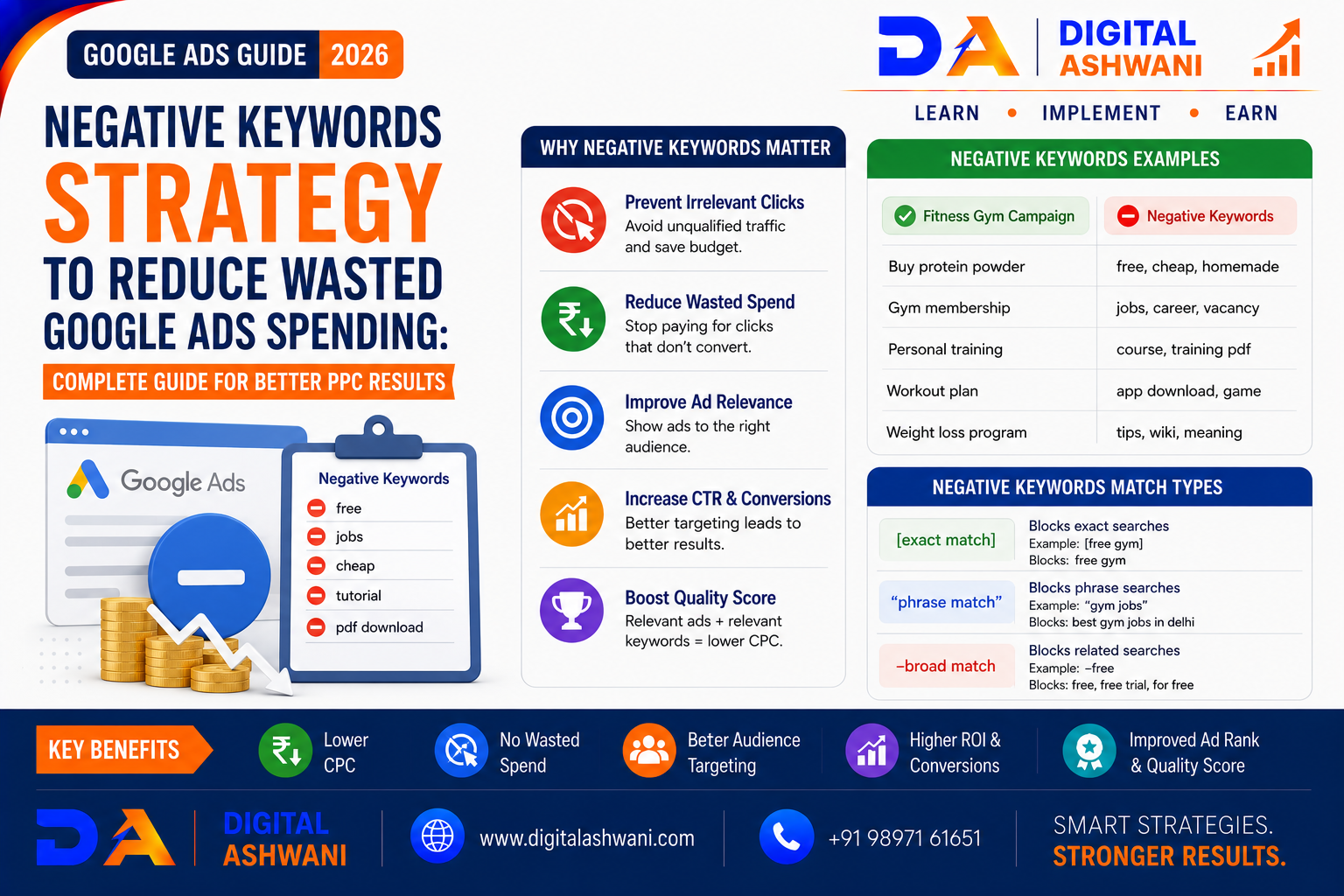
Negative Keywords Strategy to Reduce Wasted Google Ads Spending
Google Ads can generate highly targeted traffic, but irrelevant searches can quickly consume your advertising budget.
Imagine you’re running ads for a professional SEO agency and your advertisement appears when someone searches for “free SEO course” or “SEO jobs.” That click may have little business value, even though it costs money.
This is where a strong Negative Keywords Strategy becomes essential.
Negative keywords help prevent your ads from showing for searches that are irrelevant to your products, services, or business objectives. When used correctly, they can reduce wasted clicks, improve traffic quality, and help your advertising budget focus on more valuable searches.
However, negative keywords should not be added randomly. Adding overly broad exclusions can also prevent relevant customers from seeing your ads.
In this practical guide by Digital Ashwani, you’ll learn how negative keywords work, how to find them, how to create a negative keyword list, and how businesses can use them to reduce wasted Google Ads spending.
What Are Negative Keywords in Google Ads?
Negative keywords are terms or phrases you add to your Google Ads campaign to help prevent your ads from showing for searches that contain those terms.
For example, suppose you sell premium digital marketing services.
You may not want your ads to appear for searches such as:
- Free Digital Marketing Course
- Digital Marketing Jobs
- Digital Marketing Internship
- Digital Marketing PDF
You could add relevant negative keywords such as:
- Free
- Jobs
- Internship
- Course
The exact exclusions should depend on your business and actual search data.
Why Negative Keywords Matter
Without negative keywords, your campaign may receive clicks from people who are unlikely to become customers.
This can result in:
- Wasted Ad Spend
- Irrelevant Clicks
- Lower Traffic Quality
- Poor Conversion Rates
- Unqualified Leads
- Lower Campaign Efficiency
A negative keyword strategy helps businesses focus advertising on searches that are more closely aligned with their goals.
How Negative Keywords Work
Suppose your business provides paid SEO services in Delhi.
Your campaign targets:
SEO Agency Delhi
But users may search for:
- SEO Agency Delhi Jobs
- Free SEO Agency Tools
- SEO Agency Course
- SEO Agency Internship
If these searches aren’t relevant to your business, appropriate negative keywords can help reduce exposure to them.
The basic principle is:
Relevant Search → Show Ad
Irrelevant Search → Prevent Ad Where the Negative Keyword Applies
Negative keywords work differently from regular positive keyword targeting, so always review Google’s current documentation when building complex exclusion rules.
Negative Keyword Match Types
Google Ads supports negative keyword match behavior that differs from positive keyword match types.
Understanding this distinction is important before creating large negative keyword lists.
Negative Broad Match
A negative broad match can prevent an ad from showing when the search contains all the negative keyword terms, even when they appear in a different order.
Example negative keyword:
running shoes
A search containing both terms may be excluded even if additional words are present.
Negative Phrase Match
Negative phrase matching can prevent an ad from showing when the search contains the negative keyword phrase in the same order.
Example:
“running shoes”
A search such as:
buy running shoes online
could be excluded if the negative phrase applies.
Negative Exact Match
Negative exact matching provides more restrictive control.
Example:
[running shoes]
This can exclude the exact search term while allowing other searches that contain additional words, depending on Google’s current matching behavior.
Always verify current Google Ads documentation before applying negative match types at scale.
Practical Example: SEO Agency
Suppose an SEO agency wants to generate leads from businesses looking for professional SEO services.
Target Keywords
- SEO Agency Delhi
- SEO Company Delhi
- SEO Services Delhi
- Local SEO Agency Delhi
- SEO Consultant Delhi
Potentially Irrelevant Searches
- SEO Jobs Delhi
- SEO Internship Delhi
- Free SEO Course
- SEO Tutorial
- SEO PDF
- SEO Tools Free
Potential Negative Keywords
- Jobs
- Internship
- Free
- Course
- Tutorial
The actual negative list should be based on campaign data and business objectives.
Practical Example: Dental Clinic
Suppose a dental clinic wants to generate appointment enquiries.
Potential search terms might include:
- Dentist Near Me
- Dental Clinic Delhi
- Best Dentist Delhi
- Dental Consultation Delhi
But the campaign may also receive searches such as:
- Dentist Jobs
- Dental Internship
- Dental Course
- Free Dental Treatment
Depending on the clinic’s services and objectives, these may be suitable candidates for negative keywords.
Practical Example: eCommerce Store
Suppose an online store sells premium running shoes.
Relevant searches might include:
- Buy Running Shoes
- Running Shoes Online
- Premium Running Shoes
- Men’s Running Shoes
Potentially irrelevant searches could include:
- Running Shoes Repair
- Free Running Shoes
- Running Shoes Jobs
- Used Running Shoes
The business should review each search term before adding exclusions because some terms that appear irrelevant at first may actually have commercial value.
How to Find Negative Keywords
Use the Search Terms Report
The Search Terms Report is one of the most valuable sources for negative keyword research.
Review searches that triggered your advertisements and identify:
- Irrelevant Searches
- Low-Intent Searches
- Job Searches
- Educational Searches
- Free-Service Searches
- Unrelated Products
- Unqualified Queries
This turns actual campaign data into an actionable negative keyword strategy.
Look for Repeated Patterns
Don’t only look for individual words.
Look for recurring themes such as:
- Jobs
- Careers
- Salary
- Internship
- Course
- Training
- Free
- Download
- Template
- Definition
If the same irrelevant pattern appears repeatedly, consider whether it belongs in your negative keyword strategy.
Use Your Business Knowledge
Your own customer knowledge can identify searches that may be irrelevant before they generate significant spend.
For example, a premium agency may decide that searches containing:
Free
are generally unsuitable.
However, this should be confirmed against actual search behavior before applying broad exclusions.
Create a Negative Keyword List
Account-Level Themes
Depending on your business, common negative themes may include:
- Jobs
- Careers
- Salary
- Internship
- Training
- Course
- Free
- DIY
- Torrent
- Download
Don’t automatically add every term.
The correct list depends on your products, services, audience, and campaign objective.
Campaign-Level Negative Keywords
Use campaign-level negatives when an exclusion should apply across campaigns.
For example, if several lead-generation campaigns should not target employment-related searches, a shared exclusion strategy may be useful.
Ad Group-Level Negative Keywords
Ad-group-level exclusions can help prevent overlap between closely related keyword themes.
For example, imagine an account has separate ad groups for:
SEO Services
and
SEO Training
If you want each ad group to focus on its intended theme, carefully selected negative keywords can help control traffic between them.
This technique should be used cautiously because overly restrictive negatives can block valuable searches.
Negative Keywords for Local Businesses
Local businesses can use negative keywords to improve traffic quality when certain search themes don’t match their services.
For example, a local agency targeting Delhi customers may need to evaluate searches involving:
- Jobs
- Courses
- Free Services
- Other Locations
- Unrelated Services
Location-based exclusions should be handled carefully.
For example, don’t automatically exclude every city outside your main location if your business serves customers remotely or across multiple regions.
Negative Keywords for Lead Generation Campaigns
Lead-generation campaigns should focus on searches that can realistically produce customers.
Review whether searches indicate:
Research Intent
or
Hiring/Purchase Intent
For example:
“What is SEO?”
is informational.
While:
“SEO agency Delhi pricing”
may show stronger commercial intent.
Neither should automatically be classified as good or bad. The correct decision depends on the campaign’s objective and conversion strategy.
Negative Keywords and Search Intent
Negative keywords should be connected to search intent rather than simply individual words.
Informational Searches
Examples:
- What Is SEO?
- SEO Definition
- How SEO Works
These may be unsuitable for a direct lead-generation campaign but could be valuable for an educational campaign.
Commercial Searches
Examples:
- SEO Agency Delhi
- Best SEO Company Delhi
- SEO Services Pricing
These may have stronger business intent.
Employment Searches
Examples:
- SEO Jobs
- SEO Careers
- SEO Internship
These are often irrelevant to service campaigns.
How Negative Keywords Reduce Wasted Spend
Consider this simplified example.
Suppose a campaign receives:
1,000 clicks
Average CPC:
₹30
Total spend:
₹30,000
Now imagine that 200 clicks came from searches with little or no relevance to the business.
Those clicks represent:
200 × ₹30 = ₹6,000
If better targeting and negative keywords prevent a significant portion of that irrelevant traffic, the campaign can redirect more of its budget toward relevant searches.
This is an illustrative example—not a guaranteed saving.
Don’t Chase the Lowest CPC
A common mistake is assuming that reducing CPC automatically means improving performance.
A cheaper click isn’t necessarily better.
Consider two campaigns:
Campaign A
CPC: ₹15
Conversions: 5
Campaign B
CPC: ₹30
Conversions: 20
Campaign B has the higher CPC but may be substantially more valuable.
The goal of negative keywords should therefore be:
Reduce Irrelevant Spend + Improve Traffic Quality + Protect Conversions
not simply:
Get the Cheapest Clicks
Common Negative Keyword Mistakes
Adding Negative Keywords Without Checking Search Data
Don’t build a huge list based only on assumptions.
Review actual search queries whenever possible.
Using Overly Broad Exclusions
A single broad negative keyword can potentially block valuable searches.
Always understand what searches an exclusion can affect before applying it.
Ignoring Negative Keyword Match Types
Different negative match types provide different levels of control.
Choose the appropriate type for the situation.
Never Updating the Negative List
Search behavior changes over time.
Review search terms regularly and update exclusions as new irrelevant patterns appear.
Adding Valuable Commercial Terms as Negatives
Be careful with words such as:
- Cheap
- Best
- Review
- Price
- Near Me
These can sometimes indicate strong buying intent.
Don’t exclude them automatically.
Ignoring Lead Quality
A campaign can have many conversions but still produce poor-quality leads.
Where possible, connect advertising data with qualified leads and actual sales.
Negative Keyword Optimization Process
Use a simple recurring process:
Review → Identify → Validate → Add → Monitor → Refine
Review
Check search terms regularly.
Identify
Find irrelevant patterns.
Validate
Confirm that excluding them won’t remove valuable traffic.
Add
Apply the appropriate negative keyword.
Monitor
Watch campaign performance after the change.
Refine
Continue improving the list based on new data.
Negative Keywords Checklist
Before adding a negative keyword, ask:
- Is the search genuinely irrelevant?
- Does it indicate poor buying intent?
- Has it appeared repeatedly?
- Could the term also describe a valuable customer?
- Which campaigns should the negative apply to?
- Which negative match type is appropriate?
- Could this exclusion reduce qualified traffic?
- Have I reviewed actual search data?
- Should the term be added to a shared list?
- Will I monitor the result after implementation?
Internal Linking Suggestions (Digital Ashwani)
Strengthen the Google Ads and PPC content cluster by linking this article with:
- Complete Google Ads Setup Guide for Beginners With Practical Examples
- Complete Google Search Ads Campaign Setup Guide for Better Lead Generation
- Best Google Search Campaign Bidding Strategies Explained
- Google Ads Terminology Every Digital Marketer Should Understand Before Advertising
- What Is Cost Per Click (CPC)? Complete Guide to Reduce CPC and Improve ROI
- PPC Audit Checklist Every Business Should Complete Before Scaling Campaigns
- How Artificial Intelligence Is Changing Google Ads Campaign Optimization
- Meta Ads Optimization Tips for Lower Cost Per Lead
These internal links connect negative keyword optimization with Google Ads setup, Search campaigns, bidding, CPC, PPC auditing, AI optimization, and paid social advertising.
External Resources
For current Google Ads negative keyword guidance, refer to official Google resources:
- Google Ads Help
- Google Ads Keyword Matching Options
- Google Ads Search Terms Report
- Google Ads Keyword Planning Resources
Google regularly updates matching behavior, campaign features, and advertising controls, so review the latest official documentation before making major account-wide changes.
Frequently Asked Questions
What are negative keywords in Google Ads?
Negative keywords are terms used to help prevent your ads from showing for searches that are not relevant to your business or campaign objective.
How do negative keywords reduce wasted Google Ads spending?
They can reduce exposure to irrelevant searches, which can help prevent budget from being spent on clicks that are unlikely to produce valuable business outcomes.
How often should I review negative keywords?
Review search terms regularly, especially when a campaign is new or receiving significant traffic. The exact frequency depends on campaign volume and performance.
Should I add every irrelevant search as a negative keyword?
Not automatically. First determine whether the search is genuinely irrelevant and whether the exclusion could accidentally block valuable traffic.
What negative keywords should most businesses consider?
Potential themes can include jobs, careers, internships, courses, free resources, downloads, or unrelated products. However, every business should build its list based on its actual audience and search data.
Can negative keywords improve Google Ads conversion rates?
They can improve traffic relevance by reducing exposure to searches that don’t match the campaign’s objective. However, results depend on the overall campaign structure, targeting, ads, landing pages, and conversion process.
Can negative keywords lower Google Ads costs?
They can help reduce wasted spend by limiting irrelevant traffic, but they don’t guarantee a lower CPC or lower overall advertising costs.
Should I use the same negative keywords in every campaign?
Not necessarily. Some exclusions may apply across an account, while others are specific to a campaign, ad group, product, service, or audience.
Final Thoughts
A strong Negative Keywords Strategy can make Google Ads campaigns more focused and efficient by reducing exposure to searches that don’t match your business objectives.
However, negative keywords aren’t about blocking as much traffic as possible.
The best strategy is:
Relevant Searches + Better Targeting + Smart Exclusions + Conversion Tracking + Continuous Optimization
Start with actual search data, identify recurring irrelevant patterns, choose negative match types carefully, and monitor the impact of every major change.
Most importantly, don’t measure success only by reduced spending. The real goal is to move more of your advertising budget toward qualified traffic, valuable leads, and profitable customers.
At Digital Ashwani, we regularly publish practical guides on Google Ads, PPC, SEO, AI Marketing, Meta Ads, Local SEO, and Digital Marketing to help businesses reduce wasted advertising spend and build sustainable online growth.
