

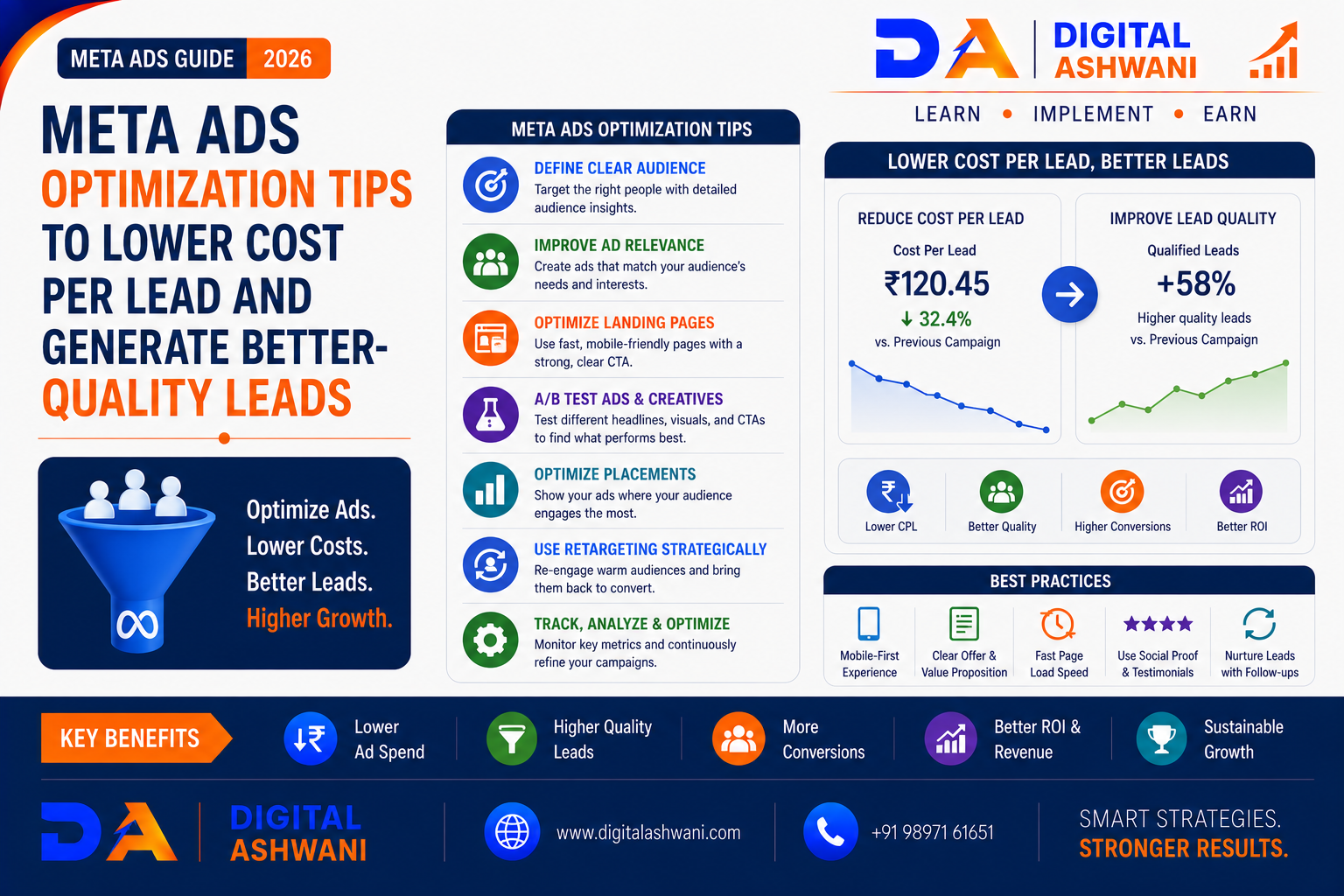
Meta Ads Optimization Tips to Lower Cost Per Lead and Generate Better-Quality Leads
Meta Ads can be a powerful channel for generating leads, increasing brand awareness, driving website traffic, and acquiring customers.
However, getting more leads doesn’t always mean getting better results.
A campaign may generate hundreds of leads while producing very few qualified prospects. At the same time, another campaign with a higher cost per lead may generate customers who are significantly more valuable.
This is why Meta Ads Optimization should focus on more than simply reducing the number shown under Cost Per Lead.
Successful optimization involves improving:
- Targeting
- Ad Creatives
- Offers
- Lead Forms
- Landing Pages
- Conversion Tracking
- Audience Quality
- Budget Allocation
- Follow-Up
- Lead Qualification
The goal isn’t to achieve the cheapest possible lead.
The goal is to generate qualified leads at a sustainable acquisition cost.
In this comprehensive guide by Digital Ashwani, you’ll learn practical Meta Ads optimization strategies to reduce wasted ad spend, improve lead quality, increase conversion efficiency, and build more profitable campaigns.
What Is Meta Ads Optimization?
Meta Ads Optimization is the ongoing process of improving advertising campaigns to achieve better results from the available budget.
Optimization can involve:
- Audiences
- Campaign Structure
- Ad Creatives
- Placements
- Offers
- Lead Forms
- Landing Pages
- Bidding
- Budget Allocation
- Conversion Tracking
The exact optimization approach depends on the campaign objective and business model.
For lead generation, the primary focus should be on qualified leads and business outcomes, not just lead volume.
Why Cost Per Lead Matters
Cost Per Lead, or CPL, measures how much advertising spend is required to generate a lead.
A simplified formula is:
CPL = Total Advertising Spend ÷ Number of Leads
For example:
If a campaign spends ₹20,000 and generates 200 leads:
CPL = ₹100
But a ₹100 lead isn’t automatically better than a ₹300 lead.
If the ₹300 leads are highly qualified and frequently become customers, they may create significantly more business value.
Why Meta Ads CPL Increases
Your Cost Per Lead can increase because of:
- Weak Ad Creatives
- Audience Saturation
- Poor Targeting
- Low Offer Relevance
- High Competition
- Weak Landing Pages
- Poor Lead Forms
- Tracking Problems
- Low Conversion Rates
- Limited Creative Variety
The first step toward reducing CPL is identifying the actual cause.
Understand the Complete Lead Funnel
A Meta Ads campaign should be evaluated as a complete funnel:
Ad Impression → Click/Engagement → Landing Page or Lead Form → Lead → Qualified Lead → Sales Conversation → Customer
If CPL increases, don’t immediately change the audience.
First identify where the problem occurs.
For example:
High CPM + Low CTR → Creative or Audience Problem
Good CTR + Low Landing Page Conversion → Landing Page Problem
Cheap Leads + Poor Sales Quality → Lead Qualification Problem
Good Leads + Low Sales → Follow-Up or Sales Process Problem
This approach prevents random campaign changes.
Meta Ads Targeting Optimization
Understand Your Ideal Customer
Before changing targeting, define your ideal customer.
Consider:
- Location
- Age Range
- Interests
- Business Need
- Purchase Intent
- Customer Value
- Previous Interactions
A clearly defined customer profile helps create more relevant campaigns.
Test Broad and Relevant Audiences
Don’t assume that highly detailed targeting will always produce the best results.
Depending on the campaign and available conversion data, broader audiences can sometimes give Meta’s systems more room to find relevant users.
Test audience approaches rather than relying on assumptions.
Use First-Party Data
Where appropriate and with proper consent, businesses can use first-party data such as:
- Customer Lists
- Website Visitors
- Existing Leads
- Purchasers
- Engaged Users
These audiences can support remarketing and customer acquisition strategies.
Creative Optimization
Test Multiple Ad Creatives
Creative performance can have a major impact on campaign efficiency.
Test variations of:
- Images
- Videos
- Headlines
- Primary Text
- Hooks
- Offers
- Calls-to-Action
Don’t make every test completely different.
Change one meaningful element at a time when practical so you can learn what influences performance.
Create Strong First Seconds
For video ads, the opening seconds are particularly important.
Start with:
- A Problem
- A Benefit
- A Question
- A Strong Visual
- A Customer Pain Point
The goal is to quickly communicate why someone should continue watching.
Match Creative to Audience Intent
A cold audience may need educational content.
A warm audience may respond better to:
- Testimonials
- Case Studies
- Demonstrations
- Offers
- Product Benefits
Different stages of the funnel require different messaging.
Improve Your Meta Ad Copy
Focus on Benefits
Instead of simply describing a product or service, explain the outcome.
For example:
Weak:
“Digital Marketing Services Available.”
Better:
“Generate More Qualified Leads With a Data-Driven Digital Marketing Strategy.”
Keep claims accurate and avoid exaggerated promises.
Offer Optimization
Improve What You’re Offering
Sometimes the problem isn’t the advertisement.
The offer itself may not be compelling enough.
Test offers such as:
- Free Consultation
- Free Audit
- Product Demo
- Course Brochure
- Strategy Call
- Free Assessment
- Limited-Time Offer Where Appropriate
The offer should provide genuine value and match the user’s needs.
Meta Lead Form Optimization
Keep Forms Simple
Ask only for information your sales team actually needs.
Common fields include:
- Name
- Phone
- Service Interest
Too many fields can reduce completion rates.
Use Higher-Intent Qualification
For businesses receiving large volumes of low-quality leads, additional qualifying questions may help.
For example:
- What service are you interested in?
- What is your approximate requirement?
- When are you planning to purchase?
However, adding too many questions can reduce lead volume.
The goal is to find the right balance between lead quantity and lead quality.
Landing Page Optimization
Match the Ad With the Landing Page
The landing page should reflect the promise made in the advertisement.
Maintain consistency across:
Ad → Headline → Offer → CTA → Form
A mismatch can reduce conversion rates and waste advertising spend.
Improve Mobile Experience
Most social media traffic is mobile.
Make sure your landing page:
- Loads Quickly
- Uses Responsive Design
- Has Easy Navigation
- Displays CTAs Clearly
- Uses Readable Text
- Makes Forms Easy to Complete
Improve Conversion Tracking
Track More Than Leads
Don’t stop measurement at lead generation.
Where possible, track:
- Leads
- Qualified Leads
- Sales Calls
- Appointments
- Purchases
- Customers
- Revenue
Connecting advertising data with CRM or sales outcomes can reveal which campaigns generate real business value.
Lead Quality Optimization
Measure Qualified Lead Rate
Suppose:
Campaign A: 500 leads at ₹100 CPL
Campaign B: 200 leads at ₹250 CPL
If Campaign B generates significantly more qualified prospects and customers, it may be the better campaign.
This is why Cost Per Qualified Lead can be more useful than raw CPL.
Budget Optimization
Allocate Budget to Stronger Campaigns
Review performance across:
- Campaigns
- Ad Sets
- Creatives
- Audiences
- Locations
- Products
- Services
Shift budget based on reliable performance data rather than short-term fluctuations.
Avoid Aggressive Budget Changes
Large and frequent changes can make campaign performance less predictable.
Scale gradually while monitoring:
- CPL
- Qualified Lead Rate
- Conversion Rate
- Customer Acquisition Cost
- Revenue
Placement Optimization
Evaluate Placement Performance
Meta can distribute ads across different placements.
Depending on the campaign, these can include environments such as:
- Facebook Feed
- Instagram Feed
- Stories
- Reels
- Other eligible placements
Don’t automatically remove placements simply because one has a higher CPC.
Evaluate the actual business outcome.
Frequency and Audience Fatigue
Watch for Creative Fatigue
If the same audience sees the same advertisement repeatedly, performance may decline.
Possible signs include:
- Falling CTR
- Rising CPL
- Increasing Frequency
- Lower Engagement
- Declining Conversion Rate
Refresh creatives when performance indicates fatigue.
Retargeting Optimization
Reconnect With Warm Audiences
Remarketing can target eligible users who have previously interacted with your business.
Examples include:
- Website Visitors
- Video Viewers
- Social Media Engagers
- Previous Leads
- Product Viewers
Use appropriate exclusions to avoid wasting spend on users who have already converted.
A/B Testing for Meta Ads
Test One Major Variable at a Time
You can test:
- Creative
- Headline
- Offer
- Audience
- Landing Page
- Lead Form
Run tests long enough to collect meaningful data and avoid declaring a winner based on very small differences.
Meta Ads Optimization Checklist
Before scaling a campaign, review:
- Campaign Objective
- Audience Quality
- Creative Performance
- Ad Copy
- Offer
- Lead Form
- Landing Page
- Conversion Tracking
- Qualified Leads
- CPL
- Cost Per Qualified Lead
- Customer Acquisition Cost
- Frequency
- Placement Performance
- Budget Allocation
- Sales Outcomes
Common Meta Ads Optimization Mistakes
Chasing the Lowest CPL
Cheap leads aren’t always valuable leads.
Changing Campaigns Every Day
Frequent changes can make performance difficult to evaluate.
Using Only One Creative
Creative fatigue can eventually reduce performance.
Ignoring Lead Quality
A large number of poor leads can waste sales-team resources.
Adding Too Many Form Fields
Long forms can reduce conversion rates.
Ignoring the Landing Page
A strong ad cannot compensate for a poor post-click experience.
Optimizing Only for CTR
A high CTR is useful, but it doesn’t guarantee leads or customers.
Scaling Too Quickly
Increasing budgets before confirming stable performance can increase inefficient spending.
Internal Linking Suggestions (Digital Ashwani)
Strengthen the Meta Ads and paid-marketing content cluster by linking this article with:
- Facebook Lead Ads Strategy That Converts Visitors Into Paying Customers
- Google Ads Terminology Every Digital Marketer Should Understand Before Advertising
- Complete Google Search Ads Campaign Setup Guide for Better Lead Generation
- PPC Audit Checklist Every Business Should Complete Before Scaling Campaigns
- What Is Cost Per Click (CPC)? Powerful Ways to Reduce CPC and Improve ROI
- How Artificial Intelligence Is Changing Google Ads Campaign Optimization
- Website Conversion Rate Optimization Guide
- How Google Analytics 4 Tracks Website Visitors and User Behavior
These links connect Meta Ads optimization with lead generation, Google Ads, PPC auditing, CPC, AI advertising, analytics, and conversion optimization.
External Resources
For current Meta advertising guidance, refer to:
- Meta Business Help Center
- Meta Ads Guide
- Meta Business Tools
- Google Analytics Help
Advertising features, targeting options, attribution, and policies can change, so always verify current platform documentation before making major campaign decisions.
Frequently Asked Questions
How can I reduce Meta Ads Cost Per Lead?
Start by identifying the source of high CPL. Review creatives, audience relevance, offer quality, lead forms, landing pages, conversion tracking, and lead quality before making major changes.
What is a good CPL for Meta Ads?
There is no universal good CPL. It depends on your industry, offer, location, customer value, conversion rate, and profitability.
Should I use broad targeting on Meta Ads?
Broad targeting can work well in some campaigns, especially when sufficient conversion data is available. Test it against relevant audience strategies and evaluate actual business results.
Why are my Meta Ads generating cheap but poor-quality leads?
Possible causes include overly broad targeting, weak qualification, an overly easy lead form, an unclear offer, or optimization toward low-value conversion events.
How often should I change Meta Ad creatives?
There is no fixed schedule. Monitor performance indicators such as CTR, frequency, CPL, and conversion quality, and refresh creatives when performance shows signs of fatigue.
Should I optimize Meta Ads for leads or qualified leads?
If your business can reliably track qualified leads, optimizing toward higher-value outcomes can produce better business results than optimizing solely for raw lead volume.
Final Thoughts
Effective Meta Ads Optimization isn’t about finding one secret setting that instantly lowers your Cost Per Lead.
It requires continuous testing and improvement across the complete advertising funnel:
Audience → Creative → Click → Landing Page/Form → Lead → Qualified Lead → Customer
Start by fixing tracking and identifying where users drop out of the funnel.
Then improve your creatives, audience strategy, offer, lead forms, landing pages, budget allocation, and follow-up process.
Most importantly, don’t judge success by CPL alone.
A slightly more expensive lead that consistently becomes a customer can be far more valuable than a cheap lead that never converts.
The real objective is:
Lower Waste + Better Leads + Sustainable Customer Acquisition
At Digital Ashwani, we regularly publish practical guides on Meta Ads, Google Ads, PPC, SEO, AI Marketing, Conversion Optimization, Analytics, and Digital Marketing to help businesses improve advertising performance and generate sustainable growth.
