

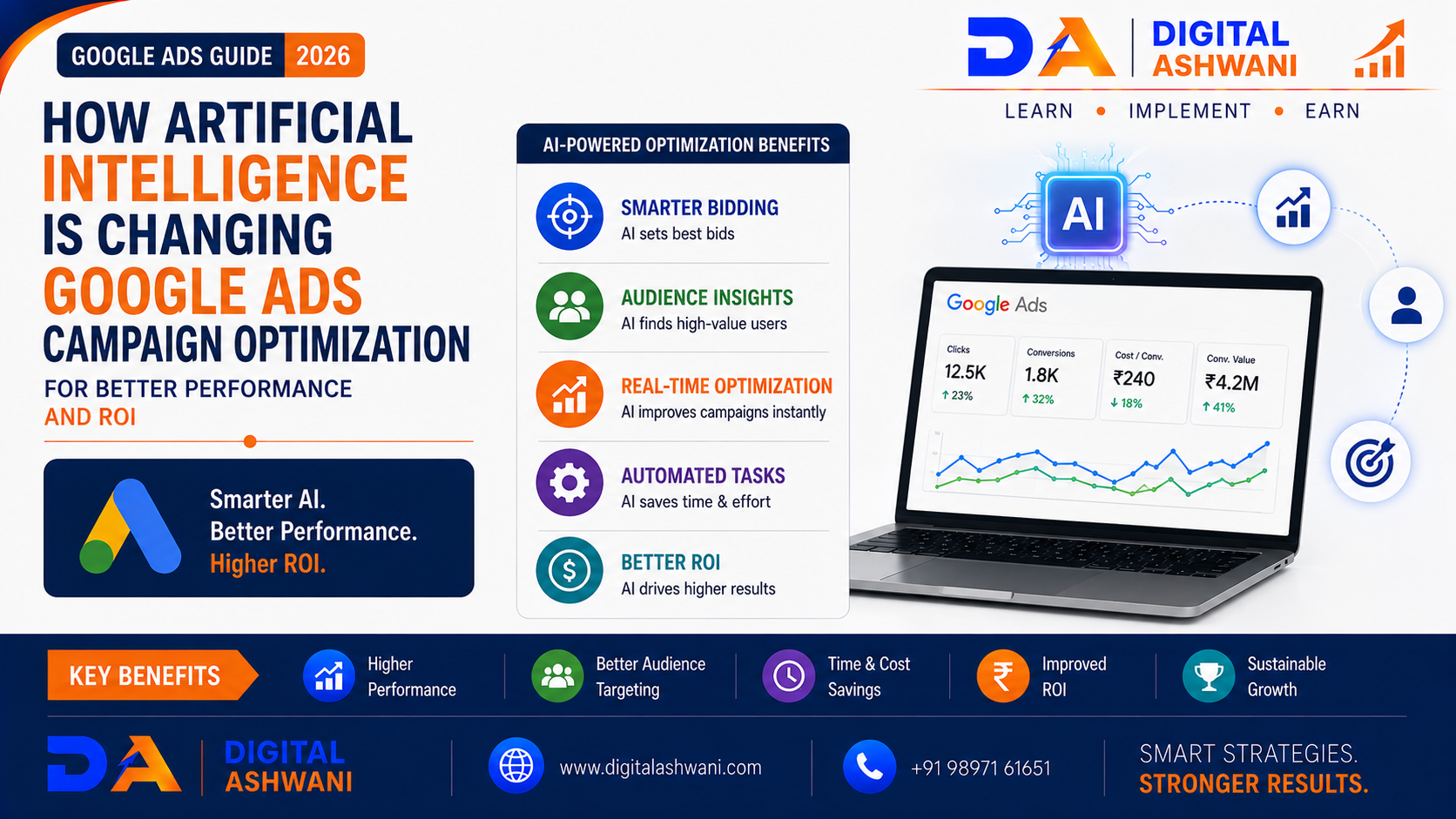
How Artificial Intelligence Is Changing Google Ads Campaign Optimization
Artificial Intelligence is transforming the way businesses manage Google Ads campaigns. Tasks that once required constant manual monitoring—such as bid adjustments, audience optimization, budget allocation, ad testing, and performance analysis—are increasingly supported by machine learning and automation.
For advertisers, this creates a major opportunity to improve campaign efficiency while spending less time on repetitive optimization tasks.
However, AI does not mean marketers can simply launch a campaign and let automation handle everything. Successful Google Ads campaigns still require strong strategy, accurate conversion tracking, relevant keywords, compelling landing pages, and continuous human oversight.
The role of the advertiser is changing from manually controlling every campaign setting to providing the right data, goals, signals, creative assets, and strategic direction.
In this comprehensive guide by Digital Ashwani, you’ll learn how Artificial Intelligence is changing Google Ads campaign optimization, where automation can improve performance, and how businesses can combine AI with human expertise to achieve better advertising results.
What Is AI-Powered Google Ads Optimization?
AI-powered Google Ads optimization uses machine learning and automated systems to analyze large amounts of campaign data and make or recommend adjustments based on defined advertising goals.
AI can help optimize areas such as:
- Bidding
- Audience Signals
- Ad Delivery
- Budget Allocation
- Conversion Optimization
- Search Query Relevance
- Creative Testing
- Performance Analysis
Instead of relying exclusively on manual decisions, advertisers can use Google’s automation to respond to changing auction conditions and user behavior.
Why AI Is Becoming Important in Google Ads
Google Ads auctions can change constantly.
Factors such as:
- Search Query
- Device
- Location
- Time
- Competition
- User Context
- Historical Performance
- Conversion Probability
can influence campaign performance.
Analyzing all of these signals manually at scale is difficult.
AI and machine learning can process large volumes of signals much faster, helping automated bidding and campaign systems make decisions during individual auctions.
AI-Powered Smart Bidding
Automating Bid Decisions
One of the biggest changes AI has introduced to Google Ads is automated bidding.
Strategies such as:
- Maximize Conversions
- Target CPA
- Maximize Conversion Value
- Target ROAS
use machine learning to adjust bids according to the campaign’s objective and available signals.
Instead of manually changing bids for individual keywords, advertisers can define a goal and allow Google’s systems to optimize toward it.
AI Improves Audience Targeting
Finding More Valuable Prospects
AI can help identify users who are more likely to complete valuable actions based on available signals and campaign settings.
For example, a business may want to generate:
- Qualified Leads
- Product Purchases
- Appointment Requests
- Quote Requests
- Phone Calls
The quality of the optimization depends heavily on the quality of the conversion data being supplied to Google.
AI Is Changing Ad Creation
Generating and Testing Creative Variations
Google’s advertising ecosystem increasingly uses AI to assist with creating and optimizing advertising assets.
AI can help advertisers develop variations of:
- Headlines
- Descriptions
- Visual Assets
- Messaging
- Calls-to-Action
Advertisers should still review generated assets carefully to ensure they are accurate, relevant, on-brand, and compliant with advertising policies.
AI Helps Optimize Budgets
Allocate Spending More Efficiently
AI-driven campaign systems can respond to changing performance and auction conditions.
Instead of assuming every keyword or audience segment deserves the same budget, automated systems can prioritize opportunities based on campaign objectives and available signals.
However, automation cannot determine whether an advertising campaign is actually profitable unless the business provides meaningful conversion and value data.
AI Improves Conversion Optimization
Optimize Toward Business Goals
AI works best when conversion tracking reflects real business outcomes.
For example, a service business could track:
- Qualified Enquiries
- Phone Calls
- Appointment Bookings
- Consultation Requests
- Quote Requests
An eCommerce business might track:
- Purchases
- Revenue
- Average Order Value
- Product Sales
The more accurately conversions represent business value, the more useful automated optimization can become.
AI Helps Identify Campaign Trends
Find Performance Changes Faster
Large Google Ads accounts can generate enormous amounts of data.
AI-assisted analysis can help advertisers identify:
- Rising Costs
- Conversion Changes
- Search Trends
- Performance Opportunities
- Underperforming Campaigns
- Budget Constraints
This allows marketers to spend more time on strategy rather than manually reviewing every campaign element.
AI and Keyword Optimization
Search Intent Still Matters
AI can help marketers identify patterns in search behavior and organize keywords according to intent.
Useful categories include:
- Informational
- Commercial
- Transactional
- Local
- Branded
However, advertisers should not rely solely on automated systems.
Search Terms reports should still be reviewed regularly to identify irrelevant queries and potential negative keywords.
AI-Powered Landing Page Optimization
Connect Ads With User Intent
AI can assist with analyzing landing-page content and identifying opportunities to improve:
- Headlines
- CTAs
- Page Structure
- User Experience
- Content Relevance
- Conversion Paths
The landing page should closely match the promise and intent of the advertisement.
More automation cannot compensate for a poor landing page.
AI Makes Campaign Testing Faster
Test More Variations
Traditional advertising optimization often required marketers to manually create and compare multiple campaign variations.
AI-powered systems can automate parts of creative and campaign experimentation.
Marketers can test:
- Headlines
- Descriptions
- Offers
- Landing Pages
- Audience Signals
- Campaign Structures
Testing should still have a clear business objective and sufficient data for meaningful evaluation.
AI and Performance Max
Automation Across Google’s Advertising Inventory
Performance Max uses Google’s machine learning and automation to help advertisers reach potential customers across eligible Google inventory.
It can use:
- Creative Assets
- Audience Signals
- Conversion Data
- Product Information
- Campaign Goals
For businesses using Performance Max, accurate conversion tracking and high-quality creative assets become especially important.
AI Is Changing the Role of PPC Professionals
From Manual Optimization to Strategic Management
The role of a Google Ads professional is increasingly shifting toward:
- Strategy
- Data Analysis
- Conversion Tracking
- Creative Direction
- Audience Strategy
- Landing Page Optimization
- Budget Planning
- Business Analysis
Instead of manually adjusting every bid, marketers can focus more on determining what should be optimized and why.
Human Expertise Still Matters
AI Cannot Understand Every Business Decision
AI can process data, but marketers provide business context.
Human professionals are still needed to understand:
- Brand Positioning
- Customer Needs
- Profit Margins
- Sales Quality
- Business Goals
- Market Conditions
- Brand Voice
- Legal and Ethical Considerations
For example, AI may identify that one type of lead is inexpensive, but only a business owner may know that those leads rarely become customers.
Importance of Accurate Conversion Tracking
Bad Data Can Lead to Bad Optimization
AI systems learn from available campaign signals.
If your conversion tracking counts low-value actions as successful conversions, automated bidding may optimize toward those actions.
Before increasing automation, verify:
- Conversion Actions
- Conversion Values
- Attribution Settings
- Phone Call Tracking
- Form Tracking
- Purchase Tracking
- Lead Quality
Reliable data should be the foundation of AI-powered optimization.
AI Google Ads Optimization Workflow
A practical workflow can look like:
Business Goal → Conversion Tracking → Campaign Structure → AI Automation → Performance Monitoring → Human Analysis → Optimization → Business Results
This approach keeps AI focused on measurable objectives rather than allowing automation to operate without strategic direction.
Common AI Google Ads Optimization Mistakes
Giving AI Poor Conversion Data
Incorrect tracking can cause automation to optimize toward the wrong outcomes.
Using Automation Without Strategy
Automation does not replace campaign planning.
Ignoring Search Terms
Advertisers should still review actual searches and identify irrelevant traffic.
Accepting Every AI-Generated Asset
Review advertising copy and creative before publishing.
Optimizing Only for Cheap Conversions
A low-cost conversion isn’t necessarily a valuable customer.
Changing Campaigns Too Frequently
Constant changes can make it difficult to determine what is actually working.
Ignoring Landing Page Performance
Campaign optimization cannot solve every conversion problem.
How Businesses Should Prepare for AI-Powered Google Ads
Improve Your First-Party Data
Maintain accurate information about:
- Leads
- Customers
- Purchases
- Revenue
- Customer Value
Improve Conversion Quality
Track meaningful business outcomes rather than superficial actions.
Create Better Creative Assets
Give AI high-quality inputs instead of relying entirely on automatically generated material.
Build Strong Landing Pages
Make sure the post-click experience matches user expectations.
Keep Human Oversight
Use automation for scale while retaining human control over strategy, quality, and business decisions.
Internal Linking Suggestions (Digital Ashwani)
Strengthen the Google Ads and AI marketing content cluster by linking this article with:
- Best Google Search Campaign Bidding Strategies Explained
- Complete Google Search Ads Campaign Setup Guide for Better Lead Generation
- What Is Cost Per Click (CPC)? Powerful Ways to Reduce CPC and Improve ROI
- Google Ads Strategy for Doctors to Increase Patient Appointments
- AI Marketing Strategies for Dental Clinics
- How AI Is Transforming Modern SEO Strategies for Business Growth
- What Is Artificial Intelligence (AI) in Digital Marketing?
- Website Conversion Rate Optimization Guide
- How Google Analytics 4 Tracks Website Visitors and User Behavior
These internal links connect AI-powered advertising with Google Ads strategy, bidding, healthcare marketing, analytics, SEO, and conversion optimization.
External Resources
For current Google Ads and AI guidance, refer to:
- Google Ads Help
- Google Ads Policies
- Google Search Central
- Google Analytics Help
Google Ads features and AI capabilities change frequently, so always verify current information through official documentation.
Frequently Asked Questions
How is AI changing Google Ads optimization?
AI is increasingly automating bidding, campaign optimization, audience signals, creative assistance, and performance analysis, allowing advertisers to manage complex campaigns more efficiently.
Is AI better than manual Google Ads optimization?
Neither approach is universally better. Automation can process large amounts of data quickly, while human expertise provides business strategy, context, judgment, and oversight.
Does AI reduce the need for Google Ads experts?
AI can reduce repetitive manual work, but skilled professionals remain important for strategy, conversion tracking, creative direction, landing pages, data interpretation, and business decision-making.
Can AI reduce Google Ads costs?
AI can potentially improve efficiency by optimizing toward campaign goals, but it does not guarantee lower costs. Results depend on competition, targeting, conversion data, creative quality, landing pages, and campaign setup.
What is the most important thing for AI-powered Google Ads?
Reliable conversion tracking is one of the most important foundations. Google’s automated systems need meaningful data to optimize toward useful business outcomes.
Final Thoughts
Artificial Intelligence is changing Google Ads campaign optimization by moving advertisers away from constant manual adjustments and toward data-driven automation.
AI can help with bidding, audience optimization, creative testing, budget allocation, performance analysis, and conversion optimization. But successful advertising still depends on the quality of the strategy, data, creative assets, landing pages, and business decisions behind the campaign.
The future of Google Ads is not AI instead of marketers.
It is:
AI Automation + Human Strategy + Better Data = Smarter Campaign Optimization
Businesses that learn how to provide accurate conversion data, strong creative assets, clear campaign objectives, and effective landing pages will be better positioned to take advantage of AI-powered advertising.
At Digital Ashwani, we regularly publish practical guides on Google Ads, AI Marketing, SEO, PPC, Analytics, Lead Generation, and Digital Marketing to help businesses adapt to the changing advertising landscape.
