

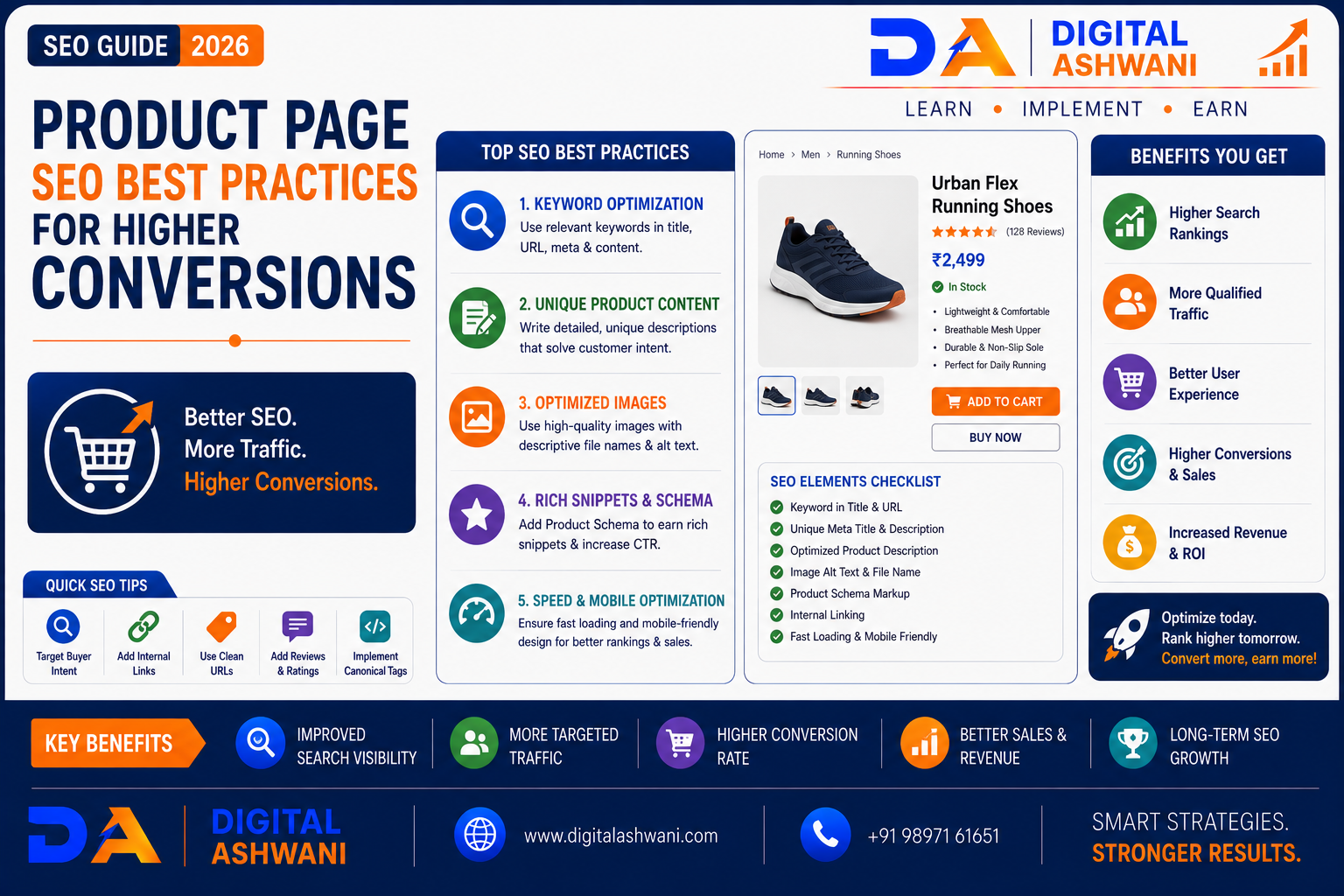
Product Page SEO Best Practices for Higher Conversions
Product pages are among the most important pages on an eCommerce website. They are where visitors evaluate a product, compare alternatives, understand its benefits, and ultimately decide whether to purchase.
A product page can receive organic traffic and still generate very few sales if the content is unclear, the page is slow, the product information is incomplete, or the buying process creates friction.
This is why Product Page SEO should focus on two objectives at the same time:
Search visibility + conversion optimization.
Search engines need to understand what your product is, while shoppers need enough useful information and trust signals to make a purchase decision.
A well-optimized product page should therefore combine keyword targeting, unique product content, structured data, high-quality images, customer reviews, clear calls-to-action, strong internal linking, mobile usability, and a smooth checkout experience.
In this comprehensive guide by Digital Ashwani, you’ll learn practical Product Page SEO Best Practices that can help eCommerce businesses improve organic visibility and turn more visitors into customers.
What Is Product Page SEO?
Product Page SEO is the process of optimizing individual product pages so search engines can understand them and potential customers can easily evaluate and purchase the product.
It involves optimizing elements such as:
- Product Titles
- Product Descriptions
- Keywords
- URLs
- Images
- Image ALT Text
- Headings
- Structured Data
- Reviews
- Internal Links
- Page Speed
- Mobile Experience
The goal is to attract relevant organic traffic and provide a better shopping experience.
Why Product Page SEO Matters
Optimized product pages can help eCommerce businesses:
- Increase Organic Visibility
- Attract High-Intent Visitors
- Improve Product Discoverability
- Increase User Engagement
- Build Buyer Trust
- Improve Conversion Rates
- Generate More Revenue
A product page should not be optimized only to rank. It should also answer the questions that prevent customers from purchasing.
Start With Product Keyword Research
Target Search Terms With Buying Intent
Keyword research helps identify how potential customers search for your products.
For example, instead of targeting only:
Running Shoes
you may also target relevant phrases such as:
- Buy Running Shoes Online
- Men’s Running Shoes
- Lightweight Running Shoes
- Running Shoes for Beginners
- Waterproof Running Shoes
Choose keywords based on actual search intent and relevance to the product.
Avoid Keyword Stuffing
Don’t repeatedly insert the same keyword into every section.
Use natural language and relevant terminology instead.
Optimize Product Titles
Make Product Names Clear and Descriptive
A good product title should quickly communicate what the product is.
Depending on the product, include useful attributes such as:
- Brand
- Product Type
- Model
- Material
- Size
- Color
- Important Feature
For example:
Men’s Waterproof Running Shoes – Lightweight Sports Shoes
is more informative than:
Best Shoes Online
The title should help both search engines and shoppers understand the product.
Create Unique Product Descriptions
Don’t Copy Manufacturer Descriptions
Duplicate product descriptions are common across eCommerce websites.
Create original descriptions that explain:
- Product Benefits
- Key Features
- Materials
- Specifications
- Use Cases
- Compatibility
- Care Instructions
- Warranty Information
Unique content can make your product page more useful and differentiate it from competing pages.
Write for Buyers First
Don’t write descriptions only for search engines.
Explain why the product is useful and who it is designed for.
Highlight Product Benefits
Features Tell; Benefits Sell
Instead of listing only technical features, explain the practical benefit.
For example:
Feature: Water-resistant material
Benefit: Helps protect the product during light rain and everyday outdoor use.
Clear benefits make it easier for shoppers to understand the product’s value.
Optimize Product Images
Use High-Quality Product Photography
Images are extremely important for eCommerce conversions.
Include multiple views where useful:
- Front View
- Back View
- Side View
- Close-Up
- Product-in-Use
- Size Reference
High-quality images help shoppers understand the product before purchasing.
Optimize Image SEO
Use descriptive file names and appropriate ALT text.
For example:
black-waterproof-running-shoes.jpg
instead of:
IMG12345.jpg
ALT text should describe the image accurately rather than simply repeating keywords.
Add Product Videos When Useful
Demonstrate the Product
Video can help shoppers understand products that are difficult to evaluate through static images.
Useful video formats include:
- Product Demonstrations
- Unboxing Videos
- How-to Videos
- Size Guides
- Product Comparisons
- Feature Demonstrations
Video can reduce uncertainty and help customers make more informed purchasing decisions.
Use Product Reviews and Ratings
Build Customer Trust
Reviews provide real-world information that product descriptions cannot always communicate.
Encourage genuine customers to leave honest feedback.
Useful review elements can include:
- Star Ratings
- Written Reviews
- Customer Photos
- Verified Purchase Indicators
- Product-Specific Questions
Never create fake reviews simply to improve SEO or conversions.
Implement Product Structured Data
Help Search Engines Understand Products
Product structured data can provide search engines with information such as:
- Product Name
- Brand
- Price
- Availability
- SKU
- Ratings
- Reviews
When eligible, structured data can help products appear with richer information in search results.
Always validate structured data and follow current search engine guidelines.
Optimize Product URLs
Keep URLs Simple
A good product URL should be:
- Short
- Descriptive
- Readable
- Stable
- Relevant
For example:
/waterproof-running-shoes/
is easier to understand than a URL containing unnecessary parameters or random characters.
Avoid changing established product URLs without a proper redirect strategy.
Improve Internal Linking
Connect Related Products and Content
Internal links help shoppers discover relevant products while helping search engines understand website relationships.
Link between:
- Related Products
- Product Categories
- Buying Guides
- Product Comparisons
- Blog Articles
- Frequently Asked Questions
For example, a blog about choosing running shoes can link directly to relevant product pages.
Optimize Category-to-Product Navigation
Create a Clear Website Structure
A strong eCommerce structure can look like:
Homepage → Category → Subcategory → Product
This helps shoppers navigate the website and makes important pages easier for search engines to discover.
Use descriptive category names and logical navigation wherever possible.
Improve Page Speed
Make Product Pages Fast
Large images, unnecessary scripts, tracking tools, and third-party applications can slow down eCommerce pages.
Improve performance by:
- Compressing Images
- Using Modern Image Formats
- Reducing Unnecessary Scripts
- Improving Hosting
- Caching Resources
- Monitoring Core Web Vitals
A faster shopping experience can reduce friction and improve usability.
Optimize Product Pages for Mobile
Make Shopping Easy on Smartphones
Mobile shoppers should be able to:
- View Product Images
- Read Product Information
- Select Variants
- Check Availability
- Add Products to Cart
- Complete Checkout
Buttons should be easy to tap and important information should not be hidden behind confusing layouts.
Create Strong Calls-to-Action
Make the Next Step Obvious
Examples include:
- Add to Cart
- Buy Now
- Shop Now
- Request a Quote
- Start Your Order
The CTA should be visible and clearly communicate what happens next.
Display Important Purchase Information Clearly
Reduce Buyer Uncertainty
Product pages should make important information easy to find.
Consider displaying:
- Price
- Availability
- Shipping Information
- Delivery Estimates
- Return Policy
- Warranty
- Payment Options
- Product Variants
Clear information reduces hesitation and supports informed purchasing decisions.
Use FAQs to Address Buyer Questions
Answer Questions Before Checkout
Product-specific FAQs can address concerns such as:
- Is the product compatible with X?
- What size should I choose?
- How long does delivery take?
- Is installation included?
- What is the return policy?
- Does the product include a warranty?
Useful FAQs can improve the customer experience and reduce repetitive support questions.
Handle Out-of-Stock Products Correctly
Don’t Automatically Delete Valuable Product Pages
If a product is temporarily unavailable, consider keeping the page active when it continues to have search value.
Provide information such as:
- Out-of-Stock Status
- Expected Availability
- Similar Products
- Back-in-Stock Option
If a product has been permanently discontinued, choose the appropriate redirect or alternative strategy based on the page’s relevance and value.
Optimize Product Pages for Conversions
SEO Traffic Is Only the Beginning
A high-ranking product page still needs to convince visitors to purchase.
Review:
- Product Value Proposition
- Images
- Reviews
- Pricing
- CTAs
- Shipping Information
- Returns
- Trust Signals
- Checkout Experience
Conversion optimization should be considered alongside SEO.
Measure Product Page Performance
Track More Than Organic Traffic
Important metrics include:
- Organic Traffic
- Product Views
- Engagement
- Add-to-Cart Rate
- Checkout Initiation
- Purchase Rate
- Revenue
- Conversion Rate
Analytics can help identify product pages that attract visitors but fail to convert.
Common Product Page SEO Mistakes
Using Duplicate Product Descriptions
Copied descriptions provide little unique value and make it harder to differentiate your pages.
Ignoring Search Intent
A product page should satisfy commercial and transactional intent rather than reading like a generic informational article.
Using Poor-Quality Images
Customers cannot physically inspect an online product, so images play a major role in purchase decisions.
Hiding Important Information
Shipping, returns, pricing, availability, and specifications should be easy to find.
Creating Too Many Similar Product Pages
Very similar pages can create duplication and indexing challenges.
Use appropriate canonicalization, consolidation, or category strategies where necessary.
Ignoring Mobile Users
A product page that works well on desktop but is difficult to use on mobile can lose valuable customers.
Product Page SEO Checklist
Before publishing or updating a product page, check:
- Product Keyword Research Completed
- Unique Product Title Written
- Original Product Description Added
- Product Benefits Explained
- High-Quality Images Added
- Image ALT Text Optimized
- Product Reviews Included
- Product Structured Data Implemented
- SEO-Friendly URL Created
- Internal Links Added
- Mobile Experience Tested
- Page Speed Checked
- CTA Clearly Visible
- Shipping and Returns Explained
- Conversion Tracking Configured
Internal Linking Suggestions (Digital Ashwani)
Strengthen your eCommerce SEO content cluster by linking this article with:
- Google Shopping Ads Guide for Ecommerce Stores
- How Google Analytics 4 Tracks Website Visitors and User Behavior
- Website Conversion Rate Optimization Guide
- What Is Cost Per Click (CPC)?
- Complete Google Search Ads Campaign Setup Guide
- Building Topical Authority Through Strategic Content Clusters and Internal Linking
- Top On-Page SEO Techniques to Improve Rankings and Organic Website Traffic
- How Search Engines Crawl, Index, and Rank Websites for Better Visibility in 2026
- Competitor Analysis Techniques to Discover New SEO Growth Opportunities Quickly
- Best ChatGPT Prompts for SEO Experts and Content Writers
These internal links connect Product SEO with Google Shopping, analytics, CRO, paid advertising, technical SEO, and content strategy.
External Resources
For reliable technical and search guidance, refer to:
- Google Search Central
- Google Search Console Help
- Google Merchant Center Help
- Schema.org
- Google Analytics Help
Always check current official documentation when implementing structured data, product feeds, or analytics tracking.
Frequently Asked Questions
What is Product Page SEO?
Product Page SEO is the process of optimizing individual eCommerce product pages to improve search visibility, attract relevant shoppers, provide useful product information, and increase conversions.
How do I optimize a product page for SEO?
Focus on relevant product keywords, unique descriptions, descriptive titles, useful images, structured data, internal linking, mobile usability, page speed, reviews, and clear purchase information.
Should product descriptions be unique?
Yes. Unique descriptions can provide more value to shoppers and help differentiate your pages from manufacturer copies and competing websites.
Do product reviews help SEO?
Genuine reviews can add useful customer-generated information and improve buyer confidence. They should be authentic and should never be artificially created.
Should every product have its own page?
Usually, each distinct product or meaningful product variation should have an appropriate page structure. However, nearly identical variants may require careful handling to avoid unnecessary duplication.
How can I improve product page conversions?
Improve product images, descriptions, trust signals, reviews, CTAs, pricing clarity, shipping information, mobile usability, page speed, and the overall buying experience.
Final Thoughts
Product Page SEO Best Practices are about more than adding keywords to product descriptions.
A successful product page needs to satisfy both search engines and real shoppers.
Use relevant keywords, create original product content, optimize images, implement appropriate structured data, build strong internal links, improve mobile performance, display genuine reviews, answer buyer questions, and make the purchase process as simple as possible.
Most importantly, measure what happens after visitors arrive. A product page that ranks well but generates few purchases needs more than additional SEO—it needs better conversion optimization.
When SEO, user experience, product information, analytics, and conversion strategy work together, product pages can become powerful sources of both organic traffic and eCommerce revenue.
At Digital Ashwani, we regularly publish practical guides on SEO, eCommerce Marketing, Google Shopping, Google Ads, AI Marketing, Analytics, and Conversion Optimization to help businesses improve their online visibility and generate more customers.
