

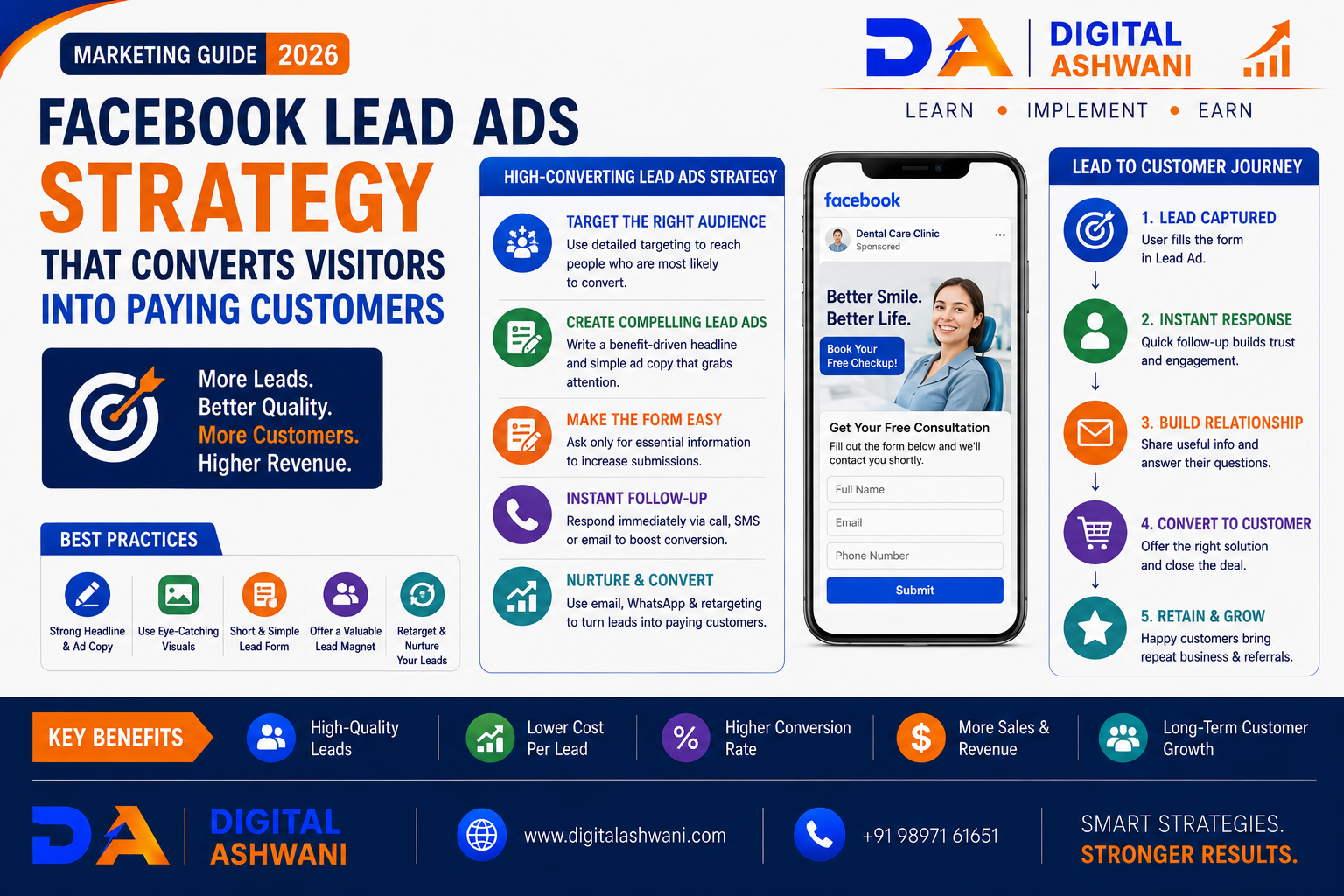
Facebook Lead Ads Strategy That Converts Visitors Into Paying Customers
Generating leads through social media is easy. Generating qualified leads that become paying customers is much harder.
Many businesses run Facebook advertising campaigns, collect hundreds of leads, and still struggle to generate meaningful sales. The problem is often not the number of leads but the quality of targeting, offer, lead form, follow-up process, landing experience, and sales strategy.
Facebook Lead Ads can simplify the lead-generation process by allowing users to submit their information directly through Facebook or Instagram without necessarily visiting an external website.
When combined with the right audience, compelling offer, carefully designed form, strong creative, and fast follow-up, Lead Ads can become a powerful customer acquisition channel.
In this comprehensive guide by Digital Ashwani, you’ll learn how to build a Facebook Lead Ads Strategy that focuses not just on collecting leads, but on turning qualified prospects into customers.
What Are Facebook Lead Ads?
Facebook Lead Ads are advertising campaigns designed to help businesses collect information from potential customers through forms within Meta’s advertising ecosystem.
Depending on the campaign setup, businesses can collect information such as:
- Name
- Email Address
- Phone Number
- Location
- Service Interest
- Other Qualifying Information
Lead Ads can reduce friction because users may not need to manually complete a traditional website form.
How Facebook Lead Ads Work
A typical lead-generation journey looks like:
Facebook / Instagram Ad → Lead Form → Lead Submission → Follow-Up → Sales Conversation → Customer
The advertising campaign attracts the prospect, the form captures information, and the sales process determines whether that lead becomes a paying customer.
This is why optimizing only the advertisement is not enough.
The entire funnel needs to work together.
Why Lead Quality Matters More Than Lead Volume
A campaign generating 1,000 irrelevant leads may be less valuable than one generating 100 qualified prospects.
Focus on Qualified Leads
Define what a good lead means for your business.
For example:
- Correct Location
- Relevant Service Need
- Real Contact Information
- Suitable Budget
- Purchase Intent
- Appropriate Timeline
The definition will vary by industry.
Choose the Right Campaign Goal
Align Advertising With the Business Objective
Before launching a campaign, decide whether your primary goal is:
- Lead Generation
- Sales
- Calls
- Appointment Requests
- Product Enquiries
- Quote Requests
Your campaign structure should reflect the actual business outcome you want.
Create an Irresistible Lead Offer
Give Users a Reason to Submit Their Information
People are more likely to submit a form when they receive clear value.
Possible offers include:
- Free Consultation
- Free Quote
- Product Demo
- Discount
- Consultation Booking
- Downloadable Guide
- Free Assessment
- Special Package
The offer should be genuinely useful and appropriate for your audience.
Build a High-Converting Lead Form
Ask Only for Necessary Information
A form that asks too many questions can create unnecessary friction.
Depending on your business, consider collecting:
- Name
- Phone
- Location
- Service Requirement
For high-value services, additional qualifying questions may be useful.
The right balance depends on whether your priority is maximum lead volume or higher lead quality.
Add Qualification Questions
Separate Serious Prospects From Low-Intent Leads
For example, a business could ask:
- Which service are you interested in?
- When do you plan to purchase?
- What is your preferred location?
- What type of solution do you need?
Qualification questions can help sales teams prioritize leads.
Target the Right Audience
Use Relevant Audience Signals
Your audience strategy can include factors such as:
- Location
- Demographics
- Interests
- Customer Lists
- Website Visitors
- Engagement Audiences
- Lookalike Audiences
Audience availability and targeting options can change, so review the current Meta Ads interface and policies when setting up campaigns.
Use Retargeting for Warm Prospects
Reconnect With People Who Already Know Your Brand
Retargeting can focus on users who previously:
- Visited Your Website
- Engaged With Your Facebook Page
- Watched Your Videos
- Interacted With Instagram Content
- Opened Previous Ads
- Started but Didn’t Complete an Action
These audiences may already have some awareness of your business.
Create High-Quality Ad Creatives
Stop the Scroll With Relevant Messaging
Effective creatives should communicate:
- The Problem
- The Solution
- The Benefit
- The Offer
- The Next Step
Use a combination of:
- Short Videos
- Images
- Carousels
- Customer Stories
- Demonstrations
- Educational Content
The creative should match the actual offer presented in the lead form.
Write Better Facebook Ad Copy
Focus on Customer Benefits
Instead of simply saying:
“We provide digital marketing services.”
A stronger message could focus on a customer outcome:
“Want more qualified enquiries from Google and social media? Get a customized digital marketing consultation.”
Avoid exaggerated promises or guaranteed results that your business cannot substantiate.
Create a Strong Lead Follow-Up System
Respond Quickly
Generating a lead is only the beginning.
A strong follow-up process can include:
Lead Submitted → Instant Confirmation → Sales Contact → Qualification → Proposal → Follow-Up → Conversion
Fast responses can help businesses engage prospects while their interest is still fresh.
Automate Lead Notifications
Send Leads to Your Sales Team
Connect your lead-generation system with appropriate CRM or automation tools where available.
This can help:
- Notify Sales Teams
- Assign Leads
- Record Lead Details
- Trigger Follow-Up Tasks
- Track Lead Status
Automation reduces the chance of leads being forgotten.
Track the Entire Funnel
Measure More Than Cost Per Lead
Important metrics include:
- Impressions
- Reach
- Click-Through Rate
- Leads
- Cost Per Lead
- Qualified Leads
- Sales Calls
- Appointments
- Customers
- Customer Acquisition Cost
- Revenue
The ultimate goal is not the cheapest lead.
The goal is profitable customer acquisition.
Calculate Lead-to-Customer Conversion
A useful business metric is:
Lead-to-Customer Rate = Customers ÷ Qualified Leads × 100
For example, if 100 qualified leads generate 10 customers, the lead-to-customer conversion rate is 10%.
This helps businesses understand whether the problem is advertising, lead quality, sales follow-up, or the offer itself.
Optimize Campaigns Using Actual Sales Data
Connect Advertising With CRM Data
If possible, connect your advertising platform with your CRM and sales process so you can identify which campaigns produce actual customers.
A campaign with a higher cost per lead may still be better if those leads generate significantly more revenue.
Test Different Campaign Elements
Run Controlled Experiments
Test elements such as:
- Ad Headlines
- Primary Text
- Creatives
- Offers
- Audiences
- Lead Forms
- Qualification Questions
- Calls-to-Action
Avoid changing everything simultaneously if you want to understand which change caused the performance difference.
Common Facebook Lead Ads Mistakes
Optimizing Only for Cheap Leads
A low cost per lead does not automatically mean a successful campaign.
Always evaluate lead quality and revenue.
Using Weak Offers
If users don’t see a clear reason to submit their information, lead volume can suffer.
Make the value proposition clear.
Asking Too Many Questions
Long forms can reduce completion rates.
Only request information that is genuinely useful for qualification or follow-up.
Slow Lead Follow-Up
A good campaign can still fail if sales teams take too long to contact prospects.
Create a clear process for responding to new leads.
Ignoring Existing Customers
Customer retention and repeat purchases can be more valuable than constantly acquiring new customers.
Consider separate campaigns for:
- New Customer Acquisition
- Retargeting
- Existing Customer Engagement
- Cross-Selling
- Upselling
Facebook Lead Ads Optimization Checklist
Before launching your campaign, check:
- Business Goal Defined
- Target Audience Identified
- Lead Offer Created
- Ad Creative Prepared
- Lead Form Optimized
- Qualification Questions Reviewed
- Privacy Information Included
- Follow-Up Process Created
- CRM Integration Considered
- Conversion Tracking Configured
- Lead Quality Defined
- Sales Metrics Tracked
Internal Linking Suggestions (Digital Ashwani)
Strengthen your paid advertising and lead-generation content cluster by linking this article with:
- Complete Google Search Ads Campaign Setup Guide for Better Lead Generation
- Google Ads Conversion Tracking Setup Using Google Tag Manager
- What Is Cost Per Click (CPC)?
- How to Increase Website Conversion Rates Using Data-Driven Optimization Methods
- Healthcare Lead Generation Strategies That Actually Work
- Law Firm Lead Generation Strategies
- AI Marketing Strategies for Dental Clinics
- Facebook Organic Marketing Tips to Grow Your Business Without Paid Ads
- Social Media Marketing vs Digital Marketing: Key Differences Explained Clearly
- What Is Meta Business Suite?
These internal links connect Facebook advertising, Google Ads, CRO, AI marketing, and lead-generation topics.
External Resources
For current advertising guidance, refer to official resources such as:
- Meta Business Help Center
- Meta Ads Guide
- Google Analytics Help
- Google Tag Manager Help
Advertising features, targeting options, and policies can change, so use official documentation when configuring campaigns.
Frequently Asked Questions
What is a Facebook Lead Ads Strategy?
A Facebook Lead Ads Strategy is a structured approach to using Meta advertising campaigns to attract prospects, collect their information, qualify leads, follow up effectively, and convert qualified prospects into customers.
Are Facebook Lead Ads good for lead generation?
They can be effective for businesses that have a strong offer, suitable audience targeting, optimized forms, and a reliable follow-up process. Results vary significantly by industry, audience, offer, and campaign execution.
How can I improve Facebook Lead quality?
Use relevant targeting, stronger offers, qualification questions, accurate messaging, and effective follow-up. Measuring qualified leads and customers is more useful than optimizing only for total lead volume.
Should Facebook Lead Ads send users to a website?
Not necessarily. Lead Ads can collect information through an in-platform form, while website campaigns can be useful when users need detailed information before converting. Choose the format based on the complexity of your offer and customer journey.
How quickly should businesses follow up with leads?
As quickly as practical. A clear automated notification and sales follow-up process can reduce delays and improve the chances of engaging interested prospects.
Final Thoughts
A successful Facebook Lead Ads Strategy is about much more than generating a large number of form submissions.
The strongest campaigns connect audience targeting, valuable offers, persuasive creatives, optimized lead forms, qualification, fast follow-up, CRM management, and revenue tracking into one complete system.
Don’t judge your campaign only by reach, clicks, or cost per lead. Track what happens after the lead is generated.
Lead → Qualified Lead → Sales Conversation → Customer → Revenue
That is the journey that determines whether your Facebook advertising is actually profitable.
When businesses combine Meta advertising with strong sales processes, conversion optimization, analytics, and consistent testing, Facebook Lead Ads can become a valuable source of qualified customers and sustainable business growth.
At Digital Ashwani, we regularly publish practical guides on Facebook Marketing, Google Ads, SEO, AI Marketing, Conversion Optimization, Local SEO, and Digital Marketing to help businesses build stronger customer acquisition systems.
