

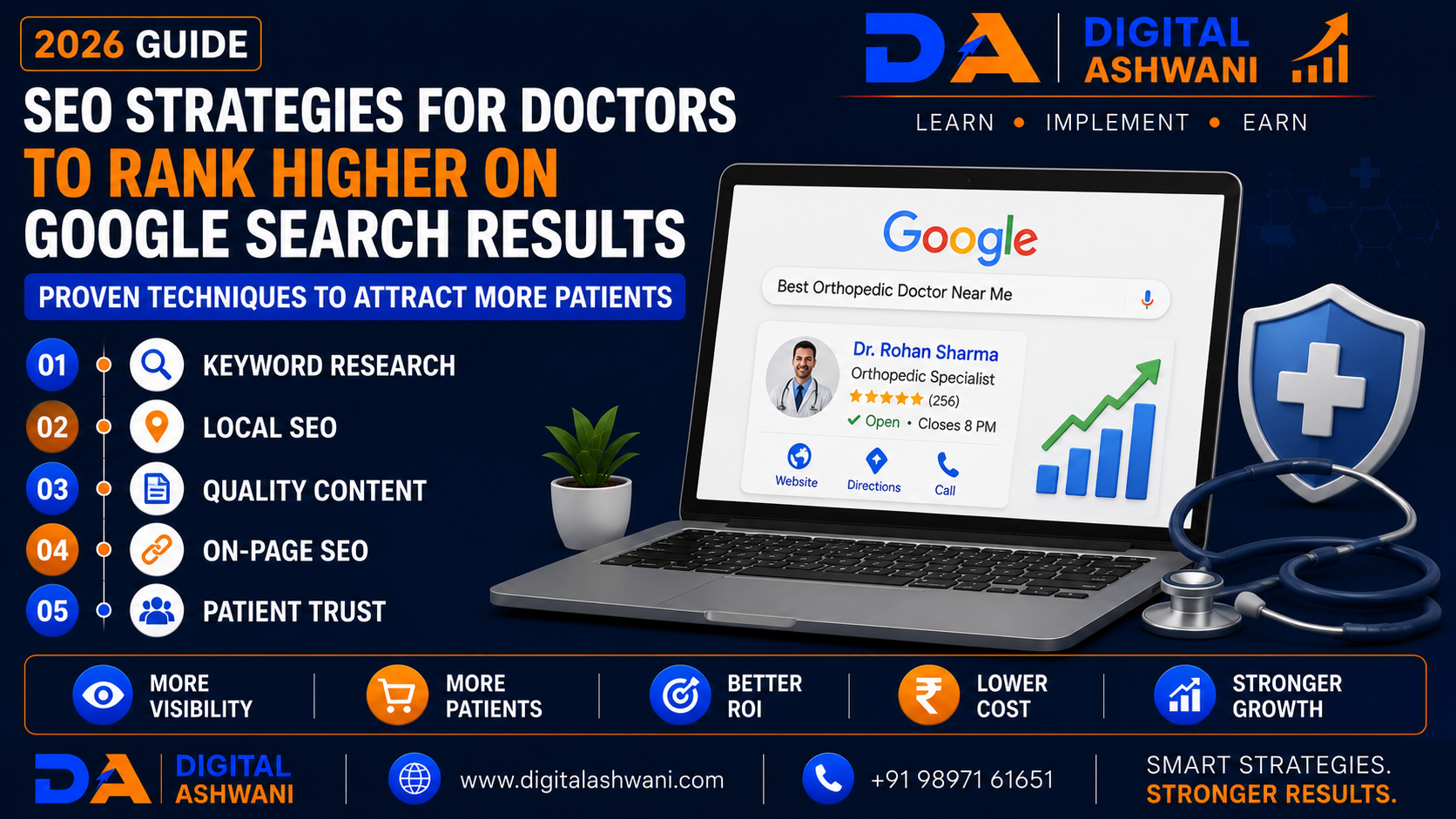
SEO Strategies for Doctors to Rank Higher on Google Search Results
Today, most patients begin their healthcare journey online. Whether they need a general physician, dentist, cardiologist, dermatologist, pediatrician, orthopedic specialist, or another healthcare provider, they usually search Google before booking an appointment.
Searches like:
- Best Doctor Near Me
- Skin Specialist in Delhi
- Orthopedic Doctor Near Me
- Child Specialist Clinic
- Heart Doctor in Noida
demonstrate strong patient intent.
If your clinic or hospital doesn’t appear on the first page of Google, many potential patients may never discover your services.
This is why SEO (Search Engine Optimization) has become one of the most effective long-term marketing strategies for healthcare professionals.
A well-executed SEO strategy helps doctors improve search visibility, build trust, attract qualified patients, and reduce dependence on paid advertising.
In this comprehensive guide by Digital Ashwani, you’ll learn 15 proven SEO strategies that help doctors rank higher on Google Search and grow their medical practice in 2026.
Why SEO Matters for Doctors
Patients increasingly research symptoms, treatments, healthcare providers, and clinic reviews before making appointments.
SEO helps doctors appear when patients search for:
- Family Doctor
- Dermatologist
- Dentist
- Cardiologist
- ENT Specialist
- Gynecologist
- Neurologist
- Orthopedic Surgeon
Better visibility means more opportunities to connect with patients actively seeking medical care.
Benefits of SEO for Doctors
Effective SEO helps medical practices:
- Increase Patient Appointments
- Improve Google Rankings
- Build Online Trust
- Generate Qualified Leads
- Strengthen Local Visibility
- Reduce Advertising Costs
- Improve Brand Authority
- Support Long-Term Growth
SEO provides consistent patient acquisition over time.
15 Proven SEO Strategies
1. Perform Medical Keyword Research
Understand what patients actually search for.
Examples include:
- Dentist Near Me
- Best Pediatrician Delhi
- Orthopedic Clinic Noida
- Skin Specialist Gurgaon
- General Physician Near Me
Targeting relevant medical keywords improves visibility.
2. Create Dedicated Service Pages
Each healthcare service should have its own optimized page.
Examples:
- General Medicine
- Dermatology
- Cardiology
- Pediatrics
- Orthopedics
- Gynecology
- Physiotherapy
Dedicated pages improve topical relevance.
3. Optimize Google Business Profile
Google Business Profile is essential for local patient acquisition.
Include:
- Clinic Name
- Address
- Phone Number
- Business Hours
- Services
- Photos
- Appointment Information
A complete profile improves local search visibility.
4. Publish Helpful Medical Content
Educational content builds trust while improving SEO.
Topics may include:
- Common Symptoms
- Treatment Options
- Preventive Care
- Recovery Tips
- Frequently Asked Questions
Content should be medically accurate, easy to understand, and regularly updated.
5. Strengthen Local SEO
Local SEO helps nearby patients discover your clinic.
Optimize for:
- City Names
- Local Keywords
- Google Maps
- Local Citations
- Patient Reviews
Strong local signals improve visibility in location-based searches.
6. Improve Website Speed
Fast-loading websites create a better patient experience.
Optimize:
- Images
- Mobile Performance
- Core Web Vitals
- Hosting
- Caching
Website performance also supports SEO.
7. Build EEAT
Healthcare websites fall under Google’s Your Money or Your Life (YMYL) category.
Demonstrate:
- Medical Expertise
- Professional Experience
- Qualifications
- Trustworthy Information
- Accurate Sources
- Clinic Credentials
Strong EEAT improves credibility with both patients and search engines.
8. Encourage Genuine Patient Reviews
Positive reviews influence both rankings and patient trust.
Encourage satisfied patients to leave honest reviews on your Google Business Profile while respecting privacy and applicable healthcare regulations.
Respond professionally to reviews without revealing confidential patient information.
9. Implement Medical Schema Markup
Structured data helps search engines understand your healthcare website more effectively.
Implement schema where appropriate for:
- Physician
- Medical Clinic
- Hospital
- Local Business
- FAQ
- Breadcrumb
- Organization
Proper schema can improve search visibility and eligibility for rich results.
10. Optimize Appointment Landing Pages
Every appointment page should make it easy for patients to contact your clinic.
Include:
- Doctor’s Name
- Qualifications
- Specialization
- Consultation Hours
- Contact Number
- Appointment Form
- Google Maps Location
- Clear Call-to-Action
Well-designed landing pages improve patient conversions.
11. Build High-Quality Medical Backlinks
Authoritative backlinks strengthen your website’s credibility.
Focus on earning links from:
- Healthcare Directories
- Medical Associations
- Hospital Networks
- Government Health Resources
- Medical Journals
- Trusted Healthcare Blogs
- Local Business Directories
Quality is far more important than quantity.
12. Improve Technical SEO
Technical SEO ensures search engines can crawl and index your website efficiently.
Regularly review:
- XML Sitemap
- Robots.txt
- HTTPS Security
- Mobile Friendliness
- Core Web Vitals
- Broken Links
- Canonical Tags
- Internal Linking
A technically sound website supports better rankings and user experience.
13. Monitor SEO Performance
Track your SEO progress using:
- Google Search Console
- Google Analytics 4
- Google Business Profile Insights
- Looker Studio
Monitor important metrics such as:
- Organic Traffic
- Keyword Rankings
- Appointment Requests
- Phone Calls
- Click-Through Rate (CTR)
- Local Search Visibility
Performance analysis helps identify improvement opportunities.
14. Optimize for AI Search
AI-powered search experiences are becoming increasingly important.
Prepare your content by:
- Answering Patient Questions Clearly
- Using Logical Heading Structure
- Creating FAQ Sections
- Publishing Evidence-Based Content
- Demonstrating Medical Expertise
- Keeping Information Updated
Clear, trustworthy content is more likely to perform well in both traditional and AI-powered search.
15. Continuously Update Your Website
Healthcare information changes regularly.
Review and update:
- Treatment Information
- Doctor Profiles
- Clinic Services
- Consultation Hours
- Medical Technologies
- Patient FAQs
- Educational Articles
Fresh, accurate content helps maintain trust and search visibility.
Medical SEO Checklist
Before considering your SEO strategy complete, confirm the following:
- Medical Keyword Research Completed
- Dedicated Service Pages Created
- Google Business Profile Optimized
- Local SEO Implemented
- EEAT Signals Strengthened
- Medical Schema Added
- Website Speed Optimized
- Patient Reviews Managed
- Conversion Tracking Configured
- Monthly SEO Review Scheduled
Following this checklist creates a stronger SEO foundation for medical practices.
Common Medical SEO Mistakes
Using Duplicate Service Pages
Publishing nearly identical pages for multiple locations or services reduces content quality.
Create unique, patient-focused content for each page.
Ignoring Local SEO
Many patients search for nearby healthcare providers.
Without Local SEO, your clinic may miss valuable appointment opportunities.
Publishing Thin Medical Content
Short, generic articles rarely build trust.
Provide accurate, detailed, and patient-friendly explanations written or reviewed by qualified medical professionals where appropriate.
Outdated Doctor Information
Incorrect consultation hours, outdated qualifications, or inactive contact details reduce patient confidence.
Review your website regularly.
Neglecting Mobile Experience
Many patients search for doctors using smartphones.
Ensure your website loads quickly and works well across all devices.
Internal Linking Suggestions (Digital Ashwani)
Strengthen your healthcare SEO content cluster by linking this article with:
- Complete Digital Marketing Guide for Doctors to Increase Patient Appointments
- Website Design Tips for Doctors and Medical Clinics
- Local SEO Strategies for Healthcare Clinics to Rank Higher on Google Maps
- What Is Local SEO and Why Is It Important for Small Businesses?
- Complete Beginner’s Guide to Understanding How Google Search Ranking Really Works
- How Search Engines Crawl, Index, and Rank Websites for Better Visibility
- How Structured Data Helps AI Understand Your Website Better
- Ultimate Analytics and Tracking Guide for Long-Term Business Growth
- How to Increase Website Conversion Rates Using Data-Driven Optimization Methods
- What Is AI SEO and How Can It Improve Your Search Engine Rankings?
These internal links strengthen topical authority while helping readers explore related healthcare SEO, Local SEO, AI SEO, analytics, and conversion optimization topics.
External Resources
For trusted medical SEO and search guidance, refer to:
- Google Search Central
- Google Business Profile Help
- Google Search Console Help
- Google Analytics Help Center
- World Health Organization (WHO)
These authoritative resources provide reliable guidance on website quality, search optimization, and trustworthy healthcare information.
Frequently Asked Questions
Is SEO important for doctors?
Yes. SEO helps doctors improve online visibility, attract patients actively searching for healthcare services, and generate more appointment requests through organic search.
How long does medical SEO take to show results?
Most clinics begin seeing measurable improvements within 3–6 months, although highly competitive locations and specialties may require more time.
Why is EEAT important for medical websites?
Healthcare websites are held to high quality standards because medical information can directly affect people’s health decisions. Demonstrating expertise, experience, authoritativeness, and trustworthiness helps build confidence with both users and search engines.
Can Local SEO help doctors get more patients?
Yes. Local SEO improves visibility in Google Search and Google Maps, helping nearby patients discover your clinic more easily.
Should doctors publish medical blogs?
Yes. Educational articles that answer common patient questions, explain treatments, and provide preventive health information can improve SEO while building patient trust.
Final Thoughts
Implementing effective SEO Strategies for Doctors to Rank Higher on Google Search Results is one of the most valuable long-term investments for any medical practice. A successful healthcare SEO strategy combines technical optimization, Local SEO, medically accurate educational content, Google Business Profile optimization, structured data, and strong EEAT signals to improve both visibility and patient trust.
Rather than focusing only on rankings, prioritize creating a website that genuinely helps patients understand symptoms, treatments, and available healthcare services. Accurate, up-to-date, and trustworthy information not only improves search performance but also strengthens your professional reputation.
As Google increasingly incorporates AI-powered search experiences, medical practices that consistently publish reliable, patient-focused content and maintain technically strong websites will be better positioned to attract qualified patients and achieve sustainable online growth.
At Digital Ashwani, we regularly publish practical guides on SEO, AI SEO, Local SEO, Google Ads, Analytics, and Digital Marketing to help healthcare professionals and businesses build a stronger online presence.
