
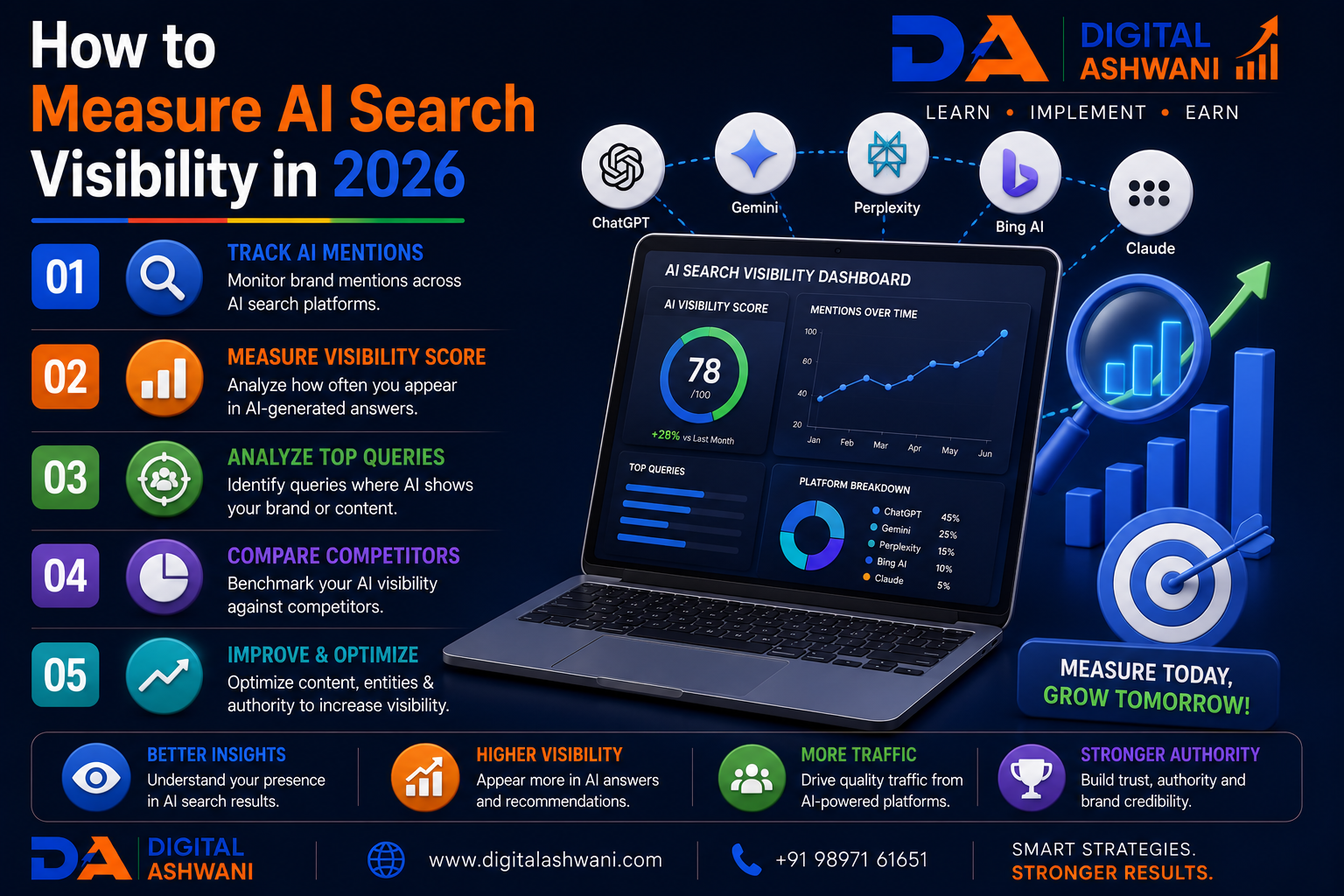
How to Measure AI Search Visibility
Search Engine Optimization is entering a new era where traditional keyword rankings are no longer the only indicator of success. As AI-powered search experiences such as Google AI Overviews, AI Mode, ChatGPT, Gemini, Perplexity, and other answer engines become more popular, businesses need new ways to evaluate their online visibility.
Many website owners still focus only on organic rankings and traffic. However, a page can now influence users through AI-generated answers even if it receives fewer traditional clicks. Likewise, some websites may lose organic traffic while gaining more brand exposure through AI-generated responses.
This shift has introduced a new SEO concept known as AI Search Visibility.
Rather than asking “What is my Google ranking?”, marketers increasingly ask:
- Is my content appearing in AI-generated answers?
- How often is my brand mentioned by AI search engines?
- Which pages are cited in AI Overviews?
- How can I improve my visibility across AI platforms?
In this comprehensive guide by Digital Ashwani, you’ll learn how to measure AI Search Visibility, which metrics matter most, and the practical strategies businesses should use to improve their presence in AI-powered search results.
What Is AI Search Visibility?
AI Search Visibility refers to how often your brand, website, or content appears, is cited, or influences answers generated by AI-powered search systems.
Unlike traditional SEO, AI visibility is not limited to ranking in the top ten blue links.
Your content may appear through:
- Google AI Overviews
- Google AI Mode
- ChatGPT responses
- Gemini answers
- Perplexity citations
- AI assistants
- Voice search platforms
The broader your presence across these experiences, the stronger your AI Search Visibility.
Why Traditional SEO Metrics Are Changing
Historically, SEO success was measured using:
- Keyword rankings
- Organic traffic
- Click-through rate
- Backlinks
While these metrics remain valuable, AI-powered search introduces additional signals.
Businesses should now also monitor:
- AI citations
- Brand mentions
- Entity recognition
- Topical authority
- Knowledge Graph presence
Success increasingly depends on influence rather than rankings alone.
Why Measuring AI Search Visibility Matters
Tracking AI visibility helps businesses:
- Understand AI search performance
- Identify content opportunities
- Strengthen topical authority
- Improve AI-generated citations
- Increase brand recognition
- Support future SEO strategies
Without measuring AI performance, it’s difficult to understand how users discover your brand through modern search experiences.
Challenges of Measuring AI Visibility
Unlike traditional search rankings, AI search results are dynamic and personalized.
Challenges include:
- Different answers for different users
- Rapid AI model updates
- Limited reporting tools
- Changing citation patterns
- Multiple AI platforms
Because of these factors, businesses should combine several metrics rather than relying on a single measurement.
15 Metrics Every SEO Should Track
1. Brand Mentions in AI Responses
Monitor how often AI systems reference your business or brand.
Increasing brand mentions often indicates growing authority.
2. AI Overview Citations
Check whether your content is referenced in Google AI Overviews.
Appearing as a cited source can increase credibility and visibility, even if users don’t immediately click through.
3. Organic Search Visibility
Traditional rankings still matter.
Track:
- Keyword positions
- Impressions
- Clicks
- Organic traffic
AI visibility complements—not replaces—traditional SEO metrics.
4. Topical Authority
Measure how comprehensively your website covers important topics.
Strong topic clusters improve both AI understanding and organic rankings.
5. Entity Recognition
Evaluate whether search engines clearly understand your:
- Brand
- Products
- Services
- Authors
- Organization
Strong entity recognition improves semantic understanding.
6. Knowledge Graph Presence
A well-established Knowledge Graph presence helps search engines confidently understand your business.
Improve:
- Organization schema
- Author schema
- About page
- Consistent business information
7. Content Freshness
AI systems often prioritize current and relevant information.
Regularly update:
- Statistics
- Examples
- Industry news
- Product information
- Case studies
Fresh content supports better AI visibility.
8. Internal Linking Quality
Strong internal links help AI systems understand relationships between topics.
Connect related articles logically to strengthen semantic relevance.
9. Optimize for AI Citations Instead of Only Rankings
Traditional SEO focuses on ranking web pages. AI-powered search engines focus on finding the most trustworthy source to generate answers.
Your goal should be to become a source that AI platforms confidently cite.
How to Increase AI Citations
- Publish original research and statistics.
- Add expert insights and unique opinions.
- Use clear definitions for important concepts.
- Support claims with authoritative references.
- Keep content updated with the latest information.
10. Monitor Brand Mentions Across AI Platforms
Brand mentions are becoming an important visibility signal.
Regularly test prompts on different AI platforms to see whether your business appears in generated answers.
Platforms to Monitor
- Google AI Overviews
- Google AI Mode
- ChatGPT
- Gemini
- Perplexity
- Microsoft Copilot
Search using prompts your customers would naturally ask, such as:
- Best SEO agency in Delhi
- Best AI SEO consultant
- Top Digital Marketing Agencies
- Best Local SEO Expert
Track:
- Brand appearance
- Mention frequency
- Position in the answer
- Competitors mentioned
11. Measure LLM Referral Traffic
AI platforms are increasingly sending visitors to websites through cited sources.
Use Google Analytics 4 to identify referral traffic generated by AI-powered platforms.
Monitor
- Sessions
- Users
- Average Engagement Time
- Bounce Rate
- Conversions
- Revenue
- Assisted Conversions
As AI adoption grows, referral traffic from Large Language Models (LLMs) will become an important KPI.
12. Compare Your AI Visibility with Competitors
Visibility is relative.
Even if your website appears in AI responses, competitors may appear more frequently.
Create a Monthly Comparison
Track:
- Number of AI mentions
- AI Overview citations
- Brand recommendations
- Entity recognition
- Knowledge Graph visibility
- Content coverage
Understanding where competitors outperform you helps identify content gaps and optimization opportunities.
13. Build an AI Search Visibility Dashboard
Instead of relying on a single metric, create a dashboard that combines multiple AI SEO indicators.
Recommended Dashboard Metrics
- AI Overview Citations
- Brand Mentions
- ChatGPT Visibility
- Gemini Mentions
- Perplexity Citations
- LLM Referral Traffic
- Organic Impressions
- Organic Clicks
- Branded Searches
- Conversion Rate
- Topic Cluster Growth
- Indexed Pages
Review these metrics monthly to understand long-term trends rather than day-to-day fluctuations.
14. Audit Your AI Visibility Every Month
AI-powered search changes rapidly.
A monthly audit helps you understand how your visibility evolves over time.
Monthly AI SEO Audit Checklist
- Check AI Overview appearances.
- Test important prompts across AI platforms.
- Review brand mentions.
- Analyze referral traffic.
- Update outdated content.
- Expand topic clusters.
- Validate Schema Markup.
- Monitor competitor visibility.
Consistent audits help maintain strong AI search performance.
15. Focus on Business Impact, Not Just AI Mentions
AI visibility is valuable only when it contributes to business growth.
Measure how AI search influences:
- Lead generation
- Sales
- Consultation requests
- Newsletter subscriptions
- Demo bookings
- Brand awareness
- Customer trust
The ultimate objective is not simply being mentioned by AI—it is generating measurable business results.
Best Tools to Measure AI Search Visibility
No single platform currently measures AI visibility completely, so use multiple tools together.
Recommended Tools
- Google Search Console
- Google Analytics 4
- Google Trends
- Looker Studio
- Microsoft Clarity
- Bing Webmaster Tools
- Semrush
- Ahrefs
- Profound AI
- Peec AI
- Scrunch AI
- Otterly.AI
Combining SEO, analytics, and AI monitoring tools provides a more complete picture of your AI Search Visibility.
Common Mistakes When Measuring AI Search Visibility
Measuring Rankings Only
Keyword rankings remain important, but they no longer represent the full picture.
Track AI citations, entity recognition, and brand mentions alongside traditional SEO metrics.
Ignoring Brand Authority
AI systems are more likely to recommend trusted brands.
Invest in building a recognizable brand rather than focusing only on keyword optimization.
Publishing Generic Content
AI platforms prefer comprehensive, experience-driven content over generic articles.
Create unique content that demonstrates expertise and provides original value.
Not Updating Evergreen Content
Outdated information reduces trust.
Refresh important articles regularly with current data, examples, and industry developments.
Tracking Too Many Vanity Metrics
High impressions or mentions alone do not guarantee business success.
Focus on metrics that contribute to leads, conversions, and long-term growth.
AI Search Visibility Checklist
| AI SEO Task | Status |
|---|---|
| Google AI Overview Monitoring | ✅ |
| AI Brand Mention Tracking | ✅ |
| ChatGPT Visibility Testing | ✅ |
| Gemini & Perplexity Analysis | ✅ |
| LLM Referral Traffic Monitoring | ✅ |
| Entity SEO Optimization | ✅ |
| Schema Markup Validation | ✅ |
| Competitor AI Benchmarking | ✅ |
| Monthly AI Visibility Dashboard | ✅ |
| Continuous Content Updates | ✅ |
Internal Linking Suggestions (Digital Ashwani)
Strengthen your AI SEO content cluster by linking this article with:
- AI SEO vs Traditional SEO
- Entity SEO Strategies for AI-Powered Search Engines
- How to Rank in ChatGPT, Gemini & AI Search Results
- Google AI Overviews Explained
- Google AI Mode: Complete SEO Guide
- Future of SEO in the AI Era
- Why Organic Traffic Is Dropping Even When Rankings Stay the Same
- Technical SEO Checklist 2026
- Schema Markup Complete Guide
- Digital Marketing Trends 2026
These internal links improve semantic relevance, strengthen topical authority, and help AI-powered search engines understand your expertise.
External Resources
For official guidance and trusted references, explore:
- Google Search Central
- Google Search Console Help
- Google AI
- Bing Webmaster Tools
- Schema.org
These resources provide the latest recommendations for AI search optimization, structured data, and search performance measurement.
Frequently Asked Questions
Can I track AI Search Visibility inside Google Search Console?
Google Search Console currently tracks impressions, clicks, CTR, and rankings but does not provide a dedicated AI Search Visibility report. Combine it with AI monitoring tools and manual testing for a broader view.
Which AI platform should I monitor first?
Start with Google AI Overviews because of Google’s search market share, then expand monitoring to ChatGPT, Gemini, Perplexity, and Microsoft Copilot.
How often should I measure AI Search Visibility?
A monthly review is recommended. This provides enough data to identify meaningful trends without overreacting to short-term fluctuations.
What is the most important AI Search Visibility metric?
There is no single metric. A combination of AI citations, brand mentions, referral traffic, topical authority, entity recognition, and conversions provides the most reliable assessment.
Will AI Search Visibility replace traditional SEO?
No. AI Search Visibility complements traditional SEO. Businesses that optimize for both organic search and AI-powered search experiences will be better positioned for long-term success.
Final Thoughts
Measuring AI Search Visibility is no longer optional for businesses that want to succeed in the future of search. As AI-powered search engines continue shifting from keyword matching to contextual understanding, marketers need to evaluate much more than rankings and clicks. Brand mentions, AI citations, entity recognition, topical authority, and referral traffic all contribute to understanding how visible your business is across AI-driven experiences.
The businesses that build trusted brands, publish original expertise, maintain accurate structured data, and consistently monitor AI performance will have a significant competitive advantage. By combining traditional SEO metrics with AI-specific KPIs, you can build a future-ready measurement framework that supports sustainable growth across Google AI Overviews, AI Mode, ChatGPT, Gemini, Perplexity, Microsoft Copilot, and emerging AI search platforms.
At Digital Ashwani, we regularly publish in-depth guides on AI SEO, Entity SEO, Technical SEO, Google Updates, AI Search Optimization, and Digital Marketing to help businesses stay ahead in the rapidly evolving AI search ecosystem.
