

Search is changing faster than ever. For decades, Google Search has been the primary way people found information online. Users typed a keyword, reviewed a list of websites, and clicked the most relevant result.
Today, Artificial Intelligence is transforming that experience.
Instead of displaying only a list of links, AI-powered search engines like Gemini AI Search can understand natural language, summarize information, answer complex questions, and provide conversational responses. Users increasingly expect direct answers rather than spending time opening multiple websites.
This shift has sparked an important question:
“Gemini AI Search vs Google Search: Which one is better?”
The answer depends on what you’re trying to accomplish. Traditional search remains powerful for discovering websites, products, and local businesses, while AI-powered search excels at explaining concepts, summarizing information, and assisting with research.
In this comprehensive guide by Digital Ashwani, we’ll compare Gemini AI Search vs Google Search, explain their strengths and limitations, explore how they affect SEO, and help you prepare for the future of online search.
What Is Gemini AI Search?
Gemini AI Search is Google’s AI-powered conversational search experience that uses advanced language models to understand questions and generate detailed, natural-language responses.
Instead of simply listing web pages, Gemini AI Search can:
- Understand conversational questions
- Summarize multiple sources
- Explain complex topics
- Compare products and services
- Help with brainstorming
- Answer follow-up questions
- Generate structured responses
This creates a more interactive search experience where users can refine questions naturally, similar to chatting with an AI assistant.
What Is Google Search?
Google Search is the traditional search engine that indexes billions of webpages and ranks them based on relevance, quality, and many other signals.
A typical Google Search provides:
- Organic search results
- Sponsored advertisements
- Featured Snippets
- Google AI Overviews (for many queries)
- Images
- Videos
- Maps
- Shopping results
- News
- Local business listings
Users decide which website to visit based on the results presented.
Google Search remains highly effective for discovering websites, products, businesses, official documentation, and current information.
Why Search Is Changing
Several major trends are driving the evolution of search.
Artificial Intelligence
AI helps search engines understand meaning instead of relying only on keywords.
Conversational Search
Users increasingly ask complete questions instead of typing short keyword phrases.
Example:
Instead of:
“SEO tips”
Users now ask:
“How can I improve my SEO rankings in 2026?”
Google AI Overviews
Google now provides AI-generated summaries for many informational searches, reducing the need to visit multiple websites.
Growing Demand for Instant Answers
People expect immediate explanations rather than spending time comparing many pages.
Better Natural Language Processing
Modern AI systems understand context, follow-up questions, and conversational intent more effectively than traditional keyword matching.
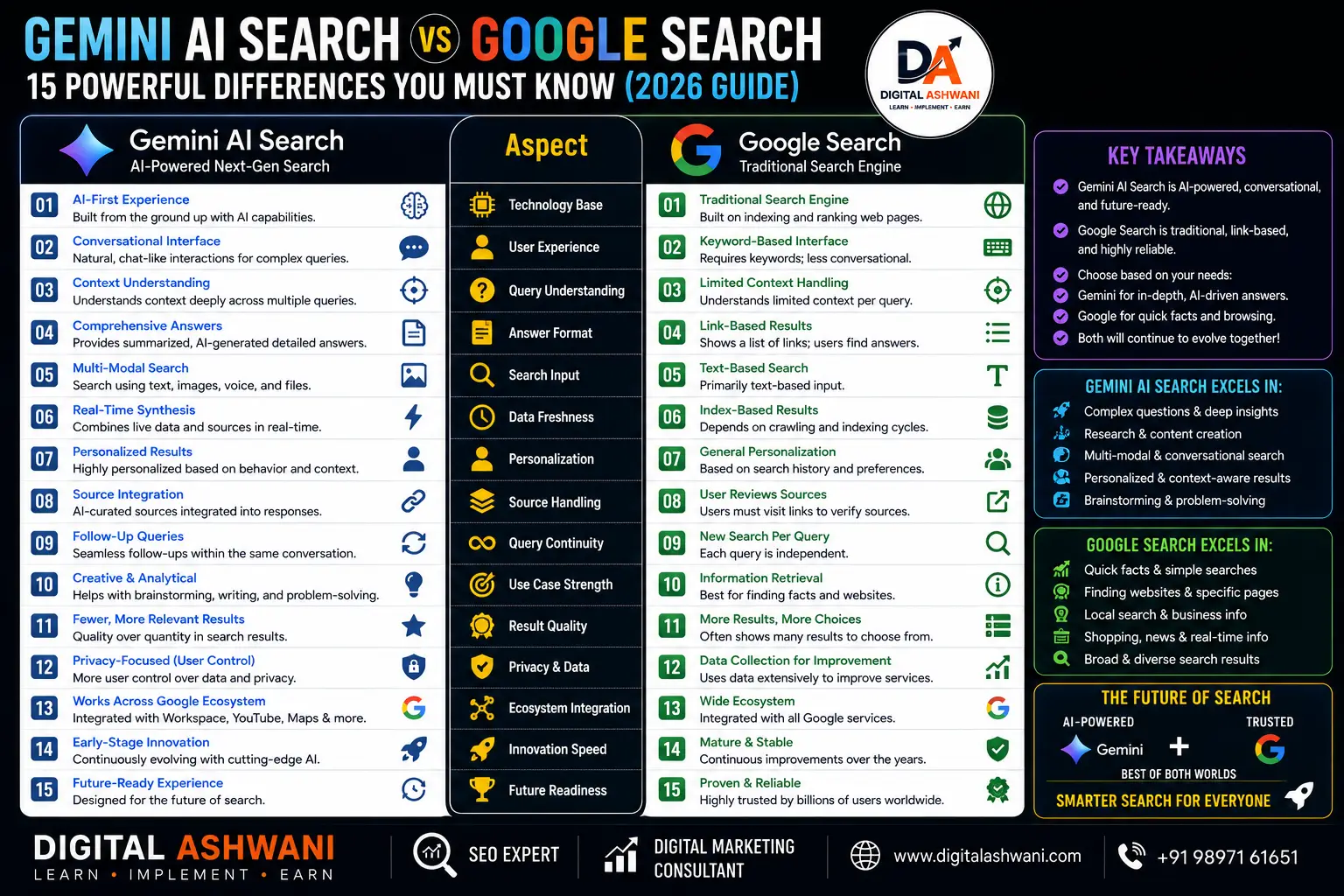
Gemini AI Search vs Google Search Overview
| Feature | Gemini AI Search | Google Search |
|---|---|---|
| Primary Experience | Conversational AI | Traditional search results |
| Answers | Direct summaries | Website listings |
| Interaction | Chat-based | Search results page |
| Follow-up Questions | Yes | Limited |
| Content Discovery | AI summaries | Direct website exploration |
| Research | Excellent | Excellent |
| Local Search | Improving | Excellent |
| Website Browsing | Limited | Excellent |
| Current Information | Depends on implementation | Strong |
| Learning | Conversational | User-driven |
Both approaches serve different user needs rather than replacing one another.
15 Powerful Differences Between Gemini AI Search vs Google Search
1. Search Experience
The biggest difference is how users interact with each platform.
Gemini AI Search
Users have conversations.
They can:
- Ask follow-up questions.
- Request explanations.
- Refine answers.
- Continue exploring a topic naturally.
Google Search
Users receive a list of relevant webpages and choose which links to open.
Winner
Depends on the task.
For learning and explanations, conversational AI often feels more natural.
For discovering websites and exploring multiple perspectives, traditional search remains highly valuable.
2. Type of Results
Gemini AI Search
Provides:
- Summaries
- Comparisons
- Step-by-step explanations
- Personalized responses
- Context-aware answers
Google Search
Displays:
- Webpages
- Videos
- Images
- News
- Shopping
- Maps
- Local businesses
Winner
Google Search offers broader content discovery, while Gemini AI Search focuses on synthesized answers.
3. User Intent
Gemini AI Search is particularly useful when users need:
- Explanations
- Learning assistance
- Brainstorming
- Writing support
- Research summaries
Google Search excels when users want to:
- Visit specific websites
- Compare products
- Find businesses
- Access official documentation
- Read multiple independent sources
Understanding user intent helps determine which experience is more suitable.
4. Speed of Finding Answers
Gemini AI Search often provides a complete answer within a single conversation.
Users may not need to open several webpages.
Google Search usually requires:
- Reviewing results
- Comparing sources
- Visiting multiple websites
For quick explanations, AI-powered search can be more efficient.
5. Content Discovery
Traditional Google Search encourages exploration.
Users can discover:
- Blogs
- Forums
- Company websites
- Research papers
- Videos
- Online tools
Gemini AI Search focuses more on summarizing information than browsing the wider web.
For discovering new websites and perspectives, Google Search maintains an advantage.
6. Personalization
AI-powered search can adapt responses based on:
- Previous questions
- Conversation context
- Clarifications
- User preferences within the interaction
Google Search personalization generally relies on factors such as location, language, and search history rather than an ongoing conversation.
7. Research Capabilities
Gemini AI Search simplifies research by:
- Summarizing information
- Organizing ideas
- Explaining technical concepts
- Comparing options
However, users should still consult original sources for important decisions.
Google Search remains valuable because it provides direct access to those original sources.
The two approaches complement each other.
8. SEO Impact
One of the biggest changes for website owners is how AI-powered search affects visibility.
Traditional SEO focused on earning clicks from search results.
AI Search introduces new priorities:
- Answer Engine Optimization (AEO)
- Topical Authority
- EEAT
- Structured content
- Clear question-and-answer formatting
Instead of optimizing only for rankings, websites should also create content that AI systems can easily understand and reference.
This shift doesn’t replace SEO—it expands it.
9. Accuracy of Information
One of the biggest discussions around AI-powered search is accuracy.
Gemini AI Search
Gemini AI Search provides summarized answers generated from multiple sources. While these summaries are often useful, users should still verify important information, especially for topics involving finance, healthcare, legal matters, or rapidly changing news.
Google Search
Google Search gives users direct access to original websites, allowing them to compare multiple viewpoints and verify information independently.
Winner
For critical decision-making, Google Search remains the stronger option because it encourages users to review original sources.
10. Real-Time Information
Current information changes quickly.
Examples include:
- Breaking news
- Stock markets
- Sports scores
- Product launches
- Government announcements
- Weather updates
Google Search is designed to surface fresh and updated webpages, making it highly effective for time-sensitive information.
AI-powered search is improving rapidly, but users should still confirm important updates through authoritative sources.
11. Shopping Experience
When users want to purchase a product, Google Search offers a complete shopping ecosystem.
Users can compare:
- Prices
- Reviews
- Product specifications
- Seller information
- Availability
Gemini AI Search can recommend products and explain differences, but traditional search remains better for product discovery and comparison.
12. Local Search
Finding nearby businesses is another area where traditional search remains extremely strong.
Google Search provides:
- Maps
- Business profiles
- Reviews
- Ratings
- Directions
- Business hours
- Photos
Gemini AI Search may provide recommendations, but Google Search continues to deliver a richer local search experience.
13. Learning Complex Topics
One of Gemini AI Search’s greatest strengths is education.
For example, users can ask:
- Explain SEO like I’m a beginner.
- How does machine learning work?
- What is technical SEO?
- Explain blockchain with examples.
Gemini AI Search can simplify difficult concepts using conversational explanations and follow-up discussions.
14. Follow-Up Questions
Traditional Google Search requires users to perform a new search for every question.
Gemini AI Search allows users to continue the conversation naturally.
Example:
User:
“What is SEO?”
Follow-up:
“Can you explain Technical SEO?”
Another follow-up:
“How do I improve Technical SEO for WordPress?”
The conversation continues without starting from scratch.
15. Future of Search
Search is moving toward a hybrid model.
Instead of replacing traditional search, AI-powered search is becoming an additional layer that helps users:
- Understand information faster
- Compare ideas
- Learn new topics
- Make informed decisions
Traditional search will continue to play a vital role in:
- Discovering websites
- Finding businesses
- Reading detailed resources
- Verifying information
The future belongs to platforms that successfully combine AI-generated answers with trustworthy web content.
Which Is Better for Users?
The answer depends on the task.
Choose Gemini AI Search if you want to:
- Learn new concepts
- Receive summarized answers
- Brainstorm ideas
- Compare topics
- Ask follow-up questions
- Save research time
Choose Google Search if you want to:
- Visit websites
- Read original articles
- Find products
- Discover local businesses
- Access official documentation
- Stay updated with current information
Most users will benefit from using both tools together rather than relying on just one.
SEO Impact for Website Owners
The rise of AI-powered search changes how websites should approach SEO.
Instead of optimizing only for rankings, businesses should optimize for visibility across both traditional and AI-powered search experiences.
Key SEO Priorities
- Build topical authority.
- Create comprehensive guides.
- Answer user questions clearly.
- Demonstrate EEAT.
- Use descriptive headings.
- Add FAQ sections.
- Improve internal linking.
- Keep content updated.
- Publish original insights.
This approach supports both Google Search and AI-powered answer engines.
How to Optimize for Gemini AI Search
To increase the chances of your content being referenced in AI-generated responses:
Write People-First Content
Focus on solving real user problems rather than writing only for keywords.
Answer Questions Directly
Provide concise answers before expanding into detailed explanations.
Build Topical Authority
Create interconnected content clusters around your niche.
Improve EEAT
Share expertise, real experiences, original research, and trustworthy information.
Structure Content Clearly
Use:
- H2 and H3 headings
- Bullet points
- Numbered lists
- Comparison tables
- FAQ sections
Structured content is easier for AI systems to understand and summarize.
Common Mistakes to Avoid
Many website owners make these mistakes when adapting to AI Search:
Publishing Thin AI Content
Low-quality content rarely performs well in either AI-powered or traditional search.
Ignoring Search Intent
Always create content that directly answers user questions.
Forgetting Internal Linking
Connect related articles to strengthen topical authority.
Avoiding AI Completely
AI is a valuable productivity tool when combined with human expertise.
Overlooking Content Updates
Regularly refresh evergreen articles with new examples, screenshots, and industry developments.
Internal Linking Suggestions (Digital Ashwani)
Strengthen your AI and SEO content cluster by linking this article with:
- How to Rank in ChatGPT Search Results
- AI SEO vs Traditional SEO
- Zero-Click SEO Strategy
- Is SEO Dead After AI?
- AI vs Human Content
- Future of Blogging in the AI Era
- Google Marketing Live 2026
- Google Ads AI Features 2026
- Top Digital Marketing Trends in 2026
- SEO Checklist for 2026
- Best AI Tools Every Digital Marketer Should Use
- Digital Marketing Career in 2026
These internal links improve user experience and help establish your website as an authority on AI Search and SEO.
External Resources
To stay informed about AI Search and SEO, follow these official resources:
- Google Search Central
- Google Search Central Blog
- Google AI
- Google Search Console Help
- Google Analytics Help Center
- Google DeepMind
These sources provide reliable guidance on search technologies and best practices.
Frequently Asked Questions
Is Gemini AI Search replacing Google Search?
No. Gemini AI Search complements traditional search by providing conversational answers, while Google Search remains essential for discovering websites, products, and official information.
Which is better for SEO?
Both matter. Websites should continue following SEO best practices while also optimizing content for AI-powered search through clear structure, topical authority, and helpful answers.
Can websites still get traffic from Google?
Yes. High-quality, trustworthy content continues to earn organic traffic. Optimizing for AI visibility alongside traditional search can further strengthen your online presence.
Does AI Search reduce website clicks?
For some informational queries, AI-generated summaries may reduce clicks. However, websites that build authority and publish unique, valuable content can still attract qualified visitors.
How should businesses prepare for AI Search?
Businesses should focus on creating comprehensive, user-first content, demonstrate expertise, keep information current, and optimize for both search engines and AI-powered answer engines.
Final Thoughts
The debate around Gemini AI Search vs Google Search isn’t about declaring one platform the winner. Instead, it reflects how search is evolving.
Traditional Google Search remains unmatched for discovering websites, accessing original sources, shopping, local searches, and staying informed about current events. Gemini AI Search, on the other hand, offers a conversational experience that simplifies learning, summarizes complex topics, and helps users explore ideas more efficiently.
For website owners, bloggers, and digital marketers, the key lesson is clear: success in 2026 depends on creating content that serves both humans and AI. Helpful, well-structured, and trustworthy content is more likely to perform well across traditional search results and AI-powered search experiences.
At Digital Ashwani, we recommend combining strong SEO fundamentals with Answer Engine Optimization (AEO), topical authority, and EEAT to stay competitive as search continues to evolve.
