
Digital marketing is one of the fastest-growing industries in the world, but many beginners still get confused between Performance Marketing vs Digital Marketing. Although these terms are often used interchangeably, they are not the same.
Digital marketing is a broad umbrella that includes every online marketing activity, while performance marketing is a specialized approach that focuses on measurable business results such as leads, sales, app installs, or conversions.
Whether you’re a business owner, marketing student, freelancer, startup founder, or agency owner, understanding the difference between these two strategies will help you make smarter marketing decisions.
In this complete guide by Digital Ashwani, we’ll explain Performance Marketing vs Digital Marketing, compare their advantages, career opportunities, costs, ROI, and help you decide which approach is right for your business.
What is Digital Marketing?
Digital Marketing refers to all online marketing activities used to promote a business, product, or service.
It includes multiple channels such as:
- Search Engine Optimization (SEO)
- Google Ads (PPC)
- Social Media Marketing
- Email Marketing
- Content Marketing
- Video Marketing
- Affiliate Marketing
- Influencer Marketing
- Mobile Marketing
The goal is to increase brand awareness, generate traffic, engage customers, and drive business growth.
What is Performance Marketing?
Performance Marketing is a data-driven branch of digital marketing where advertisers pay based on measurable results.
Businesses typically pay when users complete specific actions such as:
- Clicking an advertisement
- Filling out a lead form
- Purchasing a product
- Installing an app
- Registering for a webinar
- Subscribing to a service
The primary focus is maximizing return on investment (ROI) through measurable campaign performance.
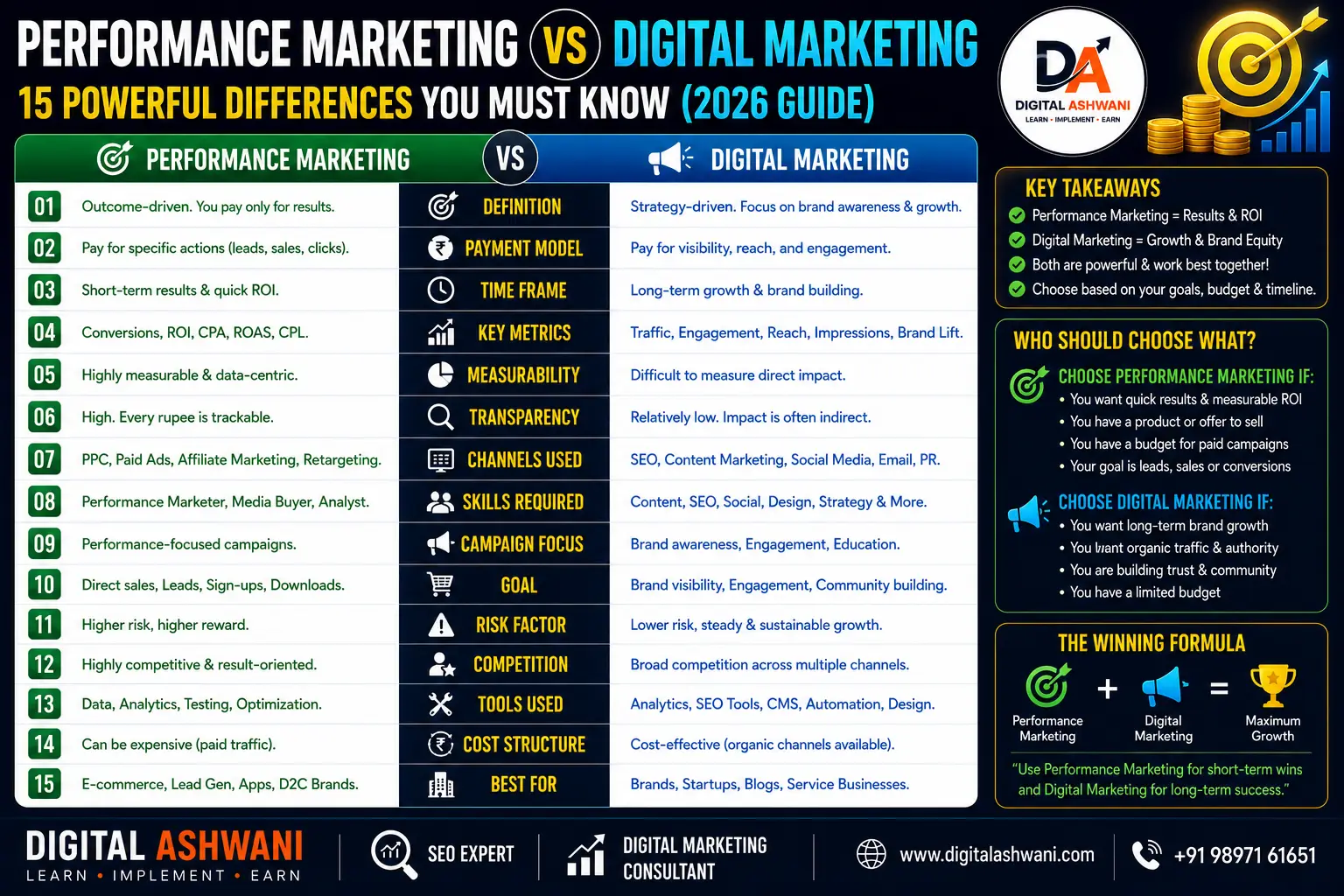
Performance Marketing vs Digital Marketing: 15 Key Differences
| Feature | Digital Marketing | Performance Marketing |
|---|---|---|
| Scope | Broad marketing strategy | Focused campaign strategy |
| Objective | Brand growth & customer engagement | Conversions & measurable results |
| Payment Model | Fixed or variable budgets | Often based on measurable outcomes |
| Metrics | Traffic, engagement, awareness | Leads, sales, ROI, CPA |
| SEO | Important | Usually supports campaigns |
| Paid Ads | One component | Core component |
| Organic Marketing | Major role | Limited role |
| Brand Building | Strong focus | Secondary focus |
| Long-Term Value | High | Depends on campaign success |
| Budget Flexibility | High | Highly optimized for performance |
| Analytics | Overall marketing insights | Conversion-focused reporting |
| Speed | Gradual growth | Faster measurable results |
| AI Usage | Increasing | Extensive automation and optimization |
| Best For | Long-term business growth | Short-term customer acquisition |
| Success Measurement | Multiple KPIs | ROI and conversions |
Advantages of Digital Marketing
Digital Marketing offers several long-term benefits:
Brand Awareness
Build recognition and trust over time.
Organic Traffic
SEO and content marketing continue generating traffic long after publication.
Customer Relationships
Email marketing, social media, and content help nurture long-term customer loyalty.
Cost-Effective Growth
Organic strategies often provide sustainable returns with lower long-term costs.
Multiple Marketing Channels
Businesses can combine search, social media, email, video, and content into one strategy.
Advantages of Performance Marketing
Performance Marketing focuses on measurable outcomes.
Faster Results
Paid campaigns can begin generating leads and sales quickly.
Clear ROI
Every campaign can be tracked using metrics such as:
- Cost Per Click (CPC)
- Cost Per Acquisition (CPA)
- Return on Ad Spend (ROAS)
- Conversion Rate
Data-Driven Decisions
Campaigns can be optimized continuously based on performance data.
Audience Targeting
Advertisers can target users based on demographics, interests, behavior, and intent.
Scalable Campaigns
Successful campaigns can often be expanded with increased budgets.
Which Strategy Should You Choose?
The answer depends on your goals.
Choose Digital Marketing If:
- You want long-term growth.
- You want consistent organic traffic.
- You are building a brand.
- You have a content strategy.
- SEO is important for your business.
Choose Performance Marketing If:
- You need leads quickly.
- You are launching a new product.
- You want measurable ROI.
- You have a dedicated advertising budget.
- Your campaigns require rapid optimization.
Best Approach: Combine Both
The strongest marketing strategies combine Digital Marketing and Performance Marketing.
For example:
- Use SEO and content marketing to build long-term authority.
- Use Google Ads and paid social campaigns for immediate traffic and conversions.
- Retarget visitors using performance campaigns.
- Build an email list for ongoing customer engagement.
This balanced approach helps businesses achieve both short-term and long-term success.
Career Opportunities
Digital Marketing Roles
- SEO Specialist
- Content Marketer
- Social Media Manager
- Email Marketing Specialist
- Digital Marketing Executive
- Digital Marketing Manager
Performance Marketing Roles
- Performance Marketing Executive
- PPC Specialist
- Google Ads Specialist
- Meta Ads Specialist
- Paid Media Manager
- Growth Marketing Manager
Professionals who understand both disciplines are increasingly valuable to employers.
Skills Required
Digital Marketing Skills
- SEO
- Content Writing
- Social Media Marketing
- Email Marketing
- Analytics
- Video Marketing
- AI Tools
Performance Marketing Skills
- Google Ads
- Meta Ads
- Conversion Tracking
- Landing Page Optimization
- Audience Targeting
- Budget Management
- Campaign Optimization
Future of Performance Marketing vs Digital Marketing
Artificial Intelligence is reshaping both fields.
Businesses now use AI to:
- Optimize ad campaigns
- Generate marketing content
- Analyze customer behavior
- Improve personalization
- Predict campaign performance
Despite these technological advances, successful marketing still depends on understanding customer needs and delivering value.
Internal Linking Suggestions (Digital Ashwani)
Link this article with:
- Digital Marketing Career in 2026
- Top Digital Marketing Trends in 2026
- Google Ads AI Features 2026
- AI SEO vs Traditional SEO
- Best AI Tools for Digital Marketing
- Google Marketing Live 2026
- SEO Checklist 2026
- How to Rank in ChatGPT Search Results
These internal links strengthen topical authority and improve user experience.
External Resources
For additional learning, explore:
- Google Ads Help Center
- Google Analytics Help Center
- Google Skillshop
- Google Search Central
- Meta Blueprint
Always rely on official documentation for the latest platform features and best practices.
Frequently Asked Questions
What is the main difference between Performance Marketing and Digital Marketing?
Digital Marketing covers all online marketing activities, while Performance Marketing focuses specifically on measurable outcomes such as leads, sales, and conversions.
Which is better for beginners?
Learning Digital Marketing first provides a strong foundation. Once you understand SEO, content, analytics, and social media, Performance Marketing becomes easier to learn.
Is SEO part of Performance Marketing?
SEO supports business growth but is generally considered part of the broader Digital Marketing ecosystem rather than Performance Marketing.
Which career pays more?
Performance Marketing professionals often earn higher salaries because they manage revenue-generating campaigns. However, experienced Digital Marketing Managers and SEO specialists can also command competitive salaries.
Should small businesses use both?
Yes. Combining organic Digital Marketing with targeted Performance Marketing often provides the best balance of sustainable growth and immediate results.
Final Thoughts
The debate around Performance Marketing vs Digital Marketing isn’t about choosing one over the other—it’s about understanding how each contributes to business growth. Digital Marketing builds your brand, attracts organic traffic, and nurtures long-term customer relationships, while Performance Marketing delivers measurable results through data-driven campaigns.
The most successful businesses use both strategies together. They invest in SEO, content, and brand building while also leveraging paid advertising for faster lead generation and sales.
As AI, automation, and analytics continue to transform marketing, professionals who understand both Digital Marketing and Performance Marketing will be well-positioned for future success.
At Digital Ashwani, we regularly publish actionable guides on SEO, Google Ads, AI Marketing, and Digital Marketing to help businesses and marketers stay ahead in a rapidly evolving digital landscape.
